
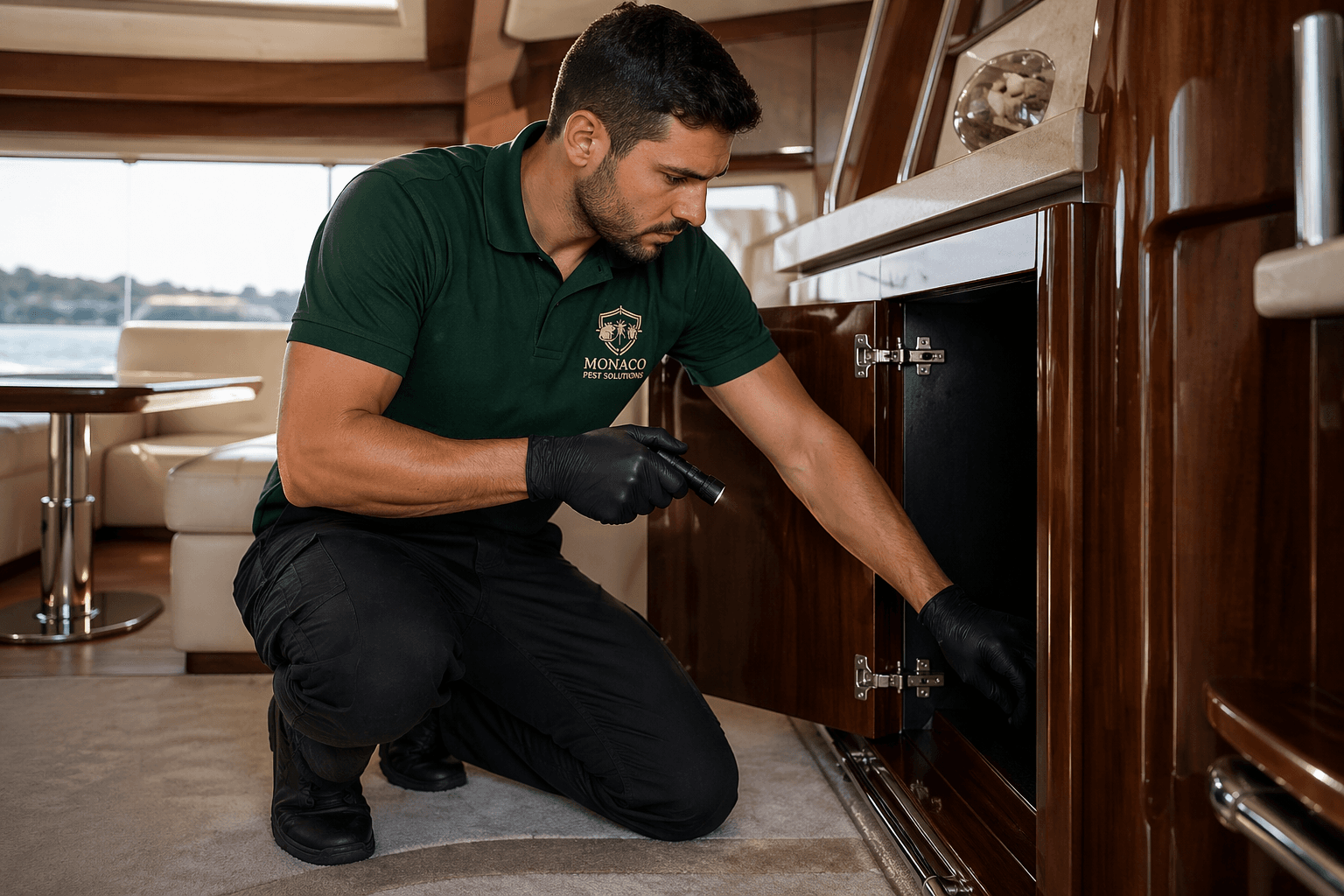
Yacht pest control · Monaco · French Riviera
Yacht Pest Control — Monaco & French Riviera
Discreet pest control on board, scheduled around your charter calendar.
On board a yacht, a pest is never a mere nuisance: it is a health risk, a reputational risk and a direct threat to the charter calendar. Cockroaches in the galley, bed bugs in a guest cabin, rodents in the engine room: each situation demands a precise protocol, compatible with fine materials, confined spaces and crew life. Monaco Pest Solutions works alongside — Port Hercule, Port de Fontvieille — as well as on the hard during refit, and at sea when the yacht is stationary at anchor. Our coverage spans Monaco and the entire Riviera, from Saint-Tropez to the Italian border, through Cannes, Antibes and Cap-Ferrat. Certibiocide N°121134 certified technicians, approved biocides, integrated pest management, HACCP methodology in food preparation areas: Monaco yacht pest control is a dedicated specialty for us, not a sideline service. Book a confidential first audit via /devis-gratuit.
What changes when we work on a yacht
What changes when we work on a yacht
Contractual discretion & NDA
An NDA is signed before any inspection; it covers the crew, the management company and the owners. Unmarked vehicles, plain civilian attire, equipment carried in neutral cases, boarding via the passerelle at times agreed with the captain or chief engineer. No client reference, no yacht name, no identifiable photograph ever leaves the vessel. Our reports go exclusively to the designated point of contact — captain, chief stewardess or management — following the vessel's chain of command.
Charter, refit and winter compatible
The yacht's calendar dictates ours. Between two charters, we treat within the turnaround window, using products with short re-entry times and no residual odour. During winter lay-up, November to March, we use the refit period for deep treatments: panels removed, linings opened, bilges accessible. In pre-season, April-May, a full audit and preventive barrier before guests arrive. During peak season, June to September, targeted night interventions or work at disembarkation.
Fine materials, measured methods
Teak, leathers, marquetry, designer fabrics: no broadcast treatment on board, ever. We favour high-temperature dry steam, trace-free bait gels, pheromone traps and localised micro-injection. Only approved biocides, applied under integrated pest management: the minimal effective dose, in the right place, fully documented. In the galley and pantries, our methodology aligns with HACCP requirements — no contact with food surfaces, no prolonged interruption of service.
Alongside, on the hard, at sea
Three intervention configurations. Alongside, at Port Hercule, Port de Fontvieille or in the Riviera marinas, for routine treatments and emergencies. On the hard, during refit, for structural treatments of the hull, bilges and technical spaces inaccessible in operation. At sea, when the yacht is stationary at anchor, for situations that cannot wait for the return to port. Our logistics are built to embark fast without ever immobilising the vessel.
The six major pests on board a yacht
The six major pests on board a yacht
Bed bugs in cabins
The number-one risk in international yachting: bed bugs travel in guest luggage and rotating linen, then colonise mattress seams, headboards and cabin linings. An affected cabin between two charters demands an immediate response: detection, high-temperature dry steam, localised treatment and verification before the next embarkation. Full protocol on /nuisibles/punaises-de-lit.
Cockroaches in the galley
The German cockroach thrives on heat and humidity: galley, crew mess, engine room, technical trunking. It boards via provisioning — cardboard boxes, crates and pallets carried up the passerelle. On the Riviera, this is the most frequent infestation on board. Our response: professional bait gels in technical alleyways, monitoring and provisioning controls, all HACCP compliant. See /nuisibles/cafards-blattes.
Rats & mice
Rodents board via mooring lines, the passerelle and shore power cables. Once aboard, they gnaw trunking and wiring — a real electrical risk in the engine room — and contaminate dry stores. We fit discreet devices at access points, secure the mooring lines and maintain permanent monitoring throughout the winter lay-up.
Mosquitoes & tiger mosquito on deck
From June to September, the tiger mosquito ruins dinners on the aft deck and evenings at anchor close to shore. It breeds in the smallest standing water: platforms, awning gutters, sundeck recesses. We treat larval breeding sites, install discreet perimeter barriers and brief the crew on the right habits. Details on /nuisibles/moustique-tigre.
Clothes & textile moths
Cashmere, wools, carpets, wardrobes in the owners' cabins: textile moths settle in poorly ventilated volumes and linen stored over the winter. The damage is often discovered in pre-season, at the worst possible moment. Pheromone traps, steam treatment of wardrobes, a linen storage protocol: we protect the vessel's wardrobes without applying any product to delicate fibres.
Ants on board
Ants board via mooring lines, the passerelle and the hull when berthed alongside, drawn by pantries and shipboard waste. Some species form multiple colonies that are nearly impossible to eliminate without a specific bait. We treat entry points on the quay side, place targeted baits in the alleyways and break the pheromone trails — with no spraying in living spaces.
Our 4-step protocol
Our 4-step protocol
- 01
Dockside inspection: a technician boards in civilian attire, at times validated by the captain. Full inspection — guest and crew cabins, galley, pantries, mess, engine room, bilges, stores and technical spaces — with detection traps and neutral photographic records. The report identifies the species present, the extent of the infestation and the entry points; it is delivered to the designated point of contact only. For an urgent suspicion between two charters, go straight to /urgence-24-7.
- 02
Treatment plan built around your schedule: we design the protocol around the vessel's calendar — the turnaround window between charters, the refit period, the winter lay-up or a night slot in high season. Each area gets a defined method, duration and re-entry time, so the captain can sign off without last-minute arbitration. Deep treatments are scheduled during winter lay-up, preventive work in April-May, and emergencies within the shortest possible window.
- 03
Discreet, measured intervention: Certibiocide N°121134 certified technicians, approved biocides applied at the minimal effective dose. Dry steam for cabins and textiles, bait gels in technical areas, traps and monitoring in food areas under HACCP methodology. No residual odour, no marks on fine materials, no branded equipment on the quay. The crew continues its duties in untreated areas throughout the entire intervention.
- 04
Follow-up and seasonal prevention: post-treatment verification, an up-to-date biocide register and a treatment certificate delivered to the vessel. We then propose an annual plan: monitoring during winter lay-up, audit and preventive barrier in pre-season, priority availability from June to September. Yachts under annual care benefit from intimate knowledge of the vessel — layouts, sensitive points, history — making every visit faster and more discreet. Book your audit via /devis-gratuit.
Our ports of intervention
Our ports of intervention
Alongside, on the hard and at stationary anchorage, from Saint-Tropez to the Italian border.
- Port Hercule — Monaco
- Port de Fontvieille — Monaco
- Saint-Tropez
- Cannes
- Antibes
- Cap-Ferrat
NDA · Absolute discretion, by contract
Absolute discretion, by contract
In yachting, confidentiality is not an option: it is the very condition of the work. No yacht name, no owner name, no identifiable home port ever appears in our communications, references or channels. The NDA is signed before the first visit and covers the entire chain: owners, family, guests, crew, management company. Our technicians work in civilian attire, with equipment in neutral cases, and are trained in shipboard etiquette — passerelle, guest areas, hierarchy. Reports, photographs and certificates are transmitted exclusively to the point of contact designated by the captain, through a secure channel.
A suspicion on board? An audit before the season?
Fast response, discreet dockside audit in Monaco and across the Riviera. Emergency between two charters: /urgence-24-7.
Frequently asked questions
Your questions, our answers
- How do you work on a yacht without disrupting the crew?
- We fit every intervention to the vessel's rhythm: times validated by the captain, areas treated one at a time, odour-free products with fast re-entry. The crew continues its duties in the free zones, and guest service is never interrupted.
- What are the most common pests on board a yacht in Monaco?
- Cockroaches in the galley, bed bugs in cabins, rodents boarding via mooring lines, tiger mosquitoes on deck in summer, textile moths during winter lay-up and ants alongside. Each has its dedicated protocol, detailed on our /nuisibles/cafards-blattes and /nuisibles/punaises-de-lit pages.
- Can a charter yacht be treated between two clients?
- Yes — it is our most frequent configuration. We work within the turnaround window using methods with short re-entry times — dry steam, gels, traps — and a final verification before the next guests embark. The charter calendar stays intact.
- When is the best time to treat a yacht?
- Winter lay-up, November to March, during refit: panels removed, vessel empty, technical areas accessible. Pre-season, April-May, is ideal for the audit and preventive barrier. In high season we work in targeted fashion, between two charters or at night.
- How do you guarantee the confidentiality of the intervention?
- NDA signed before any visit, unmarked vehicles, civilian attire, equipment in neutral cases, reports sent only to the designated contact through a secure channel. No yacht or client name ever appears in our references or communications.
- What certifications do you hold for working on a yacht?
- Our technicians are Certibiocide N°121134 certified and use only approved biocides, applied under integrated pest management. Food areas are treated under HACCP methodology, with a biocide register and a treatment certificate delivered after every intervention.