July 17, 2026 · 9-minute read
Dormice in a Cap-Ferrat villa: telling them apart from rats
Nocturnal scampering in the attic of a Cap-Ferrat villa: often an edible dormouse, not a rat. Identification, protected-species status and lawful trap and…
Cavalry charges above the ceiling, every evening around 11 p.m.
Late July, on the heights of Saint-Jean-Cap-Ferrat. A 1930s villa, a barrel-tile roof, exposed roof timbers above the bedrooms, a garden of umbrella pines, cypresses and olive trees running down towards the sea. For the past ten days or so, the owner has heard the same routine every night: a brief, surprisingly loud scampering above the ceiling, as if "something the size of a cat" were sprinting across the attic, then complete silence for several minutes, before another dash. She telephones, mentioning "rats in the roof".
The technician who visits the next day asks a simple question: are these noises continuous or in bursts? The answer — short dashes broken by long silences, only at night — steers the diagnosis immediately. In this stretch of the coast, between Villefranche-sur-Mer, Beaulieu-sur-Mer and the Cap-Ferrat peninsula, a large majority of the "rats in the roof" reported at the height of summer are in fact edible dormice, Glis glis. The distinction is no naturalist's nicety: it changes everything, from the choice of treatment to its legality.
The edible dormouse is indeed a protected species in France. Setting rodenticide or a lethal trap against it exposes both the owner and the contractor to criminal penalties. There is nonetheless a lawful, effective and lasting method for returning the attic to silence. But it must begin with correctly identifying the occupant.
Three rodents, three profiles: edible dormouse, black rat, wood mouse
Three species account for most reports of "rodents up high" on the Riviera: the edible dormouse, the black rat and the wood mouse. They resemble one another only from a distance, and each calls for a different response.
The edible dormouse (*Glis glis*), a squirrel of the attic
A body of around 15 centimetres, extended by a fully bushy 12-centimetre tail carried like a plume, much like a small squirrel. A uniform grey coat above, a clean white belly, large black eyes ringed with dark — the classic adaptation of a strictly nocturnal animal — and rounded, well-cleared ears. An accomplished tree-dweller, the dormouse travels from branch to roof without ever touching the ground. A decisive detail for the intervention calendar: it hibernates from October to April, often in a cavity in the roof timbers or beneath the insulation, and therefore concentrates all its audible activity in the warm season.
Black rat and wood mouse, the false culprits
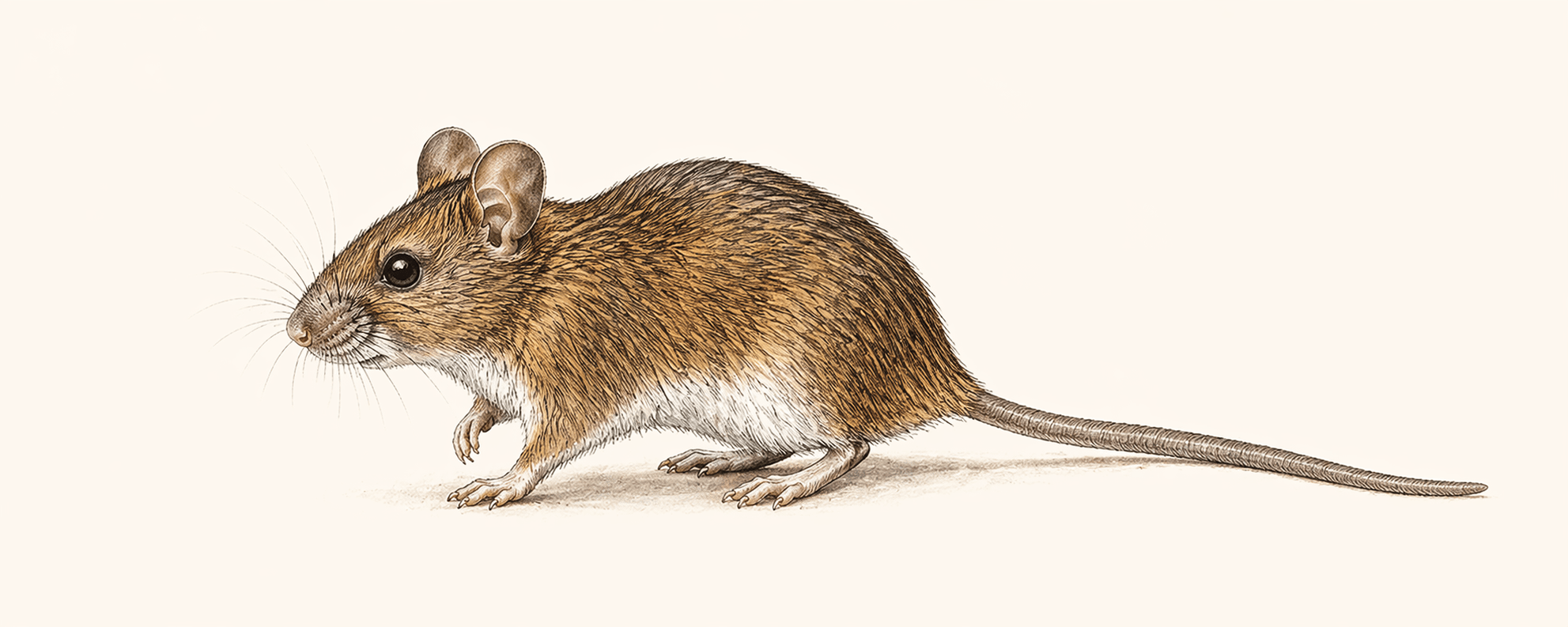
The black rat (Rattus rattus), also known as the roof rat, is itself an excellent climber and a long-standing resident of Mediterranean roof structures; it is distinguished at first glance by its bare, scaly tail, longer than its body, its dark coat and its fine, large ears. The wood mouse (Apodemus sylvaticus), markedly smaller — eight to ten centimetres, a fine, barely furred tail — occasionally invades foundations, garages or ground-floor cellars at the foot of the hills, at Èze or Cap-d'Ail, but rarely settles for long in an attic. Let us keep to a simple field rule: an occupant of the roof timbers with a plumed tail is a dormouse, and the case then falls squarely within the field of protected species.
Reading the clues without ever seeing the animal
The animal, precisely, shows itself little. The diagnosis therefore rests on three families of clues that the inspection records methodically.
The noises, first. The dormouse moves in short dashes — a few seconds of scampering across the attic floor — followed by long pauses during which it eats, listens or grooms itself. The black rat, by contrast, produces more continuous activity: scratching, steady gnawing, repeated scurrying along the same routes. A simple attentive listen between 10 p.m. and 2 a.m. is often enough to settle the matter.
The droppings, next. Those of the dormouse resemble a black grain of rice 8 to 10 millimetres long, with rounded ends, often grouped near feeding points. Those of the black rat are larger, curved and pointed at the ends, scattered along its routes. The technician completes the examination by looking for grease marks: at repeated crossing points, the coat deposits dark, glossy marks on the beams and the edges of the masonry that literally map out the animal's movements.
That leaves the feeding clues: hazelnut or almond shells cleanly opened, gnawed stones, part-eaten figs brought in from the garden. A larder of dried fruits in a corner of the roof timbers is the signature of a dormouse, not a rat.
Why the rodenticide reflex is a twofold error
Faced with rodent noises, the first reflex is almost always to buy anticoagulant bait blocks at the garden centre. Against an edible dormouse, this decision is doubly at fault.
It is unlawful, first: applying a rodenticide biocide against a protected species is an offence, whether the product is laid by a private individual or by a professional. It is then ineffective, and even counterproductive. The dormouse is a wary animal that tastes little and splits its feeding; an anticoagulant takes 7 to 10 days to act, and the poisoned animal most often takes refuge to die in a hollow wall or beneath the insulation. A classic outcome in the villas of this area: a corpse odour that pervades the upper floor for 3 to 6 weeks, carrion flies, and a partition to be opened in order to extract the carcass. The initial problem — night-time noises — ends in building works.
The other false trail is that of the ultrasonic repellents sold in the shops. Independent studies converge: rodents grow used to the signal within a few days and the measurable effect on an established population is nil. No device of this kind replaces the combination of capture and mechanical exclusion.
A three-speed legal status: France, Italy, Monaco
The edible dormouse illustrates well the regulatory particularities of the border strip. In France, the species appears on the list of protected mammals set by the French regulations on the protection of wild mammals: it is forbidden to kill it, to capture it in order to destroy it or to transport it without a prefectural derogation. As Saint-Jean-Cap-Ferrat, Beaulieu-sur-Mer and Villefranche-sur-Mer fall under French law, any lethal intervention is ruled out there, even when the animal colonises the dwelling and causes damage to insulation or conduits.
On the other side of the border, in Italy, the same animal falls under a very different status and remains huntable in certain regions — a contrast that often surprises owners who hold residences on both sides. In Monaco, finally, and on the private properties of the Principality, the framework is more flexible than in France. Monaco Pest Solutions, a company registered with the RCI of Monaco under the number 26S10394 and holder of the Certibiocide N121134, has made a simple choice: to apply voluntarily, wherever possible, the non-lethal principles of French law. This line avoids any legal risk for the cross-border client and corresponds, in practice, to the most effective method for this species.
The intervention protocol: capture, release, exclusion
The lawful treatment of a colonisation by the edible dormouse favours mechanical exclusion: sealing the entry points while the animal is out on its nocturnal foray allows the attic to be emptied lastingly without ever moving a protected individual, and therefore without triggering the transport constraints detailed below. Supervised trap and release intervenes only as a fallback, when the layout of the premises makes it necessary to remove individuals already settled in. The whole process is conducted over one to two weeks.
Capture in a double-door cage
The technician installs live-capture cages with double doors, directly on the routes identified by the grease marks. The baiting favours what the dormouse already consumes on site: a piece of apple, hazelnuts, dried-fruit paste. Setting takes place in the evening, at the start of the activity phase, and each cage is checked without fail the following morning — a captured animal must never remain shut in during the day, at the risk of stress and dehydration, particularly beneath the overheated attic of July. Depending on the size of the family group, two to six nights of trapping are generally required.
Release in woodland and definitive sealing
Each captured animal is released more than 10 kilometres from the site, in wooded and uninhabited areas of the Nice hinterland — the valleys around Peille, the mountainside slopes of La Turbie, or the forest towards Sospel offer favourable habitats. This distance is indispensable: released too close, a dormouse finds its way back to its lodging within a few nights.
This relocation is by no means trivial in regulatory terms, and that is precisely why mechanical exclusion remains the favoured route. For any intervention in France — Saint-Jean-Cap-Ferrat, Beaulieu-sur-Mer, Villefranche-sur-Mer, Èze or Cap-d'Ail — transporting a protected individual requires either a prefectural derogation under the French regulations on protected species, or an intervention framework without transport: one then confines oneself to disturbing the animal and sealing the entry points during its nocturnal foray, without ever capturing it. When the removal of individuals genuinely becomes necessary, the team coordinates the operation with the departmental veterinary services or, for one-off cases, intervenes in coordination with the approved wildlife-protection associations. In Monaco and on the properties of the Principality, where the framework is more flexible, the same requirement of traceability applies as a matter of principle.
Then comes the step that determines the lasting result: mechanical exclusion. Once the attic is empty, each entry point is sealed — stainless-steel mesh with a 6-millimetre gauge over the vents and ventilation flaps, blocking of the roof openings beneath the verge tiles, meshing of unused chimneys, repair of the accessible timber joints. Without this sealing, the villa will be recolonised the following season by other individuals.
July, the month of young dormice in search of territory
The calendar of calls owes nothing to chance. The edible dormouse is active from May to September, and reports peak in July and August: this is the period when the year's young disperse and prospect for new territories. A dry, dark, quiet attic, within reach of branches, is an ideal lodging for them.
In the field, the profile of the properties affected is remarkably constant: villas at the seafront or perched over the Rade de Villefranche, surrounded by tall umbrella pines whose branches overhang or brush the roof. The pine provides both the larder — pine nuts, bark, insects — and the aerial access route. The properties of Èze-bord-de-mer and the seafront boulevard of Beaulieu-sur-Mer, with their mature pinewoods, feature every summer among the most affected areas.
Preventing the return: the garden before the roof
Prevention plays out first in the trees. The dormouse jumps, and jumps well: effective pruning keeps every overhanging branch more than 2 metres from the roof, failing which the cutting serves no purpose. On a property planted with umbrella pines and old cypresses, this work is planned with the gardener or the tree surgeon, outside the birds' nesting season.
The second pillar is the annual inspection of the attic before hibernation, ideally in September: a search for fresh droppings, grease marks, nesting materials, a check on the condition of the meshes installed and of the timber joints. A dormouse that settles in to hibernate in October will remain silent all winter — and the colony will start up again in spring, more numerous. Detecting its presence before the torpor allows a short capture campaign and untroubled sealing.
Returning the attic to silence, within the rules
Brief dashes at night, rice-grain droppings, a bushy tail glimpsed in the beam of a torch: the "attic rat" of Cap-Ferrat is most often an edible dormouse, a protected species that prohibits any lethal treatment and makes rodenticide as unlawful as it is ineffective. The serious response comes down to three words: capture, release, exclusion.
For a species diagnosis and a compliant trap-and-release plan, the team operates from Monaco to Nice, the Cap-Ferrat peninsula included. Request a free online quote, by telephone on +377 37 70 70 02 or in writing to contact@monacopestsolutions.mc, with, if possible, a photograph of the droppings or a recording of the night-time noises: these two elements are often enough to confirm the identification even before the first visit.
Frequently asked questions
- How can I tell whether I have dormice or rats in my attic?
- Listen to the rhythm of the noises: the dormouse produces short dashes followed by long silences, only at night, whereas the rat scratches and gnaws more continuously. The dormouse's droppings resemble a black grain of rice 8 to 10 mm long with rounded ends; those of the rat are larger and pointed. If you catch sight of a bushy tail, it is a dormouse.
- Is the edible dormouse really a protected species in France?
- Yes. The edible dormouse (*Glis glis*) appears on the list of protected mammals set by the French regulations on protected species. It is forbidden to kill it, poison it or trap it to death without a prefectural derogation, including in a private dwelling at Saint-Jean-Cap-Ferrat, Beaulieu-sur-Mer or Èze. Only live capture followed by release is permitted.
- Can rodenticide be used against a dormouse?
- No, for two reasons. It is unlawful, because the dormouse is protected in France. And it is ineffective: the animal, being wary, consumes little at a time; the anticoagulant acts in 7 to 10 days and the dormouse often dies inside a partition, hence a corpse odour persisting for 3 to 6 weeks and sometimes works to open up the wall.
- Where are the dormice caught in a villa released?
- More than 10 kilometres from the site of capture, in uninhabited wooded areas of the Nice hinterland, for example around Peille, La Turbie or Sospel. This distance prevents the animal from finding its way back to its lodging. The release takes place promptly after the morning check of the cages, in order to limit the animal's stress.
- Why do dormice appear mainly in July?
- The species is active from May to September after a hibernation from October to April. At the height of summer, the year's young disperse to find a territory: the dry, quiet attics of villas bordered by tall umbrella pines, whose branches touch the roof, are then colonised as a priority. Hence the peak of calls in July and August.
- How can I stop the dormice from coming back after a capture?
- Through mechanical exclusion: stainless-steel mesh with a 6 mm gauge over the vents and ventilation flaps, blocking of the roof openings and unused chimneys, repair of the timber joints. In the garden, keep the branches more than 2 metres from the roof, because the dormouse jumps, and have the attic inspected each September before hibernation.