
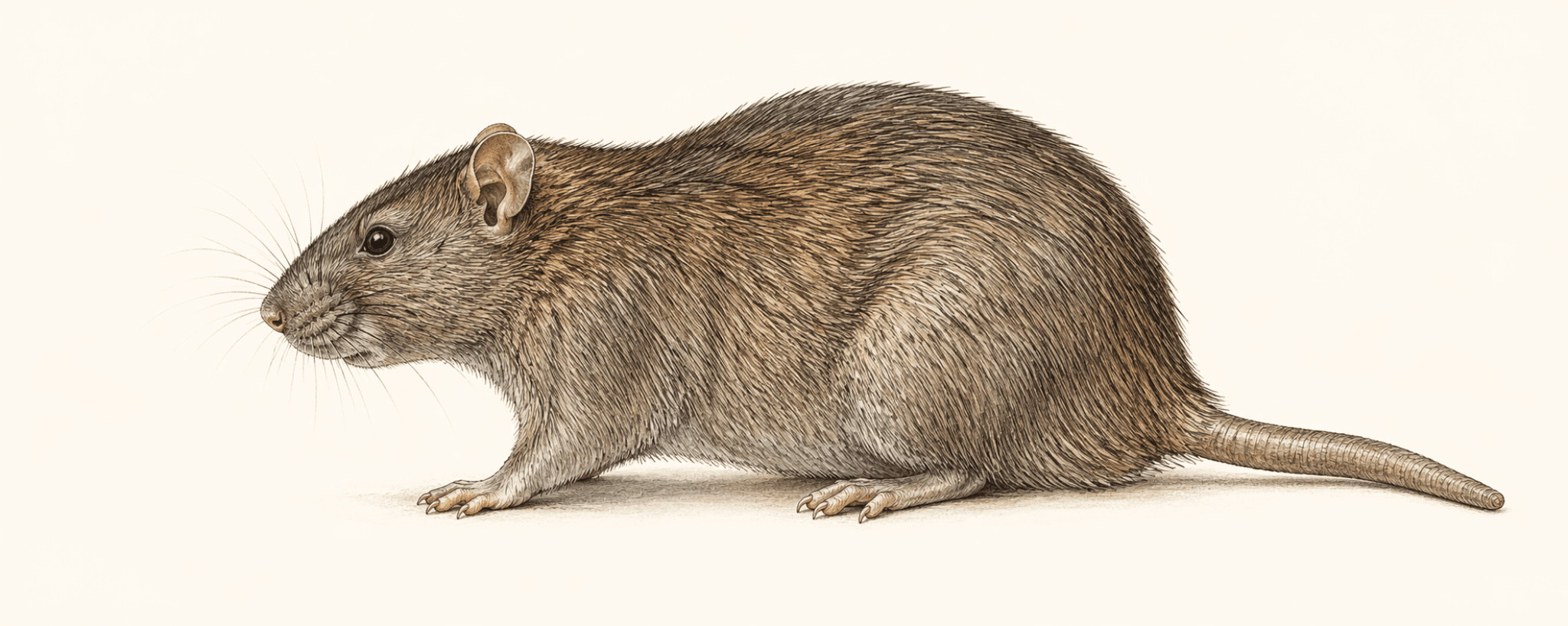
Identifying rats and mice: the signs that never lie
Rodents announce themselves through their traces before they let themselves be seen. Three indicators concentrate the essence of the diagnosis:
- The droppings: small (6 to 8 mm) and pointed for the mouse, more spindle-shaped and dark (12 to 15 mm) for the black rat, shorter and rounded for the brown rat. Fresh, they are black and shiny; old, they fade and crumble.
- The greasy marks: the rodents' coat deposits a brownish film along the skirting boards, pipes and wall corners they follow for safety. This marking is almost a signature.
- The night-time noises: scratching in false ceilings or partitions, scurrying in the loft, dull thuds behind a fitted piece of furniture.
Add to these a persistent ammoniacal odour in enclosed areas, gnawed electrical or plastic cables (rodents' incisors grow continuously), pierced food packaging and sometimes footprints in the dust. For the mouse, the activity range is reduced to a few square metres; for the rat, it can cover an entire building via the service ducts.
Health and material risks
Rats and mice are not merely a nuisance: they constitute a genuine health vector. They excrete pathogens through their urine, droppings and saliva — leptospirosis, salmonelloses, hantavirus, rat-bite fever — and carry fleas and mites, some of which cause respiratory allergies and dermatitis in susceptible people. A bite, rare but possible in the event of accidental contact, warrants medical consultation and a tetanus booster.
The material damage is just as costly:
- Gnawed electrical cables: the leading cause of rodent-related fires in older buildings.
- Destroyed insulation: mineral wool torn open for nesting.
- Contaminated foodstuffs: an outright loss in catering, wine cellars and fine grocery.
- Weakened structures: brown rat burrows under paving or terracing.
The legal dimension counts too. In catering and hospitality, the HACCP food safety management plan requires documented pest control. In co-ownership, the managing agent must protect the common areas; in letting, the landlord is required to provide sanitary accommodation. An unfavourable hygiene inspection can lead to suspension of the business and administrative sanctions.
Why this pest thrives in Monaco and on the Riviera
The Principality combines the factors that favour rodent settlement. The mild Mediterranean climate removes the winter mortality that regulates populations further north: the reproduction cycles extend across almost the whole year. The density of the built environment — adjoining buildings, shared service ducts, interconnected underground car parks — offers rodents invisible vertical and horizontal motorways. The dense drainage network and numerous inspection chambers make it easier for the brown rat to come up from the collectors.
Added to this is the specific nature of the Monégasque fabric: restaurants in Fontvieille and Larvotto, upmarket residences in Monte-Carlo, cellars in La Condamine, the wooded gardens of Roquebrune-Cap-Martin and Cap-Ferrat, yachts at Port Hercule. Each environment creates a niche — gardens and rooftops for the black rat, technical cellars for the brown rat, kitchens for the mouse. The late-summer and autumn periods concentrate the intrusions: the night-time drop in temperature pushes outdoor colonies to seek a heated shelter. The renovation works, very numerous between Beausoleil and Cap-d'Ail, temporarily open access points that sometimes go unnoticed.
The MPS protocol in five steps
Our intervention follows a rigorous sequence, documented at every stage:
- Field diagnosis: species identification from the clues, mapping of the activity zones, location of entry points (ducts, vents, thresholds, expansion joints), assessment of the accessible food resources.
- Mechanical proofing: this is the foundation of integrated pest management. We seal the openings with mortar, dense expanding foam, steel wool and stainless-steel grilles depending on the diameters. Without proofing, any chemical treatment is merely a sticking plaster.
- Secured baiting: installation of locked bait stations with approved anticoagulant biocides (second-generation rodenticides), positioned according to the diagnosed traffic. Each station is numbered and geolocated on the plan.
- Follow-up and check at D+15: a verification visit, counting the consumption, removal or renewal of the baits, adjustment of the arrangement where necessary.
- Certification and report: provision of a HACCP-compliant technical file for professionals, including a station plan, biocide safety data sheets and an intervention certificate.
The whole is carried out under a confidentiality agreement, a standard practice for our clientele. Monaco Pest Solutions holds the Certibiocide N121134 certification required for the professional use of biocides.
Mistakes to avoid
The fight against rodents concentrates the false good ideas, often counterproductive:
- Consumer rodenticide blocks scattered about: without prior proofing, they sustain the infestation rather than resolve it, and the poisoned rodents die inside partitions, generating odours and a proliferation of flies.
- Ultrasonic devices: their effectiveness in real conditions is not demonstrated on established populations, and rodents get used to them within a few days.
- Glue traps: ineffective, cruel, and banned or heavily restricted under several European regulatory frameworks.
- The pet cat: an excellent detector, a poor exterminator on established populations.
- Blocking holes with silicone or ordinary foam: the mouse gnaws the foam, the brown rat tears out the silicone. Only steel wool, stainless-steel grilles and mortar hold lastingly.
- Waiting: a female mouse produces several litters a year. Two weeks of hesitation multiplies the intervention load.
The useful reflex remains calling a professional at the first signs.
Typical Monaco case
An apart-hotel in the Fontvieille area contacts us one October morning: the head housekeeper has spotted droppings in a service pantry and a guest reports a noise in the ceiling of her room. The diagnosis identifies a population of black rats, entering through a poorly sealed smoke-extraction duct on the roof and moving through the technical loft space. We proceed in the evening, away from the clientele: proofing of the duct with a stainless-steel grille and mortar, sealing of three secondary roof passageways, installation of secured bait stations in the technical areas inaccessible to the public, and cleaning of the soiled areas. The check at D+15 confirms the disappearance of activity, with nil residual consumption on the stations. A HACCP report is provided to management, and a quarterly monitoring contract set up to prevent any seasonal recurrence. No public mention, no interruption to operations: this is the MPS standard.
Lasting prevention
A resolved infestation can re-establish itself if the environment remains favourable. The structuring habits:
- Proofing of the building: inspect the penetration points on the roof, façade and basement each year. A rodent gets through an opening the size of a coin.
- Waste management: closed containers, cleaned bin stores, no bags stored outside overnight.
- Storage of foodstuffs: airtight glass or metal jars, no open packets at the back of the cupboard.
- Maintenance of the outdoors: pruning of branches touching the roof (access routes for the black rat), clearing of dense hedges pressed against the walls.
- Monitoring: unbaited detection stations in sensitive areas (cellars, plant rooms, pantries), inspected quarterly.
For co-ownerships and premises subject to HACCP, MPS offers annual follow-up contracts with scheduled visits, consolidated indicators and reactive intervention included.
Regulatory framework
Anticoagulant rodenticides are classified as TP14 biocidal products under European the European framework on professional biocides. Their professional application requires certification — the French Certibiocide, recognised in Monaco for Monégasque operators. Monaco Pest Solutions, a company registered with the Monaco Trade and Industry Register under number 26S10394, operates within this framework.
Two points of vigilance:
- In catering, hospitality and food distribution, pest control is an obligation of the HACCP plan. The Monégasque health authorities can inspect the traceability of the arrangement, which our reporting guarantees.
- Second-generation biocides are subject to strict oversight to limit the impact on non-target wildlife (nocturnal raptors, hedgehogs). The use of closed, secured stations and the systematic removal of unconsumed baits at the end of the campaign are the rule.
In the Principality, no commensal rodent species holds protected status.
How long, how many visits
For a recent and localised residential infestation (one room, a few clues), a single visit is generally enough, complemented by a check at D+15 to validate the resolution. Complete resolution is achieved in two to three weeks, the time needed for the baits to be consumed and the individuals to disappear.
For an established infestation (several rooms, clues over several weeks, activity in the roof and cellar), allow two to three visits over four to six weeks: a first for diagnosis and setting up the arrangement, an intermediate one for adjustment, a final one for checking and removal. Proofing often represents the bulk of the on-site time.
For HACCP premises, follow-up becomes continuous, with a monthly or quarterly visit depending on exposure, and a consolidated annual report. MPS intervention lead times in the Principality and its immediate surroundings (Beausoleil, Cap-d'Ail, Roquebrune) are typically 24 to 48 hours for a first visit, reduced in a documented emergency.
In any doubt? Our team responds within 2 working hours. +377 37 70 70 02 — or [request a free quote](/devis-gratuit).
When you are facing a rat problem in Monaco, the first 24 hours shape everything that follows: our guide details the immediate steps to take, the real resolution timeline and how a professional emergency intervention unfolds.