July 7, 2026 · 14-minute read
Pest infestations in Monaco co-ownership buildings:…
Who pays for rat control in a Monaco co-ownership building? A complete overview of the managing agent's obligations and the co-owners' responsibilities.
The fundamental principle: common areas versus private lots
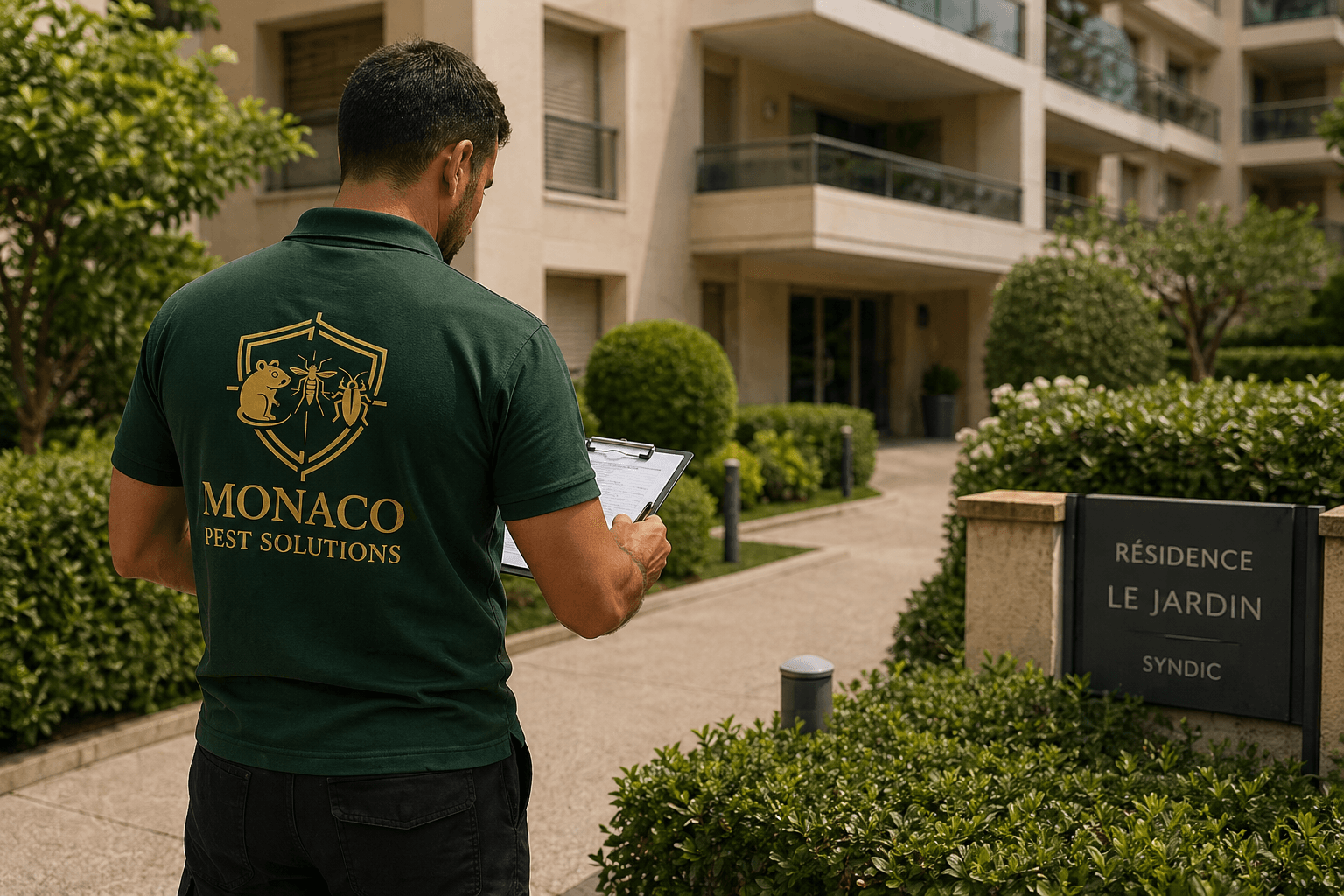
In a co-ownership building, responsibility for pest issues follows a simple but often misunderstood logic: the managing agent handles the common areas, while the co-owner (or their tenant) deals with their private lot. This division determines who pays, who decides and who must raise the alarm.
In practical terms, as soon as a rat is running through the cellars of a building in La Condamine, a wasps' nest appears on the façade of a residence in Fontvieille, or cockroaches multiply in the rubbish chutes of a building in Larvotto, responsibility falls to the managing agent. Conversely, an infestation confined to the inside of a flat (bed bugs, pantry moths, ants in the kitchen) is the co-owner's concern.
The line looks clear on paper, but it blurs as soon as pests cross those boundaries: rats travelling through service risers, cockroaches migrating from one lot to another via ducts, bed bugs carried through the common areas after a poorly managed treatment. It is precisely in these grey zones that uncoordinated treatments make the problem worse and trigger disputes.
Three questions to ask before any intervention:
- Where was the infestation first observed?
- Are the pests using shared pathways (risers, ducts, rubbish chutes, cellars)?
- Is the source down to a failure of collective maintenance or to individual behaviour?
Working through these three questions in order makes it possible, in most cases, to decide who should take the lead — and, crucially, to avoid siloed treatments that leave the pests to return a few weeks later.
Monaco's regulatory framework and how it differs from France
The Principality of Monaco applies its own legal framework, distinct from French law, even though the principles of co-ownership liability share some structural similarities. In the Principality, Sovereign Ordinance no. 3,647 on the sanitary condition of dwellings requires both the owner and the managing agent to keep the premises in a sanitary state compatible with human occupation. Pest control falls squarely within this general obligation of salubrity.
In France, the framework is different: the applicable French Civil Code provisions on tenancy requires a landlord to provide decent accommodation, and the ELAN Act has clarified obligations on bed bugs, setting out how duties are shared between landlord, tenant and co-ownership. French co-ownership buildings just across the border (Beausoleil, Cap-d'Ail, Roquebrune-Cap-Martin, Menton) therefore fall under a different regime — with practical consequences for owners who hold property on both sides of the frontier.
Key practical differences to remember:
- In Monaco, the les autorités sanitaires monégasques can be alerted where a neighbourhood nuisance stems from a clear failure of salubrity.
- On the French side, the Agences Régionales de Santé (les autorités sanitaires françaises) and local municipal hygiene services hold formal enforcement powers.
- In both jurisdictions, a managing agent who refuses to act on a confirmed infestation exposes themselves to contractual liability towards the co-owners' association.
Monaco Pest Solutions, a Monegasque company registered under RCI 26S10394 and holder of Certibiocide N121134, operates exclusively within the Monegasque framework for properties located in the Principality, and adjusts its protocols for residences on the French side of the neighbouring municipalities.
Case study 1: rats in the common cellars
A caretaker reports rodent traces in the cellars of a building in Monte-Carlo — droppings, chewed sacks, gnawed cables. This is a textbook case: as the cellars are common areas, rat control is entirely the managing agent's responsibility. They must appoint a qualified professional and include the intervention within the communal charges.
Three mistakes are common in this situation. First, waiting for several reports before acting: a rat colony doubles in size within a few weeks, and a late treatment costs more than an early, preventive intervention. Second, simply placing a few bait boxes without a diagnosis: unless entry points are identified (cracks in the foundations, pipe penetrations, ill-fitting doors), the rodents return. Third, neglecting traceability: the biocides used must be logged, dated and located.
What a serious cellar treatment must include:
- A preliminary diagnosis with mapping of at-risk zones
- Installation of secured bait stations, out of reach of children and pets
- A plan to seal entry points (metal blocking plates, appropriate expanding foams)
- Scheduled follow-up over several visits, with recording of bait consumption
- Clear communication to co-owners so they can report any further signs
In Monaco, the tight urban fabric and the density of technical networks make rat control particularly demanding. A building in Fontvieille may have its cellar connected via pipework to an adjoining car park, a shared refuse room and service risers reaching ten storeys up — which is why a comprehensive action plan matters far more than a one-off intervention.
Case study 2: bed bugs in a flat
A co-owner in La Condamine wakes up with bites, then spots black marks on the bed base: bed bugs (Cimex lectularius). The rule is clear: because the infestation is confined to the private lot, treatment is the co-owner's responsibility — or the tenant's, depending on the terms of the lease. The managing agent is not required to fund the intervention.
However — and this "however" is essential — the co-owner has a moral, and often contractual, duty to alert the managing agent as soon as the infestation is confirmed. Why? Because bed bugs travel: luggage left in the lobby, suitcases carried into the lift, textiles taken to the shared laundry. A treatment carried out in isolation, without coordination with the building as a whole, may simply move the problem to a neighbouring lot.
The right approach in three steps:
- Report the situation to the managing agent immediately, in writing, stating the date of discovery and the rooms concerned.
- Commission a professional diagnosis: bed bug bites are often confused with mosquito bites or textile allergies.
- Treat with a complete protocol: high-temperature steam, appropriate biocides, and a follow-up visit at D+15 to break the egg cycle.
The managing agent, for their part, must check that neighbouring lots and adjacent common areas (corridors, landing carpets) show no signs. In case of doubt, a canine or visual inspection of the surrounding zones is justified, and its cost can be charged to the communal budget if the source proves to be collective.
Case study 3: cockroaches migrating through service ducts
Three co-owners in an older Monte-Carlo building report German cockroaches (Blattella germanica) under their sinks, on different floors. Unlike the bed bug case, this is a collective infestation: cockroaches use service risers (wastewater, ventilation) as motorways. Treating a single flat is like bailing out a leaking boat.
In this configuration, the managing agent must take the initiative for a coordinated treatment covering the common areas (risers, basements, plant rooms) and every affected lot simultaneously. The allocation of costs may be voted on at the general meeting, but the operational logic requires a building-wide, simultaneous intervention — otherwise the cockroaches migrate into the untreated units and the cycle starts again.
Signs of a collective infestation:
- Multiple reports in non-adjacent lots
- Presence of pests in plant rooms, ducts and rubbish chutes
- Rapid resurgence after apparently successful individual treatments
- Detection inside hot-water or ventilation risers
In Monaco, where many buildings combine older structures with partial refurbishment, these vertical pathways are particularly favourable to cockroaches and to pharaoh ants. Treatment must systematically include a diagnosis of the service risers and, more often than not, the application of targeted bait gels at the identified crossing points. A simple surface treatment in individual kitchens is doomed to fail.
Annual prevention contract or curative call-outs: which to choose?
This is the most frequent question managing agents in the Principality ask us: should we sign an annual contract or wait until the problem arises? The answer depends on several factors — age of the building, exposure (proximity to the port, restaurants, vegetation), history — but in most cases, an annual contract proves both more economical and more legally protective.
What a well-designed annual contract should cover:
- A full initial audit of the common areas
- A prevention plan with scheduled visits (typically 2 to 4 per year)
- Included treatment of common pests: rodents, cockroaches, ants, seasonal wasps
- A guaranteed response time for off-schedule call-outs
- Maintenance of the sanitary logbook (see next section)
- A written report after each visit, countersigned by the caretaker or the managing agent's representative
Conversely, the curative approach — only acting when a problem occurs — has three major drawbacks. It often costs more over the year, because emergency call-outs are billed at premium rates. It leaves the managing agent without documentation if their conduct is questioned. And it exposes the co-ownership to infestations that take months to eradicate once established.
For an upmarket residence in Larvotto or Fontvieille, the logic goes further still: the perceived value of the units, the peace of mind of occupants and the discretion of every intervention all point to a preventive setup built for the long term. Monaco Pest Solutions applies a standard contractual confidentiality clause in this context.
The sanitary logbook: an obligation too often overlooked
Few managing agents are aware that traceability of pest control interventions is an integral part of salubrity obligations. In practical terms, this means a sanitary logbook must be kept and made available in the event of an inspection, a claim or a dispute between co-owners.
A complete sanitary logbook records:
- The identity and qualifications of the provider (in our case, Certibiocide N121134)
- The date and time of each intervention
- The zones treated, mapped where possible
- The biocide products used, with their marketing authorisation (AMM) number
- The quantities applied and the method of application
- The technician's observations (entry points detected, recommendations)
- The corrective measures proposed and their follow-up
This document serves two purposes. From a sanitary standpoint, it ensures the consistency of treatments over time and prevents the overuse of biocides — a principle at the heart of integrated pest management. From a legal standpoint, it constitutes tangible proof that the managing agent has fulfilled their obligations. In the event of a dispute with a co-owner or a sanitary inspection, the absence of a logbook considerably weakens the association's position.
We systematically provide this logbook to the managing agents we partner with, in both paper and digital formats, with multi-year archiving. It is as much a steering tool as a piece of evidence.
Classic mistakes to avoid in co-ownership buildings
After several years of interventions in the Principality and along the French Riviera, a handful of failure patterns keep coming back with disheartening regularity. Recognising them is the first step to avoiding them.
Mistake 1: treating on a lot-by-lot basis what is in fact collective. One cockroach in a flat, the flat gets treated. Three reports across the building, treatment carries on flat by flat. Eventually the pests retreat into the ducts and come back.
Mistake 2: choosing a provider on price alone. A low-cost intervention with no prior diagnosis, no traceability and no follow-up ends up costing more than the initial quote from a certified professional. Poorly dosed biocides also foster resistance in the surviving individuals.
Mistake 3: failing to inform the co-owners. An effective treatment relies on the occupants' cooperation: access to lots, pets removed during the visit, compliance with post-intervention instructions. Without upstream communication, the provider loses considerable time and the protocol is compromised.
Mistake 4: treating without identifying the cause. Pests are a symptom, not the disease. Water leaks, poor waste management, unprotected openings, vegetation touching the façade: without correcting the root cause, treatment is a sticking plaster.
Mistake 5: overlooking seasonality. Wasps in late spring, rodents in autumn, mosquitoes in summer, cockroaches all year round in heated areas: anticipating seasonal peaks avoids a string of emergency call-outs. A well-designed annual plan takes into account the biological calendar of the main species encountered from Menton to Cap-d'Ail.
Mistake 6: documenting after the fact. A sanitary logbook reconstructed after a dispute does not carry the evidential weight of a document kept in real time.
How we support managing agents in the Principality
Monaco Pest Solutions supports both professional and volunteer managing agents in buildings across Monte-Carlo, Fontvieille, La Condamine, Larvotto and the neighbouring municipalities (Cap-d'Ail, Beausoleil, Roquebrune-Cap-Martin, Menton) in designing and running their pest control plans. Our positioning is straightforward: a Monegasque company, certified and discreet, that builds long-term relationships.
In concrete terms, our method rests on five commitments. First, a free and thorough diagnosis before any quote, carried out by a technician holding Certibiocide N121134. Second, an action plan tailored to the building's structure and exposure — no off-the-shelf protocol applied blindly. Third, a contractual confidentiality clause that protects the residence's image, with plain vehicles and neutral professional uniforms where needed. Fourth, systematic traceability via a digital sanitary logbook, accessible online to the co-ownership council. Fifth, contractually guaranteed responsiveness: we commit to intervention deadlines, including for off-schedule requests.
This approach fits within an integrated pest management logic: use only the necessary minimum of biocides, favour mechanical solutions and the sealing of entry points, and apply chemical products only where they are truly indispensable. It is better for the occupants, better for the environment and — over the long run — better for the co-ownership's budget.
Monaco Pest Solutions is a Monegasque company, RCI 26S10394, registered office at 29 Bd Rainier III, 98000 Monaco. We operate only within a limited geographical radius to guarantee the quality of our follow-up.
Any doubts? Our team responds within 2 business hours. +377 37 70 70 02 — or **request a free quote**.
Frequently asked questions
Who has to pay for rat control in a Monaco co-ownership building?
The guiding rule is clear: rat control in the common areas (cellars, car parks, plant rooms, risers, rubbish chutes, communal exteriors) is the responsibility of the co-owners' association, decided and steered by the managing agent. Treatment of a private lot — a flat, or a private cellar allocated to a lot — remains the responsibility of the co-owner or, depending on the terms of the lease, of the tenant. In practice, difficulty arises when the infestation crosses those boundaries: rodents travelling through service risers, cockroaches circulating in ducts. In that case, a coordinated intervention led by the managing agent is required, with the financial allocation discussed at the general meeting.
Can a managing agent refuse to act on an infestation in the common areas?
No. The managing agent incurs liability if they fail to take the necessary measures to maintain the salubrity of the common areas. In Monaco, Sovereign Ordinance no. 3,647 sets the framework for the salubrity obligation on dwellings and can be invoked by any aggrieved co-owner. An unjustified refusal can lead to a formal notice and, in due course, to proceedings before the competent courts. In practice, as soon as a documented report reaches the managing agent — presence of rodents, cockroaches or bed bugs in shared areas — they must appoint a qualified professional to establish a diagnosis. Delaying the intervention worsens the problem and weakens the association's legal position.
Is an annual pest control contract compulsory for a Monegasque co-ownership building?
No statute formally obliges a Monegasque co-ownership to enter into an annual contract. That said, the general salubrity obligation requires the common areas to be kept free of pests, which in practice implies a regular monitoring system. For a building near the port, restaurants, vegetated areas or within older stock, an annual contract is the most cost-effective and legally protective solution. It allows early detection, complete traceability through the sanitary logbook, and contractual responsiveness if an incident occurs. The curative approach remains conceivable for recent, low-exposure buildings, but it leaves the co-ownership more exposed to risk.
How should a bed bug infestation in a private lot be handled?
Treatment is the responsibility of the co-owner or the tenant, but the managing agent must systematically be notified in writing. Bed bugs travel via luggage, suitcases and textiles, and an isolated infestation can quickly spread to neighbouring lots or to the common areas (landings, lifts, laundries). The right approach has three stages: immediate written notification to the managing agent, a professional diagnosis to confirm identification, then a complete treatment with a follow-up visit at D+15 to break the egg cycle. The managing agent, for their part, must check that the nearby common areas show no signs. If the source turns out to be collective, the costs can be charged to the communal budget.
What is a sanitary logbook and why is it essential?
The sanitary logbook is the register that records every pest control intervention carried out in the building: dates, zones treated, biocides used with their marketing authorisation (AMM) number, quantities, technician observations and corrective measures. It must set out the provider's qualifications, in particular their Certibiocide number. The document serves two purposes: it ensures the sanitary consistency of treatments over time by preventing overdosing, and it constitutes tangible proof that the managing agent has fulfilled their obligations in the event of an inspection or dispute. A logbook reconstructed after the fact does not carry the same weight as a document kept in real time. We systematically provide this logbook to the managing agents we partner with.
Do a Monegasque building and a building in Beausoleil or Menton fall under the same rules?
No. Monaco and France apply distinct legal frameworks. In the Principality, Sovereign Ordinance no. 3,647 governs the salubrity of dwellings, and the les autorités sanitaires monégasques is the point of contact if a nuisance arises. On the French side, the applicable French Civil Code provisions on tenancy, the ELAN Act, and the regulations issued by municipal hygiene services or by the Agences Régionales de Santé (les autorités sanitaires françaises) apply, with specific rules — notably for bed bugs — in the rental housing sector. For owners who hold property on both sides of the border, it is important to adapt protocols to each jurisdiction. Our intervention protocols are adjusted accordingly for co-ownership buildings in Cap-d'Ail, Beausoleil, Roquebrune-Cap-Martin and Menton.