July 16, 2026 · 13-minute read
Hornet Nest on a Condo Balcony: Who Decides and Who Pays
A hornet nest on an apartment balcony: the building manager's role, cost allocation between common and private parts, and urgent action without a vote.
A Hornet Nest on the Sixth Floor: The Scenario That Paralyses a Co-owned Building
The scene repeats itself every summer between Monte-Carlo and Beausoleil. A resident tells the concierge about large insects flying back and forth along a balustrade. Under the slab of the balcony above, half hidden behind an awning box, a sphere of papery material grows day by day. Within a few weeks, a hornet nest the size of a melon becomes a beach ball housing several thousand individuals, with a flight corridor cutting across the neighbouring terraces.
Then begins a conversation every building manager knows by heart. The owner of the balcony argues that the nest is attached to the façade and is therefore the building's responsibility. The co-owners' council replies that the balcony is private. The occupant upstairs refuses to open the shutters. While everyone consults the building's by-laws, the colony keeps growing, the workers become more defensive, and the risk of multiple stings rises for every occupant, from the ground floor to the upper storeys.
This deadlock is not inevitable. The question of who decides and who pays follows a clear logic once three things are established: the species involved, the exact anchoring point of the nest, and the degree of health urgency. This article sets out the course of action for a building manager or co-owners' council facing a hornet nest on a balcony, loggia or façade, drawing on our field experience in residential buildings across the Principality and the neighbouring communes, from Fontvieille to Roquebrune-Cap-Martin.
*Vespa velutina* or *Vespa crabro*: Identify Before You Decide
Every management decision starts with correct identification, because the two hornet species present on the Riviera differ in behaviour, in risk level and in their preferred nesting sites.
The Asian Hornet: Colonising Façades in Broad Daylight
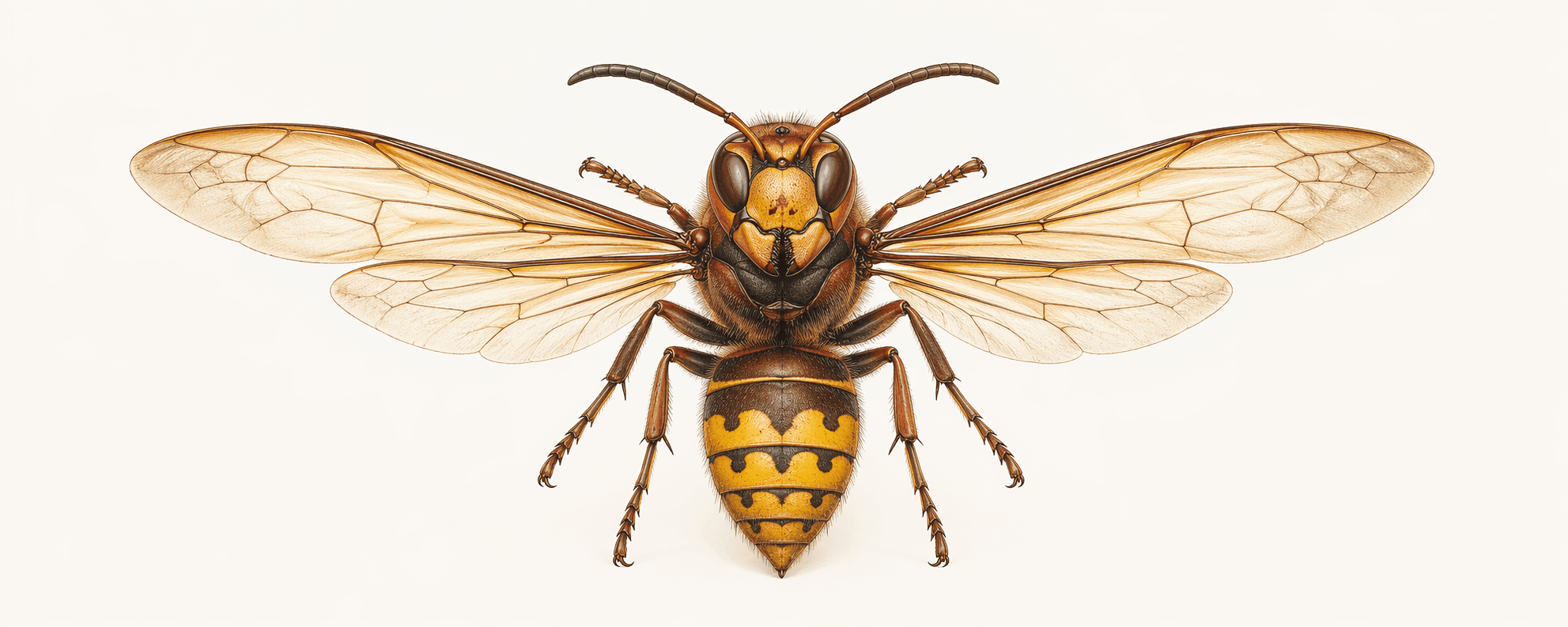
The Asian hornet (Vespa velutina nigrithorax) is recognisable by its dark colouring, the broad orange band on its abdomen and its yellow legs. Having reached the Mediterranean coast in the 2010s, it has adapted remarkably well to dense urban fabric: it readily builds its secondary nest high up and in full light, under a balcony slab, against a cornice, inside an awning box or behind a rarely touched planter. Its most dangerous trait is collective defence: when a worker perceives a vibration or a silhouette within a few metres of the nest, it releases an alarm pheromone that mobilises dozens of nestmates within seconds. Swarm attacks with multiple stings almost always involve this species. Worth noting too: Vespa velutina is capable of pursuing an intruder over several dozen metres, which rules out any amateur attempt from a neighbouring balcony.
The European Hornet: Discreet but Present in Older Buildings
The European hornet (Vespa crabro), larger and reddish-yellow, prefers darkness: disused chimney flues, attics, old roller-shutter housings, shared service shafts. It is markedly less aggressive in flight and only attacks en masse if the nest itself is directly disturbed. Its twilight and night-time activity — it is drawn to lit windows — often alarms residents, but the objective risk is lower. The distinction is not academic: it determines the degree of urgency, the safety perimeter to be established and the neutralisation technique. Any doubt about identification is resolved with a simple telephoto photograph sent to the contractor, never by approaching the nest. For reference, a common wasp nest, smaller and often with visible cells, calls for a different and generally simpler protocol.
Private Balcony, Common Façade: Why the Legal Boundary Is Blurred
The heart of the dispute lies in an architectural reality: a balcony is never entirely private. In almost all co-ownership by-laws, the enjoyment of the balcony is private — the owner has exclusive use of it — but the structure carrying it belongs to the common parts: the slab, the corbels, the railings embedded in the masonry and, above all, the façade to which everything is attached.
Yet a hornet nest does not sit "on" a balcony like a flowerpot. It almost always anchors itself to a structural element: the underside of the slab above, the slab edge, the cornice, the pelmet of an awning built into the structure, a rainwater downpipe or a shared service shaft serving several levels. In the older buildings of La Condamine or Monte-Carlo, the mouldings and recesses of the façades multiply these anchoring points straddling private lots and common parts.
Three configurations arise in practice:
- Nest anchored to a common element (slab underside, façade, cornice, service shaft): removal falls to the co-ownership, even if access is gained through a private balcony.
- Nest anchored to a strictly private element (terrace furniture, a movable planter, a pergola added by the owner): the cost falls in principle to the occupant of the lot.
- Mixed situations — the most frequent case — where the anchoring is common but the cause or the access is private: the allocation can be discussed, but it must never delay the intervention.
The golden rule we repeat to building managers: secure first, allocate afterwards. A debate over cost shares is not worth a hospital admission.
Who Decides: The Manager's Responsibility When Severe Stings Are at Stake
The building manager is responsible for preserving the building and for the safety of occupants in the common parts. An active hornet nest in the immediate vicinity of circulation areas — adjoining balconies, walkways, a shared terrace, a service entrance — constitutes a clear hazard: hornet stings, especially multiple ones, can trigger severe allergic reactions, up to anaphylactic shock. In a sensitised occupant, a single sting is enough to create a life-threatening emergency.
Faced with this risk, passivity exposes the manager to a twofold reproach: failing to address a disorder affecting the common parts, and failing to prevent a foreseeable personal injury despite having been alerted. A report from a resident, the concierge or a company working on the façade must therefore trigger a documented response within 24 to 48 hours: acknowledgement of the report, request for a professional diagnosis, immediate protective measures.
These protective measures cost nothing and change everything: temporarily closing off the balcony concerned with the occupant's agreement, cordoning off the overflight zone at ground level if the nest overlooks a courtyard or a path, informing all residents through a sober notice in the lobby, and recording everything in the concierge's logbook. We detail the first reflexes when confronted with aggressive stinging insects in our guide on what to do in an emergency wasp or hornet situation.
Emergency Convening or a General Meeting Vote: What Practice Dictates
The reflex of many co-owners' councils — "we will put the question on the agenda of the next general meeting" — is precisely what must be avoided. A Vespa velutina colony spotted in July numbers a few hundred individuals; the same colony in September numbers several thousand, with a nest that has doubled in volume and workers that are far more defensive. Waiting for an autumn general meeting multiplies both the risk and the cost of the intervention.
The management doctrine is simple. Destroying a hornet nest that endangers people is not improvement work subject to a vote: it is an urgent protective measure that the manager can and must initiate on his own authority, reporting on it afterwards. The practice proven in the Principality runs as follows:
- Day 0: report logged, photographs taken from a distance, contractor called in for a diagnosis.
- Day 1: intervention quote, written notification of the president of the co-owners' council, manager's decision under urgent measures.
- Day 1 to 3: neutralisation of the nest, preferably at night or at dawn.
- Next general meeting: ratification of the expense, presentation of the intervention report, possible decision on a prevention contract.
Convening an emergency general meeting is only justified if the intervention requires heavy ancillary work — removal of façade elements, a lift platform occupying the public highway — or if the by-laws impose a consultation threshold. In more than nine cases out of ten, the protective-measures route is sufficient, and it is the one co-owners are grateful for after the event.
Who Pays: Common Parts, Private Lots and Hybrid Cases
Once the danger has been removed, the question of allocation remains. The guiding principle is that of anchoring and cause, not of access.
If the nest was fixed to the underside of the upper slab, to the façade, to a cornice or inside a shared service shaft, the expense falls under general common charges, split according to ownership shares: it does not matter that the technician walked through an owner's living room to reach the balcony. If the nest had developed in a strictly private element — an awning box belonging to the lot, a personal planter, an added terrace shelter — the invoice can be charged to the owner concerned, with the manager having advanced the funds on grounds of urgency.
Hybrid cases are settled pragmatically. A nest anchored to the façade but made possible by an obvious lack of private maintenance may justify a split. Conversely, an owner who reported the nest without delay and facilitated access must never be penalised: the message sent to the building would be disastrous for future reporting.
Two pitfalls to avoid at all costs. First, making the intervention conditional on settling the financial question beforehand: the delay benefits only the colony. Second, letting an owner "sort it out" alone: a botched neutralisation with household insecticide scatters the colony across the neighbouring balconies and turns a localised problem into a collective claim. The building's insurer, for its part, will appreciate that a company holding the Certibiocide certificate intervened according to professional standards.
The Annual Co-ownership Contract: Intervening Without Financial Deadlock
The most effective way to dissolve the "who pays" debate is to have settled it before the first nest appears. That is the whole point of an annual pest management contract for co-owned buildings, voted once at a general meeting and integrated into the provisional budget.
In concrete terms, such a contract covers preventive inspection of sensitive points in spring — the period when founding queens establish their primary nests, still the size of an orange —, a defined number of interventions on stinging-insect nests during the season, and scheduling priority in case of emergency. For the manager, the benefits are immediate: no more financial decisions to arbitrate under pressure, a single point of contact already familiar with the building, its roof accesses and its service shafts, and a short response time because the contractual framework is already in place.
The experience of the buildings we look after year-round speaks for itself: a primary nest detected in April during the spring visit is neutralised in a few minutes, without an extended safety perimeter or a night slot. The same nest discovered in August mobilises a full team in complete protective suits. Contracted prevention does not eliminate the risk, but it turns summer emergencies into simple routine entries.
How the Intervention Unfolds: Method, Telescopic Pole and Safety
Neutralising a hornet nest on a façade or balcony follows a precise protocol, each step of which is designed around occupant safety.
Scouting and Coordination with the Concierge
Everything starts with a diagnostic visit: exact location of the anchoring point, species identification, mapping of the flight corridor, identification of access routes. The building's concierge is our operational relay: he knows the residents' habits, holds the keys to the technical rooms and the roof, and passes on the instructions — windows closed on the affected stack, balconies cleared, pets brought inside — in the hours before the visit. This coordination often makes the difference between a smooth intervention and a complicated operation.
The Telescopic Pole up to 20 Metres: Treating Without Scaffolding
Our reference equipment is the telescopic pole, which allows a biocidal powder to be injected into the heart of the nest at heights of up to 20 metres — roughly six storeys — from the ground, a lower balcony or a roof. The advantage for a co-owned building is decisive: no scaffolding, no lift platform, no permit to occupy the public highway, no intrusion into the apartments on the intermediate floors. The technician reaches the underside of a fifth-floor balcony slab from the courtyard, injects the biocide directly into the nest's entrance hole, and the colony is neutralised within a few hours, as workers returning from foraging are contaminated in turn.
Night Slot and Full Protective Suit
For very active nests or nests located directly above circulation areas, we favour intervening at nightfall or at dawn: the colony is gathered inside the nest, flight activity is minimal and residents are at home with their windows closed. The technician works in a full anti-hornet suit — thick fabric, face veil, reinforced gloves — because Vespa velutina can sting through ordinary clothing. The nest is then removed and taken away as soon as the colony is inert, generally within 24 to 48 hours, to prevent any recolonisation and to visually reassure occupants. Every intervention is carried out under our Certibiocide certificate N°121134, using products approved for use in inhabited environments.
Documentation and Reporting: From the Meeting Minutes to the Insurer
A successful intervention does not end with the removal of the nest: it has to be proven. For a building manager, documentary traceability serves three purposes. It feeds into the minutes of the next general meeting, where the expense incurred as an emergency will have to be ratified. It is the key exhibit if a co-owner challenges the allocation of costs. Finally, it secures the building's position with its insurer should a sting or damage occur before, during or after the operation.
Our standard intervention report includes: time-stamped photographs of the nest before and after treatment, species identification, precise location of the anchoring point with an explicit statement of whether it is common or private — an element building managers systematically ask us for, because it puts the allocation of charges on an objective footing —, the product used with its approval number, the safety perimeter put in place, and prevention recommendations for the following season. The document is sent to the manager within a few days, in a format that can be annexed directly to the meeting minutes and forwarded to the insurer. Our company is registered in the Monegasque trade register under number RCI 26S10394, a reference that appears on every report and invoice — an administrative detail that matters when the file is reviewed by an insurer or a co-owner's lawyer.
Belle Époque Buildings: Field Experience with Architecture That Attracts Hornets
The Belle Époque buildings that give Monte-Carlo and La Condamine their character offer, from a hornet colony's point of view, every advantage: deep cornices, mouldings and friezes creating dry shelters, stone balconies on corbels whose underside is invisible from the apartment, old awning boxes that are never opened, and through-running service shafts whose ducts provide temperate cavities. Every season we find nests that have been in place for weeks without a single occupant noticing them, revealed by a gardener, a window cleaner or a roofer.
Three lessons emerge from these interventions. First, early detection depends on the building's regular contractors: a concierge and maintenance companies who know what to look for report primary nests as early as May, when neutralisation is trivial. Second, the telescopic pole is particularly suited to this architecture: it makes it possible to treat a fifth-level cornice without touching fragile mouldings or erecting scaffolding on a façade of heritage interest. Finally, recurrence is a genuine issue: a favourable spot — the same cornice, the same box — can be recolonised the following year by a new founding queen. Hence the value, once the nest is removed, of sealing the accessible cavities and adding the sensitive point to the building's monitoring plan.
Act Fast, Decide Fairly: The Summary for Building Managers
Faced with a hornet nest on a balcony, the winning sequence comes down to five points: identify the species from a distance, secure the area immediately, have a professional intervene within 72 hours under protective measures, document the nest's anchoring point to give the cost allocation an objective basis, and ratify the expense at the next general meeting while proposing, in the same movement, an annual prevention contract that will avoid reliving the same episode.
Our team operates throughout the Principality and the neighbouring communes, from photographic diagnosis to nest removal, including night slots and heights of up to 20 metres by telescopic pole. Building managers and co-owners' councils can request a free quote for a one-off intervention or an audit visit prior to an annual contract: the answer comes within 24 hours, with an intervention slot proposed from the very first exchange.
Frequently asked questions
- Who pays for destroying a hornet nest on a balcony in a co-owned building?
- Everything depends on the nest's anchoring point, not on the access route. Fixed to the slab underside, the façade, a cornice or a service shaft, it falls under common charges split by ownership shares. Anchored to a strictly private element — an awning belonging to the lot, a planter, an added pergola — it can be charged to the owner. The intervention report states whether the point is common or private, giving the allocation an objective basis.
- Can the building manager have a hornet nest destroyed without a general meeting vote?
- Yes. Destroying a nest that endangers people is an urgent protective measure, not improvement work subject to a vote. The manager initiates the intervention on his own authority, notifies the president of the co-owners' council in writing, then has the expense ratified at the next general meeting, annexing the intervention report to the minutes. Waiting for a meeting would multiply both the risk and the cost.
- How can you tell an Asian hornet from a European hornet on a balcony?
- The Asian hornet (*Vespa velutina*) is dark, with an orange band on the abdomen and yellow legs; it nests in full light under slabs, cornices and awning boxes, and defends its nest in swarms. The European hornet (*Vespa crabro*), larger and reddish-yellow, prefers the darkness of shutter boxes, attics and service shafts, and is less aggressive. Identification is done with a telephoto picture, never by approaching the nest.
- Can you destroy a hornet nest on your own balcony yourself?
- No, and above all not an Asian hornet nest. An alerted worker releases an alarm pheromone that triggers a collective attack within seconds, with a risk of multiple stings and anaphylactic shock. Household insecticide also scatters the colony across neighbouring balconies. Neutralisation requires a full protective suit, a professional biocide injected into the heart of the nest and a secured intervention setup.
- How is an inaccessible hornet nest high on a façade treated?
- The telescopic pole allows a biocidal powder to be injected directly into the nest at heights of up to 20 metres — about six storeys — from the ground, a lower balcony or the roof. No scaffolding, no lift platform, no occupation of the public highway, no passage through intermediate apartments. The intervention is preferably scheduled at nightfall or at dawn, when the colony is gathered inside the nest, which is removed once inert.
- What documents does the building manager receive after the nest's destruction?
- A complete intervention report: time-stamped photographs before and after treatment, the identified species, the location of the anchoring point with a statement of whether it is common or private, the product used and its approval number, the safety perimeter put in place and prevention recommendations. Drawn up under Certibiocide certificate N°121134, the document can be annexed directly to the meeting minutes and forwarded to the building's insurer.