July 23, 2026 · 15-minute read
Villa roof-structure audit at Cap-Ferrat: acoustic detection of wood borers
On a villa's exposed roof structure, acoustic sounding reveals the hidden attack of longhorn and woodworm beetles. Piezo-probe diagnosis, wood/fungus distinction, curative injection treatment and architect coordination.
The context: why villa roof-structure audits matter on the Riviera
On the exposed roof structure of an old villa, acoustic sounding can reveal five square metres of hidden attack when nothing shows on the surface. That single fact explains why a villa roof-structure audit on the Monaco Riviera has become second nature to informed owners across the whole hinterland and coastline, from the hills above the Principality to the wooded headlands.
The Riviera's older building stock, often Belle Époque in style, combines three factors that delight wood-boring insects: solid softwood roof timbers laid more than a century ago, a mild and humid microclimate that keeps timber above the critical moisture threshold, and rarely ventilated lofts where summer heat stagnates. This trio creates an ideal environment for two insect families the public constantly confuses: the house longhorn beetle and the woodworm beetle.
The stakes are not merely cosmetic. An attacked purlin, rafter or tie-beam gradually loses its load-bearing section. The insect hollows out the interior — the sapwood first, sometimes the heartwood — while leaving a film of sound wood on the surface. The result: the piece looks intact to the eye, but its structural capacity collapses. This is exactly what acoustic detection of wood borers is designed to expose before failure.
For an owner, an architect or an estate manager, understanding this mechanism changes everything: you do not treat a roof structure because you saw an insect fly past, you treat it because a rigorous diagnosis has mapped the real extent of the attack. That is the difference between an expense you endure and an investment you control.
House longhorn or woodworm beetle: identifying the enemy
The first step of a villa longhorn and woodworm diagnosis is to name the species precisely, because behaviour, speed of degradation and treatment protocol differ radically.
The house longhorn beetle, Hylotrupes bajulus, is the most fearsome roof-timber borer. Its larva, white and fleshy, can reach two or three centimetres and live several years inside a single piece of wood, feeding exclusively on the sapwood of softwoods — fir, spruce, pine. It bores large oval galleries, up to a centimetre wide, filled with fine powdery frass mixed with small pellets. The adult exit hole is oval and characteristic, six to ten millimetres across. One essential point: the longhorn works in apparent silence, and there may be no visible exit hole for years while the inside of the beam is already largely excavated. It is the insect that most justifies an acoustic audit.
The woodworm beetle comes mainly in two species. Anobium punctatum, the common furniture beetle, attacks both softwoods and hardwoods and leaves small round exit holes, one to two millimetres, with granular frass. The larger deathwatch type, more tied to already dampened and sometimes fungus-degraded wood, bores wider galleries. Woodworm often signals an underlying moisture problem: its presence is a valuable clue that a water source must be found — roof infiltration, rising damp, loft condensation.
Distinguishing Hylotrupes bajulus from Anobium punctatum is therefore not a pedantic exercise: it dictates the depth of sounding, the choice of active substances and the structural prognosis. A useful resource on the biology of these pests is our dedicated page on longhorn and woodworm beetles, which details life cycles and distinguishing signs.
The classic mistake: spraying without a diagnosis
The temptation is universal. You spot sawdust at the foot of a beam, buy an aerosol product, spray liberally, and reassure yourself. Our method starts from the opposite end: by removing the cause before treating the symptom, and by measuring before acting.
Surface spraying on a roof structure attacked by the longhorn is therapeutic illusion. The larva lives several centimetres deep, protected by the layer of sound wood it deliberately leaves on the surface. A product applied by brush or sprayer penetrates a few millimetres at best. It never reaches the active larva, may kill a few passing adults, and leaves the owner in false security while internal degradation continues.
Worse, blind spraying hampers any later diagnosis: it masks fresh clues, saturates the wood with solvent and complicates acoustic reading. That is why any serious wood treatment starts with an audit, never with an application. Our approach to wood treatment reverses the usual logic: identify, map, then and only then treat, with a method adapted to the species and the real depth of the attack.
Removing the cause also means hunting down moisture. A roof structure kept dry, ventilated and out of reach of infiltration becomes a hostile environment for woodworm again. Chemical curative treatment only makes sense coupled with this restoration of the environment. Treating without drying condemns the wood to reinfestation.
Piezo-probe acoustic detection: seeing the invisible
The heart of our expertise rests on acoustic detection of wood borers, a non-destructive method that literally lets us listen inside the wood.
The principle is twofold. First, percussive sounding: the technician methodically strikes the timber with a mallet and a calibrated punch, centimetre by centimetre. Sound wood gives a full, dull, clean note. Wood excavated by galleries gives a hollow, soft note, sometimes with a slight surface collapse under the point. The trained ear thus maps suspect zones. Second — and this is where technology comes in — the piezoelectric probe: a piezo sensor applied against the grain turns micro-vibrations into a measurable signal. We can then detect larval activity — the longhorn larva, as it bores, emits chewing sounds the sensor perceives in the quiet of a loft — and assess wood density through sound propagation.
In practice, an acoustic audit takes place in near-total silence, often early morning, probe in hand, ear to the headset. The piezo probe reveals two things the eye will never see: the horizontal extent of the attack, beam by beam, and its depth. This is how a roof structure with not a single visible exit hole can reveal five square metres of structurally compromised wood. On the villas of the hills, this contrast between intact façade and hollowed interior is the rule rather than the exception.
Acoustic reading produces a map: each piece is graded sound, suspect or attacked, and the extent is quantified in area and linear metres. This document becomes the basis of the quote, of dialogue with the architect and, later, of efficacy checks. It turns intuition into data. To launch such a diagnosis on your property, the first step is a simple free quote with an on-site technical visit.
Telling a borer attack from wood fungus
A frequent confusion, including among some hurried surveyors, is to attribute to insects a degradation that actually stems from a fungus. Yet the treatment differs entirely.
A borer attack — longhorn, woodworm — is recognised by its galleries and frass. The wood stays dry, the grain structure is preserved between galleries, and you find exit holes and sawdust. Fungal decay is a different biological phenomenon: a wood-rotting fungus, favoured by high and lasting humidity, digests the wood's lignin or cellulose. Depending on the species, the wood browns and cracks into small cubes — cubical rot, whose most feared case is dry rot, able to cross masonry — or whitens and becomes fibrous and spongy.
Acoustic sounding helps decide: wood attacked by a fungus gives a dull, soft note over a diffuse area, without the network of regular galleries of an insect, and usually comes with moisture measurable by a meter. The joint presence of fungus and insects is not rare either: woodworm particularly likes wood already softened by incipient rot. The diagnosis must therefore always cross three measurements: sound, moisture and visual appearance.
This distinction dictates the protocol. Against the insect, we inject and brush an insecticidal active substance. Against the fungus, we must above all remove the water source, dry out, cut away the too-far-gone wood and apply a fungicide. Confusing the two means treating beside the problem and watching degradation continue. That is precisely why the audit always takes precedence over application.
Our four-stage curative protocol: injection and brushing
Once the audit is done and the species identified, curative treatment follows a rigorous four-stage protocol, proven on dozens of roof structures.
Stage one, mechanical preparation. We carry out chiselling out: with a gouge or wood chisel, we remove all excavated, worm-eaten, non-resistant wood until sound grain is reached. This step, often spectacular, reveals the real extent of the galleries and restores a sound base for treatment. Pieces whose residual section is too weak are flagged to the architect for reinforcement or replacement — that is no longer treatment but structure.
Stage two, brushing and dusting off. The surface is brushed to open the pores and remove residual frass, then dusted off. Clean, open wood absorbs the active substance far better. This step conditions the effectiveness of everything that follows.
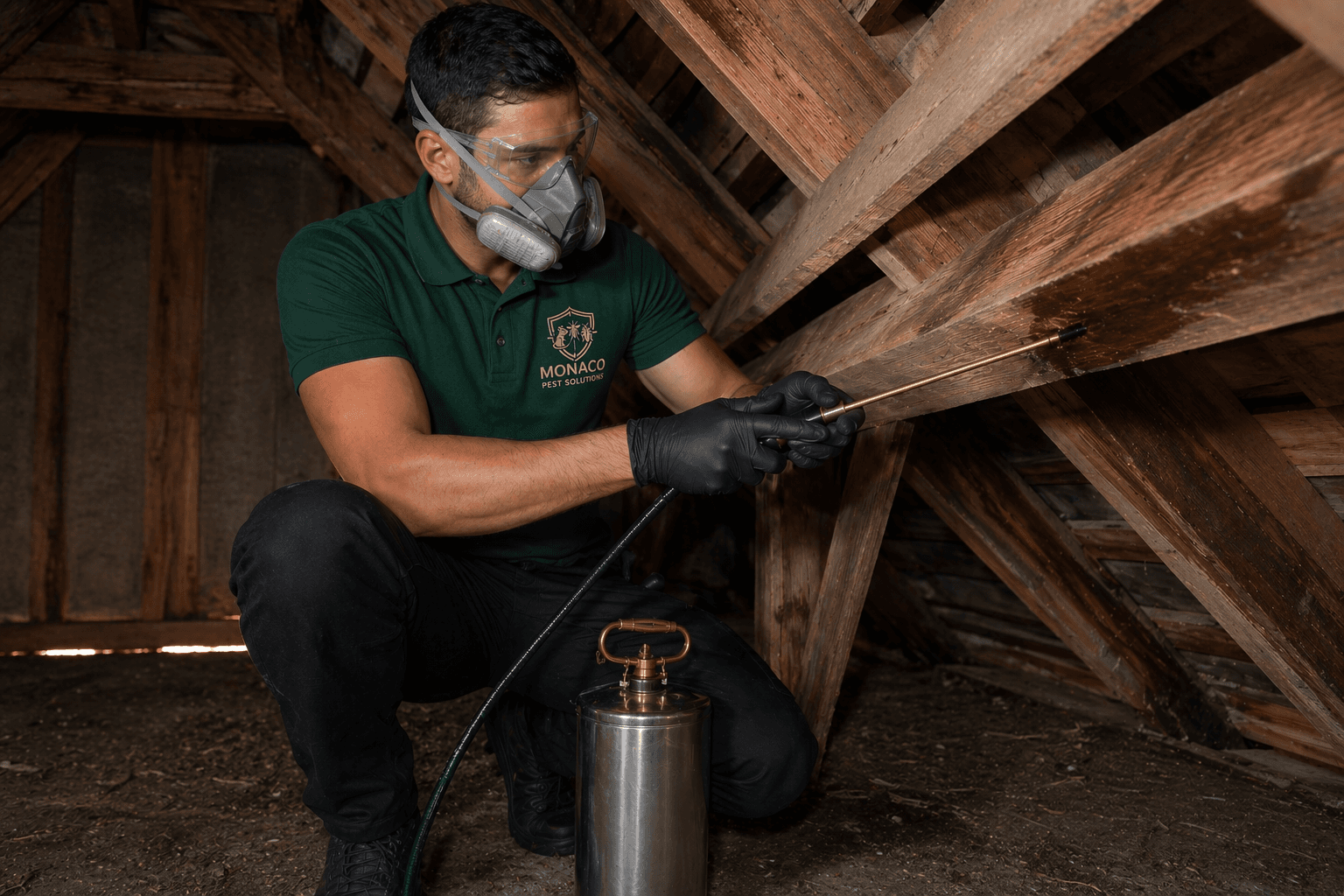
Stage three, pressure injection. On large-section pieces, where the larva works deep, surface application alone is not enough. We drill a staggered network of holes, insert valved injectors, and inject the insecticidal product under pressure so it diffuses to the core of the wood, right to the galleries. This is the only way to reach Hylotrupes bajulus in its refuge. The mesh of injection points is calculated according to section and species.
Stage four, finishing coat and mass treatment. The whole roof structure, including sound neighbouring pieces, receives a generous low-pressure spray or brush application, to create a preventive barrier against any recolonisation. The active substances used are exclusively approved products, applied under Certibiocide certification N°121134. An intervention report details products, quantities, treated zones and follow-up recommendations. To understand this chain in detail, our wood treatment page documents each phase and the associated guarantees.
Coordinating with the architect on listed villas
On villas of character, often listed for heritage value or in a protected sector, roof-structure treatment is never conceived alone. It fits into a chain where the architect plays a central role, and our job is to slot into it without friction.
The heritage constraint imposes choices: we favour preserving original material, limit removals, document every intervention. Our acoustic map then becomes a valuable tool for the architect, letting him decide, piece by piece, what can be treated and kept and what must be reinforced by a timber prosthesis or a discreet metal splint. A historic tie-beam whose residual section remains sufficient can be saved by injection; another too far hollowed will be doubled rather than removed, to preserve the original reading of the roof structure.
Coordination also concerns timing and access. On a listed-villa site, several trades intervene — roofer, carpenter, plasterer, decorator. Our treatment must slot into the right window: after the roof is made watertight, before the loft is closed and repainted. We give the architect a precise schedule and the drying times to respect before covering.
Finally, traceability. A heritage file requires written documents: audit report, map, product sheets, treatment certificate under Certibiocide N°121134, before-and-after photographs. This set feeds the architect's file and secures the property's resale value. It is a point owners of the hillside villas particularly appreciate: treatment becomes a documented added value, not just a line of expense.
Field experience: the hillside villas of the Riviera
The roof structures of the Riviera's hillside villas all tell a similar story, and yet each case has its singularity. Here is what years of interventions have taught us.
First lesson: the contrast between appearance and reality is almost always striking. On an exposed roof structure beautifully maintained, waxed, showcased by the lighting of a cathedral living room, sounding regularly reveals unsuspected hollow zones. The longhorn larva, discreet, had worked for years without ever breaking the surface. Five square metres of hidden attack beneath a beam of impeccable appearance: this is not a textbook case, it is a recurring scenario.
Second lesson: moisture is the common thread. Seafront and exposed-hillside villas undergo strong hygrometric swings, and the slightest roofing or ventilation defect creates the conditions for woodworm, sometimes fungus. Treating the insect without correcting the moisture guarantees the problem's return in the following years.
Third lesson: the value of anticipation. Owners who have their roof structure audited coolly, outside any incident, often discover incipient attacks treatable by simple localised injection. Those who wait for a rafter to collapse or a sag to appear on a purlin face heavy structural repairs, with removal, replacement and the coordination of a full site. Geography counts too: in towns such as Saint-Jean-Cap-Ferrat and across the wooded Riviera, the age of the building stock and the microclimate make a preventive audit particularly relevant.
Fourth lesson: discretion is a requirement, not a comfort. On this type of property, the intervention must be silent, clean, respectful of the premises and the occupants. Our teams work by protecting floors and furniture, clearing out each evening, and adapting to the household's living constraints.
Certibiocide, environment and commitment to results
Treating a roof structure means handling biocides in a living space. Our responsibility is twofold: effectiveness and control of impact.
All our interventions are carried out under Certibiocide certification N°121134, proof that operators are trained in the handling, dosing and safety of insecticidal and fungicidal products. We use only approved active substances, at the strictly useful dose, with a marked preference for targeted techniques — injection into the core of the wood rather than widespread saturation — that limit the quantities used. Injection places the product precisely where the larva lives, and nowhere else.
The environmental commitment also means refusing disproportionate methods. Fumigating an entire roof structure, heavy and constraining, is reserved for extreme cases; in the vast majority of situations, the pairing of acoustic audit and targeted injection solves the problem with a far smaller footprint. Drying, ventilating, brushing: these mechanical gestures reduce the recourse to chemistry accordingly.
Finally, the commitment to results. Serious treatment is checked: after intervention, a follow-up verifies the absence of renewed activity, by ear and by probe. The report given to the owner or architect records everything and forms a lasting piece of the property's file. It is this rigour, from audit to final check, that distinguishes true expertise from mere spraying. For any roof structure you consider at risk, the starting point remains the same: a technical visit and a free quote with no obligation.
The questions our clients ask most
How do I know my roof structure is attacked when I can see nothing?
That is precisely the crux: the absence of a visible sign proves nothing. The house longhorn can bore for years without breaking the wood's surface, and the attack is discovered only on sounding. Signs to watch for are fine sawdust at the foot of the pieces, small round or oval holes, a rustling in the quiet of a loft in summer, or a hollow note on percussion. But the only reliable way to know remains an acoustic audit by a professional, mapping the attack beam by beam, including where nothing shows. A visual examination alone regularly misses several square metres of compromised wood.
What is the difference between the longhorn and the woodworm, and does it matter?
The difference is crucial because it changes the prognosis and the treatment. The house longhorn, Hylotrupes bajulus, attacks softwoods, bores large deep galleries and quickly compromises the piece's resistance; it is the most dangerous for the structure. The woodworm, Anobium punctatum, bores small galleries, leaves round holes one to two millimetres across, and often signals an underlying moisture problem to be corrected. Identifying the species dictates the depth of sounding, the choice of products and the urgency of intervention. The same action does not suit both.
Is acoustic detection really more reliable than a visual check?
Yes, very clearly, for the simple reason that it explores the inside of the wood and not its surface. Percussive sounding reveals voids by sound, and the piezoelectric probe detects the micro-vibrations of larval activity as well as density variations. Where the eye sees an intact beam, acoustics hears a gallery. It is this method that lets us quantify the real extent of an attack, often far greater than the wood's surface suggests. A visual check keeps its usefulness as a first approach, but it never replaces sounding for establishing a reliable diagnosis and a quantified map.
Do we have to leave the villa during roof-structure treatment?
In the vast majority of cases, no. Curative treatment by injection and brush is targeted and does not impose a general evacuation, unlike fumigation, reserved for extreme situations. Our teams protect the premises, work cleanly and respect drying and airing times before the treated loft is reoccupied. We adapt the schedule to the household's living constraints and can, on listed villas, coordinate with the other trades to limit disruption. The precise terms are defined during the technical visit according to the extent of the attack and the layout of the premises.
How does coordination with my architect work on a listed villa?
It is at the heart of our method on heritage buildings. We provide the architect with a detailed acoustic map letting him decide, piece by piece, what can be kept and treated by injection and what must be reinforced or doubled. We respect the principles of preserving original material, limit removals, and slot into the site schedule at the right window, after watertighting and before the loft is closed. Everything is documented — audit report, product sheets, certificate under Certibiocide N°121134, before-and-after photos — to feed the heritage file and secure the property's value.
Is roof-structure treatment definitive, or must it be renewed?
A well-conducted curative treatment — chiselling out, brushing, core injection, barrier coat — eliminates the attack in place and protects the wood durably, provided the cause has been removed. That is the decisive point: if an infiltration or loft moisture persists, woodworm can return, and sometimes a fungus settle in. So we always correct the environment alongside the chemical treatment. A follow-up check verifies the absence of renewed activity. Properly carried out and combined with a roof structure kept dry and ventilated, the treatment is not meant to be renewed in the short term.