
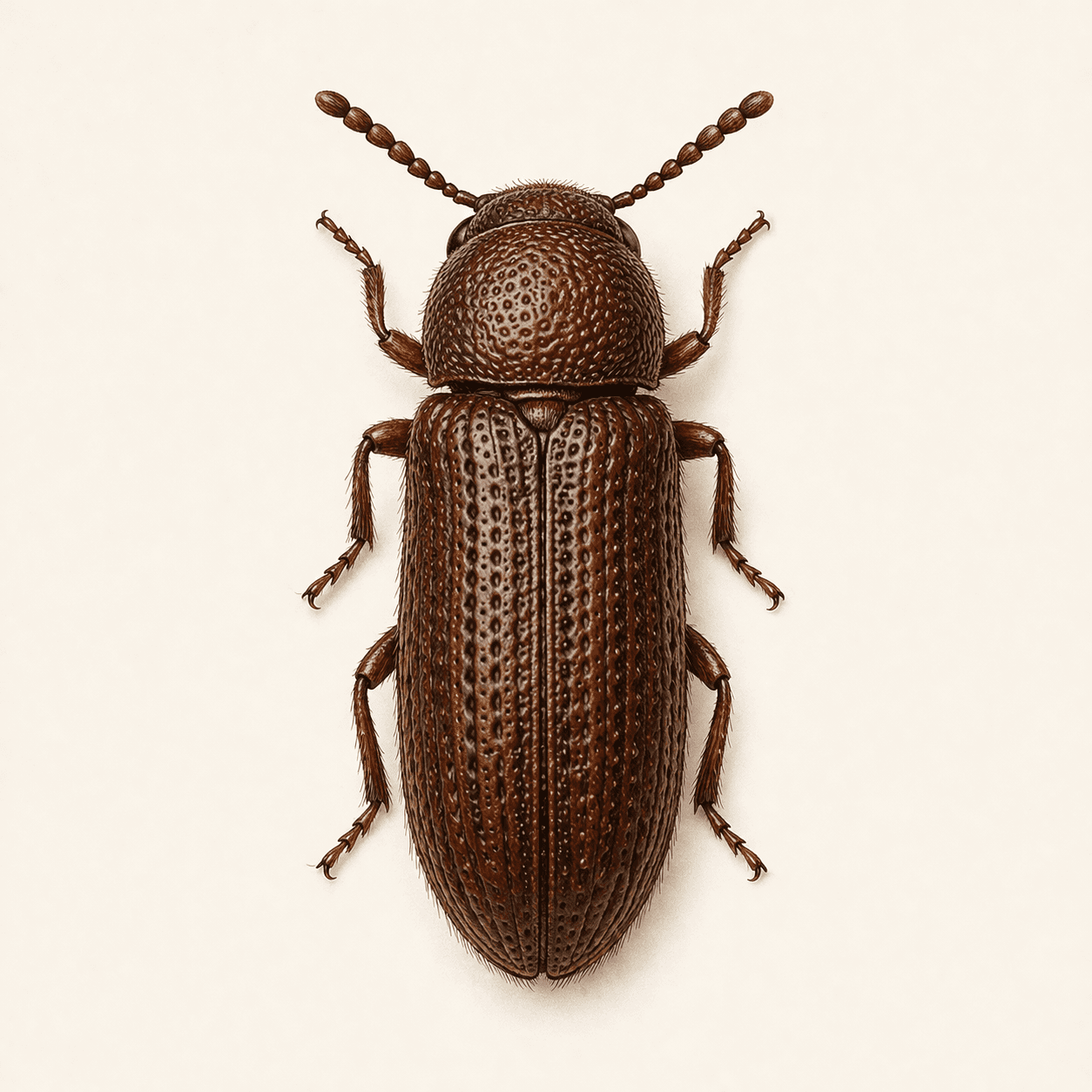
Identifying the house longhorn beetle and woodworm: the signs that never lie
Two families account for most of the wood-boring infestations of buildings on the Riviera. The house longhorn beetle (Hylotrupes bajulus) attacks almost exclusively the sapwood of softwoods — fir, spruce, pine — that is, traditional roof timbers. The adult, 8 to 20 mm, brown-black, with two pale patches on the elytra, rarely flies indoors. The death-watch beetle (Xestobium rufovillosum) and the common furniture beetle (Anobium punctatum) prefer hardwoods: antique furniture, parquet, oak beams, carved woodwork.
The signs of their presence are rarely the insects themselves, but their traces:
- Round exit holes, 2 to 4 mm for woodworm, 5 to 10 mm and oval for the house longhorn beetle.
- Frass (very fine sawdust) at the base of the wood, sometimes trapped in a spider's web.
- A chewing noise or crackling beneath the structure, audible at night — the famous "ticking" of the death-watch beetle is a sexual calling signal.
- Wood that sounds hollow when struck with a mallet, gives way under a bradawl, or whose sapwood peels off in flakes.
The absence of holes does not rule out infestation: the larvae spend 3 to 10 years inside before emerging.
Health and material risks
Unlike bed bugs or cockroaches, longhorn beetles and woodworm do not bite and carry no direct pathogen. The risk lies elsewhere, and it is major.
Health — The dust from worm-eaten wood, breathed in during works or a simple pass of the vacuum cleaner, can trigger asthma-like reactions in sensitive people. The moulds that colonise damp galleries add an allergenic component.
Material — This is where the essentials are at stake. Roof timbers colonised for ten years can lose a significant part of their mechanical strength. On a historic building in La Condamine or a villa in Cap-d'Ail, underpinning repairs can represent considerable works, out of all proportion to a preventive treatment.
Legal — The seller of a property has a duty to disclose. The Monaco landlord, like the French landlord, must provide a dwelling in good working order: undisclosed infested roof timbers engage their liability. For co-owned buildings, the structural common areas (roof timbers, upper floors) fall to the managing agent. An up-to-date treatment certificate provides protection in the event of a dispute.
Why this pest thrives in Monaco and on the Riviera
Three factors combine to create particularly favourable ground in the Principality and its hinterland.
The Mediterranean climate — mild winters, relative humidity constant at around 60 to 75%, no prolonged frost — lengthens the larvae's period of activity. A northern longhorn beetle can take eight years to reach adult form; on the Côte, the cycle shortens appreciably.
The built fabric also plays a part. Monaco combines Belle Époque buildings, old villas over towards the Rocher, recent restorations incorporating quality solid wood (old-oak parquet, reclaimed exposed beams), and yachts whose teak or mahogany interior fit-outs can carry eggs from one port to another. In Menton, Roquebrune-Cap-Martin and Beausoleil, the late-19th-century villas are classic targets.
Finally, the turnover of occupants — second homes closed for several months, prolonged renovation sites, properties going through probate — favours silent infestations: with no daily occupation, no one to hear the nocturnal ticking or notice the frass under a skirting board.
The MPS protocol in five steps
- Independent diagnosis — A visit from a Monaco Pest Solutions technician, equipped with a bradawl, an acoustic mallet and a timber stethoscope. We map the active areas, identify the species from the holes and frass, and distinguish an old infestation (traces without recent emergence) from an ongoing one.
- Mechanical preparation — Draw-knifing of surface-attacked timbers to remove the worm-eaten sapwood, complete dust removal, protection of adjacent surfaces (floors, fabrics, artworks).
- Curative treatment — Twofold action. Pressure injection of a wood-preserving product into calibrated bore-holes spaced at regular intervals, allowing the heart of the wood to be saturated. Surface spraying or brush-coating with an authorised biocide, with a residual active effect. We use exclusively products entered in the biocide register, suitable for occupied premises.
- Post-treatment inspection — Return to site some time after the initial intervention to check for the absence of adult emergence, to verify by sampling the mechanical recovery of the wood, and to top up if a residual hotspot appears.
- Certification — Issue of a treatment certificate stating the products used, the treated areas and the contractual guarantee. This document is admissible before a notary at a sale, before an insurer in the event of a claim, or before the managing agent within a co-ownership.
Mistakes to avoid
DIY wood-treatment is one of the areas where private individuals waste the most.
- Supermarket wood preservative sprayed from a bottle never reaches the heart of the wood where the larvae live. It creates an illusion of treatment, most often ineffective beyond 2 mm of depth.
- Steam or a heat gun can, on certain pieces of furniture, kill surface larvae, but does not reach roof timbers and damages the finishes.
- Partial replacement of the wood without treating the whole leaves the neighbouring hotspots in place, which will recolonise the new piece within a few months.
- Cosmetic filling of the holes with wood filler masks the problem without solving it. Worse, it complicates the later diagnosis.
- Waiting — many believe that an "old" infestation does not reactivate. That is statistically true, structurally false: roof timbers weakened twenty years ago remain weakened today.
A longhorn beetle is treated seriously, once, or the problem is pushed back to a structural survey.
A typical Monaco case
A 1920s villa on the heights of Beausoleil, undergoing restoration before being put back on the market. During the removal of a suspended ceiling in the main lounge, the tradesman exposed the original roof timbers and reported a series of oval holes of 6 to 8 mm on several fir joists. The owner contacted us through his architect.
On-site diagnosis: house longhorn beetle, an active hotspot localised on three joists and part of the purlin. Mapping of the entire roof structure with the bradawl and by acoustic listening, extension of the perimeter to be treated to the adjoining rooms as a precaution. Draw-knifing of the attacked surfaces, deep injection over the whole fir structure, surface brush-coating. Two visits, a few weeks apart. Certificate delivered to the notary at signing, with no treatment information visible in the sale report beyond the regulatory mention.
Lasting prevention
After treatment, a few habits prevent recurrence and detect a new infestation early.
- Annual visual check of accessible roof timbers, particularly in late spring when the adults emerge.
- Maintain moderate humidity (ideally 50-60%) in lofts and rooms with antique woodwork; wood-borers thrive in a damp atmosphere.
- Treat any new wood brought into the house (a second-hand find, a reclaimed beam, a raw panel) with a preventive pass or a quarantine period.
- Ventilate second homes closed for long periods: even minimal air renewal reduces the contact humidity of the wood.
- Watch antique furniture placed against a cold wall, where condensation creates humidity favourable to woodworm.
Regulatory framework
Curative treatments of structural timbers fall, in France, under the biocide decree and the Certibiocide certification mandatory for applicators. Monaco Pest Solutions holds the Certibiocide certificate N121134 and is registered with the Monaco trade register under the number 26S10394. In the Principality, the use of biocidal products is governed by local regulations and by the European directive in its Monaco transposition: only products authorised for sale and professional use can be applied in occupied premises. In a French property sale, the termite survey (1999 law) is mandatory in certain designated communes; the longhorn beetle is not covered by this survey but engages the seller's liability on the grounds of latent defects.
How long, how many visits
A curative longhorn-beetle or woodworm treatment is generally scheduled over two to four calendar weeks between the first visit and the completion of the works. The treatment phase proper occupies the technician for one to two days depending on the area — a villa's complete roof structure requires more than a lounge of antique furniture. A single curative visit is sufficient in the great majority of well-diagnosed situations; we systematically schedule a later inspection to confirm the absence of recurrence. The contractual guarantee then takes over beyond that. On large projects or mixed cases (longhorn beetle + woodworm + residual damp), a third visit can be provided for in the initial quote so as to remain transparent about the final cost.
In any doubt? Our team responds within 2 working hours. +377 37 70 70 02 — or [request a free quote](/devis-gratuit).