September 19, 2026 · 4-minute read
Old roof timbers in Monaco: the right order to treat woodworm
Diagnosis, cutting back, curative treatment, ventilation, then insulation: the order to follow to save old roof timbers attacked by wood borers.
Belle Époque villas, old buildings in Monaco-Ville, village houses in the hinterland: on the Riviera, many roofs still rest on timber structures that are a century old or close to it. During a renovation, finding small holes and wood dust at the foot of the beams is common. The danger does not come only from the insect: it also comes from works carried out in the wrong order. Treat before the damaged wood has been cut back, or insulate before treating, and the whole job loses its effectiveness. Here is the sequence to follow.
First, identify the insect and check whether it is active
Each wood borer leaves a different signature:
- The house longhorn beetle attacks softwoods (pine, fir, spruce). Its exit holes are oval, roughly 6 to 10 mm, and its larvae can tunnel through a beam for years beneath an intact surface; in warm weather you can sometimes hear them gnawing.
- The common furniture beetle bores round holes of 1 to 2 mm and leaves fine, gritty dust; it likes slightly damp wood.
- The deathwatch beetle mainly targets hardwoods such as oak, in old buildings where the wood stays damp, often alongside fungal decay.
- The powderpost beetle (Lyctus) attacks the sapwood of certain hardwoods and produces very fine, flour-like dust, mostly in floorboards and joinery.
Holes with clean edges and pale dust that is still falling point to an active attack; dark holes with no fresh dust may betray an old infestation. If the wood is flaky and layered with no exit holes, or if earthen tubes appear, think termites: the protocol is then different. To recognise each species, see our page on longhorn and furniture beetles.
The right order of operations
- Full diagnosis: probing the timbers with an awl, listening for larvae, identifying the species, mapping the affected areas and sources of damp (see our article on the acoustic audit of a villa's roof timbers).
- Making the roof watertight: repairing roof leaks, gutters and failing valleys, otherwise furniture beetles and fungi will come back.
- Structural assessment: the carpenter or structural engineer decides which pieces to keep, reinforce or replace, depending on the remaining sound section.
- Cutting back: removing the degraded wood down to sound timber, dusting down thoroughly and taking away the debris, which may still contain larvae.
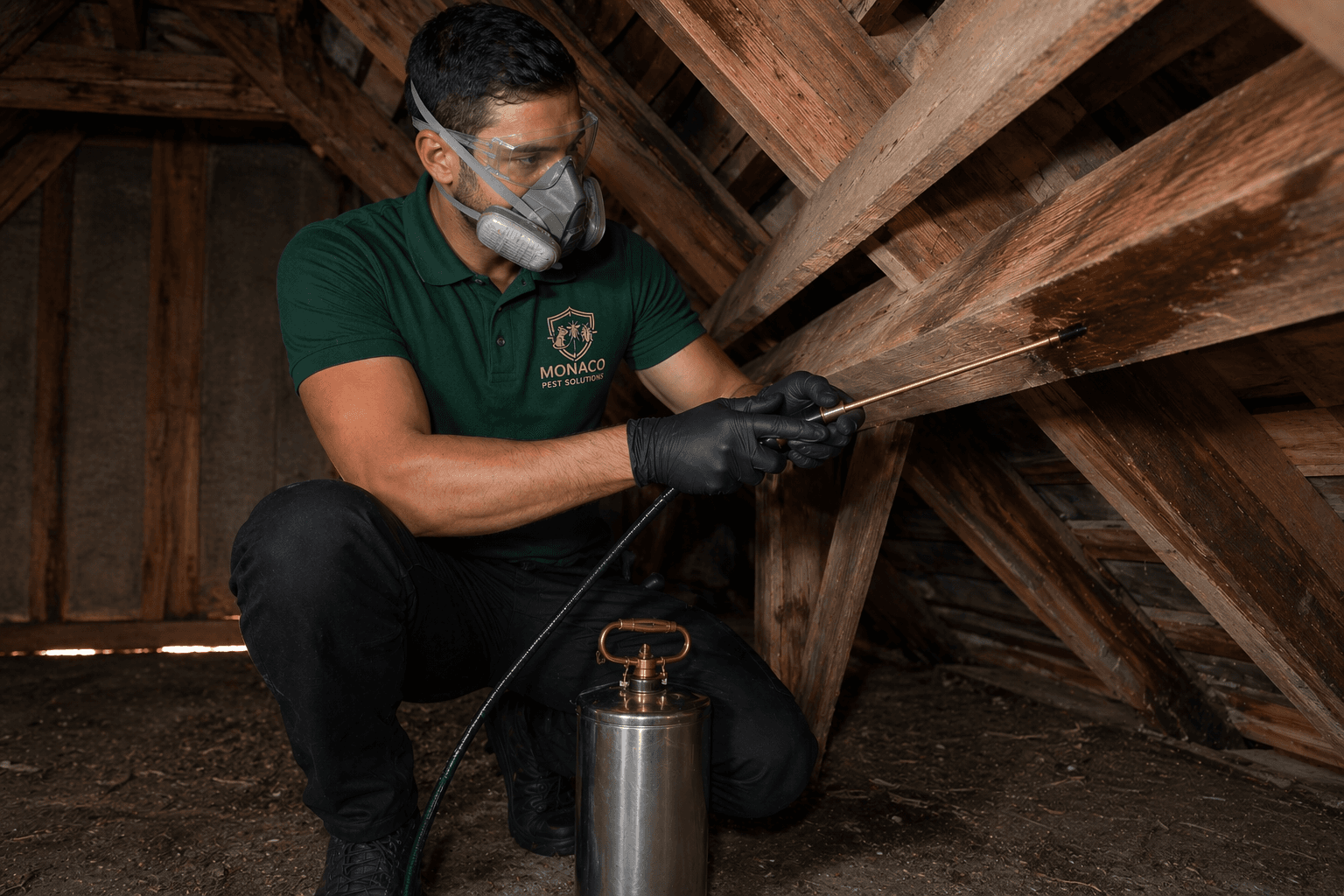
- Curative treatment: pressure injection into large-section timbers, then spraying of every accessible face with approved biocidal products. New replacement timbers receive a preventive treatment.
- Drying and ventilation: respecting the product's drying time and making sure the roof space is well ventilated, to keep the wood dry over time.
- Insulation and finishing: only at this stage, with inspection hatches so that the timbers can be checked later.
Mistakes that ruin a roof timber treatment
- Insulating or boarding before treating: once the insulation is in, the wood becomes inaccessible and the larvae carry on, sheltered.
- Treating before cutting back: the product mostly soaks into wood bound for the skip and barely reaches the sound timber.
- Spraying dusty timbers: the dust stops the product from penetrating.
- Ignoring damp: if the cause is not fixed, the furniture beetle comes back.
- Leaving offcuts in the roof space or storing them next to other timber.
- Treating only the visibly affected pieces: neighbouring timbers may hide invisible larvae.
Typical scenario: an early 20th-century villa
Take a common case on the Côte d'Azur. While stripping the tiles, the roofer notices wood dust on the rafters, and the insulation is due to be delivered the following week. The right sequence: postpone the delivery, have the timbers diagnosed, repair the leaking valley, let the carpenter replace the most weakened rafters, then cut back, treat, leave to dry and only then insulate. A few extra days of planning avoid having to reopen a finished ceiling a few years later.
How MPS works on your roof timbers
The on-site diagnosis is free: visual and acoustic inspection to detect larval activity, species identification, mapping of the affected areas. You then receive a personalised action plan, organised around your works schedule, and a detailed quote, free and without obligation. Wood treatment is carried out by our Certibiocide-certified technicians (certificate N121134) with approved biocidal products. At the end, the intervention report signed electronically, with photos, and the treatment certificate are available in your client area: useful documents for your insurer or for an audit. We work in villas, condominiums and buildings throughout the Principality and the Riviera, from Roquebrune-Cap-Martin to Nice.
Have the timbers diagnosed before the works start
The best time to call us is before the insulation arrives on site: as soon as the roof covering comes off, or at the first signs of wood dust. An early diagnosis sets the right order of works and saves you from reopening what has just been finished.
Request your free quote or call +377 37 70 70 02: reply within 6 hours.
Frequently asked questions
- Can roof timbers be treated once they are insulated?
- Treatment requires access to the faces of the wood: on insulated or boarded timbers, at least the affected areas have to be opened up. That is why, in a renovation, treatment comes before insulation.
- How can I tell whether the attack is still active?
- Pale dust that keeps falling, holes with clean edges or the sound of larvae in warm weather are signs of activity. The MPS diagnosis, with visual and acoustic inspection, is free.
- How much does a roof timber treatment cost?
- It depends on the species involved, the volume of wood, access and the extent of the attack: there is no answer without seeing the timbers. The on-site diagnosis and the detailed quote are free and without obligation: call +377 37 70 70 02.