July 28, 2026 · 13-minute read
Discreet pigeon-proofing of a Saint-Jean-Cap-Ferrat villa: protecting the stone without altering the facade
Cornices, roofs, loggias: on the Riviera capes, pigeons colonise the finest villas. Stone-coloured nets, made-to-measure stainless spikes, architect coordination and an annual contract: the method behind invisible, lasting pigeon-proofing.
The context: why this matters on the French Riviera
Between Nice and Menton, the capes concentrate some of the finest residences in Europe. Saint-Jean-Cap-Ferrat, Cap-Martin, Cap d'Antibes: three peninsulas where villas converse with the sea, where dressed-stone facades, carved balustrades, shaded loggias and old tiled roofs form an exceptional architectural heritage. And it is precisely this setting that pigeons have learned to colonise. Deep cornices, sheltered genoise eaves, warm gutters, an almost total absence of predators: a cape villa offers the feral pigeon everything a natural cliff once did — with the added bonus of properties that often stand unoccupied for part of the year.
The problem is twofold. On one side, very real damage: acidic droppings that eat into limestone, nests that block rainwater downpipes, parasites migrating from nests into attics, terraces rendered unusable. On the other, a constraint few trades know how to handle: on these villas, often protected or set within remarkable landscapes, the solution has to be invisible. Bristling a Belle Époque balustrade with visible hardware, or stretching a net that cuts across the perspective of a facade drawn more than a century ago, is simply not an option.
There is also a question of timing that owners rarely anticipate. The ideal window for a full pigeon-proofing campaign is late summer to late winter, after the main breeding season and before the first spring nesting attempts: the birds are less attached to the facade, the works do not disturb occupied nests, and the villa is protected before the next reproductive cycle begins. On seasonally occupied properties, this window conveniently coincides with the months when the owners are away — which is why so many of these projects are planned in autumn, run in complete discretion, and simply handed over as a fait accompli when the household returns in spring.
That is the whole point of discreet pigeon-proofing — heritage-grade bird control: protecting durably without disfiguring. Professional pigeon control on a prestige villa is never just a row of spikes: it is a complete technical project that begins with an ornithological and architectural survey, continues with devices selected cornice by cornice, and extends into an annual maintenance contract. This article details that method, from the behaviour of the urban pigeon to concrete field experience on a Cap-Ferrat villa.
Why pigeons choose the cape villas
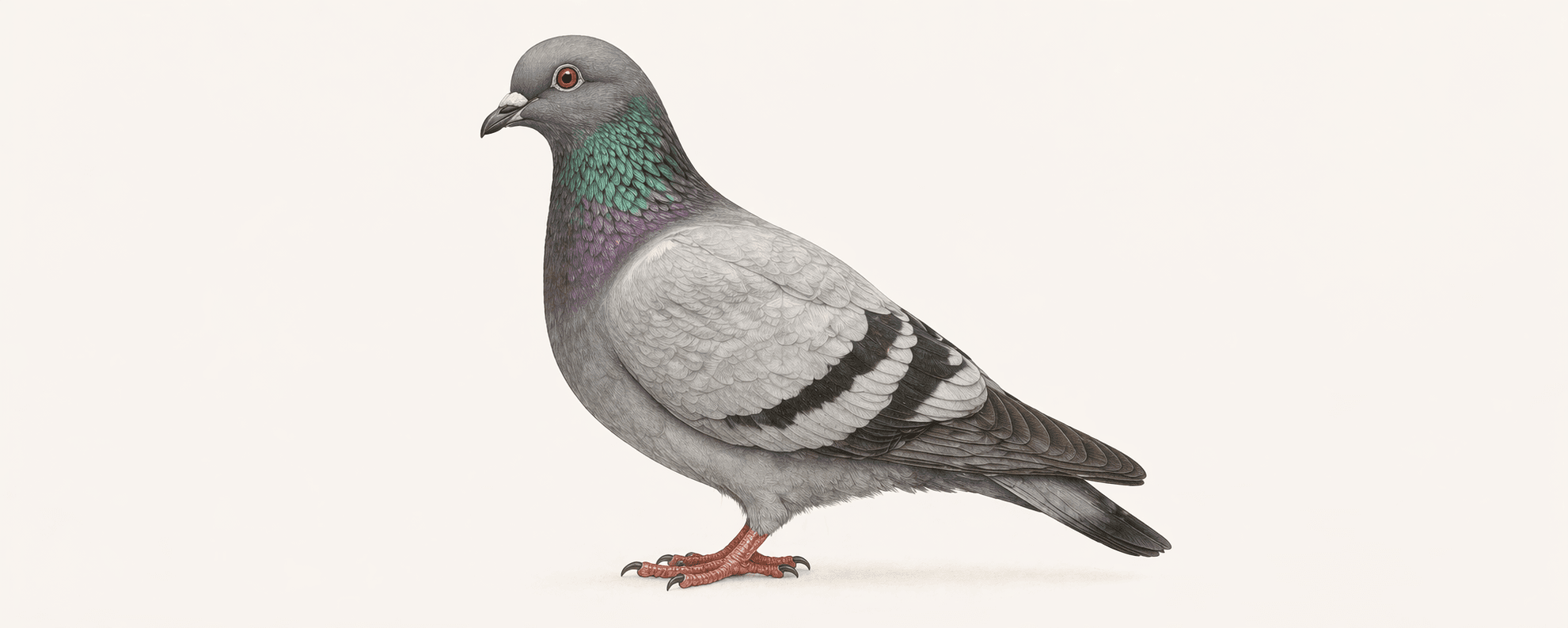
The rock dove is originally a cliff-dwelling bird: it nested in the crevices of coastal cliffs. A cape villa, with its moulded cornices, entablatures, niches and facade recesses, reproduces exactly that topography — only better. Stone releases the heat stored during the day, roof overhangs shelter from rain, and the Mediterranean vegetation of the gardens supplies twigs and nesting material at will.
Three factors make the Riviera's peninsulas an ideal habitat. First, the microclimate: on the capes it practically never freezes, and a pair of pigeons can raise six to eight broods a year instead of two or three in a continental climate, so colony growth is exponential. Second, the food supply: marinas, restaurant terraces, markets and irrigated gardens are minutes away by flight; the pigeon feeds elsewhere and returns to roost and nest on the villa. Third, tranquillity: many of these properties are occupied only a few months a year. A facade with no regular human presence, no shutters opening, no footfall on the upper terraces, is a perfect nesting site.
Add one decisive behavioural trait: philopatry. A pigeon returns to nest where it was born, and a pair stays faithful to its nesting site for years. A colonised villa therefore never empties spontaneously: the pioneer pair of year one becomes a dozen birds in year two and several dozen in year three. The longer one waits, the higher the pressure, and the more the damage silently accumulates — often out of sight from the garden.
Cornices, roofs, loggias: anatomy of a colonisation
On a cape villa, colonisation almost always follows the same vertical geography. At the very top, ridges and hips serve as lookout posts and daytime roosts: this is where you see the birds lined up in the sun. Just below, gutters, valleys and the backs of chimney stacks offer wind-sheltered nesting sites: nests there block rainwater flow, causing overflows and leaks into the attic.
Then come the moulded cornices and entablatures, the signature of Belle Époque villas: their ogee profiles create horizontal platforms protected by the overhang above, invisible from the ground. Provençal genoise eaves, with their courses of stacked tiles, form cavities the pigeons occupy to nest in the dry. Loggias and colonnades — open yet covered — become veritable dovecotes when the villa is unoccupied: floors speckled with droppings, soiled capitals, nests wedged behind the columns. To these, add the upper-floor window surrounds, roller-shutter boxes, rarely used sills, technical equipment on roof terraces — air-conditioning units, ventilation outlets — and finally the outbuildings: pool house, guest pavilion, garage, whose open roof frames are prime refuges.
The warning signs are simple: white vertical streaks below the cornices, twigs and feathers in the gutters, insistent cooing at dawn, the same birds shuttling back and forth to the same point on the facade. A professional survey maps these zones precisely and distinguishes nesting sites, where pressure is highest, from mere resting perches — because the technical response is not the same.
Droppings and dressed stone: how facades actually deteriorate
Pigeon droppings are not mere dirt: they are a chemically aggressive agent. Rich in uric acid, they attack the calcareous binder of the soft stone used on most Riviera villas. Under the combined effect of acidity, marine humidity and heat-cool cycles, the stone's skin disintegrates: the grain opens, the arrises of the mouldings soften, carvings lose their relief. Accumulated crusts of droppings hold moisture against the stone and encourage micro-organisms that blacken facades. On wrought ironwork — railings, canopies, lambrequins — the acidity accelerates corrosion, even on treated metals.
Indirect damage is often even more expensive. A gutter blocked by a nest overflows at the first autumn rain; water travels beneath the tiles, saturates the masonry, stains ceilings and can reach the roof timbers. Dry nesting material accumulated under tiles also creates a fire risk near flues. On marble or polished-stone terraces, droppings create slippery patches and rings that become ingrained if not treated quickly.
Finally, the health issue is real. Dried droppings release dust laden with micro-organisms that are potentially harmful to the airways, and nests harbour parasites — including bird-specific mites and bugs — capable of migrating into the attic and then the living areas once the young leave the nest. On a property where children and guests stay, and where staff tend terraces and gardens daily, an established colony is not a mere aesthetic nuisance: it is a genuine hygiene issue.
The classic mistake: spraying without a survey
Faced with the first soiling, the temptation is to order "a product": repellent gel on the sills, an ultrasonic scarer, a plastic raptor, reflective tape. These solutions almost always fail against an established colony, for one simple behavioural reason: philopatry. A pigeon that has nested on a cornice for two seasons will not be dislodged by a stimulus, however unpleasant. Sound and visual scarers produce a measurable effect for a few days, then habituation sets in; repellent gels run in the Mediterranean sun, stain the stone and lose effectiveness within weeks, while sometimes trapping small songbirds.
Our method starts from the opposite end: remove the cause before treating the symptom. The cause is not the bird's presence — it is the accessibility of nesting and roosting sites. The initial survey includes bird counts at morning and dusk, a map of soiled areas, an inspection of roofs and gutters, and a ranking of every point by observed pressure. That document determines, zone by zone, the appropriate device — and it is what guarantees that colonisation will not simply shift to a wing or outbuilding left unprotected.
Before any installation, colonised areas are cleaned and disinfected under a professional protocol: removal of nests and accumulations, vacuum extraction of dust under respiratory protection, detergent cleaning, disinfection and treatment against the associated parasites. Installing a device over old droppings would lock the health problem beneath the protection — and leave odours that keep attracting birds.
The discreet devices: stone-coloured nets and made-to-measure stainless spikes
The entire value of villa pigeon-proofing lies in choosing and installing devices the eye does not see. Four families cover almost every situation.
Stone-coloured netting is the answer for volumes: loggias, colonnades, light wells, facade recesses, balcony soffits. Unlike the black nets of urban buildings, we use mass-dyed mesh — sand, ivory, mineral grey — selected against the facade from physical samples, in the site's own light. Tensioned on a stainless perimeter cable with discreet fixings set into the joints, a well-matched net becomes invisible from about ten metres, from the garden as from the sea. It physically closes off the volume: the only genuinely permanent solution on an established nesting site.
Marine-grade stainless spikes (AISI 316, the only grade that withstands salt spray over time) treat the linear runs: cornices, entablatures, sills, wall copings. On a villa they are never installed "off the shelf": each row is cut to the exact width of the cornice profile, on a stainless or clear polycarbonate base, and bonded with neutral silicone — a reversible fixing, with no drilling into carved stone. Seen from the ground, correctly sized fine spikes disappear into the cornice's shadow line.
Spring-tensioned wires complete the system on balustrades, handrails and hips: two or three near-invisible stainless wires are enough to make perching uncomfortable on resting zones, with zero visual impact. Finally, roof protections — gutter guards, mesh closure of access points to attics and genoise cavities using recessed stainless mesh — seal the last refuges. On certain singular points, a low-intensity electric deterrent strip, installed as a discreet band, can complete the scheme. The combination is always site-specific: netting on nesting sites, spikes and wires on roosts, roof protection wherever water runs.
Working with the villa's architect: essential coordination
On a house of character, pigeon-proofing touches the building envelope; it is therefore run like a finishing-works package, in coordination with the villa's architect or the heritage architect who oversees the property. In practice this coordination covers five points. Marking up the drawings: every device is plotted on the facade elevations so the architect can validate positions before work starts. Colour selection: nets and fixings are approved from samples held against the stone at different times of day. Reversibility: on carved elements and exceptional stones, bonded fixings or fixings set into the joints are preferred so the protection can later be removed without a trace. Logistics: when the villa is being refaced or reroofed, installation is synchronised with the existing scaffolding — a substantial saving, and a facade treated in a single campaign. Documentation: a before/after photographic dossier is delivered to the owner and the architect, particularly useful when the property lies within a protected landscape where external appearance is regulated.
The same rigour applies to operational discretion, a strong expectation on the private estates of the Riviera: technicians in neutral clothing, unmarked vehicles on request, coordination with household staff and property managers, work scheduled outside occupancy periods. The neighbours on a cape have no need to know an operation is under way.
Field experience: a Cap-Ferrat villa protected without altering its silhouette
A recent project illustrates the approach, on a late-nineteenth-century villa on the Saint-Jean-Cap-Ferrat peninsula. The colony, established for around three years, numbered some thirty birds: nesting in the first-floor loggia and behind the genoise eaves of the west wing, roosting on the south facade cornices and the pool-house ridge. The west-wing gutters overflowed with every rain, and the cornice stone showed black streaks visible from the main drive.
The survey took two visits, with counts at dawn and dusk and a full roof inspection. The works themselves lasted eight days, carried out mostly on ropes to avoid heavy scaffolding on the parterres. Phase one: removal of nests, curative low-pressure mist cleaning of the stone, disinfection and anti-parasite treatment of the nesting zones. Phase two: an ivory-tinted net over the entire loggia, tensioned set back from the columns so as to remain invisible from the terrace; made-to-measure stainless spikes on the south cornices, cut to the ogee profile; tensioned wires on the roof-terrace balustrade and the pool-house ridge; stainless gutter guards and meshed closure of the genoise cavities.
The result showed within weeks: deprived of their nesting sites, the birds first multiplied attempts on the spiked zones, then left the property. At the three-month check: no nesting, no displacement to the outbuildings. At the one-year review: clean facades, devices still invisible from the garden — to the point that the owners, back for the summer, asked where the protections had been installed. That is precisely the definition of success on this type of project.
The annual contract: protection is managed over time
A successful pigeon-proofing project does not end at handover. By the sea, the devices live: wind tensions and slackens the cables, salt works on the fixings, a fallen branch can deform a net, and pigeon pressure in the area never disappears — it relocates. That is why the villas we equip are monitored under an annual contract, usually structured around two to four visits.
Each visit includes checking net tension and perimeter cables, verifying fixings and spike rows, replacing fatigued components, clearing gutters and their guards before the autumn rains, and inspecting the whole property — outbuildings included — to detect any early displacement of colonisation. A photographic report is sent after every visit to the owner or the property manager, enabling remote oversight for residences occupied only part of the year. The contract also includes priority call-out between scheduled visits: a net unhooked by a gust is refixed within days, before the birds can exploit the breach.
This follow-up is delivered by Certibiocide-certified technicians (No. 121134), trained in rope access, in the hygiene protocols applicable to droppings, and in the specific requirements of heritage residences. Continuity matters: on a villa, the same team returns, knows the access points, the house's codes of discretion and the history of every cornice.
The cost, compared with doing nothing
The rule is universal: the survey always costs less than the repair. On a cape villa it takes on a particular dimension, because what a colony degrades is difficult — sometimes impossible — to restore identically. Recutting a carved cornice eaten by years of droppings requires a stonemason; replacing corroded period ironwork, an ornamental metalworker; making good roof timbers damaged by a blocked gutter's leaks, a full roofing operation. At every step, the sums involved far exceed those of protection installed in time — not to mention the depreciation of an exceptional property whose facades are deteriorating, and the loss of use of terraces and gardens.
The rational trade-off is therefore simple. At the first signs — streaks under a cornice, regular cooing at dawn, twigs in a gutter — a survey measures the real pressure and scales a proportionate response: a few metres of spikes and two tensioned wires are sometimes enough, if action is taken before the first nesting. Beyond that stage, colony dynamics kick in and the scale of the work grows every season. Our team operates across all the Riviera capes, from Saint-Jean-Cap-Ferrat to Cap d'Antibes via Cap-Martin, and will travel to draw up a precise assessment of your property. The evaluation visit carries no commitment: request your free quote and protect your facades before the stone records the time you lost.
Frequently asked questions
- Can the anti-pigeon devices be seen from the garden or from the sea?
- No — provided they are correctly chosen and installed. Mass-dyed nets (sand, ivory, mineral grey) are approved from samples held against the facade and become invisible from about ten metres; fine stainless spikes, cut to the exact cornice profile, disappear into its shadow line; tensioned wires on balustrades are barely perceptible. On our villa projects, the acceptance criterion is precisely that nothing is noticeable from the usual viewpoints: drive, terraces, garden and sea.
- Can protection be installed on a period villa or a carved stone facade?
- Yes — provided reversible fixings are used: spikes bonded with neutral silicone on stainless or polycarbonate bases, net cables anchored in the joints rather than the stone, wires on discreet brackets. No drilling is done into carved elements. The layout is plotted on the facade elevations and validated with the villa's architect before work starts, and a before/after photographic dossier documents everything — allowing traceless removal if ever required.
- How long do stainless spikes and nets last by the sea?
- In a marine environment only marine-grade materials endure: AISI 316 stainless for spikes, cables and fixings, and UV-stabilised, mass-dyed nets. Correctly installed, these devices remain effective for around ten years and often longer. The key factor is maintenance: wind, salt and falling branches stress the installations, and it is the annual check — net tension, condition of fixings, clearing of gutter guards — that guarantees the real service life.
- Why aren't repellents, ultrasound and scarers enough?
- Because of philopatry: a pigeon returns to nest where it was born, and a pair stays faithful to its site for years. Sound or visual scarers work for a few days before habituation sets in; repellent gels run in the sun, stain the stone and lose effectiveness within weeks. Against an established colony, only physically removing access to nesting and roosting sites — nets, spikes, tensioned wires, roof protection — produces a lasting result.
- Do pigeon droppings really damage stone, and are they a health risk?
- Yes, on both counts. Chemically, uric acid attacks the calcareous binder of soft stone: the grain opens, mouldings soften, facades blacken and ironwork corrodes faster. Health-wise, dried droppings release dust laden with micro-organisms potentially harmful to the airways, and nests harbour parasites capable of migrating into attics and then living areas. That is why every project starts with professional cleaning, disinfection and anti-parasite treatment before the protections are installed.
- What does the annual villa pigeon-control contract include?
- It is scheduled monitoring, usually two to four visits a year: checking net and cable tension, verifying fixings and spikes, replacing fatigued components, clearing gutters before the autumn rains and fully inspecting the property, outbuildings included, to detect any displaced colonisation. Every visit produces a photographic report sent to the owner or property manager, and the contract includes priority call-out between visits — useful after a windstorm. The service is delivered by Certibiocide-certified technicians (No. 121134).