July 13, 2026 · 15-minute read
Cockroaches in Monaco Restaurants: the Complete HACCP Protocol
Roaches in your professional kitchen in Monaco? HACCP-compliant gel-injection protocol, total discretion during service, audit-ready documentation.
A single cockroach spotted by an auditor at the wrong moment can be enough to tip a health inspection. For a restaurant in Monaco, the stakes are not merely regulatory: they are reputational. In a Principality with one of the highest densities of fine-dining establishments per square metre in the world, where kitchens sometimes run two services plus overnight room service, the slightest rumour of an infestation spreads faster than the roaches themselves.
The cockroach problem in Monaco restaurants has well-identified structural causes: constant heat from stoves and dishwashing stations, residual humidity, daily deliveries of goods, technical ducts shared between neighbouring establishments, and older buildings with interconnected networks. A professional kitchen offers cockroaches exactly what they are looking for: water, food, warmth and crevices that even the most rigorous daily cleaning cannot reach.
The good news: a cockroach infestation in a professional kitchen can be treated without closing the establishment, without odour and without interrupting service, provided a structured, documented protocol is applied. That is precisely what the HACCP approach expects of you: not the theoretical absence of all pests, but proof that the risk is under control, with a monitoring plan, corrective actions and full traceability. This article details the professional-kitchen cockroach protocol we apply in the Principality's restaurants, from species identification through to the exportable file you will confidently hand to the inspector at your next audit.
HACCP and Pests: What the Method Actually Requires
The HACCP method (hazard analysis and critical control points) is the foundation of food safety in catering. It rests on a simple principle: identify biological, chemical and physical hazards, then demonstrate that they are controlled at every stage, from goods reception to plating. Pests, and cockroaches first among them, fall under prerequisite hygiene programmes: without a credible pest-control plan, the entire food safety management system wobbles.
In practice, an auditor or inspector expects four things from your establishment. First, a formalised pest-control plan: who intervenes, how often, with which products, in which zones. Second, a map of control points: the location of monitoring traps, bait stations and sensitive areas. Third, dated records: every visit must leave a written trace, with observations, any captures and the actions triggered. Finally, proof of the contractor's competence: applicator certification, safety data sheets for the products used, registration numbers.
What the HACCP approach does not demand is instant perfection. A restaurant that discovers cockroaches and immediately launches a documented protocol with a certified professional is in a defensible position. A restaurant that sprays a supermarket aerosol the night before the inspection, with no traceability whatsoever, is not. In an auditor's eyes, the difference between those two situations is the difference between a corrected minor non-conformity and a suspension of activity. Our role is to keep you, at all times, on the right side of that line.
German or Oriental Cockroach: Identify the Enemy Before Striking
Not all cockroaches are fought the same way, and confusing the species leads to ineffective treatments. Two species dominate professional kitchens on the Riviera.
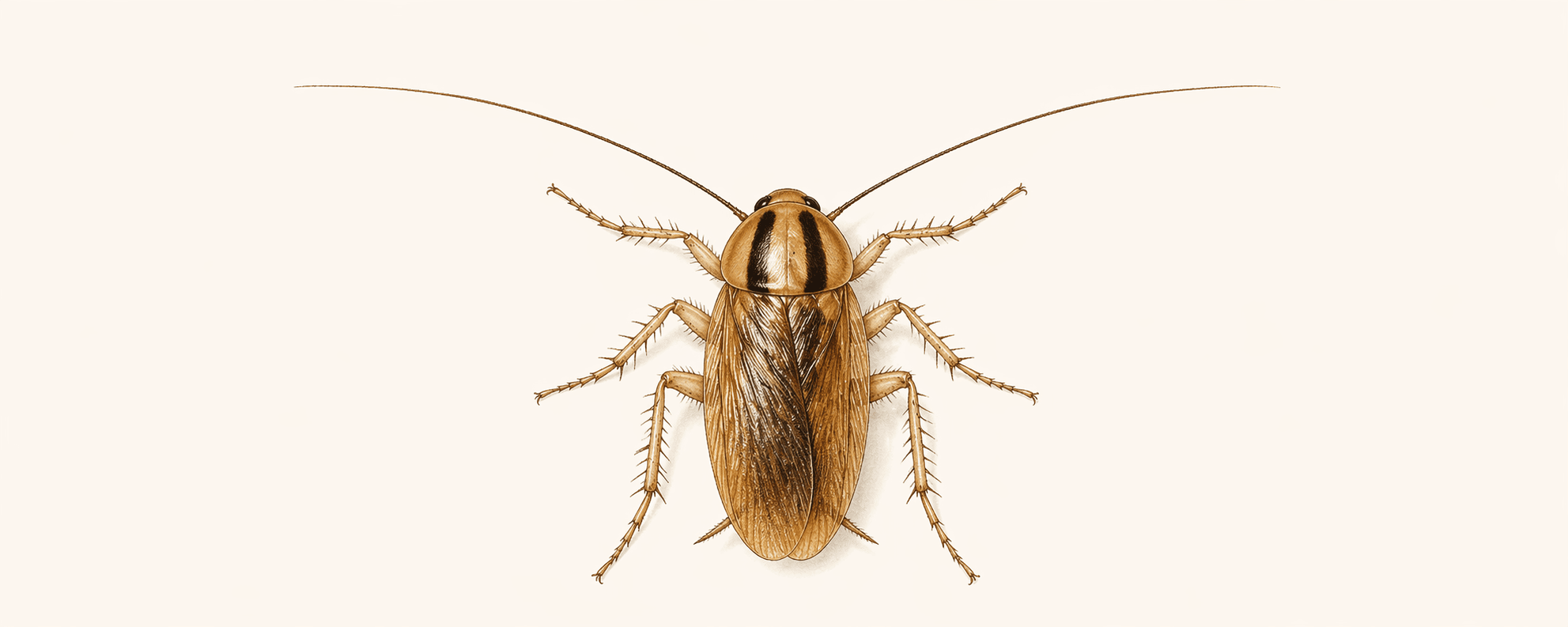
The German cockroach (Blattella germanica) is by far the most common in catering. Small (12 to 15 mm), light brown with two dark stripes behind the head, it lives exclusively indoors, as close as possible to heat and humidity: refrigerator motors, undersides of dishwashers, worktop joints, electrical panels, coffee machines. Its reproductive cycle is formidable: a female carries her ootheca until hatching, which shields the eggs from most treatments, and a single female can generate tens of thousands of descendants in a year. If you see German cockroaches in broad daylight, the hidden population is already substantial: each visible individual is estimated to represent many more concealed ones.
The Oriental cockroach (Blatta orientalis), larger (20 to 28 mm), dark brown to black, prefers cool, damp areas: cellars, storerooms, floor drains, sewer access points, refuse rooms, technical ducts. It readily climbs up through pipework and often signals a sealing problem in the drainage network rather than an infestation of the kitchen itself. Slower to reproduce than the German species, it is also more cold-resistant and colonises the basements of the Principality's older buildings.
Species diagnosis determines the entire strategy: the German cockroach is treated inside the kitchen, with gel applied into micro-cracks; the Oriental is treated upstream, in networks and basements, with work on entry points. Treating one with the other's strategy means losing weeks. Our dedicated cockroach and roach control page details the identification criteria with photos.
Cross-Contamination: Why a Cockroach Is Never a Mere Nuisance
In a professional kitchen, a cockroach is not a cosmetic problem: it is a mechanical vector of cross-contamination. A cockroach travels at night between the pot-wash drain, the refuse room, sewer access points and your worktops. Along the way, it carries pathogenic bacteria on its legs, antennae and abdomen: salmonella, staphylococci, coliforms, as well as mould spores. It contaminates everything it touches: cutting surfaces, stored utensils, poorly protected foodstuffs, cold-room door seals.
Add to that droppings and moults. Cockroach faeces, the characteristic black specks found in corners, on hinges and behind equipment, contain powerful allergens, documented as aggravating factors in asthma and implicated in cross-reactive food allergies. Shed skins (exuviae) fragment into particles that settle on preparation surfaces. Finally, cockroaches mark their territory with aggregation pheromones with a characteristic acrid, oily smell: in an advanced infestation, this odour permeates cupboards and can taint dry goods.
The link to HACCP is direct: the cockroach turns clean surfaces into contaminated ones after the end-of-service clean-down, precisely during the overnight window when nobody is watching. That is why a cleaning plan alone, however strict, is never enough against an established population: the insect's biological cycle must be broken. A cloth wiping a soiled worktop during morning mise en place can then spread the contamination across an entire cold-preparation line: this is the textbook cross-contamination scenario auditors fear most.
The Classic Mistake: Spraying Without a Diagnosis
Faced with the first cockroaches, the most widespread and most counterproductive reflex is to spray an aerosol insecticide around the kitchen. In professional catering, this mistake is costly three times over.
First, the aerosol scatters the colony instead of destroying it. The pyrethroids in consumer spray cans have a repellent effect: the surviving cockroaches, meaning the vast majority, hidden in ducts and motors, flee the treated zone and found new harbourages in adjacent rooms, changing rooms, the dining room, or even the business next door. A localised infestation behind the pot-wash becomes a problem spread across the whole establishment.
Second, spraying in a kitchen creates a chemical hazard incompatible with food safety: insecticide deposited on food-contact surfaces, contamination of unprotected foodstuffs, and the need for a complete re-clean before production can resume. You add a chemical hazard to the existing biological one, and an auditor will flag it.
Third, aerosols make subsequent professional treatment harder: cockroaches exposed to sub-lethal doses of pyrethroids develop an aversion to treated areas and a bait-shyness that temporarily reduces the effectiveness of gel baits. We then have to adapt the bait matrices and extend the protocol.
Our method starts at the exact opposite of spraying: with a silent diagnosis. Before any treatment, we seek to understand where the insects come from, where they shelter, what they feed on and how they move. We do not treat a symptom: we dismantle a system.
Our Four-Stage Gel-Injection Protocol
The professional-kitchen cockroach protocol we deploy in Monaco follows four phases, each documented and compatible with continued operation.
Stage 1: inspection and mapping (day 1). A certified technician inspects the establishment outside production hours: kitchen, pot-wash, storerooms, cold room (seals and motors), refuse room, technical ducts, false ceilings, floor drains. We use sticky detection traps and an inspection lamp to locate traces (droppings, oothecae, shed skins). The deliverable is a map of the infestation: species identified, harbourages located, travel routes, entry points, with time-stamped photos.
Stage 2: targeted gel-injection treatment (days 1 to 3). The heart of the protocol is the application of baited insecticide gel in micro-dots, using a precision syringe, directly into cracks, hinges, cable runs and equipment gaps, in other words where the cockroaches live, and never on food-contact surfaces. The gel works by domino effect: cockroaches consume the bait, return to their harbourage, die there, and are eaten by their fellows (necrophagy and coprophagy), who are poisoned in turn. The cascade effect reaches individuals that never emerge, including larvae. No evacuation of the premises, no re-entry delay, no odour: the kitchen can produce that very evening.
Stage 3: treating networks and barriers (depending on diagnosis). If Oriental cockroaches are climbing up from the basements, we add a treatment of access shafts, ducts and plant rooms, together with sealing recommendations: drain grilles, sealing of cable penetrations, skirting joints. Without this work on access routes, a treated kitchen gets recontaminated from the building.
Stage 4: control, monitoring and consolidation (weeks 2 to 6). A second visit verifies the population drop on the sentinel traps, renews the gel at still-active points and neutralises hatchlings from oothecae, which are unaffected by the first treatment. A permanent monitoring network is then maintained: it is what feeds your HACCP file over time.
Coordinating with the Chef: Treating Without Disrupting Service
A professional kitchen is not an apartment: you do not intervene there at just any time, or in just any manner. The success of a protocol in catering depends as much on coordination with the brigade as on the chemistry of the gel.
In practice, every intervention is scheduled with the chef or operations manager during the establishment's dead slots: between the end of the night clean-down and goods reception, during the afternoon break, or on the weekly closing day. Our technicians work in unmarked clothing, with no sign-written vehicle parked outside the entrance, and can use the delivery access. Neither the guests in the dining room nor the delivery drivers are aware of the nature of the intervention. This discretion is not a luxury: in Monaco, where word travels fast, it is an integral part of the service.
Coordination also covers the brigade's own actions. We give the chef a short list of instructions compatible with the protocol: do not clean the gel points (discreetly marked), report any sighting of a live cockroach with zone and time, keep dry goods in closed containers during the attack phase, and above all use no insecticide aerosols, which would ruin the baiting. In return, the team's observations, from people who know their kitchen better than anyone, refine our mapping: a kitchen porter who sees a cockroach emerge from a motor at 11 pm saves us days of diagnosis.
Finally, we synchronise with your other contractors: the existing cleaning plan and rodent-control plan are integrated into the file so the auditor sees one coherent system, with no grey areas between providers. If cockroaches are discovered a few days before a scheduled audit, our 24/7 emergency service can trigger the inspection and the first application within the shortest possible time.
Exportable Documentation: Your File Ready for the Health Inspection
Where pests are concerned, what is not written down does not exist in an auditor's eyes. That is why every protocol we run in catering produces, visit after visit, a structured, up-to-date and exportable file that you can hand over as-is during a health inspection or an internal HACCP audit.
This file includes: the establishment's floor plan with the numbered location of every bait station and monitoring trap; dated, signed intervention reports, with observations, recorded activity levels and actions taken; the safety data sheets and technical sheets for every product applied; the applicator's Certibiocide certification (No. 121134) and the company's Monaco trade register entry (RCI Monaco 26S10394); trend curves from the monitoring, which materialise the population's decline and then its maintenance at zero; and the structural recommendations (sealing, maintenance, storage) with their implementation status.
This last point deserves emphasis: a file that also documents structural corrective actions, sealing work completed, drain grille fitted, cold-room seal replaced, demonstrates to the auditor a logic of continuous improvement, which is exactly the spirit of HACCP. Conversely, visit reports with no follow-up on recommendations signal a box-ticking arrangement.
The file is available in digital form, exportable on request, and as a paper binder kept on site if you prefer: during an unannounced inspection, the head chef must be able to present it in under a minute, without depending on the availability of the office or head-office staff. We train your team in presenting it: knowing how to show a baiting plan and a monitoring curve changes the tone of an inspection.
Field Experience: What We See in Monaco's Restaurant Sector
Several years of interventions in the Principality's kitchens, from neighbourhood counters to gastronomic tables, reveal constants every restaurateur should know.
First observation: the infestation rarely originates in the kitchen's own hygiene. In the majority of cases we treat, cockroaches arrive via two vectors: deliveries (cardboard boxes and crates, whose corrugations shelter oothecae) and the buildings' common areas (technical ducts, refuse chutes, basements). Kitchens with impeccable cleaning get colonised by the building's structure. The practical consequence: unpacking deliveries outside the kitchen and removing cardboard immediately is one of the most cost-effective preventive measures there is.
Second observation: basement configurations, common in Monaco where land constraints push kitchens underground or half-underground, including in Belle Époque style buildings with ageing networks, combine the favourable factors for both species: equipment heat for the German cockroach, network humidity for the Oriental. These kitchens require denser monitoring and more extensive sealing work.
Third observation: seasonality. The activity peaks we record follow the operating peaks: the summer high season, the Principality's major events, periods when kitchens run flat out with multiplied deliveries and reinforced teams. It is precisely when you have the least time that the risk is highest, one more argument for a prevention contract rather than crisis treatment. For an overview of the first steps in an emergency, see our guide on what to do urgently about cockroaches in Monaco.
Final observation, and the most encouraging one: treated early and by the book, a German cockroach infestation in a professional kitchen is brought under control without closure in almost every case, with a visible drop in trap activity within the first days.
Continuous Prevention: a Monitoring Contract Rather Than Crisis Treatment
The difference between a restaurant that suffers cockroaches and a restaurant that never sees one is rarely down to luck: it comes down to having a permanent surveillance system. That is also the deep logic of HACCP: controlling a hazard is a continuous process, not a one-off intervention.
A monitoring contract in catering rests on regular visits, at a frequency suited to the establishment's sensitivity, typically monthly for a professional kitchen and tightened in high season. At each visit: reading of the sentinel traps, inspection of sensitive zones, preventive renewal of gel points in technical areas, update of the documentation file. Between visits, a direct line lets the brigade report any sighting, triggering an interim visit if needed.
The benefit is threefold. Sanitary: an introduction of cockroaches via a delivery is detected on the traps and neutralised before it becomes a colony, often before the team's first visual sighting. Regulatory: your pest-control plan exists permanently, with a history of records that constitutes the best possible evidence before an auditor, including for the voluntary certification schemes that high-end establishments pursue. Operational: you leave the crisis mindset, of emergency interventions the night before an audit, and enter a maintenance mindset, planned around your dead slots.
Monitoring also includes an advisory component: adjusting storage points, choosing equipment that limits harbourages (solid worktop legs, siliconed joints), cardboard management, drain maintenance. Year after year, the kitchen becomes structurally less hospitable to cockroaches, reducing dependence on treatments.
Why Monaco Pest Solutions for Your Establishment
Pest control in catering cannot be improvised: it demands simultaneous mastery of the insect's biology, the constraints of a kitchen in production and the documentary expectations of an audit. That triad is what structures our offering for the Principality's restaurants.
Our applicators hold Certibiocide certification (No. 121134) and the company is registered in Monaco (RCI Monaco 26S10394): your HACCP files rest on verifiable, local credentials you can present to an auditor without reservation. Our kitchen protocols rely on targeted gel-injection and monitoring, never on volume spraying: no evacuation, no re-entry delay, no possible contact between product and foodstuffs. We work within your time slots, in unmarked clothing, with total discretion towards your guests and your neighbours.
Finally, our Monaco base gives us what cannot be replaced: knowledge of the Principality's buildings, their networks, their underground kitchen configurations, and the ability to be on site quickly, including via our 24/7 emergency line when an audit is approaching or a harbourage has just been discovered mid-service.
If you have seen cockroaches in your kitchen, or if your next inspection is approaching and your pest-control plan needs strengthening, the first step is simple: a confidential, no-obligation diagnostic inspection. Request your free quote: we respond quickly, and your establishment can be mapped, treated and documented within a few days, without closing a single service.
Zones served in Monaco and on the Riviera
Frequently asked questions
- Can cockroaches be treated without closing the restaurant?
- Yes, in almost every case. The gel-injection protocol is applied in micro-dots inside cracks and technical gaps, never on food-contact surfaces: it requires no evacuation, no re-entry delay and no full re-clean. Interventions are scheduled during your dead slots (afternoon break, closing day, after the night clean-down) and the kitchen can produce that very evening. Only massive infestations with harbourages inside equipment that must be dismantled may require temporarily taking one station offline, and very rarely the whole kitchen.
- Is a single cockroach seen in the kitchen already an infestation?
- Treat it as one until proven otherwise. The German cockroach is nocturnal and light-averse: an individual visible in the daytime usually signals an already large hidden population, because saturated harbourages push insects out into the open. Conversely, an isolated Oriental cockroach near a floor drain may just be a one-off rise from the sewer. Only an inspection with monitoring traps can distinguish a recent introduction from an established colony, and that distinction determines the scale of the protocol.
- How long does it take to eliminate cockroaches from a professional kitchen?
- The drop in activity is visible on the traps within the first days after the gel is applied, and the bulk of the population is eliminated within two to three weeks. However, allow four to six weeks for consolidated eradication: oothecae are not reached by the initial treatment, and the hatchlings must be neutralised at the follow-up visit. That is why any serious protocol includes at least two visits, followed by monitoring that confirms the population is held at zero over time.
- Does anti-cockroach gel pose a risk to food or guests?
- No, when applied according to professional rules. The gel is deposited in micro-dots with a syringe into cracks, hinges and technical gaps, areas by definition out of contact with foodstuffs and out of reach of hands. It releases no vapour or odour, requires no evacuation and stays in place without dispersing, unlike spraying. Every product used is covered by a safety data sheet included in your HACCP file, and the applicator holds Certibiocide certification.
- Which documents must I be able to present during a health inspection?
- At a minimum: the formalised pest-control plan, the establishment's floor plan with the numbered locations of bait stations and monitoring traps, dated and signed intervention reports, the safety data sheets of the products applied, and proof of the contractor's competence (applicator certification, company registration). A history of readings showing the population trend and the follow-up of structural recommendations greatly strengthens the file. We supply the whole set in exportable form, updated at every visit.
- How can I prevent re-infestation via deliveries or the building?
- Three habits do most of the work. Unpack deliveries outside the kitchen and remove cardboard boxes and crates immediately: their corrugations shelter oothecae. Have the access routes from the common areas sealed: grilles on floor drains, sealing of cable and pipe penetrations, skirting and duct joints. Finally, maintain a network of monitoring traps checked regularly: any introduction is then detected and neutralised before it becomes a colony, often before your team's first visual sighting.