July 10, 2026 · 12-minute read
Cockroach problem in Monaco: what to do in an emergency?
A cockroach problem in Monaco? Here are the emergency steps to take, the real timelines and the pro no-dispersal protocol to regain control fast.
A cockroach problem in Monaco: the first 5 actions within 24 hours
A cockroach problem in Monaco is never solved by crushing the insect spotted under the sink. A cockroach darting toward a baseboard when you switch on the light, peppery droppings at the back of a drawer, a persistent sweetish smell behind the dishwasher: discovering a cockroach rightly triggers an emergency reflex. Whether the problem concerns an open restaurant kitchen in Larvotto, an apartment in Fontvieille or a shared cellar in La Condamine, the emergency response always follows the same logic: deprive the insect of resources, document, then treat without dispersing. Here are the five actions to take immediately, before even dialing a number.
- Remove accessible food. Store fruit, bread, flours, dry goods and pet kibble in airtight containers of glass or rigid plastic. Empty the bin under the sink and clean greasy residue behind the hobs and under appliances. A German cockroach survives on crumbs a human eye cannot see.
- Do not spray anything. This is the most important and most counter-intuitive emergency instruction. An over-the-counter aerosol disperses the colony, pushes individuals toward neighboring units and durably complicates professional treatment. Leave the insects in place.
- Photograph the activity zones. Warm, humid corners, the backs of appliances, tile joints, service ducts: each shot helps our technician map the harborage. Note where and at what time you observe the insects.
- Isolate moisture sources. Wipe up condensation, repair a leaking seal, do not leave standing water in saucers or trays. The cockroach needs water far more than food.
- Call a certified operator. In Monaco, treatment must be carried out by a professional holding the Certibiocide certification (Monaco Pest Solutions: Certibiocide N°121134, RCI Monaco 26S10394). A call to +377 37 70 70 02 triggers an assessment the same day.
These five actions stabilize the situation without worsening the risk of dispersal. They give you the essential thing when facing the problem: diagnostic time. The sooner you call about a cockroach problem in Monaco, the shorter the treatment will be and the lower its total cost. The first twenty-four hours determine whether the harborage stays local or starts spreading through the building.
One cockroach spotted = how many unseen? Reading the infestation
Facing a cockroach problem in Monaco, the insect you see is only the tip of the colony. Cockroaches are photophobic: more than ninety percent of their activity takes place at night, hidden in warm, dark crevices. Spotting a cockroach in broad daylight, on a lit worktop, is not trivial: it is often the sign of an already dense population, where competition for hiding spots pushes some individuals out into the open.
The field ratio is telling: for one visible cockroach, one can reasonably estimate about ten individuals concealed in ducts, cavity walls and behind appliances. In Monaco, a daytime sighting can therefore correspond to several dozen insects already established.
The reproduction speed turns an incident into an emergency. The female German cockroach carries an ootheca — an egg capsule — containing sixteen to forty eggs, which she keeps until hatching. The full cycle, from egg to reproducing adult, closes in about forty days in the warm conditions of a kitchen. A single founding female can, within a few months, generate several overlapping generations. This is why a problem treated too late costs far more than an emergency response at the first signs.
Signs that should alert you:
- Fine, black droppings resembling ground pepper, in drawers and along joints.
- Empty ootheca casings, translucent moults abandoned near hiding spots.
- Persistent sweetish smell when the population becomes dense.
- Sighting of an insect in full light: an indicator of an already established colony.
In Monaco, the density of the building stock, continuous heating and the shared service ducts accelerate the shift from a discreet harborage to a widespread infestation. This is why, at the very first cockroach spotted, it is wise to treat the find as an alarm signal rather than an isolated case, and to launch the diagnosis without delay.
Three species to know in the Principality
The Principality mainly encounters three commensal cockroach species. Confusing them leads to treatment errors: each has its hiding spots, its way of moving and its sensitivity to baits.
The German cockroach (*Blattella germanica*)
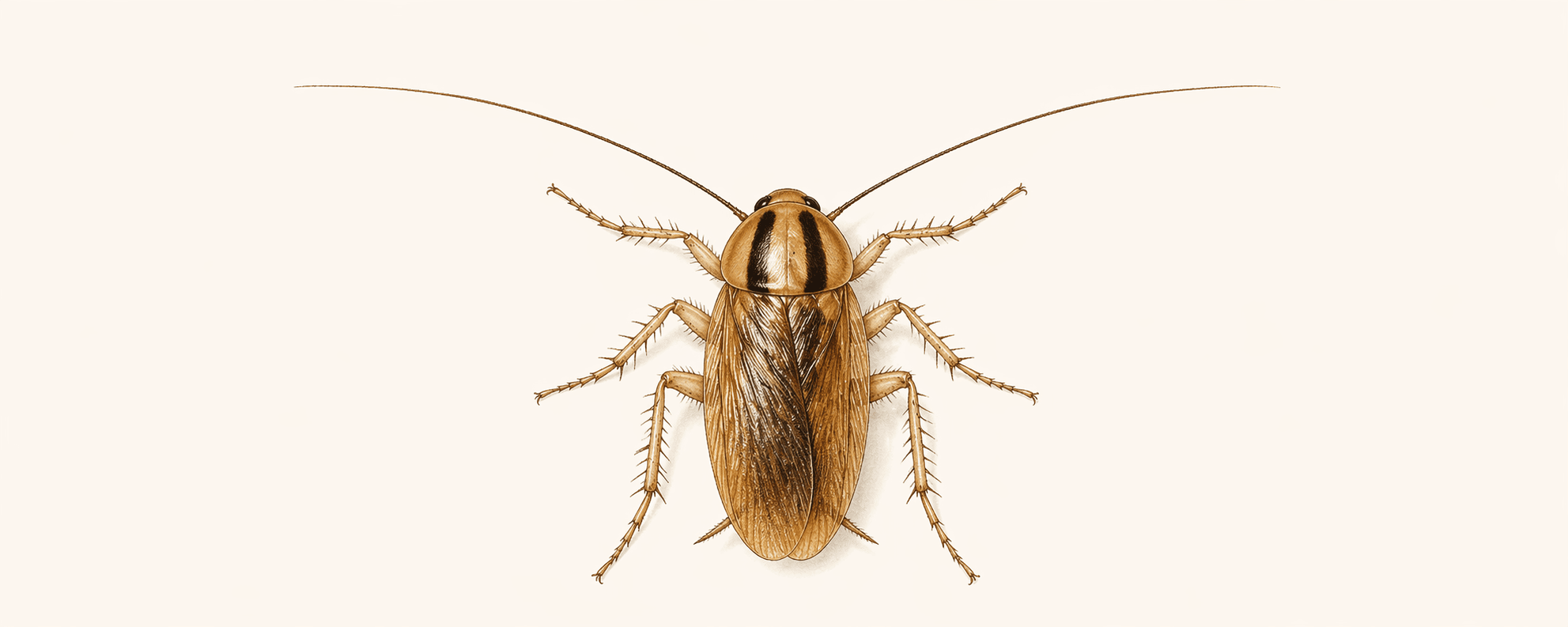
This is the dominant and most difficult species in Monaco, omnipresent in the Principality's homes and food service. Small, light brown, marked by two dark bands on the pronotum, it seeks heat and humidity: it thrives between twenty-five and thirty-three degrees, in a humidity of sixty-five to eighty-five percent. Its ootheca contains sixteen to forty eggs, carried until hatching, and its cycle closes in about forty days. It colonizes kitchens, the backs of ovens, dishwashers and refrigerators, service ducts and warm crawl spaces. Its reproduction speed and its ability to migrate from one unit to another make it the heart of most emergency interventions in the Principality.
The oriental cockroach (*Blatta orientalis*)
Larger, very dark brown to black, glossy in appearance, it is less agile and tolerates cool and damp conditions better. It is found in cellars, basements, technical rooms, drainage inspection chambers and the lower zones of buildings. In Monaco, it frequently appears in the shared cellars of older buildings and climbs up through drainage networks.
The American cockroach (*Periplaneta americana*)
The most imposing of the three, reddish-brown, capable of short flights. It favors the warm, humid environments of sewage networks, sewers, waste chutes and pipes. In the Principality, it transits through collectors and damp ducts before emerging in common areas or technical rooms.
A field diagnosis identifies the dominant species from droppings, oothecae and pathways — an essential condition for choosing the right strategy. An error in identifying the species leads to the wrong bait choice and the loss of precious weeks during which the colony keeps growing.
The real risks: health, HACCP, image
A cockroach problem not treated as an emergency never stays contained: the population grows fast and the consequences accumulate on three fronts.
Health risks. Cockroaches travel from pipes and soiled areas to preparation surfaces. They passively carry pathogens, including salmonella (Salmonella), and can be the source of cross food contamination. Their droppings, moults and secretions are recognized allergens, liable to aggravate asthma and skin reactions, particularly in children. They also carry dermatophytes responsible for fungal infections. A dense population in a kitchen is enough to turn an incident into a real health risk. In the Monegasque context, where restaurant kitchens run under heavy load, this risk quickly becomes a direct threat to customers and staff.
HACCP risks. For a food service establishment in Monaco, the presence of cockroaches constitutes a major non-conformity with regard to European food hygiene regulations and hazard control principles. An observation during an inspection by the Monegasque health authorities can lead to immediate corrective measures, or even a temporary closure while conformity is restored. The traceability of pest control operations then becomes a piece of the hygiene file.
Image risks. In the Monegasque context, where clientele is demanding, a single cockroach spotted in the dining room by a customer triggers a complaint, an unfavorable public review and a lasting loss of trust. For a restaurant, a hotel or an upscale residence, the damage to reputation often exceeds the material cost of the problem. This is why the discretion and speed of the intervention matter as much as its technical effectiveness.
Why consumer spraying always fails
Faced with the first cockroach, the temptation is to spray an over-the-counter insecticide. This is, in almost all cases, a bad response that worsens the problem.
Spraying only reaches a fraction of the colony. An aerosol reaches at best the fifteen to twenty percent of individuals exposed in the open at the moment of treatment. The rest of the population, hidden in ducts and cavity walls, is never reached. The colony rebuilds within a few weeks from the survivors.
Oothecae are protected. The egg capsule of the German cockroach is barely permeable to contact insecticides. Even spraying that kills adults leaves the oothecae intact: a new generation then hatches, relaunching the infestation despite the initial impression of success.
Spraying causes migration. The repellent effect of an aerosol disperses cockroaches fleeing the treated zone. In a Monaco building with shared service ducts, this dispersal translates into an inter-unit migration within forty-eight hours: the problem of the treated apartment becomes that of the neighbor, then of the floor. This is the mechanism by which a localized infestation spreads to an entire co-ownership.
A professional response proceeds the opposite way: no repellency, but baits that the insects carry back to the heart of the harborage. This is the only logic that treats the entire colony, oothecae included, without dispersing it.
The Monaco Pest Solutions intervention protocol in 4 steps
Our response to a cockroach problem in the Principality follows a four-step protocol, calibrated for emergency and adapted to the Monegasque building stock, where shared service ducts require a building-scale vision.
Step 1 — Endoscopic diagnosis and monitoring (day 0). A certified technician comes out on an emergency basis. Using an endoscopic camera, he inspects the voids inaccessible to the eye: the backs of appliances, ducts, cavity walls, false ceilings. Monitoring sticky traps are placed at strategic points to measure density, identify the dominant species and locate active harborages. A visual report is provided.
Step 2 — Gel bait at application points. Treatment relies on deposits of gel bait placed as close as possible to the hiding spots, never sprayed. The active ingredient is chosen according to the strain and context: indoxacarb, hydramethylnon or fipronil. These baits exploit a decisive mechanism: the contaminated cockroach returns to the harborage, dies there, and the post-mortem cannibalism of its fellows spreads the active ingredient to individuals that never came into direct contact with the gel. The effect thus reaches the colony in depth, without causing dispersal.
Step 3 — Follow-up over three to six weeks. One to three control visits allow us to check the sticky traps, renew the gel points and adjust the strategy until the measured extinction of activity. The threshold of zero capture over two consecutive passes validates neutralization.
Step 4 — Co-ownership coordination. When service ducts are shared, treatment limited to one unit is not enough. We coordinate the intervention with the building manager to simultaneously treat the connected units, a condition for a durable result in a Monaco building.
The whole is covered by a commitment to discretion: technician in neutral attire, unmarked vehicle on request.
How long to recover a clean site: realistic timing
This is the first question on the phone. Here are the honest benchmarks, without commercial promises.
Within a few days: surface activity decreases. After the gel bait is applied, daytime sightings become rare. This lull signals the effectiveness of the device, without concluding the treatment: the oothecae have not yet hatched.
Within three weeks: about ninety percent of the population neutralized. The gel bait, relayed by post-mortem cannibalism, gradually reaches the hidden individuals. The latency of the active ingredient allows the cockroaches to carry the active principle back to the harborage before dying, which maximizes diffusion.
Within three to six weeks: validation. The control sticky traps confirm the absence of resurgence. The hatching of the last oothecae is covered by the maintained gel points, which prevents the restart of a new generation.
Beyond: maintenance. For a Monaco restaurant, where pressure is permanent from deliveries and networks, a monthly contract of surveillance is the only truly lasting protection. It also provides the traceability required in case of a hygiene inspection.
These timelines apply to an intervention carried out at the first signs. An infestation established for several months may require a longer cycle before reaching a clean and stable site.
Concrete cases in Monaco
Three configurations recur regularly in the Principality. Each illustrates why a field diagnosis remains irreplaceable.
Restaurant in Larvotto. An operator calls in an emergency after seeing cockroaches run across the pass of an open kitchen, in full service. Diagnosis: strong population of German cockroaches nesting in the backs of dishwashers and warm ducts. Treatment by gel bait at application points, monitoring by sticky traps and follow-up over several weeks. Traceability file provided for hygiene. Return to a clean kitchen without prolonged closure.
Apartment in Fontvieille. Residents report cockroaches that appear in the evening in the kitchen and bathroom. Diagnosis: German cockroaches circulating between units through the common service ducts. Treating a single apartment would have moved the problem to the neighbor: intervention coordinated with the building manager on the connected units, gel bait and sealing of the passages. Activity extinguished at the scale of the technical column.
Building cellar in La Condamine. A building manager reports dark, glossy insects in a shared cellar of an older building. Diagnosis: oriental cockroaches established in a low humid zone, climbing up through a drainage inspection chamber. Gel bait adapted to the species, moisture treatment and sealing of the chamber. No return of activity observed at the control visits.
These three cases share a common point: without an initial diagnosis, none of these solutions would have been correctly prescribed.
After the intervention: locking down prevention
A cockroach problem resolved as an emergency calls for documented prevention, to prevent the cycle from starting again.
Physical sealing. Reseal with silicone sealant the cracks in tile joints, the passages of pipes and cables, the crevices behind baseboards and kitchen units. These crevices are the favorite hiding spots of the German cockroach.
Cardboard management. Do not store delivery cardboard on the floor or against the walls: they constitute warm shelters and vectors for introducing oothecae. Unpack deliveries at the entrance, remove cardboard quickly and favor washable containers.
Waste management. Closed bins, emptied daily, cleaned waste rooms. Eliminate greasy residue behind and under appliances, the main food resource of a colony.
Moisture control. Repair leaks, wipe up condensation, ventilate humid zones. The cockroach depends on water: a dry environment is unfavorable to it.
Coordination with the building manager. In a Monaco building, prevention is only truly effective at the co-ownership scale. Coordinated surveillance of common areas and service ducts closes the door to any new inter-unit migration.
A cockroach problem right now? Reach Monaco Pest Solutions in an emergency
Monaco Pest Solutions intervenes on an emergency basis throughout the Principality and the neighboring municipalities. Our technicians hold the Certibiocide N°121134 and the company is registered with the RCI Monaco 26S10394.
Our commitments when facing a cockroach problem:
- Fast response to any emergency intervention request.
- No-dispersal protocol: endoscopic diagnosis, monitoring by sticky traps, gel bait at application points.
- HACCP compatibility for food service, with complete traceability usable in case of an inspection.
- Co-ownership coordination when service ducts are shared.
- Discretion: staff in neutral attire, unmarked vehicle on request.
A cockroach problem does not wait. Contact our team in an emergency at +377 37 70 70 02, by email at contact@monacopestsolutions.mc, via a **free quote request or our 24/7 emergency** line.
*cockroach guide · coverage areas in Monaco · prevention tips*
Frequently asked questions
- How long to eradicate a cockroach infestation in Monaco?
- Surface activity decreases within a few days after the gel bait is applied, but this is not the end of the treatment. About ninety percent of the population is neutralized within three weeks, the time for the gel bait and post-mortem cannibalism to reach the hidden individuals and for the last oothecae to hatch under the cover of the maintained gel points. Validation by sticky traps takes place between the third and sixth week. For an infestation established for several months, or a Monaco restaurant kitchen subject to permanent pressure, a monthly surveillance contract extends the protection and provides the traceability required in case of an inspection.
- Can I use a supermarket insecticide?
- It is not advised, because it almost always worsens the problem. Spraying reaches only fifteen to twenty percent of the individuals exposed in the open, leaves intact the oothecae that are barely permeable to contact insecticides, and above all causes dispersal: the cockroaches flee the treated zone and migrate toward neighboring units through the service ducts within forty-eight hours. In a Monegasque building, this inter-unit migration turns a localized harborage into a widespread infestation. The emergency action to remember is to spray nothing and leave the insects in place until the professional diagnosis.
- How to tell a German cockroach from an oriental one?
- The German cockroach (*Blattella germanica*) is small, light brown, marked by two parallel dark bands on the pronotum; it seeks the heat and humidity of kitchens and stays near food sources, behind appliances and in warm ducts. The oriental cockroach (*Blatta orientalis*) is larger, very dark brown to black, glossy in appearance, less agile; it occupies cellars, basements and low humid zones, and climbs up through drainage networks. The location is often the first clue: a population in the kitchen points to the German cockroach, a presence in the cellar to the oriental.
- Do cockroaches present a health risk?
- Yes. Cockroaches travel from pipes and soiled areas to preparation surfaces and passively carry pathogens, including salmonella (*Salmonella*), the source of cross food contamination. Their droppings, moults and secretions are recognized allergens, liable to aggravate asthma and skin reactions, particularly in children. They also carry dermatophytes responsible for fungal infections. A dense population in a kitchen therefore constitutes a real health risk that justifies an emergency intervention.
- Are your interventions HACCP-compatible for a restaurant?
- Yes. Our protocol relies on deposits of gel bait at targeted application points and on monitoring by sticky traps, without spraying in the active production zone. This approach is compatible with European food hygiene regulations and hazard control principles. Each intervention gives rise to complete documentation — visit report, application point plan, monitoring records — usable as a piece of the hygiene file in case of an inspection by the Monegasque health authorities. For a food service establishment in Monaco, a monthly contract guarantees the continuity of this traceability.
- How quickly can a technician come out in an emergency in Monaco?
- We handle cockroach emergency requests and a certified technician generally comes out the same day in Monaco and the neighboring municipalities, with an assessment triggered as soon as you call. An emergency line is reachable continuously. A quick contact at +377 37 70 70 02, by email at contact@monacopestsolutions.mc or via our 24/7 emergency page allows you to set the endoscopic diagnosis slot and start the monitoring without waiting for the problem to worsen.