
Identifying cockroaches: the signs that never lie
A cockroach infestation stays invisible for a long time. These nocturnal, light-shy insects take refuge in warm, damp crevices during the day and only come out in the complete absence of light and movement. Three species coexist in Monaco and on the Côte d'Azur, with very different profiles.
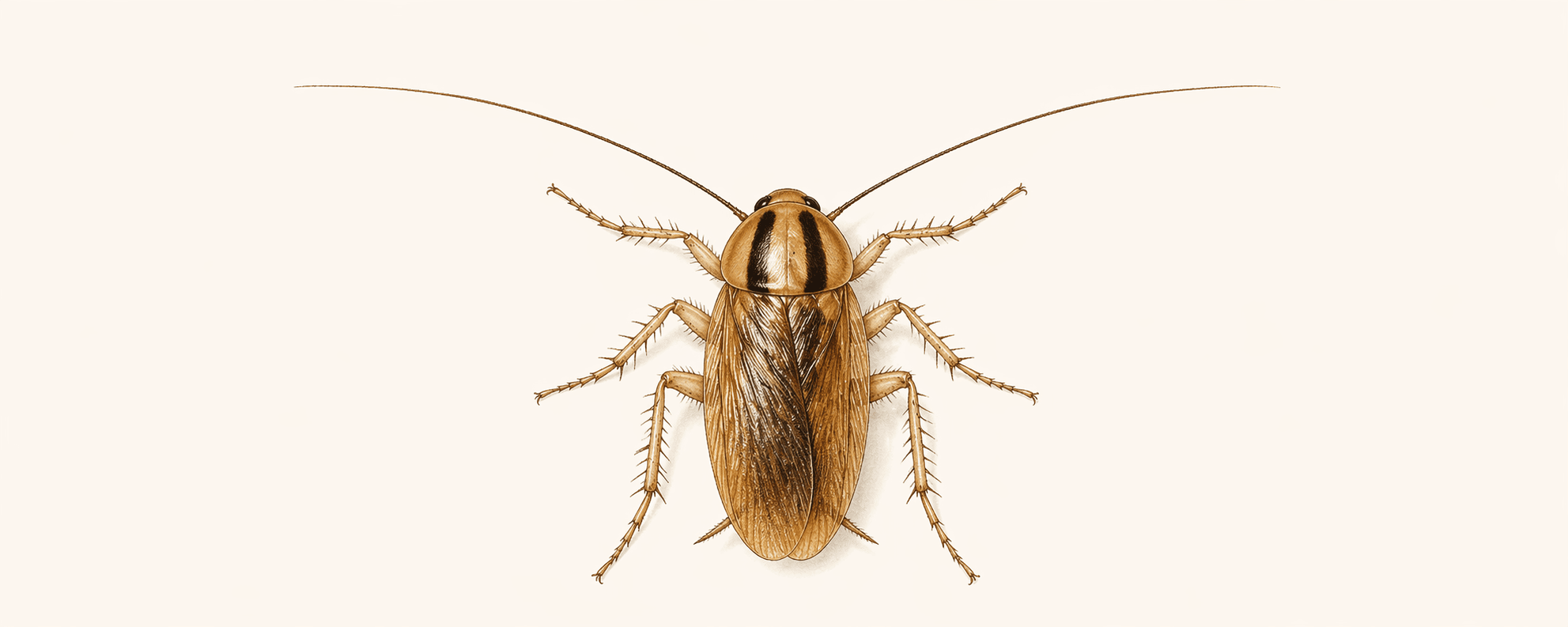
- German cockroach (Blattella germanica): the most common in kitchens, 12 to 15 mm, light brown with two longitudinal black bands on the pronotum. It swarms in warm, damp areas (behind ovens, dishwashers, service ducts).
- Oriental cockroach (Blatta orientalis): 20 to 25 mm, glossy black, slower. It colonises cellars, basements, crawl spaces and bin stores.
- American cockroach (Periplaneta americana): up to 40 mm, reddish-brown, capable of gliding flight. It comes up from the sewers, boiler rooms and wastewater networks.
Indirect signs often arrive before direct observation:
- Droppings resembling ground coffee or black pepper along skirting boards, drawers and worktop joints.
- Oothecae (brown capsules 6 to 12 mm long) stuck under furniture, behind hinges, in packaging cartons.
- A characteristic odour of "mouldy bread" or rancid must in closed cupboards — this is the aggregation pheromone.
- Translucent moults left behind by the larvae at each growth stage.
- Faint rustling behind partitions at night in heavy infestations.
Seeing an individual by day in a lit room signals a population already established for several weeks.
Health and material risks
The cockroach is a recognised mechanical vector: it moves between pipework, bins and food areas, carrying on its legs and in its digestive tract germs such as Salmonella, Escherichia coli, Shigella and Staphylococcus aureus, along with parasite eggs. It is also associated with collective food poisoning outbreaks when it contaminates preparation surfaces.
The allergenic risk is major, notably for asthma: the proteins contained in the moults and droppings become airborne and particularly sensitise children in dwellings infested for several months.
On the material front, cockroaches gnaw paper, cardboard, the animal glues in bindings and the soft cable insulation, and soil textiles and foodstuffs with their greasy secretions. A prolonged infestation in a food store can lead to entire stocks being scrapped.
On the legal side, liability varies:
- In catering and food processing, the presence of cockroaches constitutes a serious HACCP non-conformity, exposing the business to a formal report, administrative closure, or even the withdrawal of approval.
- In co-ownership, spread through the shared ducts engages the managing agent's responsibility for the common areas; the private unit remains the responsibility of its occupant.
- In letting, the landlord has an obligation to provide decent accommodation, free of pests when the tenant moves in.
Why this pest thrives in Monaco and on the Riviera
Monaco brings together the ideal conditions for all cockroaches. The Mediterranean climate offers a long warm, damp season, and the mild winters never entirely halt reproduction in heated buildings. The Principality's extreme urban density — adjoining buildings, continuous vertical service ducts across thirty storeys, a tight sewer network — allows populations to move from one unit to another without ever leaving the indoor environment.
The Monégasque fabric combines several aggravating factors:
- Dense high-end catering in Monte-Carlo, La Condamine, Fontvieille and Larvotto, with kitchens running continuously, daily deliveries of cartons and shared bin stores.
- Upmarket residential with air-conditioned crawl spaces, fitted kitchens with dual cold/hot zones, domestic professional coffee machines — so many thermal micro-refuges.
- Yachting at Port Hercule and Fontvieille: warm passageways, galleys, holds, exchanges of equipment between boats.
- Cross-border neighbourhood (Cap-d'Ail, Beausoleil, Roquebrune-Cap-Martin, Menton) where an untreated infestation in France can migrate through the networks into a Monégasque unit.
Seasonality is barely marked indoors: in Monaco, treatment happens all year round, with a peak in calls at the end of summer and at each restart of the tourist season.
The MPS protocol in 4 steps
1. Entomological diagnosis. An MPS technician identifies the species (treatments differ), maps the harbourages with sentinel sticky traps, inspects ducts, skirting boards, the backs of appliances, tile joints and traps, and assesses the load (isolated, active, heavy). We document with geolocated photos, under systematic NDA.
2. Targeted gel bait treatment. We apply micro-deposits of food-matrix biocide gel at the identified transit points — no fumigation, no evacuation of the premises, no odour. The active molecule (fipronil, imidacloprid or indoxacarb depending on local resistance) is ingested then transmitted by trophallaxis and cannibalism to the hidden larvae, reaching the heart of the harbourage. On oriental and American cockroaches, we combine insect growth regulators (IGR) and targeted dusting in service ducts inaccessible to the gel.
3. Follow-up at 15-21 days. A second visit checks the fall in activity via the sentinel traps, tops up the gel where it has been consumed, and lifts or maintains the arrangement.
4. Certification and follow-up. We provide a HACCP-compliant intervention report with safety data sheets for the biocides used, batch numbers and a placement plan. A quarterly or half-yearly follow-up contract is offered for sensitive premises. All interventions are carried out under Certibiocide N121134 certification.
Mistakes to avoid
Self-treatment attempts almost always worsen the infestation. The most frequent cases we put right:
- "Shock" aerosol bombs: they kill a few visible adults but scatter the colony by pushing the cockroaches deeper into the ducts, onto neighbouring units. The ootheca, waxed and watertight, resists most sprays.
- Fogger / automatic diffuser: superficial coverage, no effect on the eggs and hidden larvae, and above all a disqualifying food contamination risk in a professional kitchen.
- Sticky traps alone: useful for diagnosis, ineffective as treatment — they capture a marginal fraction of the population.
- Consumer ultrasonic devices: no demonstrated effectiveness on cockroaches.
- Repeated bleach cleaning before intervention: destroys the traces that allow the technician to map the harbourages.
- Premature sealing of passageways: walls the colony in without killing it; it will reappear elsewhere.
Finally, mixing several consumer biocides rapidly selects for resistant strains, particularly well documented in the German cockroach across Europe. This is the main factor that makes recurrences slow to treat.
Typical Monaco case
A Mediterranean restaurant seating around thirty, located in an office building in Fontvieille, contacts us on a Monday morning after spotting several German cockroaches in the dining room on the Saturday evening in front of its clientele. The manager spent the Sunday spraying a consumer insecticide throughout the kitchen.
Our diagnosis reveals, within two hours: a main harbourage in the heating seal of the dishwasher, a secondary harbourage in the electrical duct feeding the slicer, and a beginning colonisation in the shared bin store in the basement. The German species and the prior spraying point towards a treatment by gel micro-deposits (some thirty points), doubled with targeted duct dusting and sentinel traps.
Service resumes the same evening with no administrative closure. The three-week check shows nil residual activity. A quarterly follow-up contract is set up, with a coordinated inspection of the bin store with the managing agent. No visible trace in the dining room, no public communication — the MPS NDA covers the entire intervention.
Lasting prevention
MPS integrated pest management rests as much on prevention as on treatment. A few habits drastically reduce the pressure:
- Thermal and water break: wipe down worktops and the sink before closing, empty draining racks, leave no standing water under plants or in pet saucers.
- Sealing: food-grade silicone on worktop and tile joints, expanding foam in pipework openings, fine grilles on low ventilation vents.
- Carton management: delivery cartons are a major vector for introducing oothecae; unpack them in a buffer zone and remove them immediately.
- Bins: sealed bags, a regularly rinsed store, watertight lids.
- Stock rotation in the dry store, airtight containers, monthly inspection of warm areas (behind fridges, oven, coffee machine).
- Monitoring: sentinel sticky traps at sensitive points, quarterly readings for premises under HACCP.
In Monégasque co-ownerships, coordination with the managing agent over the common areas (refuse chute, service ducts, bike and pram stores) often makes the difference between recurrence and lasting eradication.
Regulatory framework
In France, the use of insecticidal biocides is governed by European the European framework on professional biocides and requires the provider to hold Certibiocide certification for professional products. In catering, the the European food hygiene regulation (Hygiene Package) makes a documented pest control plan mandatory, enforceable in the event of a les services vétérinaires départementaux inspection. The presence of live cockroaches in a food zone constitutes a major non-conformity.
In Monaco, the Directorate of Health Action oversees operations in premises open to the public and food businesses. The obligation to keep a control plan and intervention reports available is equivalent to the French practice, with a heightened traceability requirement for upmarket catering establishments.
MPS operates under Monaco business registration RCI Monaco 26S10394 and Certibiocide N121134. Our reports are produced in a format directly acceptable to a Monégasque or French health inspection.
How long, how many visits
For a localised residential German cockroach infestation detected early, a single gel treatment visit followed by a three-week check is enough in the majority of cases. Complete resolution — no further sightings, no further captures on sentinel traps — is generally achieved in two to three weeks.
For a heavy infestation in a professional kitchen, or in the presence of oriental/American cockroaches coming up from the network, allow two to three visits spaced three to four weeks apart, plus quarterly follow-up in the first year to lock in the result.
Co-ownerships involving several units require coordination with the managing agent and phasing over one to two months to treat the common areas and the contaminated units simultaneously — essential to prevent re-migration.
Every MPS quote sets out the resolution windows, the number of visits included, the biocides used, and the commitment to a free return in the event of residual activity within the guarantee period.
In any doubt? Our team responds within 2 working hours. +377 37 70 70 02 — or [request a free quote](/devis-gratuit).
When you are facing a cockroach problem in Monaco, the first 24 hours shape everything that follows: our emergency guide details the immediate steps, the realistic resolution timeline and how a professional intervention unfolds.