
July 18, 2026 · 8-minute read
Yacht pest control contract in Monaco: 7 clauses to negotiate
Seasonal frequency, 24/7 on-call cover, food-safe biocides, traceability: the seven clauses a captain or yacht manager should examine before signing an…
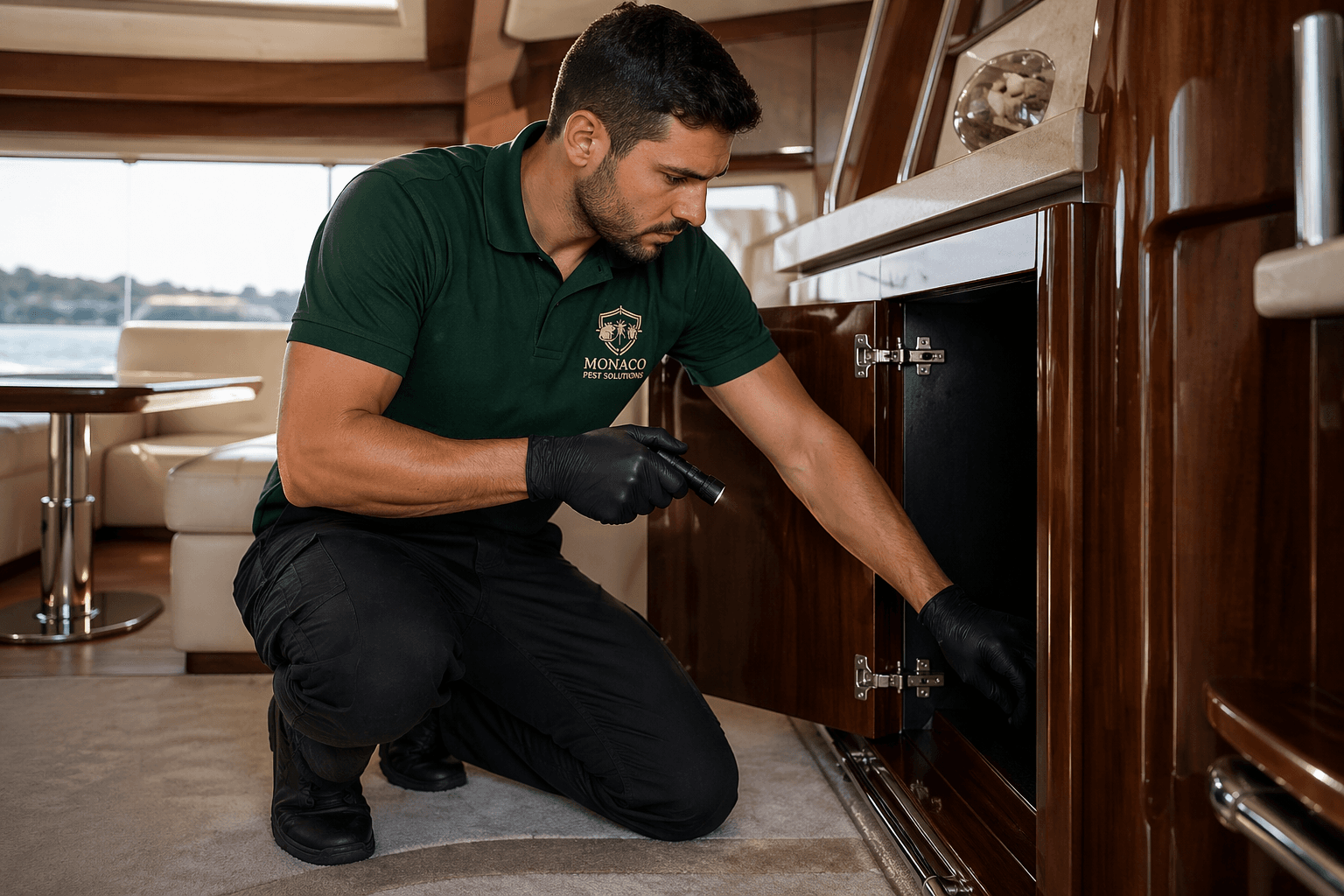
Berthed in Monaco in July: the context your contract must reflect
In high season, Monaco's main harbour hosts thirty to forty yachts over 40 metres at the same time, plus the units berthed at Fontvieille, those at Cap-d'Ail and a constant ballet of tenders. Provisions delivered dockside several times a week, charter guests boarding with their luggage, port calls at Antibes or Saint-Tropez: every movement is a potential vector. A Blattella germanica in a provisioning box, a Cimex lectularius in a guest's suitcase, a Rattus norvegicus climbing a mooring line with no rat guard — every experienced chief stew knows these scenarios.
The stake is not primarily sanitary, it is reputational. A charter guest who photographs a cockroach near the galley does not ask for a gesture of goodwill: they change boats. And the owner, in turn, often changes management company. In this market, a single report can end a management contract worth hundreds of thousands of euros a year.
Yet a large share of the pest control contracts offered to yachts are recycled commercial-property contracts: four visits a year, standard products, an oral report to the deckhand on watch. They ignore the seasonality of the Riviera, the HACCP constraints of a professional galley on board and the documentary requirements of a flag state or a charter insurer's audit. Before signing, seven clauses deserve to be read line by line, discussed and, where necessary, rewritten.
Clause 1 — A differentiated seasonal frequency, not a uniform flat rate
What a bad contract says: "four annual visits at regular intervals". What a good contract should say: six visits between April and October, two visits during the lay-up period, whether the vessel stays berthed in Monaco or heads to a yard at La Ciotat.
The rationale is biological before it is commercial. Pest pressure is roughly three times higher in season: high temperatures, near-daily provisioning, guest turnover and frequent port calls multiply introductions. In a galley kept around 28 to 30 °C, Blattella germanica completes its full cycle in about forty days, each ootheca releasing 30 to 40 juveniles. A quarterly visit therefore lets two entire generations pass between inspections — enough to turn an isolated introduction into an established population behind the galley equipment.
Conversely, paying a summer frequency all year round makes no sense. In lay-up, two visits focused on rodents, control of entry points and inspection of the lazarette and engine room are enough, provided they are genuinely adapted and not mere copies of the summer protocol.
Clause 2 — A costed 24/7 on-call cover, not a promise of responsiveness
"Fast intervention guaranteed" commits to nothing. A good contract puts figures on the timescales: for a vessel berthed on the Monegasque quays, from the main harbour to Fontvieille, response within four hours by day and within eight hours at night during high season. These figures must appear in the body of the contract, not in a sales brochure.
The activation procedure must be equally explicit: a dedicated on-call number, separate from the switchboard, and a designated replacement technician should the primary one be unavailable. A cockroach spotted by a guest on a Saturday evening in August cannot wait for offices to open on Monday.
The geographical scope, in black and white
A yacht on charter moves. The contract must specify how far the on-call cover applies without a surcharge: the Monaco–Antibes–Saint-Tropez stretch falls within a scope reasonably included in the flat rate. Beyond that — a call at Corsica or Sardinia — travel is charged, and the scale should be appended to the contract rather than discovered on the invoice. A captain planning a charter itinerary must be able to cost this risk in advance.
Clause 3 — Food-safe biocides in food zones, without exception
What a bad contract says: "approved products". The wording is hollow — any legally marketed biocide is approved. What a good contract should say: a positive list of authorised active substances zone by zone, appended and enforceable.
For the galley, dry storage and the walk-in fridge, the reference is a food-grade anti-cockroach gel bait, based on indoxacarb or an equivalent active substance, placed at discreet points in technical crevices. No residual spraying in an active galley: a synthetic pyrethroid sprayed on worktops contaminates preparation surfaces and exposes the chef to direct non-compliance with their HACCP plan.
What the vessel's HACCP plan requires
Charter yachts operating under a flag regularly inspected by the flag state's maritime authorities document their critical points exactly as a restaurant ashore does. The provider must be able to supply the safety data sheet for every product laid and justify its right to apply it: Monaco Pest Solutions' Certibiocide N121134 certificate precisely covers the professional use of these preparations. A contract that does not require this level of justification places the regulatory risk on the vessel, not on the provider.
Clause 4 — Written traceability, archived for five years
An oral report to the crew member present that day protects no one. A good contract requires a written report after each visit: product used, active substance, quantity laid, zones treated, observations, and the signature of the intervening technician. A signed, time-stamped PDF has become the expected standard.
The report must also cover passive surveillance: monitoring traps, numbered and mapped in the galley, storage and lazarette, with a record of catches at each visit. It is this series of records — and not the technician's impression — that objectifies a trend and justifies, figures in hand, a strengthening or an easing of the protocol. Some providers add an IR thermography check of technical bulkheads, useful for spotting the warm zones where cockroaches aggregate.
This is not bureaucracy. During a classification audit, a charter insurer's audit before entering charter, or a flag state check, the yacht manager must be able to produce the complete history of treatments. The contract must therefore provide for a digital archive accessible for five years, available to the captain as well as to the owner's family office, including after a change of crew — crew rotations being frequent, the vessel's memory cannot rest on individuals.
Clause 5 — No anticoagulant rodenticide in port or at sea
This is the clause almost no standard contract contains, and yet it is the one that protects the vessel from the most visible risk. Anticoagulant rodenticides laid in a port area expose gulls and the wildlife of the water body to secondary poisoning: a Rattus norvegicus weakened by the anticoagulant becomes easy prey, and the toxin moves up the chain. In Monaco, where the environmental regulation of the water body is particularly strict, a poorly positioned bait on a passerelle engages the liability of the vessel as much as that of the provider.
A good contract therefore formalises a commitment not to use anticoagulants in areas accessible to wildlife, both alongside and at sea.
The alternatives that work dockside
The commitment only has value if the substitution methods are named: locked and secured tamper-resistant bait stations, controlled-trigger mechanical traps checked at each visit, and above all mechanical exclusion — rat guards on mooring lines, blanking of unused hull penetrations, grilles over lazarette ventilation. On a vessel, preventing entry remains more reliable than treating the infestation.
Clause 6 — Coordination with the crew, written into the contract
A treatment carried out without the crew loses much of its effectiveness. The contract must provide for a pre-intervention briefing of about fifteen minutes with the chief stew: sensitive zones, known passenger allergies, owner preferences, cabins or spaces not to be opened. On a yacht, the technician works in a private space of the very highest standard; improvisation has no place there.
The post-intervention briefing is just as contractual: which surfaces to clean and which on no account to wash down (a gel bait cleaned off the same evening will have served no purpose), how soon the galley can resume service, what signs the crew should watch for in the following days and how to report them. Between two charters, these instructions may include a dry steam pass on the seams of the mattresses in the guest cabins — dry steam above 120 °C destroys eggs and adults of Cimex lectularius with no chemical residue whatsoever. A provider who leaves without passing on these instructions leaves the interior team alone to face guests' questions.
Clause 7 — Legible pricing and a clean exit
What a bad contract says: a global flat rate, with no detail, with automatic renewal and six months' notice. What a good contract should say: an explicit basis of calculation — a price per linear metre or an annual flat rate depending on the vessel's typology —, emergency and weekend surcharges costed from signature, and a thirty-day termination notice.
The exit clause deserves particular attention: a final exit audit must be included, with a documented state of residual infestation and of the devices in place, handed to the vessel. This document protects both parties — the vessel has a reference state enforceable against the next provider, and the outgoing provider proves the quality of the work delivered. A provider who refuses this clause says something about their confidence in their own work.
Read it again before signing
Seasonal frequency, costed on-call cover, listed food-safe biocides, archived traceability, zero anticoagulant in the port area, formalised crew coordination, transparent pricing and exit: these seven clauses turn a generic contract into a genuine tool for managing reputational risk, from the Monegasque harbour to Beaulieu-sur-Mer.
Monaco Pest Solutions, a company registered with the RCI Monaco under number 26S10394, works on this contractual basis with yachts berthed in Monaco and along the coast as far as Antibes and Saint-Tropez. To have an existing contract reviewed or to draw up a proposal suited to your vessel, the team can be reached on +377 37 70 70 02 or in writing at contact@monacopestsolutions.mc — a quote can be requested online, with a prior on-board visit by appointment.
Frequently asked questions
- How many pest control visits a year for a yacht in Monaco?
- A rhythm suited to the Riviera provides for six visits in high season (April to October), when pest pressure is roughly three times higher, and two visits during lay-up, focused on rodents and entry points. A uniform flat rate of four annual visits leaves windows of several months, enough for a cockroach population to establish itself.
- Which anti-cockroach products are allowed in a yacht's galley?
- In an active galley, the reference is a food-grade gel bait, based on indoxacarb or equivalent, placed at discreet points in crevices. Residual pyrethroid sprays are to be banned there: they contaminate preparation surfaces and put the vessel's HACCP plan into non-compliance.
- How do bed bugs get on board a yacht?
- *Cimex lectularius* almost always travels in luggage, mainly that of charter guests, more rarely in the linen or effects of a new crew member. An inspection of the cabins between two charters, supplemented if necessary by a canine check or a dry steam treatment, allows an introduction to be detected before it settles in.
- Can rat poison be used on a boat berthed in Monaco?
- It is strongly discouraged, and a good contract expressly prohibits it: anticoagulants expose seabirds and the harbour's wildlife to secondary poisoning, in a water body where Monegasque environmental regulation is strict. The alternatives are tamper-resistant bait stations, mechanical traps and mechanical exclusion (rat guards, blanking of hull penetrations).
- What documents must a pest control provider supply after each intervention?
- A written report, ideally a signed PDF: product used, active substance, quantity, zones treated and identity of the technician. These reports must remain consultable for five years in a digital archive, as they are requested during charter insurers' audits and flag state inspections.
- What should an emergency pest control on-call cover include for a yacht on charter?
- Response times costed in the contract — for a vessel berthed in Monaco, four hours by day and eight hours at night are a realistic baseline —, a dedicated number with a designated replacement technician, and an explicit geographical scope: the Monaco–Antibes–Saint-Tropez stretch included, more distant travel charged according to an appended scale.