July 26, 2026 · 15-minute read
Charter Yacht in Saint-Tropez: Pest Audit Between Two Port Calls
Charter yacht pest audit in Saint-Tropez: 2-3 hours alongside during the turnaround, guest-free protocol, chief stew coordination and reports in English. The complete method for Monaco–Saint-Tropez–Cannes rotations.
A charter yacht at the height of the Riviera season never truly stops. One party of guests disembarks on a Saturday morning in a Saint-Tropez marina, the next party embarks on Sunday afternoon, and in between the crew has to do everything: full cabin turnover, provisioning, fresh flowers, laundry, fuel, last-minute maintenance. Within that twenty-four to forty-eight hour window, one operation is almost always missing from the planning board — and it is precisely the one that can save the season: the pest control audit. A cockroach photographed in the galley by a charter guest, a bed bug discovered in a VIP cabin on day two of the cruise, and the yacht's reputation starts to wobble, with commercial consequences measured in lost charter weeks. Here is how a charter yacht pest audit genuinely designed for the constraints of a Saint-Tropez turnaround is organised: fast, discreet, aligned with the schedule, coordinated with the chief stew and documented in English. An expert protocol — not a recycled office-building contract.
The Riviera summer charter: rotations that forgive no improvisation
The Mediterranean high season plays out across a tight geography: yachts string together the same legendary legs, from Monaco to Saint-Tropez and on towards Cannes and the islands, before heading back the other way with the next clientele. A single yacht can run eight to twelve charter weeks between June and September, with turnarounds compressed to the extreme: outgoing guests leave the boat late morning, incoming guests sometimes arrive the very next day.
This cadence has a direct consequence for pest risk management: there is no "quiet period" in which to intervene. In a villa, you schedule a treatment while the owners are away. On a charter yacht in season, the boat is either occupied by guests, in the middle of a frantic turnaround, or on a delivery passage to the next port of call. If the pest audit is not built into the rotation schedule as an operation in its own right — on the same footing as provisioning or bunkering — it will simply never happen. And every unmonitored week increases the probability that a quiet introduction (a few German cockroaches in a provisioning carton, a bed bug in a suitcase) turns into an established infestation.
That is why the most rigorous crews treat the audit as a recurring line item of a dedicated yachting pest control programme: a short intervention, planned in advance on turnaround windows, delivered by a provider who knows the constraints of the boat and how to work without leaving a visible trace.
Why the port call is the weak link in onboard biosecurity
Under way, a yacht is a relatively closed environment: nothing comes aboard, nothing leaves, and any existing pest population evolves in isolation. Everything happens alongside. Each port call opens the passerelle to a continuous flow of people and goods, and every crossing is a potential vector.
A turnaround call in Saint-Tropez concentrates into a few hours what a shore-side building sees in a month: multiple food deliveries, crates of drinks, cut flowers, clean linen returning from the laundry, luggage for a dozen guests, crew going ashore and back, outside contractors, spare-parts parcels. Add the immediate proximity of other yachts berthed side by side, quays where rodents and cockroaches roam, drawn by marina waste points and the restaurant terraces nearby, and you get an environment under maximum pest pressure.
The classic mistake is assuming the big turnaround clean "covers" this risk. It does not: a clean, however meticulous, detects neither cockroach oothecae glued under a galley drawer, nor the early signs of bed bugs in a mattress seam, nor a rodent's nocturnal passage along a mooring line. Only a methodical inspection, carried out by a technician trained in detection, turns the port call — the moment of maximum vulnerability — into a control point.
The three major vectors: provisioning, guest luggage, mooring lines
Field experience on Riviera yachts consistently highlights three routes of introduction that concentrate most of the risk.
Provisioning is vector number one. Corrugated cardboard is the favourite refuge of German cockroaches: warmth, darkness, residual humidity, the glue in the fluting — everything suits them, including as a place to deposit their oothecae. A carton of fruit or a crate of drinks stored for a few hours in a contaminated supplier's storeroom is enough to bring a future colony aboard. Pallets, wooden crates and laundry bags are secondary vectors of the same order. The professional rule is simple: cardboard never crosses the passerelle. De-boxing happens on the quay, foodstuffs are transferred into the boat's own sealed containers, and the packaging goes straight to the skip. On yachts that apply this protocol strictly, introductions of cockroaches drop dramatically.
Charter guest luggage is the preferred vector for bed bugs. Your guests often arrive from a sequence of hotels, long-haul flights and rental residences: every stop is a collection opportunity. A single fertilised female in the lining of a suitcase is enough to seed a cabin. Unlike cockroaches, bed bugs cannot be controlled through hygiene: the cleanest boat in the world can be infested in a single night. The answer lies in early detection — cabin inspections at every turnaround, focused on sleeping areas — and in a few simple habits when luggage comes aboard, which we return to below. The subject is serious enough to warrant a dedicated page on bed bugs and their treatment protocols.
Mooring lines and the passerelle are the rodents' access route. A brown rat travels along a hawser without difficulty and climbs a passerelle in seconds, at night, between two watch rounds. Riviera marinas, with their rock armour, waste rooms and quayside restaurants, sustain permanent populations. Rat guards on the lines, gangway lighting and raising the passerelle at night are among the basic measures; the audit verifies their presence and condition, and looks for signs of intrusion (droppings, gnaw marks, rub marks) in the lazarette, the engine room and the stores.
The rapid dockside audit: two to three hours, zone by zone
A charter yacht pest audit is no courtesy visit. It is a systematic inspection, run along a standardised route that covers the boat from the bilges to the sundeck, and calibrated to fit within a two-to-three-hour window — a duration compatible with a turnaround, without ever blocking another operation on board.
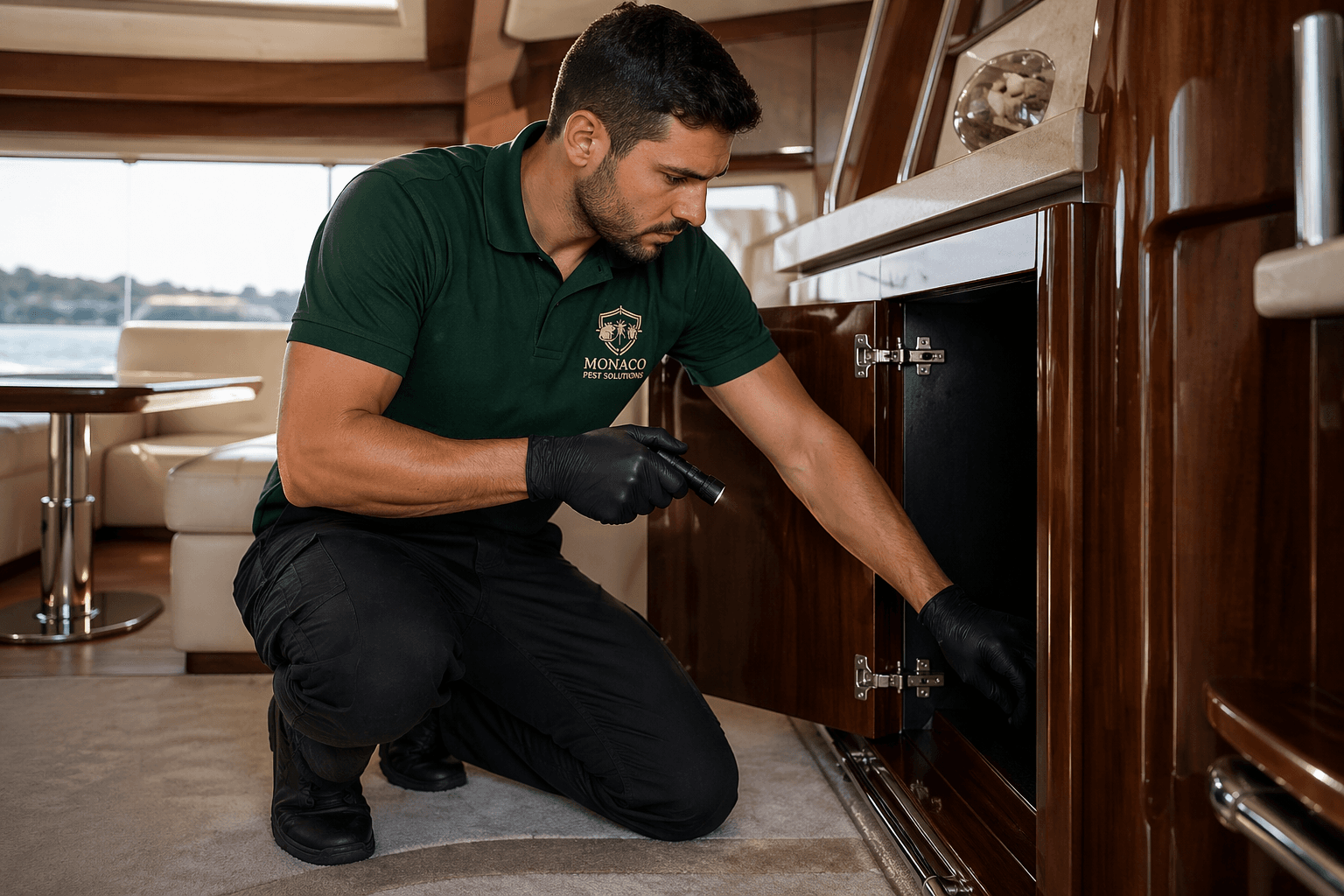
The typical route starts with the highest-risk zones: the galley and its annexes (pantry, dry stores, cold rooms, behind counters, under equipment), where most of the cockroach risk plays out. The technician removes accessible kick-plates, inspects cable and pipe penetrations, checks the motors of refrigeration equipment — warm spots where German cockroaches love to settle — and reads the monitor traps placed on the previous visit. Next come the crew mess and crew cabins, often neglected even though they concentrate food, warmth and personnel rotation. Then the guest cabins: bed bases, mattress seams, headboards, skirting, electrical sockets — the full bed bug protocol, cabin by cabin. The audit continues with the garbage room and waste circuits, the laundry, the lazarette, the stores and the engine room for the rodent component, and finishes outside: passerelle, mooring lines, covers, fenders and the quay edge.
Every finding is photographed, located on the boat's general arrangement plan, and classified on a simple criticality grid: compliant, watch point, recommended action, urgent action. The audit closes with a fifteen-minute debrief with the chief stew or the captain, before the written report is even issued. In two to three hours, the boat has a complete status picture and a prioritised action list — without a single turnaround operation having been delayed.
The guest-free protocol: working without ever crossing a charter guest
The absolute rule of pest control in yachting fits in one sentence: the guest must never know. Never encounter a technician, never spot a trap, never smell a product, never find a document. This requirement is no affectation: in the world of luxury charter, the mere suggestion of a pest treatment on board is enough to shatter the perception of excellence the crew builds hour by hour.
The guest-free protocol rests on four pillars. Timing first: every intervention takes place exclusively in guest-free windows — turnarounds, delivery days, mornings when the guests are ashore on a planned excursion. The provider commits to immediate re-scheduling capacity: if guest disembarkation slips by three hours, the intervention slips by the same amount, with no penalty and no negotiation. Visual discretion next: unmarked vehicle, neutral clothing with no branding, equipment carried in sports bags or anonymous cases indistinguishable from those of an AV technician or a florist's delivery. On a quay where every passerelle is watched by neighbouring boats and passers-by, nothing must signal the nature of the visit. Device discretion: monitors and traps are placed in technical areas invisible to guests, or in concealed formats (under drawers, behind equipment); no visible device in guest areas, ever. Contractual confidentiality finally: a non-disclosure agreement covering the yacht's name, the findings and even the existence of the commercial relationship itself. Reports are transmitted through agreed channels, to the sole recipients designated by the captain or the management.
This level of discipline is exactly what we describe in our field report on discreet pest control for a yacht berthed alongside: the same reflexes apply in Monaco, Saint-Tropez or Cannes.
Fitting the audit into the Monaco → Saint-Tropez → Cannes turnaround
In practical terms, how do you slot an audit into a typical rotation? Take a classic high-season itinerary: guests embark in a Monegasque marina, cruise for a week towards the gulf of Saint-Tropez, disembark, a thirty-six-hour turnaround, a new clientele, then onwards to Cannes and the islands.
Best practice is to define, at the start of the season, a map of intervention windows: every planned turnaround is flagged as an audit opportunity, with high priority given to long turnarounds (over twenty-four hours) and to calls in marinas where the provider has rapid-response capacity. A provider established on the Riviera can cover the whole Monaco–Saint-Tropez–Cannes arc with the same pair of technicians: a decisive advantage, because at every call the boat is met by people who already know its layout, its sensitive points and its onboard rules.
A typical turnaround-with-audit sequence looks like this: guests and their luggage leave late morning; the technician arrives within the hour, while the crew launches the full cabin strip; audit of the guest areas in parallel with housekeeping, zone by zone, coordinated so that no cabin is blocked for more than twenty minutes; audit of the technical areas during the afternoon provisioning, with incoming deliveries checked in passing; debrief with the chief stew at the end of the day; the next morning, if a targeted treatment is needed, it is carried out early, with re-entry intervals respected well before the next embarkation. The boat welcomes its new clientele with a verified, documented pest status — and nobody saw a thing.
Between two audited calls, delivery passages offer a precious complementary window: no guests aboard, crew available, no discretion constraints. It is the ideal moment for heavier operations — deep treatment of a galley, device installation, sealing of entry points.
The chief stew, conductor of the audit on the boat's side
A successful audit is always a two-hander: the technician brings method and a trained eye, the chief stew brings intimate knowledge of the boat. He or she is the one who knows that an unusual smell was noticed in the pantry on Tuesday, that a guest reported a bite on day three, that the forward starboard cabin received luggage arriving from a tropical destination, or that the last fruit delivery came from an unfamiliar supplier.
Coordination is organised around three moments. Before the call: a brief exchange (messaging or a call) in which the chief stew passes on the week's observations, the precise turnaround schedule and any particular constraints — inaccessible areas, owner on board, works in progress. The technician thus arrives with an inspection plan already prioritised. During the audit: the chief stew or a designated member of the interior team accompanies the technician in guest areas (nobody moves alone through a cabin on a well-run yacht), opens locked compartments and validates monitor locations in real time. After the audit: the debrief structures the action list in two columns — what falls to the provider (treatments, devices, next visit) and what falls to the boat (de-boxing rules, waste management, luggage vigilance, reporting). This clear split avoids the classic trap of recommendations that nobody owns.
Crews change, mid-season and from one season to the next. A good provider offsets that rotation by holding the boat's memory: history of findings, device plan, onboard preferences. The new chief stew inherits an up-to-date file instead of starting from scratch.
Bed bugs and German cockroaches: the two scenarios crews fear most
Not all pests are equal in charter. Two species concentrate most of the reputational risk, and the audit is built around them.
The bed bug is the absolute nightmare scenario, because it strikes the guest in their sleep and leaves visible marks. Introduced in a piece of luggage, it settles within a few metres of the berth and becomes active at night. The early signs — pinpoint droppings along seams, shed skins, blood spotting on sheets — are detectable by a trained eye well before the first bite. That is the whole point of systematic cabin inspection at every turnaround: caught on arrival, an introduction is dealt with in one targeted intervention in one cabin; discovered by a guest on day four, it becomes a crisis. Where there is serious doubt, protocols combine in-depth inspection, heat treatment or targeted insecticide depending on the configuration, and follow-up monitoring — all detailed on our bed bugs page.
The German cockroach is the second nightmare, because it establishes quickly and shows itself late. A yacht galley offers it ideal conditions: equipment warmth, humidity, inaccessible recesses, a continuous food supply. An introduction via a provisioning carton can go unnoticed for weeks — the time it takes for the population to reach the threshold at which individuals venture into visible areas, usually at night, usually when a guest switches on a light. Professional treatment relies on bait gels positioned in the insect's harbourage zones, invisible and causing no disturbance on board, complemented by follow-up monitors. Consumer aerosols, by contrast, scatter populations without eliminating them and complicate any later work; using them aboard is the false good idea par excellence, as we explain on our cockroaches page.
In both cases the logic is identical: early detection turns a potential crisis into a simple maintenance line. That is exactly what the turnaround audit buys the boat.
Documentation in English, ready for management and brokers
An audit without a usable report is worth nothing in the charter ecosystem. The boat answers to a chain of international stakeholders — management, owner, brokers, insurers, hygiene auditors — and the working language of that chain is English. The audit report must therefore be natively bilingual: findings, annotated plans, captioned photographs, criticality grid, recommended actions and deadlines, all in French and English, in a format that can be forwarded as is.
A good turnaround audit report fits into a few structured pages: a one-page summary (overall status of the boat, evolution since the previous visit, points of attention), zone-by-zone detail with photographs, a register of devices in place (type, location, installation date, readings), certificates for any products used with their safety data sheets, and an intervention certificate stating the technician's qualification — in this case Certibiocide No. 121134, the regulatory guarantee of professional product use. Kept up to date visit after visit, this file becomes a genuine sanitary logbook for the yacht: it documents the crew's diligence, smooths due diligence at resale or on a change of management, and provides an immediate factual answer if a guest or a broker raises a question.
The detail that changes everything: confidentiality applies to the documentation too. Reports mention the yacht's name only if the boat wishes, can be issued under a coded reference, and are never used as a commercial reference by the provider.
Between two audits: the five crew habits that make the difference
The professional audit is the backbone of the system, but day-to-day biosecurity belongs to the crew. Five simple habits, built into onboard routines, drastically reduce the risk between visits.
First, systematic de-boxing on the quay: no carton, no crate, no pallet crosses the passerelle; everything transfers into the boat's own sealed containers. Second, luggage vigilance: guest suitcases transit through a single point, are placed on hard stands (never on beds), and the interior team glances over seams and outer pockets during unpacking — a thirty-second habit per case. Third, waste management: daily removal, sealed bags, garbage room cleaned and inspected weekly. Fourth, exterior discipline: passerelle raised or lit at night, rat guards on the mooring lines from the moment of arrival alongside, no foodstuffs stored outside. Fifth, immediate reporting: every observation — an insect, a suspicious bite, a noise, a smell — is logged with date, time and zone, and passed to the provider before the next call, however trivial it seems. Half of all early detections start with a crew report.
A charter yacht that combines these onboard routines with a professional audit at every major turnaround does not eliminate the risk — nobody can, on the Riviera in summer — but it brings it down to a level where no introduction has time to become an infestation, and no infestation has time to become a crisis.
Every boat has its own schedule, its favourite marinas and its constraints. The right approach is to map your turnarounds between Monaco, Saint-Tropez and Cannes ahead of the season, and to slot in two-to-three-hour audit windows — adjustable until the last moment, like everything in charter. Technicians certified Certibiocide No. 121134, a proven guest-free protocol, direct coordination with your chief stew, bilingual French-English reports within twenty-four hours: our yachting programme is built for the real constraints of charter, not for office buildings. For a first, no-commitment conversation about your itinerary and turnaround windows, request your free quote: fast response, confidentiality guaranteed from the very first contact.
Frequently asked questions
- How long does a pest audit take on a charter yacht between two port calls?
- The standard format is calibrated at two to three hours alongside, precisely so it fits within a turnaround without blocking any other onboard operation. The route covers the galley and its stores, the crew mess, the guest cabins (full bed bug protocol), the garbage room, the lazarette, the engine room and the exterior, including mooring lines and passerelle. The debrief with the chief stew or captain happens on the spot, and the bilingual written report is delivered within twenty-four hours.
- Can the audit take place with charter guests on board?
- No, and this is a non-negotiable principle of the guest-free protocol: guests must never encounter a technician, spot a device or suspect that an intervention exists. The audit is scheduled exclusively in guest-free windows — turnarounds between two charters, delivery days, or mornings with a planned excursion ashore. If disembarkation slips by a few hours, the intervention is rescheduled by the same amount, at no penalty. An unmarked vehicle, neutral clothing and equipment in anonymous containers complete the discretion setup.
- What are the main routes by which pests get aboard a charter yacht?
- Three routes concentrate most of the risk. Provisioning first: corrugated cartons carry German cockroaches and their oothecae, hence the rule of systematic de-boxing on the quay. Guest luggage next: it is the preferred vector for bed bugs, which travel in suitcase linings after a string of hotels and flights. Finally, mooring lines and the passerelle: the rodents' access route from the quays, countered by rat guards, lighting and raising the gangway at night.
- Is the audit report available in English for management and brokers?
- Yes, systematically. The report is natively produced in French and English: a one-page summary, zone-by-zone findings with captioned photographs, a plan of devices in place, a criticality grid, recommended actions with deadlines, safety data sheets for any products used and an intervention certificate stating the Certibiocide No. 121134 qualification. It can be forwarded as is to management, the owner, brokers or insurers, and can be issued under a coded reference to preserve the yacht's confidentiality.
- What happens if the audit reveals bed bugs just before the next embarkation?
- This is precisely the scenario the turnaround audit exists for: detected at that stage, an introduction remains confined to one cabin and is dealt with by a targeted intervention — in-depth inspection of the berth and its surroundings, heat treatment or targeted insecticide depending on the configuration, then follow-up monitoring. Re-entry intervals are timed to be comfortably respected before the guests arrive. If the window is too short, the affected cabin can be taken out of service for the first night, a solution the chief stew arranges discreetly on the planning side.
- Is an audit needed at every port call, or is once a season enough?
- Once a season is far from sufficient for a yacht in active charter: a few weeks are all a cockroach or bed bug introduction needs to become an established infestation. The right cadence follows the boat's actual schedule: an audit at every major turnaround between two charters, prioritising the long rotations of the Monaco–Saint-Tropez–Cannes arc, supplemented by heavier operations during guest-free delivery passages. In practice this works out at a visit every two to four weeks in high season, adjusted to the itinerary.