July 12, 2026 · 14-minute read
Yacht in Monaco: discreet pest control at berth
Cockroaches in provisioning, bed bugs in luggage, rats via mooring lines: the discreet pest control protocol for yachts berthed in Monaco, NDA included.
A superyacht berthed in Monaco's marinas is anything but a closed environment. Provisions delivered dockside several times a week, charter guests embarking with their luggage, crew going ashore every day, fresh flowers, laundry, spare-parts packages: every movement crosses the passerelle in both directions, and every movement is a potential pest vector. Yacht pest control in Monaco is therefore not a comfort option. It is a component of reputational risk management, on the same level as crew confidentiality or fire safety. Here is how a pest control protocol genuinely designed for life alongside the quay in the Principality is organised — and why it has nothing in common with a recycled office-building contract.
The stakes are not sanitary — they are reputational
Let us start with the scenario every captain and every chief stew knows, even if they prefer not to talk about it. A charter guest gets up at night, switches on the light in the pantry or the saloon, and photographs a cockroach. They do not ask for a gesture of goodwill. They do not file a formal complaint. They finish their week, politely, and then they change boats — and so does their broker. In an industry where recommendations circulate by word of mouth among a handful of brokers, family offices and management companies, a single report of this kind can be enough to take a yacht out of the charter circuit for an entire season.
The economics are brutal. A charter week on a 40 to 60 metre yacht is invoiced in hundreds of thousands of euros. A compromised season represents several million in lost revenue, not counting the resale discount on a boat whose reputation has been tarnished. Set against this, the cost of a professional pest control programme is trivial: it is probably the most lopsided risk-to-investment ratio in a yacht's entire operating budget.
There is a second, less visible layer: crew liability. A chief stew or chef who discovers an infestation and handles it "in-house" with products bought ashore takes a double risk: ineffectiveness (German cockroach or bed bug infestations are not resolved with consumer aerosols) and traces — a guest who finds a poorly concealed glue trap understands immediately what it means. Using a discreet professional, bound by a confidentiality agreement, protects the crew as much as the owner. That is precisely the purpose of a pest control programme dedicated to yachting, as opposed to a generic service.
Monaco's marinas: an environment of permanent pest pressure
Why is a yacht berthed in Monaco more exposed than a villa in the hills? Because the Monegasque marinas concentrate, over a few hectares, every factor that favours pest establishment.
First, density. In high season, dozens of large yachts lie berthed side by side, each with its professional galley, its garbage rooms, its technical spaces warmed by generators. A pest thriving on a neighbouring boat has only a few metres of quay to cross.
Second, logistics. A yacht in operation receives dockside deliveries several times a week: food provisioning, beverages, flowers, linen, technical consumables. Every pallet, every corrugated cardboard box, every crate of fruit is a potential Trojan horse. Suppliers' warehouses and refrigerated trucks are themselves at-risk environments, and corrugated cardboard is literally the German cockroach's favourite habitat: warmth, darkness, cellulose and flutes exactly the width of its body.
Third, human rotation. Guests succeeding one another week after week with their luggage, crews changing mid-season, day workers, subcontractors, maritime agents: the flow of people and personal effects crossing the passerelle of a charter yacht exceeds that of many small hotels. Add the ports of call — Antibes, Saint-Tropez, Cannes, Corsica, Italy — and you get an exposure profile combining the risks of hospitality, catering and international transport.
Three species, three entry routes: the risk triangle of a yacht alongside
On a yacht berthed in the Principality, three species account for most of the risk, and each has its own entry route: the German cockroach through provisioning, the bed bug through luggage, the brown rat via the mooring lines. Understanding these three vectors already structures half of the prevention plan.
Blattella germanica: the stowaway in your provisioning
The German cockroach is by far the number-one risk on board. Small (12 to 15 mm) and heat-loving, it does not live outdoors on the Riviera: it travels. And its favourite vehicle is the provisioning box. An ootheca — the egg capsule the female carries — contains 30 to 40 embryos. A single ootheca lodged in a corrugated-cardboard flute and brought into the galley is enough to found a colony.
On board, the German cockroach finds an ideal habitat: constant warmth from refrigeration compressors and galley equipment, humidity, inaccessible recesses behind custom joinery, permanent food sources. The cycle is fast: in a galley at 28 °C, a population goes from a few individuals to several hundred in two to three months. And the early stages are completely invisible in daytime — the species is strictly nocturnal and light-averse. When a crew member sees a cockroach in broad daylight, the population is already established and saturated.
The countermeasure works on two levels. Upstream: a systematic provisioning-landing protocol, with de-boxing on the quay or in a buffer zone, never in the galley — no corrugated cardboard should ever go below into the accommodation. Downstream: permanent monitoring with pheromone traps in technical areas, checked at every technician visit, allowing an introduction to be detected before it becomes an infestation. Treating an established population relies on professional gel baits applied at discreet points invisible to guests — an approach detailed on our cockroach control page.
Cimex lectularius: the risk that arrives in guests' luggage
The bed bug does not fly, does not jump and does not come from the port: it is carried. On a charter yacht, the vector is almost always a guest's luggage — or, more rarely, the bag of a crew member returning from holiday or a training course. Guests on a Mediterranean charter typically string together palace hotels, private jets and rental villas: every stop is a collection opportunity.
The yacht-specific problem is twofold. First, the cabins are the most intimate and most scrutinised space on the boat: a line of bites on a guest's forearm at breakfast triggers a conversation no captain wants to have. Second, naval architecture complicates everything: bed bases built into furniture, padded wall panels, glued carpets, technical bulkheads — refuges impossible to inspect without dismantling, and heavy chemical treatment is barely practicable there during the season.
The effective strategy is therefore preventive and detective. Systematic cabin inspection between charters, at turnaround, when the boat is empty: mattress seams, reading lights, headboards, skirtings, with lamp and magnifier. Full protective encasements on guest-cabin mattresses. A luggage protocol for crew returning from travel. And in case of doubt, professional early detection before any treatment: treating a cabin on an unconfirmed suspicion is the best way to disrupt a charter schedule for nothing. Once confirmed, localised heat treatments and cryogenics can sanitise a cabin without immobilising the boat or leaving residues — the methods are described on our bed bug page.
Rattus norvegicus: the intruder that climbs the mooring lines
The brown rat is a remarkable climber and swimmer, and marina quays are its natural territory: waste rooms, restaurant terraces, rock armour. An unprotected mooring line is, for a rat, a direct access gangway. A passerelle left down overnight, a side gate open during loading, a tender alongside: so many entry doors.
A rodent on board is an incident of a different magnitude from a cockroach. Beyond the health risk (leptospirosis, salmonella) and the obvious reputational risk, the brown rat gnaws — and on a yacht it gnaws electrical looms, hydraulic hoses, insulation. Rodent damage to cabling is a classic large-yacht casualty, with technical downtime that can run into weeks of yard time.
Prevention is simple and must be required of the deck crew: rat guards on all mooring lines as soon as the boat comes alongside, passerelle raised or lit at night, no garbage bags stored on the aft deck, gangway watched during deliveries. In addition, the technician installs discreet detection stations in technical areas — never visible bait stations on exterior decks, whose mere presence tells a story no guest should read. In the event of a confirmed intrusion, the response combines rapid mechanical capture with entry-point investigation, following the principles detailed on our rats and mice page.
The discreet protocol: plain clothes, invisible time slots, systematic NDA
This is where yachting pest control parts company radically with the standard service. On a yacht, discretion is not a courtesy: it is a technical specification of the service, on the same level as treatment efficacy.
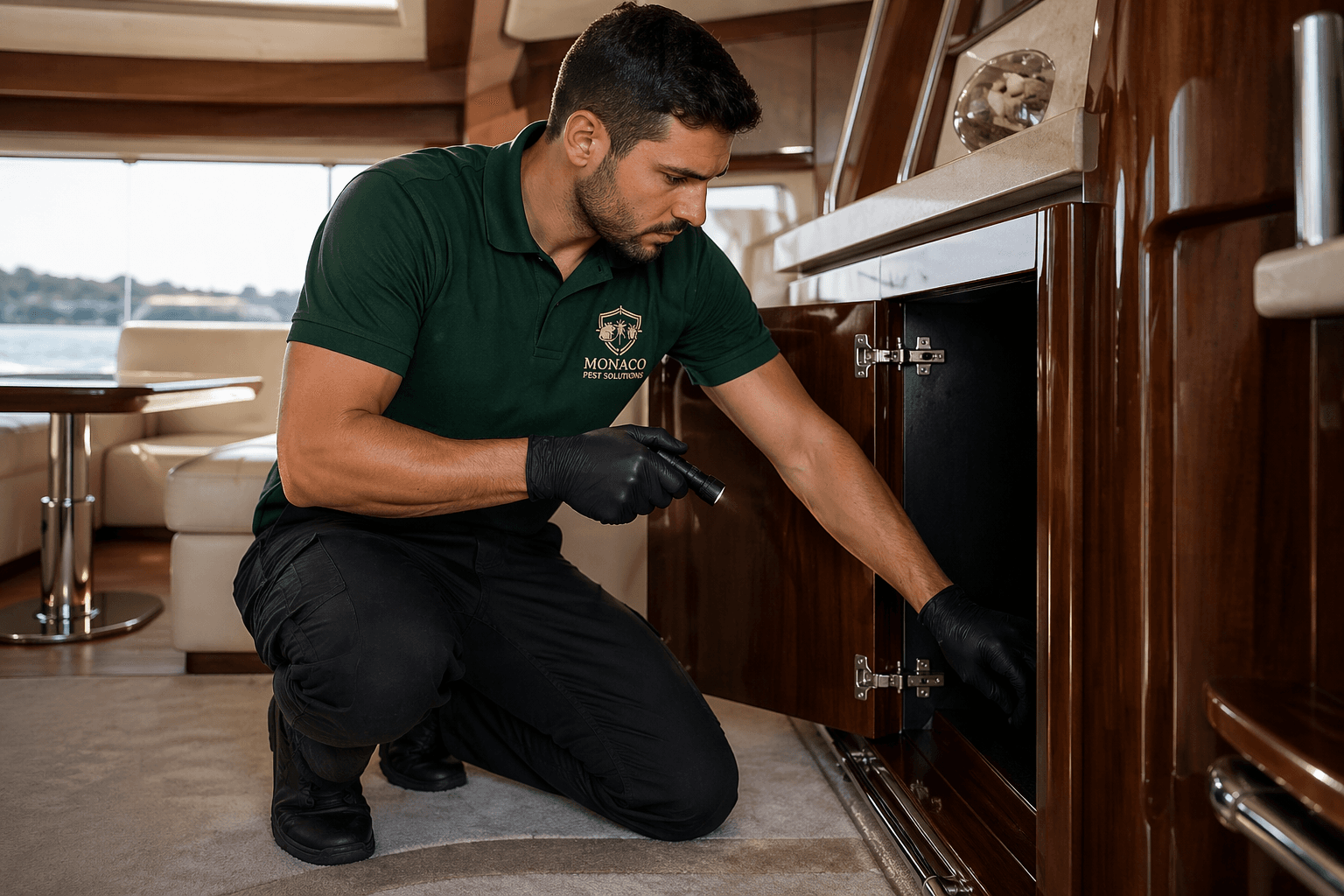
Concretely, it means plain clothes first. No sign-written vehicle parked on the quay, no branded coveralls, no identifiable equipment on display: the technician who comes aboard looks like one supplier among others, neutral case in hand. On a quay where neighbouring crews notice everything and passers-by photograph yachts continuously, a "pest control" logo on a polo shirt is the equivalent of a press release.
It then means intervention slots chosen to be invisible. Never during a guest embarkation, never during an event on board, never at the hours when the quay is busiest. The ideal windows: the turnaround between two charters, winter-season mornings, slots agreed with the chief stew when the owner is away. The technician comes and goes within the normal flow of deliveries.
It finally means a systematic non-disclosure agreement, signed before the first visit. The NDA covers the identity of the boat, its pest status, the work carried out, and prohibits any commercial use as a reference. No photos of the boat, no mention of the yacht's name in shared documents beyond the strictly necessary, reports transmitted through channels agreed with the captain. For an owner, the certainty that their contractor will never cite their boat is worth as much as the quality of the treatment itself.
Coordinating with the boat: chief stew, chef, captain
A pest management programme only works on board if it slots into the yacht's hierarchy, which is precise and non-negotiable. The contractor who turns up without understanding who does what on board has already failed.
The operational contact is generally the chief stew (or the purser on larger units) for everything touching the interior: cabins, saloons, pantries, laundry. They know the guest schedule to the minute, know which cabin will be occupied, and can open a two-hour intervention window between a departure and an arrival. They are also the one applying the daily preventive protocols: cabin inspection at turnaround, linen management, luggage vigilance.
The chef is the contact for the galley, the cold rooms and the provisioning circuit. The de-boxing protocol, dry-stores rotation, visual checks on fruit and vegetable deliveries: none of it works without their buy-in. A good contractor does not impose abstract rules; they adapt the protocol to the reality of the chef's galley and suppliers.
The captain, finally, validates the framework: NDA, time slots, communication channels, budget, and reports to the management company or the owner. The captain arbitrates when charter schedule and intervention need collide. Reports are addressed to them, and to the chief engineer for machinery spaces. One single point of contact at the contractor, reachable directly, including when a decision must be made within hours on a Saturday in July — that is the level of responsiveness this business demands, and it is what we have built into our yachting service.
Documentation in English, in the format international management companies expect
Yachting is an English-speaking industry. The captain may be French-speaking, but the management company is in Monaco, London or Fort Lauderdale, the flag auditor is international, and the boat's file must be readable by everyone. A contractor who delivers reports only in French creates a translation burden and an ambiguity risk nobody will accept for long.
The expected standard: intervention reports written in English (or bilingual French-English), time-stamped, specifying the areas inspected, observations, products applied with their safety data sheets, monitoring readings and recommendations. A plan of numbered control points. Continuous traceability that allows the boat's pest history to be reconstructed over several seasons — invaluable at the time of a sale, a change of manager or an insurer's audit.
This formalism is not bureaucracy. For an international management company overseeing dozens of units, a contractor's documentary quality is a selection criterion in its own right: it must be able to demonstrate, at any moment, that due diligence was exercised. On the qualification side, the technician operates under professional certification for the use of biocidal products (Certibiocide No. 121134), with protocols meeting the requirements applicable to food-preparation areas — a yacht's galley being treated with the same rigour as a starred restaurant kitchen.
Why a recycled commercial-property contract does not protect a yacht
Many berthed yachts are covered, on paper, by a pest control contract. The problem is that this contract is often a carbon copy of an office-building contract: four visits a year on fixed dates, standard bait stations, a generic report left "at reception", a different technician at every visit. This model, designed for a static 5,000 m² building, fails on a yacht for structural reasons.
A yacht moves. It leaves for three weeks in Corsica, comes back, runs two charters back to back, leaves again. Quarterly visits on fixed dates inevitably fall during an absence or an embarkation, get cancelled, and leave windows of several months without control — ample time for a German cockroach population to establish itself. The relevant rhythm follows the boat's schedule: interventions at turnaround, reinforced monitoring in high season, a full audit at spring recommissioning and at autumn decommissioning.
A yacht has an inverted risk density. In a building, sensitive areas are a fraction of the surface. On a yacht, the galley, pantries, cold rooms, laundry and cabins concentrate most of the risk into a few dozen square metres of custom, interlocking, hard-to-access joinery. The technician must know the boat — the same technician, visit after visit, who knows which panel comes off and where the conduits run.
Finally, a commercial-property contract knows nothing of discretion: sign-written vehicle, visits during office hours, paper report left in plain sight. Details of no consequence in an office building, and disqualifying on a quay in the Monegasque marinas. If your boat is covered by a contract of this type, the question to put to your contractor is simple: "What exactly do you provide specifically for a yacht?" The silence that follows is usually the answer.
Antibes, Saint-Tropez, Cannes: covering the coastal ports of call
A yacht based in the Monegasque marinas does not live only in Monaco. The season takes it to Antibes for a yard period or provisioning, to Cannes during the big spring events, to Saint-Tropez in July and August, with constant back-and-forth. Every port of call is a fresh exposure: other quays, other suppliers, other pest populations.
A coherent programme covers this perimeter. Concretely: the ability to have the same contractor — and ideally the same technician, the one who knows the boat — intervene at a stopover between Saint-Tropez and Menton, under the same discretion conditions and with the same documentary traceability. A suspected bed bug case detected on a Friday evening in Antibes with guests embarking on Sunday in Monaco cannot wait for the return to the home berth: it requires an on-site inspection, within the available window, wherever the boat is.
This continuity has an additional value: consistency of history. If every stopover triggers a one-off intervention by a different local contractor, the boat's pest file becomes an unreadable patchwork — different products, different report formats, no overview. A single contact across the Saint-Tropez–Monaco arc means one history, one documentary standard, one chain of responsibility.
Setting up the programme: initial audit, rhythm, budget
Implementation follows a simple sequence. Step one: a full audit of the boat, carried out alongside over half a day to a day depending on size, with no guests aboard. The technician inspects the galley and its equipment, the cold rooms and dry stores, the pantries, the laundry, the cabins, the waste rooms, the technical spaces and the entry points (through-hulls, cable penetrations, gangways). The output is an initial pest status, a map of vigilance points and a monitoring plan tailored to the boat.
Step two: setting the rhythm with the captain and the chief stew, based on the boat's programme. A common profile for a yacht in active charter: monthly visits in season (April to October), positioned on turnarounds, and bi-monthly visits during the winter period, focused on rodents and entry points, with on-demand interventions whenever there is a suspicion. Step three: formalisation — NDA, boarding protocol, communication channels, English report format.
On the budget side, the order of magnitude of a complete annual programme for a 30 to 60 metre yacht is a negligible fraction of the operating budget — far below, to give a telling comparison, the fresh-flowers line of a single charter season. The quote is drawn up after the initial audit, based on the boat's size, its programme and the level of service expected; the process starts with a simple contact via our free quote request, with a response within 24 hours and a direct exchange with the captain or the management company.
One last word, which sums it all up: on a yacht, the best pest control is the one nobody knows exists. No logo on the quay, no visible trap in a corridor, no report lying around — just an immaculate boat, season after season, and a flawless documentary file the day an auditor, a buyer or a management company asks for it. That is exactly the standard our yachting programme was designed for; if your boat does not yet have it, a confidential initial audit is the right starting point before the next guest rotation.
Frequently asked questions
- How often should a yacht berthed in Monaco be checked for pests?
- For a yacht in active charter, the reference rhythm is a monthly visit in season (April to October), positioned on the turnarounds between two charters, supplemented by bi-monthly visits during the winter period focused on rodents and entry points. This calendar follows the boat's actual schedule, never fixed quarterly dates: a window of several months without control is enough for a German cockroach population to establish itself in a galley.
- Can the intervention remain completely invisible to guests and neighbouring crews?
- Yes, it is a specification of the service: technician in plain clothes with a neutral case, no sign-written vehicle on the quay, time slots chosen outside embarkations and busy hours (turnaround, winter mornings), monitoring equipment placed only in technical areas, never on visible decks. The technician comes and goes within the normal flow of deliveries, like any other supplier.
- Suspected bed bugs in a cabin, guests arriving in 48 hours: what should we do?
- Do not treat anything blindly and do not move the bedding to other cabins, which would spread the infestation. Request immediate professional detection: a meticulous inspection of mattress seams, headboards and padded panels. If presence is confirmed, a localised heat or cryogenic treatment sanitises the cabin without residues within the available window; if it is ruled out, the charter departs with peace of mind and the report documents the verification.
- Are the reports provided in English for the management company?
- Yes. Intervention reports are written in English or in a bilingual French-English version: areas inspected, observations, products applied with safety data sheets, monitoring readings, recommendations and a plan of numbered control points. This format can be used directly by an international management company, a flag auditor or an insurer, and the history remains traceable over several seasons.
- How do we stop cockroaches coming aboard with dockside provisioning?
- The golden rule: no corrugated cardboard goes below into the accommodation. De-boxing takes place on the quay or in a buffer zone, foodstuffs are transferred into the boat's own clean containers, and fruit crates undergo a visual check. In addition, pheromone monitoring traps placed in the galley and technical areas detect any introduction before a Blattella germanica ootheca can found a colony.
- Does the service cover stopovers in Antibes, Saint-Tropez or Cannes?
- Yes. A yacht based in the Monegasque marinas spends part of the season at stopovers along the coast, and the programme follows it: the same contractor — ideally the same technician, the one who knows the boat — can intervene along the Saint-Tropez–Menton arc, under the same discretion conditions, the same NDA and the same report format. One single documentary history, wherever the boat is positioned.