July 19, 2026 · 12-minute read
Argentine Ant on the Riviera: the protocol that actually works
Linepithema humile is the most invasive ant species on the French Riviera. Spraying makes it worse. Here is the delayed-release gel bait protocol that works — and why it is the only one to reach the queens.
The Argentine ant is by far the most invasive ant species on the French Riviera. Along the coast, when a villa reports "ants," nine times out of ten the culprit is Linepithema humile, a tiny, brown, discreet — and formidably organised — species. The most common reflex against it, spraying insecticide, is also the most counterproductive: it splits the colony instead of extinguishing it, turning a seasonal nuisance into a chronic infestation. This article explains why the Argentine ant escapes conventional treatments, how an effective invasive ant protocol for the Cote d'Azur actually works, and what serious management really involves for a villa with a garden or within a co-ownership building.
The Argentine ant, invisible queen of the Riviera
Linepithema humile is not native to the Mediterranean. It arrived through trade, and the Riviera coastline offers it ideal conditions: mild winters, dry summers, generous automatic garden irrigation, dry-stone walls, sun-warmed terraces. So many micro-habitats that let it thrive where other species stall.
What strikes the resident is the suddenness. One morning in May, an unbroken line crosses the kitchen worktop, climbs a skirting board, converges on a pet bowl or a poorly sealed jar of honey. The day before, nothing. This abrupt appearance is no accident: it marks the moment the colony, whose activity had been underground and diffuse, switches to actively seeking sugary resources. The Argentine ant on the Riviera does not "arrive"; it was already there, under the terrace, in the wall, between two slabs, and it suddenly becomes visible.
It is this underlying invisibility that makes the subject a trap. You think you have "a few ants" to deal with. In reality you are facing a population whose visible surface is only a tiny fraction of the whole. Understanding the Argentine ant in Monaco and along the coast means first accepting that what you see is never the problem — only its symptom.
Identifying Linepithema humile without error
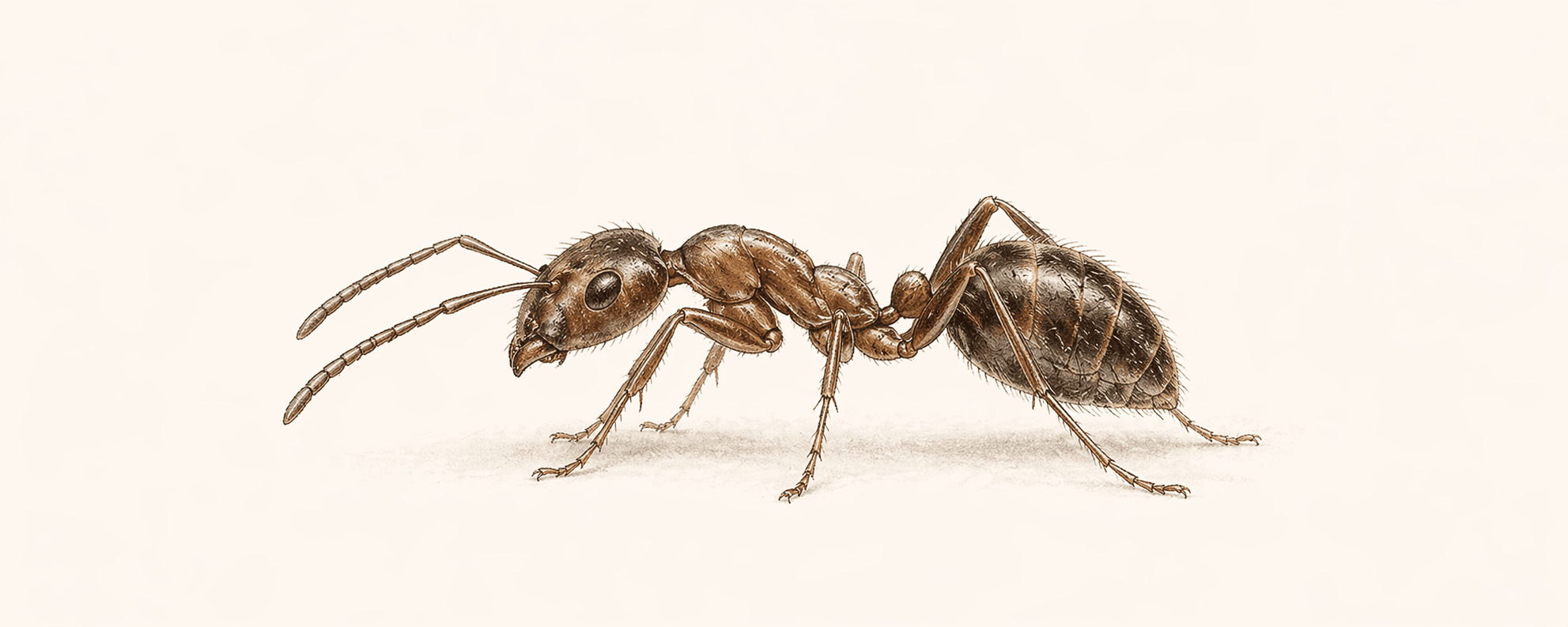
Correct identification is the first step of any serious protocol, because it entirely dictates the strategy. The Argentine ant is small, its workers measuring roughly two to three millimetres, of a uniform light brown to honey-brown colour with no metallic sheen. It moves in dense, regular, highly characteristic lines along joints, cables, pipes and terrace edges.
One distinctive sign matters more than all the others: the absence of aggression between individuals from neighbouring villas. In most ants, two colonies that meet will fight. In Linepithema humile, workers from two distant nests cooperate as if they belonged to the same family. This lack of a territorial boundary is the behavioural signature of the species, and it has a direct field consequence: there is no single colony to destroy, but a continuous network.
Another clue: the nest has no spectacular shape. No dome, no visible mound as in some woodland ants. Argentine ant nests are shallow, opportunistic, set under a slab, in a flowerpot, behind a skirting board, in the void of a wall. They relocate easily when disturbed. If you think you have "found the nest" and drowned it, you have most often merely displaced a satellite. For a useful starting point, our dedicated guide on what to do about an ant problem urgently sets out the sensible first reflexes before any intervention.
The coastal supercolony: why a villa is never alone
Here is the concept that changes everything, and that too many treatments ignore. Along the Riviera, Argentine ant colonies are not independent: they form what specialists call a supercolony. In practice, nests spread across several properties, several gardens, several buildings, do not fight one another — they communicate, exchange workers, share resources. On the scale of the Riviera, we are talking about a continuum stretching over vast portions of coast.
This has a brutal operational implication: treating a villa as a closed system is an illusion. You may reduce visible activity in a garden to zero; if the adjoining properties host the same supercolony, recolonisation is only a matter of weeks. The Argentine ant knows no fences. A party wall, a hedge, a property boundary are, to it, merely surfaces to follow.
That is why a credible invasive ant protocol for the Cote d'Azur begins with a contextual diagnosis, not with a technical gesture. Where are the exchange points with the outside? Does the pressure come from the garden, the buried network, a neighbouring property, recently delivered potted plants? On the heights of Monte-Carlo as in terraced gardens, this reading of the environment determines everything else. Ignoring the supercolony dimension means condemning yourself to treating the same symptom indefinitely.
Argentine ant or carpenter ant: do not confuse them
Not all ants are treated the same way, and the most costly confusion concerns the carpenter ant. The latter is much larger, often black or two-toned, and above all behaves radically differently: it excavates wood. Where the Argentine ant seeks sugar and water, the carpenter ant hollows galleries in woodwork, roof timbers, beams and damp frames to house its colony. It does not eat the wood — it empties it.
The distinction is crucial because the stakes differ. An Argentine ant infestation is a nuisance and a food-contamination risk; a carpenter ant infestation can, over time, weaken structural elements. The signs also differ: the carpenter ant leaves fine sawdust, "frass," at the foot of the attacked woodwork, and its activity is often nocturnal. In an older Riviera villa, with traditional timber framing and period joinery, this differential diagnosis is no detail.
A single home may in fact host both species, each with its own logic. Applying a protocol designed for the Argentine ant to a carpenter ant colony, or the reverse, means treating beside the target. This is one reason we never sell a standardised "anti-ant" treatment: the species dictates the method. Our dedicated ant intervention page details the approaches according to the species encountered in the area.
Why spraying makes everything worse: the trophallaxis trap
We now reach the heart of the misunderstanding. Spraying contact insecticide, the reflex gesture, is the worst possible response to Linepithema humile. To understand why, you must understand how the colony feeds and coordinates itself: through an exchange mechanism called trophallaxis.
In the Argentine ant, workers that find a resource do not consume it alone. They bring it back and share it, mouth to mouth, with their nestmates, who in turn redistribute it to the nurses and queens. The colony works like a collective stomach. It is precisely this circuit that an intelligent treatment must exploit — and that spraying destroys.
When you spray a contact insecticide on a line, you kill the visible workers, the exposed ones. But the queens, the broods, the vast majority of the population remain intact and sheltered. Worse still: the Argentine ant reacts to chemical stress through a fragmentation phenomenon known as "budding." Sensing danger, queens disperse with groups of workers to found new foci elsewhere. You have not reduced the colony; you have multiplied and scattered it. A line treated on Monday reappears as three lines on Friday, in three different places. This is the scenario we most often correct after months of over-the-counter spraying. This is precisely why our first-response advice in an emergency formally warns against the insecticide can from the very first lines. Spraying, on this species, means making things worse.
The delayed-release gel bait protocol
The right approach tackles the problem from the other end: instead of quickly killing what is visible, you slowly poison what is not. This is the principle of the delayed-release gel bait protocol, the reference method against the Argentine ant.
The gel bait is a sugary, attractive matrix containing a slow-acting active substance at low dosage. That is the key point: the bait does not kill the worker on the spot. It is designed so that she has time to carry it back to the nest and share it through trophallaxis before the effect appears. The poison then circulates through the collective stomach: from worker to worker, to the nurses, to the broods, to the queens. You reach the colony's reproductive function, which no spraying ever does.
Implementation demands precision. The gel is deposited in discreet micro-points, out of reach of children and pets, exactly on the circulation routes identified during diagnosis: joints, skirting boards, thresholds, cable runs, edges. You must also, temporarily, leave competing food sources undisturbed and above all spray nothing nearby, on pain of making the bait repellent. Patience is part of the protocol: in the first days you may even observe increased activity on the bait — a sign that the transfer is working, not a failure. Follow-up verifies the real decline of the population, adjusts the deposits, and targets residual foci. A serious invasive ant protocol for the Cote d'Azur is judged over time, at confirmed extinction, not on the spectacular effect of the first day.
Coordinating a co-ownership: treat the building, not the flat
As soon as you move from the villa to the apartment block, the supercolony logic becomes an unavoidable constraint. In a co-ownership, an Argentine ant colony does not inhabit a flat: it inhabits the building. Technical ducts, crawl spaces, pipework, false ceilings and expansion joints form a three-dimensional network in which ants move from one floor and one unit to another without obstacle.
Treating a single flat in this context is structurally doomed. The second-floor resident treats their own home; the colony, disturbed, redistributes towards the first or third floor, where other occupants discover it a few weeks later. Each treats in their corner, no one coordinates, and the supercolony thrives in the common areas that no one takes on. This is the classic vicious circle of Riviera buildings.
The only coherent response is an intervention at the scale of the whole building, planned with the property manager and the occupants: diagnosis of common areas and ducts, mapping of exchange points between units, coordinated bait deposits, a single follow-up schedule. It is as much a logistics job as a technical one, where the difficulty is often obtaining access to every affected unit on the same day. We detail this unit-by-unit organisation in our interventions across Monte-Carlo, where dense collective housing makes coordination all the more decisive. Without it, you treat the current complainant's unit forever.
Field lessons: Riviera villas and gardens
The field teaches what no data sheet says. In Riviera villas with gardens, the entry point is almost always outside: automatic irrigation creates ideal damp zones, imported potted plants sometimes bring their own nests, dry-stone walls and terraces on pedestals offer thousands of hiding places. A treatment confined to the interior ignores the source. You then see the frustrating scenario of a kitchen "cleared" of its ants that becomes a motorway again the following week, because nothing was done in the garden the pressure comes from.
Another recurring lesson concerns false trails. Many residents arrive after months of self-medication: sprays, powders, household products poured onto the lines, folk remedies. Not only do these gestures never reach the queens, but they contaminate the circulation routes and temporarily make the gel bait less effective, because the species avoids treated areas. Part of our work then consists of letting the environment "calm down" before placing the bait in the right spots. The initial patience of the delayed gel bait protocol unsettles those expecting an immediate result, but it is what makes the difference at two months.
A final observation: on the coast, the question is almost never "eradicate for good," but "bring pressure back and keep it below the nuisance threshold." Because the coastal supercolony is an environmental fact on a regional scale, the isolated villa will never be a sterile island. The realistic, sustainable goal is durable control, revised by season, with targeted visits in spring when activity resumes. To assess your specific situation, a free quote on diagnosis remains the most reliable starting point.
The real cost: inaction is always more expensive
The rule is universal and holds for the Argentine ant as for the rest: diagnosis always costs less than repair. Letting a population settle means accepting a silent progression. Repeated contamination of food surfaces, colonisation of cupboards and pantries, daily nuisance, and, in the case of confusion with the carpenter ant, a far more serious risk to woodwork and structure.
To this is added the hidden cost of self-medication: months of over-the-counter products, applied without method, which not only fail but worsen the colony's dispersal and complicate later professional treatment. The resident who has "tried lots of things" often reaches us with a harder situation than on day one. Treating early, with the right protocol and the right species diagnosis, always remains the most economical path. An ant problem caught early is settled faster and more cleanly than an established infestation.
Our commitment: regulatory rigour and respect for life
An effective protocol is not one that pours. On the Argentine ant, the use of targeted gel bait in micro-deposits illustrates our philosophy: the smallest possible quantity of active substance, placed in the right spot, produces a far superior result to mass spraying — for an incomparably lower environmental impact. Less product, better placed, is both more effective and more respectful of gardens, soils, pets and the non-target species that make Mediterranean gardens rich.
This requirement rests on a professional reality: our interventions involve professional use of biocidal products, regulated and traced, under certibiocide N°121134. This means active substances chosen for their profile, controlled dosages, traceability of deposits and advice on the preventive measures to put in place — managing garden humidity, reducing accessible food sources, maintaining the exchange points with the outside. For any villa or co-ownership affected by the Argentine ant on the Riviera, the best first step remains an on-site diagnosis: request your free quote and bring in a trained eye before spending your energy on lines that, alone, say nothing about the network feeding them. Our teams cover the whole area, from Monte-Carlo to the villas on the heights.
Frequently asked questions
- Why do the ants come back after I've sprayed insecticide?
- Because spraying only reaches the visible workers, not the queens or brood, which are protected inside the nests. Worse, in the Argentine ant, chemical stress triggers a fragmentation phenomenon: queens leave to found new foci elsewhere. You don't reduce the colony, you scatter it. That is why a treated line reappears a few days later as several lines, in several places.
- How do I tell an Argentine ant from a carpenter ant?
- The Argentine ant is small (two to three millimetres), uniform light brown, and moves in dense lines towards sugary sources. The carpenter ant is much larger, often black or two-toned, and hollows wood to nest in it: it leaves fine sawdust at the foot of woodwork and is often active at night. The distinction is crucial: the carpenter ant can weaken structural elements, which completely changes the treatment strategy.
- What is a supercolony and why does it concern my villa?
- Along the Riviera, Argentine ant nests do not fight one another: they cooperate, exchanging workers and resources over vast stretches of coast. This is a supercolony. In practice, your villa does not host an isolated colony but a portion of a network extending into your neighbours' land. Treating your garden as a closed space is therefore never durably enough: if the surrounding pressure is not accounted for, recolonisation returns within a few weeks.
- How long does the gel bait protocol take to work?
- The gel bait works slowly by design: the worker must have time to carry it back to the nest and share it before the active substance takes effect. In the first days, you often see increased activity on the bait — this is a good sign, proving that transfer to the colony is working. The real decline of the population shows over several weeks. A serious treatment is judged on confirmed extinction over time, never on the immediate effect of the first day.
- Can ants in a building be treated flat by flat?
- No, and this is the most common mistake in co-ownership. An Argentine ant colony does not inhabit one home but the whole building: it moves through technical ducts, crawl spaces, pipework and false ceilings. Treating a single flat simply shifts the population to neighbouring units. The only effective response is a coordinated intervention at building scale, with diagnosis of common areas and a shared follow-up schedule, organised with the property manager and all occupants.
- Are the products used dangerous for my children, pets and garden?
- The gel bait protocol rests precisely on the opposite principle to mass pouring: very small quantities of active substance, deposited in discreet micro-points placed out of reach of children and pets, exactly where the ants travel. Less product, better targeted, means a far lower environmental impact than blanket spraying. Our interventions involve regulated and traced professional use, under certibiocide N°121134, with controlled dosages and advice on the preventive measures to put in place.