
Identifying ants: the signs that never lie
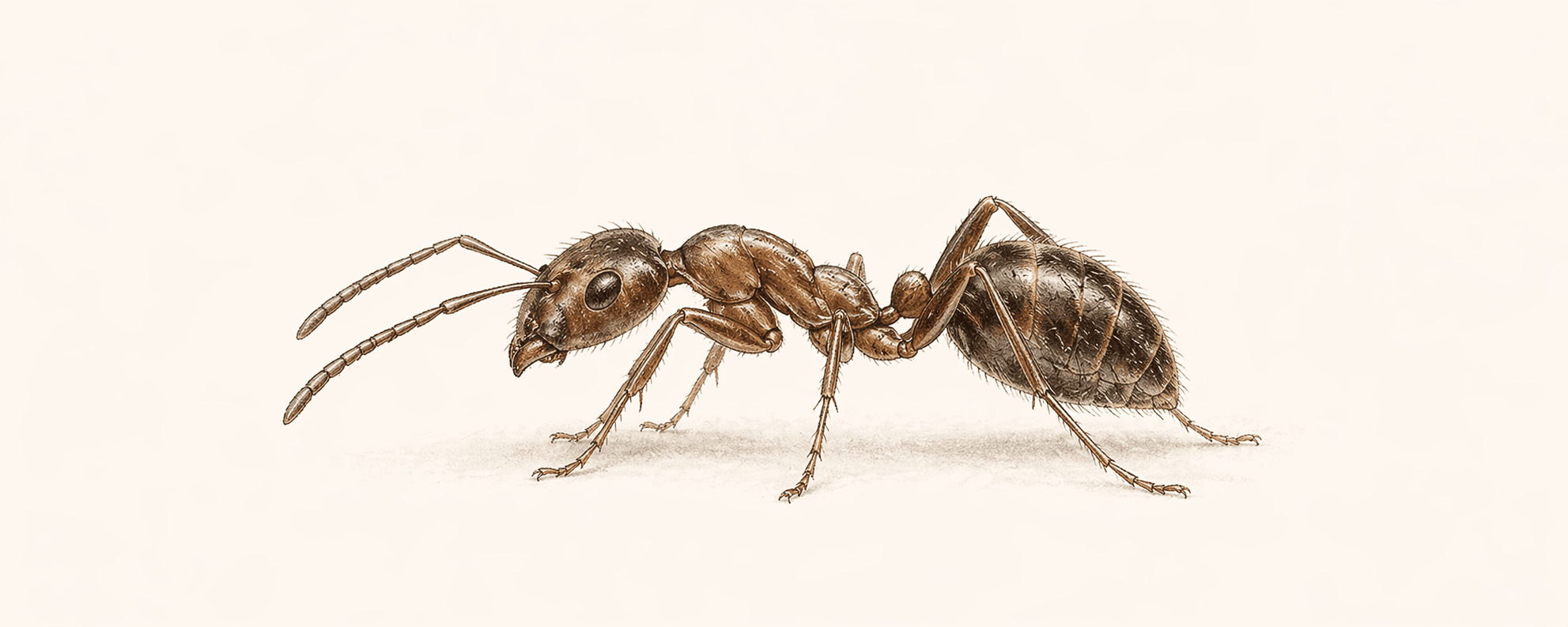
The Argentine ant, dominant along the Monaco coastline, is recognised by its small size (2 to 3 mm), its uniform honey-brown colour and its quick, purposeful gait. Unlike the black garden ants, it neither bites nor stings, but its physical inconspicuousness is deceptive: it is ecologically far more aggressive.
The signs of infestation to watch for:
- Continuous trails along skirting boards, tile joints and window frames, often from a plant pot or an electrical socket
- Small mounds of fine sand or debris between terrace slabs, at the base of low walls
- Convergence on a sugary source: crumbs, a pet's bowl, fruit, but also aphids on indoor plants
- Nuptial flights occasionally in spring in other species (carpenter ants, pharaoh ants in professional kitchens)
- Ants at water points (sinks, bathrooms) during heatwaves
The absence of a single visible nest is characteristic of Linepithema humile: the colony is fragmented, polygynous (several queens), and spread between flowerpots, service ducts, dry-stone walls and roof insulation. A simple count of workers on a trail never reflects the true scale.
Health and material risks
Ants are not harmless. On the health side, they mechanically carry bacteria (salmonella, staphylococci, enterobacteria) on their tarsi as they move between bins, litter trays, sinks and food surfaces. In a professional kitchen or a care residence, this vector is incompatible with hygiene obligations. The pharaoh ant (Monomorium pharaonis), present in some heated buildings, is particularly dreaded in hospital settings for its ability to colonise medical devices and infusion bags.
On the material side:
- Short circuits in electrical equipment (nests in home-automation boxes, pool control cabinets, outdoor bollards)
- Degradation of insulation (foams, mineral wool tunnelled through)
- Proliferation of aphids and scale insects on olive trees, lemon trees and terrace bougainvilleas (the ants farm them for their honeydew)
- Contamination of a wine cellar, dressing room or library by satellite colonies
On the legal side, a Monaco landlord must provide a decent dwelling free of pests. For food businesses (restaurants, hotels, patisseries), the HACCP food safety management plan requires documented control of crawling pests, with traceability of interventions — a point on which inspections are regular in the Principality.
Why ants thrive in Monaco and on the Riviera
The Monaco coastline ticks every box favourable to Linepithema humile. A mild Mediterranean climate without prolonged frost allows near-continuous activity, short overwintering and a resumption as early as February. Vertical urban density with ducts, expansion joints and suspended ceilings offers invisible movement corridors between floors and buildings. Dense terrace planting (Larvotto, Fontvieille, Monte-Carlo) multiplies the micro-habitats.
The distinctive feature of the Argentine ant on the Riviera is the formation of a Ligurian-Provençal supercolony that extends, with no territorial boundaries between nests, from Liguria to the Marseille area. The workers of a nest in Beausoleil can, in theory, cooperate with those of a nest in Cap-d'Ail without intraspecific aggression. As a result, treating a flat without coordinating with the common areas or neighbours produces an almost systematic rebound.
The seasonality is worth knowing:
- March-April: emergence from overwintering, rebuilding of trails
- May-September: peak activity, indoor invasion of homes in the event of drought
- October-November: return towards the outdoor nests
- December-February: residual activity in heated areas (kitchens, boiler rooms, party walls)
The MPS protocol in five steps
Our intervention follows a structured sequence, designed to eradicate the colony without reactive budding.
- Initial diagnosis: mapping of trails, identification of the species (binocular magnifier if necessary), location of entry points, assessment of the environment (planting, party walls, food sources). We also note the presence of satellite nests in ceilings or partition walls.
- Targeted gel-bait treatment: deposit of micro-drops of a biocidal gel with a sugar matrix (fipronil or imidacloprid depending on context) on the active trails. The active substance is slow-acting: the workers have time to carry it back to the nest and share it with the queens and brood through trophallaxis. No spray, no fumigation.
- Complementary treatment of outdoor areas if needed: bait granules at the base of walls, in planters, flowerpots and dry-stone walls.
- Inspection at 10-15 days: verification that the trails have died out, spot re-treatment if any areas resist (very large colonies or resurgence from untreated party walls).
- Certification and recommendations: delivery of an intervention report and preventive advice.
MPS holds the Certibiocide certificate N121134, mandatory for the professional use of TP18-class biocides.
Mistakes to avoid
Self-treatment is the leading cause of the worsening of an Argentine-ant infestation. The most frequent counter-productive actions:
- Spraying a household insecticide (aerosol, contact lacquer): the product kills a few hundred visible workers but triggers a defensive budding: the colony splits, the queens disperse, and the infestation doubles in extent
- Cleaning the trails with bleach or vinegar while a gel treatment is under way: destroys the pheromones that guide the workers to the bait, cancelling the effect
- Sealing the entry points with silicone before treatment: the ants open new passages and diagnostic access is lost
- Setting contact traps (sticky strips, barrier powders): ineffective against a supercolony, they mask the true scale
- Using coffee grounds, bicarbonate of soda or cinnamon: anecdotal repellents with no effect on an established colony
- Mixing several gels from different brands: the ants desert the baits out of chemical wariness
The rule: observe without intervening before the expert survey, do not wash the trails, do not move the furniture involved.
A typical Monaco case
The manager of a Monte-Carlo residence contacted us in early June after several reports from co-owners: light-brown ants were coming up from the terrace of a sixth-floor unit into the kitchens of three different flats, using the service ducts. A previous contractor had sprayed an insecticide in the common areas, without result — on the contrary, the trails had multiplied.
Our diagnosis identified Linepithema humile with at least two main hotspots: a terrace planter and a crawl space in the basement. We coordinated a synchronous treatment of all identified points on the same morning, with gel bait, in both common-area and private access. Two inspection visits at fifteen days and then at one month confirmed that the trails had died out. The managing agent received a documented report, ready to be added to the management file. Total discretion, no smell, no interruption of the seasonal lettings under way.
Lasting prevention
Once the colony is eradicated, prevention rests on simple habits and light monitoring.
- Sealing: neoprene silicone around pipe penetrations, window seals renewed, door thresholds adjusted
- Food sources: keeping sugary foods in airtight boxes, pet bowls picked up after meals, a kitchen bin with a lid, emptied daily in summer
- Terraces and planters: control of scale insects and aphids on citrus trees and bougainvilleas (white-oil treatment outside flowering), avoiding overly thick mulch pressed against walls
- Water points: repair of slow leaks under sinks and behind washing machines, drain traps kept full during prolonged absences
- Monitoring: visual inspection of skirting boards and terrace edges every fortnight from April to October
For prestigious residences, hotels and food businesses, we offer a seasonal watch contract with visits scheduled at the start of spring and documented, HACCP-compliant follow-up.
Regulatory framework
In Monaco as in France, the professional use of insecticidal biocides is governed by the European framework for professional biocides. Operators must hold a valid Certibiocide (personal, five years) — MPS holds N121134. The application of TP18 products (insecticides) in occupied premises requires a prior risk assessment and clear information to the client about re-entry times.
In the Principality, food establishments are subject to inspection by the les autorités sanitaires monégasques and must keep an up-to-date pest-control register compliant with HACCP requirements, with traceability of interventions and products used. In neighbouring France (Beausoleil, Menton, Cap-d'Ail), it is the les autorités sanitaires régionales françaises and the les services vétérinaires départementaux that exercise this control. The biocides used must hold marketing authorisation, which excludes most products sold in consumer garden centres for commercial applications.
For Monaco co-owned buildings, responsibility is generally shared between the common areas (managing agent) and the private areas (occupant), according to the co-ownership regulations.
How long, how many visits
For a standard residential Argentine-ant infestation, complete resolution generally occurs within two to four weeks after the first visit. The visible trails fade within a few days (the workers die progressively), but the extinction of the queens and brood takes time — that is the price of lasting effectiveness.
Realistic timeframes by case:
- Isolated flat, single hotspot: one visit is sufficient in most cases, inspection at three weeks
- Planted terrace with outdoor nests: two visits recommended, a fortnight apart
- Co-owned building with several units affected: coordinated treatment in one morning + one to two inspections
- Restaurant, hotel, professional kitchen: integration into a watch plan with quarterly visits
- Villa with garden and dry-stone walls: two-stage treatment (indoors then outdoors), one-month observation period
We do not charge for the follow-up inspections included in the initial quote. In the event of a proven rebound within three months, we re-treat at no extra cost — a results principle that few professionals formalise.
In any doubt? Our team responds within 2 working hours. +377 37 70 70 02 — or [request a free quote](/devis-gratuit).
When you are facing a ant problem in Monaco, the first 24 hours shape everything that follows: our emergency guide details the immediate steps, the realistic resolution timeline and how a professional intervention unfolds.