July 10, 2026 · 13-minute read
Ant problem in Monaco: what to do in an emergency?
An ant problem in Monaco? Here are the emergency steps, the species to know and the pro bait-gel protocol to wipe out the colony at its source.
An ant problem in Monaco: the first 5 actions within 24 hours
An ant problem in Monaco almost always begins with a trivial detail: a dark, moving line along a tile joint, a few workers around a sugary saucer, a discreet file climbing a kitchen wall in Monte-Carlo. These first signs are easy to underestimate, yet discovering an active trail warrants an emergency response. Whether the problem concerns an apartment in Larvotto, a terrace in La Condamine or a catering back-office in Fontvieille, the emergency logic is identical: deprive the ant of resources, preserve the clues, call. Here are the five actions to take in the first hours, before you even dial a number.
- Secure sugars and fats. The ant looks first for carbohydrates and lipids. Move sugar, honey, syrups, ripe fruit, cakes, pet kibble and greasy leftovers into airtight glass or metal containers. Wipe worktops with diluted vinegar to erase the micro-residues that keep the traffic going.
- Do not wipe out the chemical trail. A file of ants follows a pheromone trace laid on the ground. Crushing it or cleaning it partially scatters the colony without reducing it, which complicates targeted treatment. Leave the trail visible for the technician: it often leads straight to the nest.
- Isolate water points. The ant needs moisture as much as food. Repair micro-leaks under traps, wipe condensation under the sink and around air conditioners, and never leave standing water in plant saucers. A single permanent water point is enough to anchor a colony.
- Photograph the route. Take pictures of the complete line, from the entry point to the food source, as well as close-ups of the workers. These shots help identify the species and map the problem without having to disturb everything before the intervention.
- Call a certified operator. In Monaco, treatment must be carried out by a professional holding the Certibiocide certification (Monaco Pest Solutions: Certibiocide N121134, RCI Monaco 26S10394). A call to +377 37 70 70 02 or a message to contact@monacopestsolutions.mc triggers a same-day assessment.
These five actions stabilise the situation without worsening the risk or scattering the colony. They win you the essentials: diagnostic time and a usable trail.
Emerging or established colony: reading the signs
Faced with an ant problem in Monaco, the first question is whether you are seeing a passing exploration or an already established colony. The distinction shapes both the level of urgency and the nature of the protocol, because a handful of scouts is not treated like a mature nest of several thousand individuals.
Signs of an emerging colony:
- A few isolated, scattered worker ants, with no continuous file.
- An intermittent presence, often linked to a forgotten piece of food, which stops as soon as you clean.
- No sign of winged ants.
- A single apparent entry point, usually a joint or a crack.
Signs of an established colony:
- A dense, permanent file of ants, active day and night, around the clock.
- A visible number of ants increasing from one week to the next.
- The presence of winged ants (reproductive sexuals) around windows or light points: the sign of a mature nest that is swarming.
- Workers facing each other mouth to mouth to exchange food: this is trophallaxis, a key ant behaviour that explains why a well-designed bait can reach the queen.
- Several ant trails converging on the same gap in a wall, skirting board or slab.
From three cumulative signs, the colony is considered active. In Monaco, the density of the built environment, the mild climate and the continuity of planted façades favour a rapid transition from one stage to the next. An ordinary observation at the start of the week can become a structured problem within a few days, hence the value of an emergency response at the first clues.
Three species to know in the Principality
The Principality is home to several harmful ant species, and confusing them leads to treatment errors. Each ant species has its own routes, food preferences and biology. Three of them account for most of the ant problems encountered in Monaco.
The Argentine ant (*Linepithema humile*)
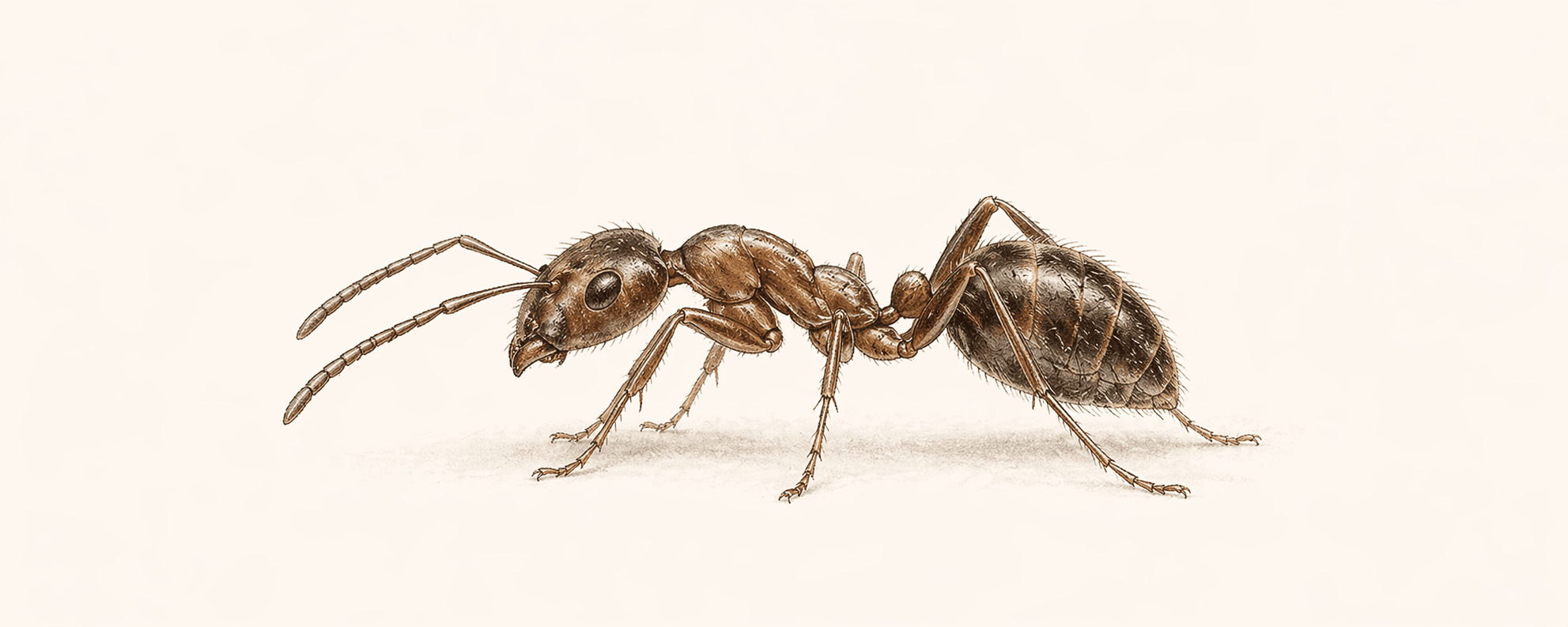
This is the dominant species across the whole French Riviera and in Monaco, where it has become endemic after an old introduction. Small and light brown, it is recognised above all by its organisation into super-colonies: instead of isolated, rival nests, Argentine ants form a continuous network of interconnected nests that cooperate rather than fight. A single super-colony can span several buildings, gardens and terraces in Monte-Carlo. This biology explains why a localised treatment almost always fails: reducing one entry point simply shifts the flow to another. The Argentine ant loves sugary substances and follows façades, low walls and vegetation at the edge of the built environment.
The carpenter ant (*Camponotus*)
Markedly larger, often black, the carpenter ant does not eat wood but hollows it out to house its colony. It seeks out damp or degraded wood: beams exposed to infiltration, old joinery, poorly ventilated frameworks. In Monaco, it is found in older buildings and the villas of Fontvieille whose framing elements have taken on moisture. Its presence often signals an underlying moisture problem that must be treated in parallel. The galleries it hollows out gradually weaken the load-bearing elements.
The Pharaoh ant (*Monomorium pharaonis*)
Tiny and amber-yellow, the Pharaoh ant is the most problematic in sensitive settings. It favours the heat and humidity of kitchens, back-offices and technical rooms, and nests in the smallest gaps. Its danger lies in two traits: it can carry germs while moving between soiled zones and food surfaces, and it reacts to aggressive treatments by budding, meaning the splitting of the colony into several foci. This is precisely the species dreaded in professional kitchens and care areas, where its management demands a bait method rather than spraying.
A field diagnosis makes it possible to identify the dominant species from the workers, the routes and the entry points. This is the essential condition for choosing the right strategy.
The real risks: food contamination, structure, image
An ant problem not treated as an emergency never stays contained. The colony grows, trails multiply, and the consequences build up on three fronts that must be faced squarely.
Food contamination. In catering, the ant moves between dirty zones and preparation surfaces, which places it in direct conflict with HACCP principles. A file of ants crossing a worktop, a flour stock or a cold room constitutes an immediate non-conformity during an inspection. The Pharaoh ant in particular is recognised as a passive vector of germs. For a restaurant in Monte-Carlo, a visible presence in the dining room or kitchen can be enough to trigger a procedure and to engage the operator's liability towards the Monegasque health authorities.
Risks to the structure. The large carpenter ant hollows galleries in load-bearing wood, and mature colonies can weaken a beam or a frame over several seasons. Moreover, all species readily exploit electrical corridors: conduits, boxes, panels and warm fittings attract workers, who accumulate there and can cause short circuits. In a Monegasque building where conduits serve several lots, an ant problem in a technical box quickly becomes the whole co-ownership's concern.
Image and liability. An ant spotted by a customer on a table, a tray or a windowsill is enough to trigger a guest complaint, an unfavourable online review or a claim. For a high-end address in Monaco, the reputational damage caused by ants far exceeds the cost of treatment. The discretion and speed of the emergency response are here an integral part of the service.
Why supermarket sprays often make the problem worse
Faced with the first ants, the reflex is to spray a contact insecticide bought at a supermarket. In the vast majority of cases, this is a poor response that worsens the problem instead of solving it.
The spray scatters the colony. A contact insecticide kills the few visible ants but never reaches the queen, the only one ensuring reproduction. Worse, the chemical aggression triggers in several ant species a flight-and-division reflex. In the Pharaoh ant, this causes colony budding: the single nest fragments into several scattered foci, each with its queen, and the problem goes from one point to treat to five. You thus multiply the work instead of reducing it.
The spray teaches the colony to avoid the poison. By making a zone repellent, you push the ants to go around the bait the professional will later place. Spraying also destroys the ant's pheromone trails which, left intact, would have guided the technician to the nest. So you lose the most valuable information of the diagnosis.
The spray needlessly exposes the indoor environment. Diffusing an aerosol near worktops, children's toys or pet bowls introduces a domestic risk with no lasting benefit. The colony, meanwhile, reforms within a few weeks.
This is why a professional intervention rests on the opposite logic: not to repel, but to let the colony transport a slow bait itself to the queen. This bait approach, patient and targeted, is the only one that lastingly neutralises an established ant problem.
The Monaco Pest Solutions intervention protocol in 4 steps
Our response to an ant problem in the Principality follows a four-step protocol, calibrated for emergencies and adapted to the Monegasque built environment, from the old buildings of La Condamine to the planted terraces of Monte-Carlo.
Step 1 — Diagnosis and species identification. A certified technician comes out within a short timeframe. He identifies the species involved (Argentine, carpenter or Pharaoh ant), traces the trails back to the entry points and, where possible, locates the nest or nests. This step conditions everything: the Argentine ant requires treatment on the scale of the super-colony network, the carpenter ant a treatment coupled with the moisture question, the Pharaoh ant a bait method excluding any spraying.
Step 2 — Targeted bait gel. We place an appetising bait gel at strategic points, along the active ant trails. The workers consume it and carry it back to the nest, where it is distributed by trophallaxis mouth to mouth to the queen and the brood. It is this internal transport, carried out by the colony itself, that neutralises the focus in depth where a spray would only touch the surface. The active ingredients are chosen according to the species and the context, residential or catering.
Step 3 — Follow-up and adjustment. One to several control visits make it possible to check bait consumption, reposition the placement points and confirm the drop in activity. A threshold of nil activity stable over two consecutive passages validates the neutralisation.
Step 4 — Physical sealing and prevention. Once the colony is extinguished, we seal the entry points with suitable materials: sealant for cracks, joints on pipe passages, treatment of skirting-board gaps. Without this physical exclusion, a new colony can reinvest the same routes. Prevention advice is handed to the client.
The whole is covered by our commitment to discretion: technician in neutral attire, unmarked vehicle on request, contractual confidentiality.
How long to eradicate the colony: the realistic timing
This is the first question that comes up on the phone. Here are the honest benchmarks, with no commercial promise.
Within 3 to 7 days: visible activity drops markedly. Once the bait gel is in place, the ants carry it back to the nest and the surface flow gradually reduces. Be careful: this lull does not mean the end of the problem. It indicates that the bait is circulating in the colony, which is precisely the desired effect. Seeing fewer ants at this stage is a signal of effectiveness, not a conclusion.
Within 2 to 6 weeks: the colony is eradicated. The bait acts with a delay, the time it takes to reach the queen and the brood by trophallaxis and interrupt reproduction. The exact duration depends on the species. A Pharaoh ant colony or a very extensive Argentine ant super-colony sits in the upper part of the range; a more confined focus is neutralised faster. The carpenter ant often requires treating in parallel the moisture source that attracted it.
Beyond: the prevention phase. Once the problem is solved, the calendar shifts to periodic visits for exposed sites. For a restaurant in Monte-Carlo or a residence in Fontvieille with a garden, a maintenance contract remains the most reliable protection, notably against the Argentine ant whose regional network exerts constant pressure from the surrounding vegetation.
These timeframes apply to an intervention carried out at the first signs. A colony established for several months, or a super-colony extended to the scale of a block, may require a longer treatment and reinforced follow-up.
Real cases encountered in Monaco
Three configurations recur regularly in the Principality. Each illustrates why a field diagnosis remains irreplaceable.
Terrace restaurant in Larvotto. An operator reports an emergency invasion of small brown ants on his terrace, climbing onto tables and trays in full service. Diagnosis: Argentine ant, with a super-colony anchored in the vegetation and low walls bordering the establishment. A one-off treatment would have been useless; we placed a mesh of bait gel along the routes and worked the built edge on the vegetation side, then sealed the rises through the slab joints. The return to a clean terrace was obtained within a few weeks, with seasonal follow-up to contain the regional pressure.
Apartment in Monte-Carlo. A resident observes tiny yellow ants in a continuous file in her kitchen, right into a food cupboard. Diagnosis: Pharaoh ant, a species never to be treated by spraying on pain of budding. We removed any spray source already used by the client, placed a discreet bait gel at the crossing points, and let the colony transport the bait itself to the nest lodged in a technical partition. Complete disappearance required several weeks of patient follow-up, with no nuisance for the occupant.
Villa in Fontvieille. The owner notices large black ants coming out of an exposed beam, accompanied by fine sawdust. Diagnosis: carpenter ant established in a framing element that had suffered infiltration. Beyond the bait treatment, we flagged the moisture problem to be dealt with to prevent any recolonisation, then sealed the emergence holes. The case illustrates a constant rule: with the carpenter ant, extinguishing the colony without correcting the moisture is like leaving the door open.
These three cases share one common point: without an initial diagnosis and precise species identification, none of these solutions would have been prescribed correctly.
After the intervention: locking in prevention
An ant problem solved as an emergency calls for documented prevention, to prevent the cycle from starting again. In Monaco, a successful intervention is only worthwhile if the environment stays unfavourable to the ant colony. Here are the measures we systematically recommend.
Physical closure. Treat skirting-board gaps, redo disjointed tile joints, seal wall cracks and pipe passages. These micro-openings are the ant's motorways. Careful sealing closes the routes reused from one season to the next.
Food hygiene. Sugary and greasy foods in airtight containers, worktops wiped after each use, crumbs and residues removed in the evening. Pet kibble put away after meals, bowls cleaned. Bins closed and emptied regularly. The ant only settles lastingly where it finds a stable resource.
Water management. Remove permanent moisture points: trap leaks, condensation under the sink and behind air conditioners, excess plant saucers. With the carpenter ant, monitoring and correcting any infiltration in the wood is the most decisive preventive measure.
Vegetation at the edge of the building. This is the key point against the Argentine ant. Prune plants touching the façades, clear low walls and planters stuck to the building, prevent branches and foliage from bridging the garden and the openings. The super-colony network relies on this plant continuity to reinvest a treated space.
Monitoring contract. For shops, restaurants, residences and exposed co-ownerships, scheduled passages are the best insurance against reinstallation, with complete documentation usable in the event of an inspection.
An ant problem right now? Reach Monaco Pest Solutions in an emergency
Monaco Pest Solutions operates across the whole Principality and neighbouring communes for any ant problem. Our technicians hold the Certibiocide N121134, the company is registered with the RCI Monaco under number 26S10394.
Our commitments:
- Rapid response to any emergency treatment request.
- Diagnosis with species identification before any action, the condition of an effective treatment.
- Bait-gel method that neutralises the colony at its source, with no scattering or budding.
- Contractual discretion: staff in neutral attire, unmarked vehicle on request.
- Full traceability: visit reports usable for your documentary obligations.
An ant problem in Monaco is all the better managed for acting early. Contact our team on +377 37 70 70 02 or at contact@monacopestsolutions.mc — or make your **free quote request. In the event of an active infestation, our 24/7 emergency** line answers without delay.
Frequently asked questions
- How long does it take to get rid of an ant invasion in Monaco?
- Visible activity drops markedly within 3 to 7 days after the bait gel is placed: the workers carry it back to the nest and the surface flow reduces. Complete eradication of the colony generally takes 2 to 6 weeks, the time it takes for the bait to reach the queen and the brood by trophallaxis and interrupt reproduction. The duration depends on the species: an Argentine ant super-colony extended to the scale of a block or a Pharaoh ant focus sits in the upper part of the range, a confined focus is neutralised faster. In Monaco, for an exposed site such as a restaurant or a residence with a garden, periodic follow-up is recommended to contain regional pressure and prevent any reinstallation.
- Can I use a supermarket anti-ant spray?
- It is not advised, because a contact insecticide often makes the problem worse. It kills the few visible workers but never reaches the queen, the only one ensuring reproduction. In the Pharaoh ant, the chemical aggression triggers budding: the single nest fragments into several foci, each with its queen, and a localised problem becomes multiple. The spray also destroys the pheromone trails that would have guided the technician to the nest, and makes the zone repellent, which pushes the ants to go around the professional bait placed afterwards. The effective method is the opposite: let the colony transport a slow bait gel itself to the queen. This is the only approach that lastingly neutralises an established ant problem in Monaco.
- How do I recognise an Argentine ant?
- The Argentine ant (Linepithema humile) is small, about two to three millimetres, of uniform light brown colour, and moves in dense, regular files. Its most characteristic trait is not its appearance but its organisation: instead of isolated, rival nests, it forms super-colonies, continuous networks of interconnected nests that cooperate rather than fight. A single super-colony can span several buildings, gardens and terraces. Concretely, if you crush a file and another reforms immediately by a neighbouring route, if the ants follow the low walls and vegetation at the building's edge and love sugary substances, it is very probably this species, endemic to the French Riviera and Monaco. Its identification requires treatment on the scale of the network, not of an isolated point.
- Are ants dangerous for children or pets?
- The common species in Monaco do not sting and present no direct danger comparable to other pests. The main risk is sanitary and indirect: the Pharaoh ant in particular moves between soiled zones and food surfaces and can passively carry germs, which makes it problematic near food, in a kitchen or a child's room. The real danger for children and pets often comes from the occupants' hasty reaction: spraying a contact insecticide near worktops, toys or bowls introduces a domestic risk without neutralising the colony. The professional bait-gel method, placed at discreet, secure points out of reach, precisely avoids this exposure while treating the problem at its source.
- Are your interventions discreet for a private residence?
- Yes, discretion is an integral part of our service, especially in Monaco where confidentiality is essential. Our technicians work in neutral attire and, on request, with an unmarked vehicle. The bait-gel treatment is itself discreet: a few targeted placement points along the routes, with no aerosol cloud or visible equipment, without disturbing household life. We adapt visit times to your constraints and cover the intervention with a contractual confidentiality commitment. Visit reports are handed directly to you. For a high-end residence in Monte-Carlo or a villa in Fontvieille, this approach makes it possible to solve an ant problem without those around you being informed.
- How quickly can a technician come out on an emergency basis in Monaco?
- For an emergency request in Monaco, a certified technician comes out within a short timeframe, generally the same day for the Principality and neighbouring communes. Faced with an active ant problem in a professional kitchen, a restaurant dining room or a home, speed matters as much to limit spread as for the establishment's image. A first contact on +377 37 70 70 02 or at contact@monacopestsolutions.mc makes it possible to qualify the situation, probably identify the species from your photos and schedule the visit. In the event of an active infestation, our 24/7 emergency line answers without delay. The on-site diagnosis always precedes treatment, in order to adapt the method to the species and the context.