July 16, 2026 · 8-minute read
Cockroaches in Fontvieille: why this neighbourhood suffers…
Fontvieille, a neighbourhood reclaimed from the sea, combines humidity conditions and a shared building fabric that favour the German cockroach. Analysis…
An infestation that keeps coming back, floor after floor
The scenario recurs often in Fontvieille. An occupant treats their kitchen, believes the problem is solved, then finds cockroaches again three weeks later along the skirting board, behind the dishwasher, in the drawer under the sink. They start over, with a product bought at the supermarket. The population falls, then rises again. After a few months, the flat above reports the same thing, then the one across the landing. What looked like an isolated domestic incident turns out to be a co-ownership matter.
This pattern is no geographical accident. Within a restricted perimeter, Fontvieille concentrates a set of conditions that make the German cockroach particularly hard to dislodge: made ground, a high water table, and recent buildings whose technical networks are shared between several units. The neighbourhood is home to Monaco's second harbour and several large public facilities. Behind this contemporary façade, the building fabric tells a particular story: that of a landfill platform.
In Monaco, not all neighbourhoods are equal when facing this pest. The older buildings of neighbouring La Condamine present other weaknesses — thick partition walls, irregular crawl spaces. The villas of Saint-Roman raise still other questions. But Fontvieille accumulates humidity and topographical factors which, taken together, form ground for the lasting establishment of Blattella germanica. Understanding why requires looking back at how the neighbourhood was built.
A neighbourhood reclaimed from the sea: what made ground changes
Between 1966 and 1980, Fontvieille rose out of the water. The extension added around 22 hectares to the Principality, on a platform reclaimed from the Mediterranean. This way of manufacturing the ground is not neutral for pest control: it determines the residual humidity of the building fabric and the way water circulates beneath the foundations.
A high water table and concrete raft foundations
Made ground remains, by its nature, in close contact with sea level. The water table there stays high and relatively stable. The buildings rest on concrete raft foundations, those large foundation slabs that spread the load across the platform. These rafts, in contact with a damp subsoil, maintain high humidity in the lower levels and in the ducts that run through them.
Yet the German cockroach seeks precisely a humidity level of between 65 and 85%. The bases of walls in contact with a cold slab, the plant rooms, the shared cellars offer this microclimate almost permanently, whatever the season. Where a building on dry rock naturally dries out its lower parts, the Fontvieille fabric keeps them damp.
Networks shared between buildings
The neighbourhood's buildings were designed as a whole. Wastewater networks are frequently shared between buildings, and the vertical technical ducts connect the units of a single building over their full height. These warm, damp conduits form internal motorways. A population established on the third floor can colonise the first and the fifth without ever going outside. It is this invisible continuity that explains why a flat-by-flat treatment almost always fails.
Blattella germanica: the biological profile that fits the neighbourhood
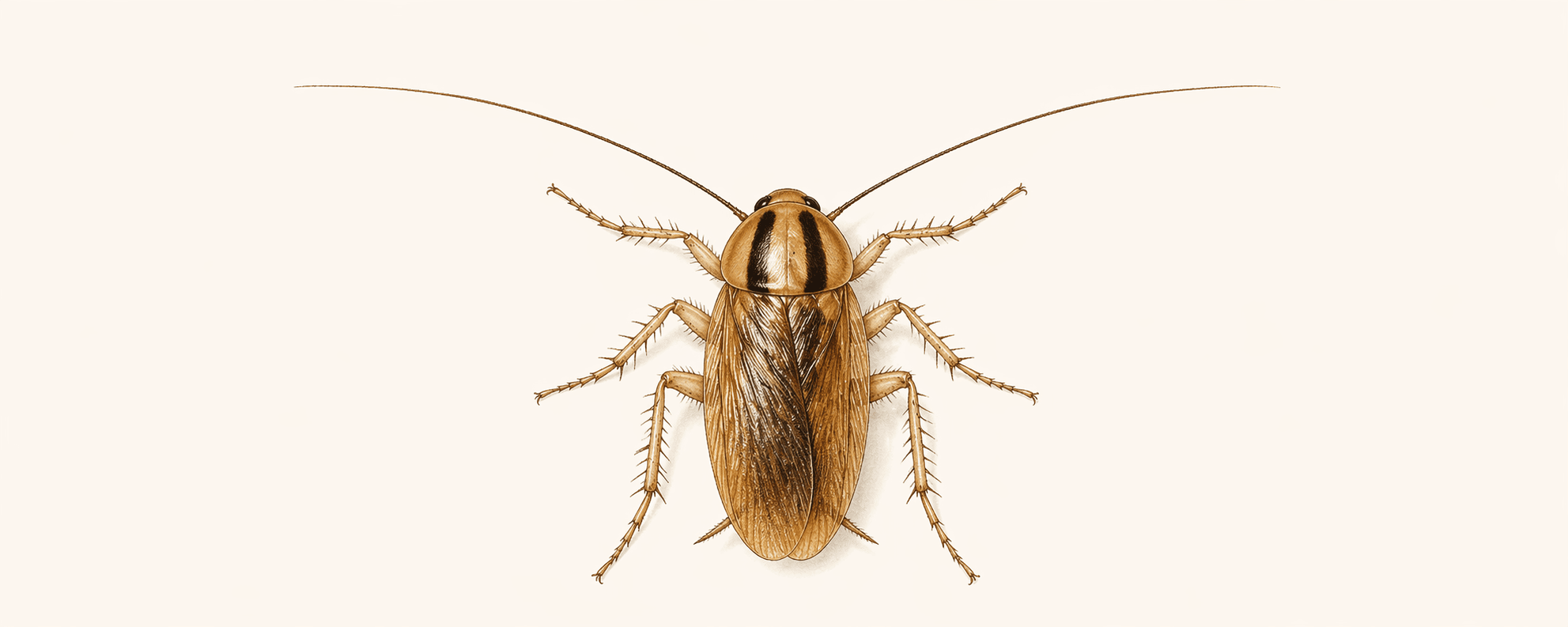
The German cockroach is not the largest of the urban species, but it is the most tenacious indoors. As an adult it measures 12 to 16 millimetres and does not fly in our conditions. Its behaviour is markedly nocturnal: more than 90% of its activity takes place in darkness, which keeps it discreet as long as the population remains moderate. Seeing a cockroach in broad daylight already signals a significant density.
Its thermal requirements match those of kitchens and plant rooms: it thrives between 25 and 33 °C, temperatures found behind a refrigerator, under an oven or along a hot-water pipe in a false ceiling. Combined with the humidity of the Fontvieille fabric, this warmth creates pockets of ideal habitat.
The life cycle is rapid: around 40 days from egg to adult in good conditions. Each female carries its ootheca — the capsule containing 16 to 40 eggs — until hatching, or nearly so. It is this detail that makes treatment so difficult: as long as the ootheca is carried and then deposited, the eggs remain isolated from most contact insecticides. The shell protects the next generation.
Add to this a remarkable resistance to deprivation: the German cockroach survives around a month without food, but only a fortnight without water. Strongly water-dependent, it is all the more at ease in a damp building fabric such as that of Fontvieille. Emptying a kitchen, cleaning, removing foodstuffs is therefore not enough to starve it within a useful timeframe. It waits, protected in a duct, and recolonises as soon as conditions become favourable again.
The entry routes specific to the Fontvieille building fabric
In Fontvieille, the points of passage follow the neighbourhood's construction logic. The vertical technical ducts, which connect the units to one another, are the main migration route. The skirting boards at the base of walls, in contact with a damp slab, offer both shelter and humidity; the slightest gap between the skirting board and the floor becomes a daytime refuge.
Kitchen false ceilings deserve particular attention: they run alongside hot pipes and form a dark, warm and rarely inspected space. Finally, the shared cellars and storage rooms, with their cardboard boxes and their stillness, serve as a population reservoir between two flats. A packing box brought up from a cellar can be enough to reintroduce cockroaches into a freshly cleaned home.
Why surface spraying fails
The most common reflex is also the least effective: spraying an insecticide on the visible surfaces. The problem lies in the neighbourhood's biology and topography. A surface spray reaches only a fraction of the population — of the order of 15 to 20% — because most individuals stay in the ducts, voids and interstices that the product does not touch.
The second pitfall is the ootheca. The insecticide does not enter the egg. Unhatched capsules are therefore spared and will release, a few days later, a new generation onto a surface now treated but ageing. The population starts up again.
The third pitfall is migration. Within the 48 hours following an aggressive intervention limited to a single unit, the cockroaches flee the treated zone and spread into the neighbouring units through the shared ducts. Treating a single flat, in Fontvieille, often amounts to moving the problem to the neighbour's — and then seeing it come back. This is why a coordinated treatment at building scale, under the aegis of the managing agent, is the only coherent approach.
The MPS protocol in Fontvieille
The Monaco Pest Solutions team approaches these cases as building problems, not as flat-level incidents. The approach targets the population as a whole, ducts included, and not just the visible cockroaches.
Endoscopic diagnosis and mapping of the foci
The first step is a precise diagnosis. Using flexible endoscopy, the technician inspects the technical ducts, the false-ceiling voids and the pipe runs without dismantling the partitions. This direct reading, completed by a survey of the activity zones, makes it possible to map the real foci — often very different from the places where the occupant saw the insects. The hot spots are thus located along the vertical columns, where inter-unit migration takes shape.
Targeted bait gel along the ducts
The treatment relies on a bait gel deposited at targeted application points, along the technical ducts and near the identified foci, rather than on a general spray. The active ingredient is chosen according to the strain encountered — indoxacarb, hydramethylnon or fipronil. These gels have a decisive property: they progress through the population by post-mortem cannibalism, a contaminated individual contaminating others after its death. This chain diffusion reaches the cockroaches that never leave the ducts and allows an elimination rate above 90% in around three weeks, including for the generations born of oothecae deposited in the meantime. Each intervention gives rise to a written report specifying the treated zones, a document handed to the managing agent — a requirement of Monegasque co-ownership.
The role of the managing agent and the co-ownership framework
In Monaco, tackling cockroaches in a building rarely falls to a single occupant. Coordinating interventions on the common areas — technical ducts, columns, cellars — falls to the managing agent. It is the agent who organises the vertical flow of information, warning the units above and below a focus, a condition without which a treatment remains incomplete.
Monegasque co-ownership law governs the allocation of charges. The common areas fall to the managing agent, the private areas to the co-owner. In the event of a widespread infestation, however, collective handling with recovery is possible, as the source of the problem is often shared. This is why Monaco Pest Solutions works in direct liaison with the managing agents and systematically provides a traceable report. The company operates under Certibiocide certificate N121134 and is registered with the RCI Monaco under number 26S10394, two references that any managing agent can verify before committing to a service on the common areas.
Prevention and monitoring after eradication
Once the population is extinguished, the objective becomes preventing reintroduction. A few structural measures make the difference in the Fontvieille fabric. Applying food-grade silicone sealant to kitchen skirting boards closes the refuges at the base of walls in contact with the slab. Rubbish bags must be sealed and kept off the ground at night, particularly in the common rooms. Reducing the storage of cardboard boxes, in the cellar as in the home, removes shelters and transport vectors.
Finally, an annual preventive check after eradication makes it possible to detect any recolonisation through the ducts before it becomes an infestation again. In a neighbourhood where the networks connect the units on a lasting basis, this light monitoring is worth more than a further heavy treatment. It follows the same logic as the initial diagnosis: treat the building, not just the flat.
Summary and getting in touch
In Fontvieille, the persistence of German cockroaches is no mystery: damp made ground, raft foundations in contact with a high water table, shared ducts and a biology cut out for darkness and waiting. Surface treatments fail because they ignore this continuity. A protocol coordinated with the managing agent, backed by an endoscopic diagnosis and a targeted bait gel, responds to it durably.
For a diagnosis on a building in Fontvieille or a neighbouring district, the Monaco Pest Solutions team can be reached on +377 37 70 70 02 and at contact@monacopestsolutions.mc. A request can also be sent via the free quote form.
Frequently asked questions
- Why are there more cockroaches in Fontvieille than elsewhere in Monaco?
- Fontvieille is built on a platform reclaimed from the sea, with made ground and a high water table. The concrete raft foundations and the technical ducts shared between units maintain high humidity, between 65 and 85%, exactly the microclimate sought by the German cockroach. The building fabric therefore favours its lasting establishment.
- Why don't my anti-cockroach treatments work in the long term?
- A surface spray reaches only 15 to 20% of the population, the rest staying in the ducts. The insecticide does not enter the oothecae, which release a new generation afterwards. And within 48 hours, the cockroaches migrate to the neighbouring units through the common networks. Without a coordinated treatment, the infestation starts up again.
- What is an ootheca and why does it complicate treatment?
- The ootheca is the capsule that the female German cockroach carries, containing 16 to 40 eggs until hatching. Its shell protects the eggs from contact insecticides: the insecticide does not enter the egg. A new generation therefore hatches after a conventional treatment, which explains the recurrences observed three weeks later.
- Must the managing agent intervene in a case of cockroaches in a co-ownership in Monaco?
- Yes. Coordinating treatments on the common areas, ducts and cellars, falls to the managing agent, who also ensures that neighbouring units are informed. Monegasque co-ownership law allocates the charges: common areas to the managing agent, private areas to the co-owner, with collective handling possible in the event of a widespread infestation.
- How does the bait gel used against German cockroaches work?
- The gel is deposited at targeted points along the technical ducts. The active ingredient — indoxacarb, hydramethylnon or fipronil depending on the strain — diffuses through the population by post-mortem cannibalism: a contaminated individual contaminates others after its death. This diffusion reaches the hidden cockroaches and gives an elimination rate above 90% in around three weeks.
- How can the return of cockroaches be avoided after a treatment?
- By closing the refuges with food-grade silicone sealant on kitchen skirting boards, by keeping rubbish bags sealed and off the ground at night, and by reducing the storage of cardboard boxes in the cellar as in the home. An annual preventive check makes it possible to detect a recolonisation through the ducts before it becomes an infestation again.