July 11, 2026 · 14-minute read
Wasp problem in Monaco: what to do in an emergency?
Wasp nest under a cornice, in a shutter box or near a terrace in Monaco? The emergency steps, the real risks and the professional protocol to secure the…
A wasp problem in Monaco: the 5 first actions within 24 hours
A relentless coming and going under a cornice in Monte-Carlo, a dull buzzing inside a roller-shutter box in Larvotto, dozens of striped insects circling a terrace in Fontvieille at lunchtime: a wasp problem does not announce itself, it imposes itself. From May to October, Monaco offers wasps everything they look for — warmth, facade cavities, watered gardens, outdoor tables. Facing an active nest, the first hour matters more than the first week. Here are the five emergency steps to take within 24 hours, before any other initiative.
- Evacuate the immediate area. Set up a perimeter of 5 to 10 metres around the point of activity. A foraging wasp is indifferent; a wasp defending its nest is not. Walk away calmly, without sudden movements, and do not return to the area until it has been secured.
- Do not spray anything from the ground. An aerosol sprayed towards a nest overhead almost never reaches the heart of the colony; it agitates the workers present and triggers an immediate defensive response. This is the classic scenario of the avoidable multiple sting.
- Close windows and shutters on the nest side. Disturbed or disoriented wasps seek light and warmth: an open flat becomes a refuge. Keep the openings on the nest side closed until the intervention.
- Move children, pets and allergic people away. A running child, a dog snapping at the insect in flight, a person with a known venom allergy: these three profiles account for most serious accidents. They leave the area first and only return after the treatment.
- Photograph from a distance and call. A zoomed shot, taken from several metres away, is enough for our technician to pre-identify the species and the type of nest. In Monaco, destroying a nest must be entrusted to a certified operator: Monaco Pest Solutions holds Certibiocide No. 121134 and is registered with the Monaco RCI under 26S10394. One call to +377 37 70 70 02 triggers an assessment the same day.
These five steps do not solve the problem, but they remove most of the immediate risk: the confrontation between the colony and the occupants.
A lone wasp or an active nest: reading the signs
Not every visible wasp in Monaco signals a nest on your property: in summer, a wasp drawn to a glass on a terrace in La Condamine may come from 300 metres away. Before speaking of an emergency, three signs distinguish an opportunistic visit from an established colony.
The repeated flight path. This is the most reliable clue. A foraging wasp wanders and zigzags; a worker returning to the nest flies straight, always along the same axis, and disappears at the same point: a facade joint, a shutter box, the underside of a cornice. Watch for five minutes from a distance: if several insects use the same flight corridor in both directions, the nest is a few metres away.
Activity in time slots. The paper wasp, very common on the Riviera, times its activity to the sun exposure of its nest. An open nest under a south-east-facing cornice comes alive in the morning then quietens during the hottest hours; a west-facing nest gets busy in late afternoon. If the traffic returns every day at the same times, in the same place, it is not chance: it is the rhythm of a colony.
Chewing sounds. The European hornet, and to a lesser extent the common wasp, builds its nest from chewed wood fibre. In an attic, a partition wall or a garden shed, this activity produces a dry, regular crackling, audible in the calm of the evening. Combined with insect traffic towards an opening, this sound signals a nest in full growth.
One last benchmark: traffic volume. Two or three passages per minute suggest a young nest; beyond ten, the colony is mature and numbers several hundred individuals. The problem then calls for an emergency professional intervention, not a home remedy.
Three species to know in Monaco and on the Riviera
Identifying the species is not an academic exercise: it determines the predictable aggressiveness, the likely location of the nest and the treatment protocol. Three species dominate interventions in Monaco between May and October.
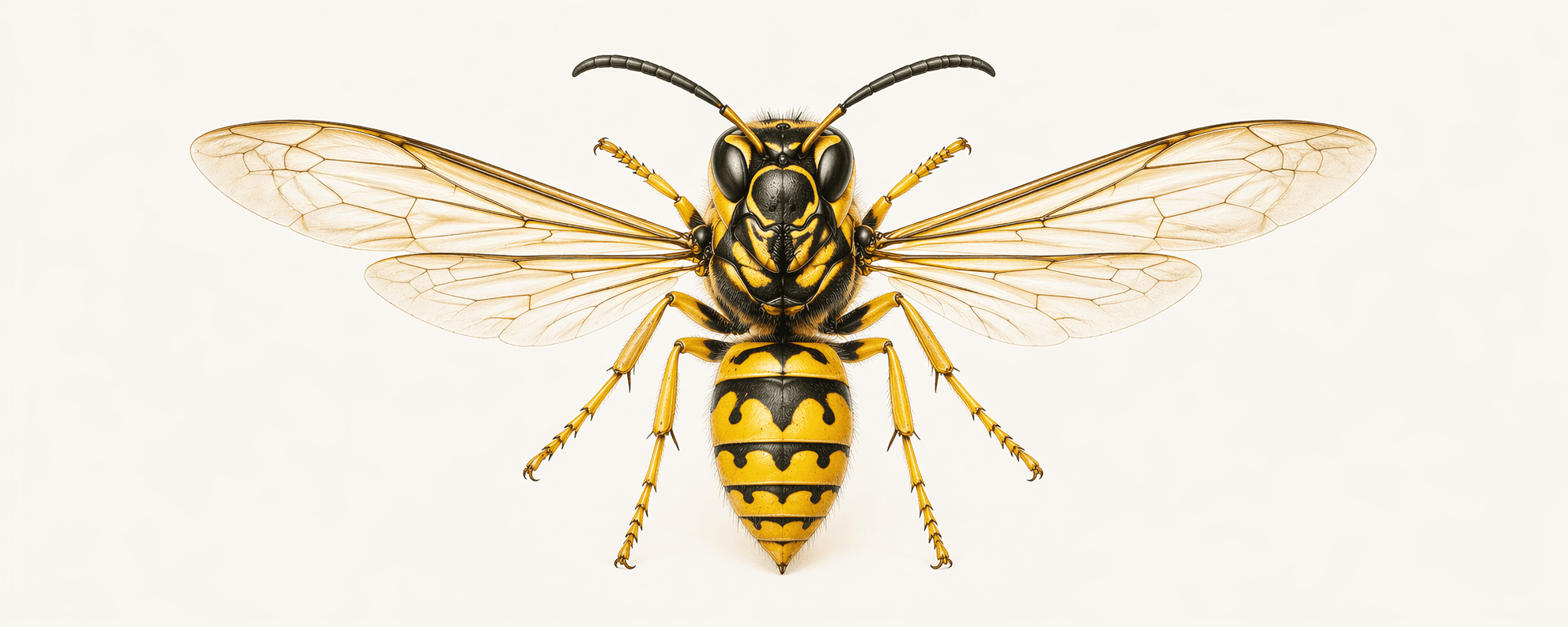
*The common wasp (Vespula germanica).* From 12 to 17 mm, sharp, high-contrast black and yellow stripes, fast and nervous flight. This is the species of roller-shutter boxes, construction voids, attics and ground cavities. Its enclosed nest, wrapped in grey paper, can house several thousand workers by late summer. It is also the most defensive species: as soon as the nest is disturbed — a vibrating shutter, a drill, a jet of water — the response is collective and immediate. Most of the multiple stings we see in Monaco involve this species.
*The paper wasp (Polistes dominula).* A finer, more elongated silhouette than the common wasp, with long legs dangling in flight. It builds open, umbrella-shaped nests with exposed cells under cornices, roof overhangs and south-facing pergolas. Modest colonies — a few dozen individuals — and a calm temperament: the paper wasp only attacks if its nest is touched. Its main issue is proximity: its nests sit exactly where people live, at terrace and window height.
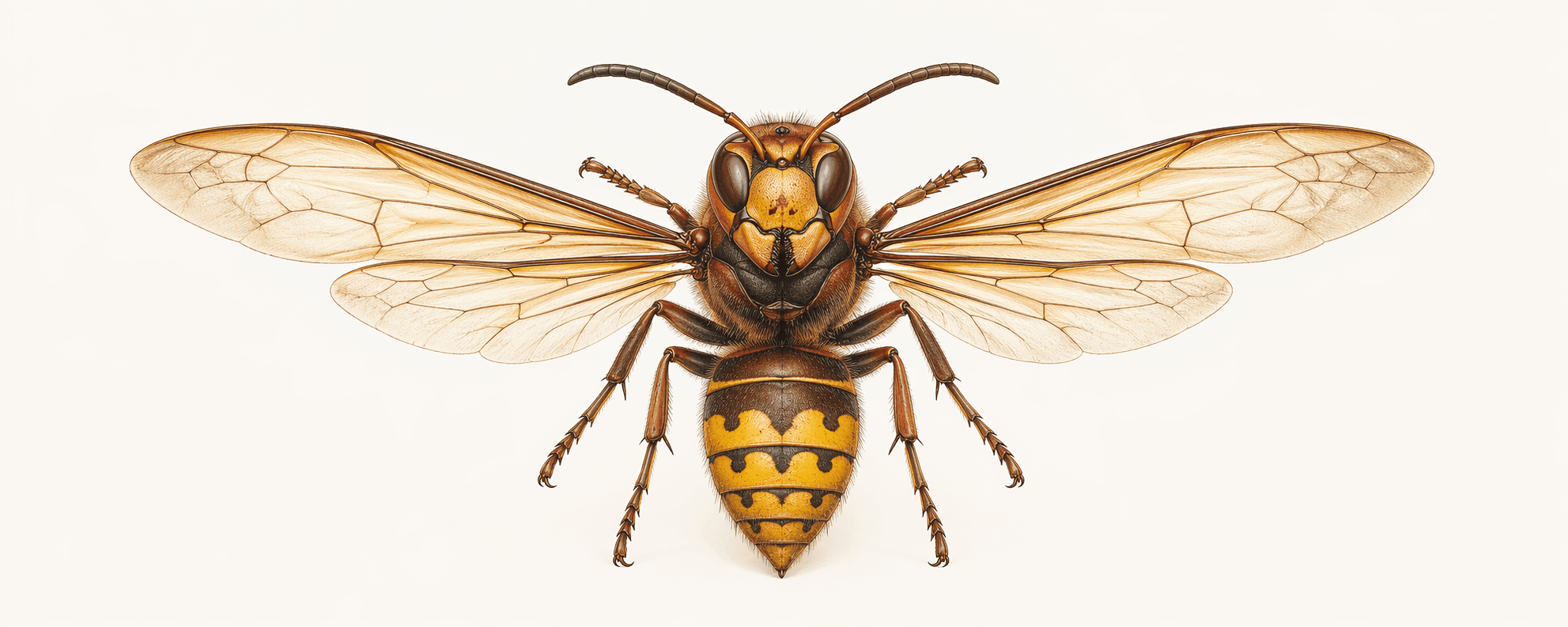
*The European hornet (Vespa crabro). From 25 to 35 mm, it impresses with its size and loud flight, but remains a relatively tolerant insect away from its nest. It becomes very defensive, however, in the last few metres around its colony, often set in a hollow tree, an attic or an unused flue. It must not be confused with the Asian hornet (Vespa velutina*), recognisable by its black thorax and yellow-tipped legs: its biology and the treatment of its nests differ, and we devote a dedicated article to it.
In all three cases, the season follows the same curve: nest founding by a lone queen in April-May, rapid growth in June-July, peak numbers and tension between August and October. The later the summer, the harder and more costly the same nest becomes to neutralise.
The real risks: multiple stings, anaphylactic shock, reputation
The risks deserve to be stated without dramatising or downplaying. A lone foraging wasp presents almost no danger. An active nest near a living area presents three very real ones.
Multiple stings. Unlike the bee, whose barbed sting remains in the skin, the wasp has a smooth sting: it can sting several times in a row without dying. Above all, a crushed wasp or a knocked nest releases an alarm pheromone that recruits nearby workers. A handled shutter or a mower striking a nest entrance thus turns into dozens of stings within seconds; in a child or a fragile person, the severity threshold is far lower than in a healthy adult.
Anaphylactic shock. An estimated 1 to 3% of the population is allergic to hymenoptera venom. For these people, a single sting can trigger a general reaction within minutes: widespread hives, swelling of the face or throat, breathing difficulty, faintness. This is a life-threatening emergency, which requires calling the emergency services immediately and using an adrenaline auto-injector without delay if the person carries one. This risk alone justifies never tolerating an active nest near a frequented area.
The reputational and business risk. In Monaco, a wasp nest is not only a health problem, it is a commercial problem. Wasps in numbers above a restaurant terrace, around a hotel pool or during a private outdoor event are enough to empty the tables and feed lasting negative reviews. The cost of an intervention bears no comparison with that of a lost service at the height of the season — not to mention a sting suffered by a guest. Our emergency line treats these situations as an absolute priority.
Why consumer aerosols and smoke bombs are dangerous
The pest-control shelf of a supermarket gives the illusion of an immediate solution. On a real nest, these products raise three problems, one of which is pure safety.
They trigger the defensive attack. An aerosol jet reaches the wasps present at the nest entrance, never the colony deep inside. The workers hit or alerted release the alarm pheromone, and the user — often in short sleeves, sometimes on a stepladder — ends up at the centre of a collective response. Ladder falls caused by wasp attacks are among the most serious accidents this kind of attempt produces.
They do not destroy the nest. The heart of the nest — the queen, the brood, the reserves — is protected by the paper envelope and the depth of the cavity. A surface treatment kills a few dozen workers and leaves the reproductive structure intact. Two days later, activity resumes, often with a colony that has become nervous and far more reactive to the slightest movement.
They disperse without solving. Smoke bombs and total-release foggers drive part of the wasps out of the treated cavity without killing them. A frequent outcome in Monaco's buildings: the insects fall back on neighbouring flats, ducts or adjacent shutter boxes, and the problem moves instead of disappearing, while the colony remains viable.
Added to this is the question of non-target wildlife: an insecticide sprayed in the open air makes no distinction between a wasp, a bee and the useful insects of a garden. A professional treatment, targeted at the nest entrance, reduces this collateral damage to almost nothing.
The Monaco Pest Solutions intervention protocol in 4 steps
Our wasp protocol is designed for a simple objective: neutralise the entire colony, not just the visible insects, with minimal exposure for occupants and for the environment. It unfolds in four steps.
Step 1 — Identification from a distance. The technician identifies the species and locates the nest entrance, with binoculars or from your photos, without disturbing the colony. This phase determines everything else: an open paper-wasp nest, an enclosed nest in a shutter box and a hornet nest in an attic call for neither the same equipment nor the same timing.
Step 2 — Dusting the entrance at the end of the day. The reference treatment is the application of a biocidal powder at the nest entrance, with a telescopic lance, by a technician in a full protective suit. The intervention is scheduled at the end of the day, when the workers return to the nest: each return carries the powder into the heart of the colony, all the way to the queen and the brood. This contamination by the wasps themselves guarantees complete destruction, where a surface treatment fails.
Step 3 — Mechanical removal at D+2. Forty-eight hours after the treatment, once all activity has ceased, we physically remove the nest whenever it is accessible: taking down the paper-wasp umbrella, extracting the nest from the shutter box, vacuuming debris in the attic. This removal prevents odours and secondary pests, and eliminates a marker for future founding queens.
Step 4 — Restart check. A check is scheduled in the following days to verify that no traffic resumes, either at the treated site or at a neighbouring cavity. In high season, a second discreet nest is sometimes discovered on this occasion; it is treated straight away.
Every intervention is documented in a written report: identified species, location, product used, prevention recommendations. For a hotel, a restaurant or a co-owned building in Monaco, this document slots directly into the health-monitoring file.
How long to secure the area: timing
The question comes up with every emergency call: when can the terrace, the pool, the bedroom be reopened. Here are the real timelines, observed in the field in Monaco.
The intervention itself: 30 to 90 minutes. An accessible paper-wasp nest under a cornice is treated in half an hour. A common-wasp nest in a shutter box or a facade cavity takes more like 60 to 90 minutes, securing the area included.
Residual activity: 24 to 48 hours. After the dusting, workers still in flight keep returning to the nest and contaminate themselves there. A declining traffic remains visible around the entrance: it is the sign that the mechanism is working. The immediate area should still be avoided during this window.
Safe area: within 48 hours in almost every case. Past this point, activity is nil and the area can be reoccupied without restriction. For an establishment open to the public, we schedule the treatment in the evening so that this window encroaches as little as possible on operations.
The season to keep watching. Neutralising a nest in June does not guarantee a wasp-free summer: other founding queens may have settled nearby, and the site's attractiveness (cavities, water, food) remains. Between May and October, a site already affected deserves simple vigilance — a weekly glance at cornices, shutter boxes and eaves — to intercept any new nest while it still measures only a few centimetres.
Real cases in Monaco
Three recent, anonymised interventions illustrate the variety of situations in Monaco and its neighbouring communes.
Paper-wasp nests under the cornice of a villa in Cap-d'Ail. A family notices a traffic of slender insects above the pool terrace, four metres from the diving board. Identification from a distance: three Polistes dominula umbrellas under the south cornice, one of them the size of a hand. Treatment at dusk with the telescopic lance, removal of the three nests at D+2, inspection of the remaining cornices — two primary nest buds removed during the same visit. Pool reopened 48 hours after the first visit.
Common-wasp nest in a roller-shutter box in Monte-Carlo. A resident reports a continuous buzzing in the shutter box of her bedroom and a few wasps found inside the flat. Immediate instructions by phone: stop operating the shutter, close the window, keep the children away. The outside traffic confirms a Vespula germanica nest entering under the casing. Dusting at the end of the day, extraction of a 30 cm nest two days later, then fitting of a sealing brush. No activity at the following week's check.
Nest in the attic of a garden shed in Fontvieille. A building caretaker hears a regular crackling in the ceiling of a maintenance shed and observes sustained traffic under the edge flashing. More than twenty passages per minute: a mature colony of several thousand individuals. Dusting of both accesses, temporary closure of the shed, removal of a 40 cm nest at D+2 and mesh sealing of the edges. The room was handed back to the team three days after the initial call.
Three settings, three configurations, one common point: in every case, nobody was stung, because nobody tried to treat the nest themselves.
After the intervention: prevention for next season
A destroyed nest does not protect against next year's nests: every spring, young founding queens that overwintered look for a cavity or a shelter to start a new colony. Prevention rests on three measures, all cheaper than an emergency intervention in August.
The spring inspection. In April, a primary nest is the size of a golf ball and houses only the founding queen: removing it is fast, carries no notable risk, and costs roughly ten times less than treating a mature nest in August. An inspection of the sensitive points — cornices, shutter boxes, eaves, garden sheds — at the start of the season intercepts the majority of colonies before they become a problem. For Monaco's hotels and restaurants, this inspection is built into the first spring visit of the annual contract.
Traps for founding queens. Between March and May, pheromone and selective bait traps, positioned away from living areas, catch part of the founding queens searching for a site. Every queen caught in this period is an entire colony that will never exist. Late trapping in summer, by contrast, is of little use: it catches workers without weakening the nests.
Sealing the cavities. This is the most durable measure. Sealing brushes on shutter boxes, fine mesh on vents and roof edges, filling of facade cracks: every closed cavity is one less nesting site, for wasps as for other pests. Our end-of-intervention report lists the recommended sealing points, in order of priority.
Add two simple habits in season: cover sweet food and drinks outdoors, and pick up fallen fruit in gardens. A less attractive site is a less colonised site.
A wasp problem right now? Reach Monaco Pest Solutions urgently
Based at 29 Bd Rainier III, 98000 Monaco, Monaco Pest Solutions operates across the whole Principality and the neighbouring communes (Cap-d'Ail, Beausoleil, Roquebrune-Cap-Martin, Menton). Our technicians hold Certibiocide No. 121134, and the company is registered with the Monaco RCI under number 26S10394.
Our commitments for any wasp emergency:
- Response within 2 working hours to any request concerning an active nest.
- Priority intervention when the nest threatens a terrace, a pool, a child's bedroom or an establishment open to the public.
- Targeted treatment: full protective suit, telescopic lance, dusting of the nest entrance, respect for non-target wildlife.
- Clear quotation provided before any intervention, with no obligation.
- Written report: species, location, product, prevention recommendations for the next season.
An active nest, a recent sting, a doubt about a repeated flight path under your cornice? Describe the situation, send a photo taken from a distance, and leave the rest to a team equipped for it. +377 37 70 70 02 — contact@monacopestsolutions.mc — **free quotation request — 24/7 emergency line**.
Interventions at height up to 20 metres
Many wasp and hornet nests sit out of reach of a simple stepladder: Belle Époque cornices in Monaco buildings, roof soffits, mature trees in Riviera villa gardens. Our technicians operate at height with telescopic pole and full PPE up to 20 metres, covering the vast majority of residential and hospitality configurations in the region — mature trees, cornices, roof soffits unreachable from a stepladder present no operational obstacle.
*wasp and hornet guide · coverage areas in Monaco · prevention tips*
Frequently asked questions
- How quickly can you treat an active wasp nest in Monaco?
- Every request concerning an active wasp nest receives a response within 2 working hours, and in most cases the intervention is scheduled for the same day or the next. When the nest directly threatens a busy terrace, a swimming pool, a child's bedroom or premises open to the public, the case is given absolute priority via our emergency line. The treatment itself takes 30 to 90 minutes depending on accessibility, and the area can be used again without restriction within 24 to 48 hours. In peak season, from June to September, a photo of the nest taken from a distance and sent as soon as you call significantly speeds up preparation of the intervention in Monaco and the neighbouring municipalities.
- How can I tell a wasp from a bee or a hornet?
- A wasp has a smooth, almost hairless body, sharp black-and-yellow stripes and a distinctly narrow waist; a bee is stockier, brownish and visibly hairy, and stings only once because its stinger stays in the skin. The common wasp measures 12 to 17 mm; the paper wasp is slimmer and flies with long dangling legs. The European hornet is much larger, 25 to 35 mm, with reddish tones; the Asian hornet is recognisable by its black thorax and the yellow tips of its legs. If in doubt, a zoomed-in photo taken from a distance is usually enough for our team to identify the species before the intervention — never approach the nest to get a better shot.
- What should I do if my child or a guest is stung by several wasps?
- Move the person away from the nest area immediately, calmly and without sudden movements. Remove rings and bracelets if the hand has been stung, apply cold to the sting sites and keep the person under observation for at least 30 minutes. Call the emergency services without delay if general symptoms appear — widespread hives, swelling of the face or throat, difficulty breathing, faintness — or in the event of a sting in the mouth or throat, numerous stings, or if the person is a young child or a known allergy sufferer. If the person carries an adrenaline auto-injector, it must be used immediately in the event of a general reaction. Then report the nest to us: multiple wasp stings almost always indicate an active colony in the immediate vicinity.
- Are your treatments safe for non-target wildlife (bees, birds)?
- Yes — it is a core principle of our protocol. The treatment is applied as a targeted dusting directly at the nest entrance, not sprayed into the environment: non-target wildlife does not come into contact with the biocide. We never use smoke generators or outdoor space treatments for a wasp nest. Mechanical removal of the nest two days later then eliminates any residues, and bees receive particular attention: if identification reveals a bee swarm rather than a wasp nest, we refer the case to a beekeeper for recovery instead of destruction. Our technicians hold the required professional biocide certification and apply dosages strictly in line with the data sheets of the products used.
- Is it compulsory to destroy a wasp nest in the Principality?
- There is no general obligation to destroy every wasp nest: a nest far from busy areas, deep in vegetation, can sometimes simply be left at the end of the season, as the colony dies naturally with the first cold spells. However, the occupant's or operator's liability is engaged as soon as an active nest threatens third parties: terrace customers, employees, neighbours, users of a swimming pool or of a co-owned building. For premises open to the public in Monaco, tolerating an active wasp nest near busy areas creates a health and commercial risk out of all proportion to the cost of an intervention. Our recommendation: have each situation assessed — neutralisation is only prescribed when it is genuinely justified.
- How much does a wasp nest intervention cost in Monaco?
- The cost depends on three factors: the accessibility of the nest (height, roller-shutter box, attic, façade), the size of the colony and the urgency of the request. A primary spring nest the size of a golf ball costs roughly ten times less to treat than a mature August nest requiring a lift platform or the removal of structural elements. A clear, no-obligation quote is provided before any intervention, after remote identification from a photo or on site. The price includes the treatment, mechanical removal of the nest two days later, a check that the colony has not restarted and a written report with prevention recommendations. For an immediate estimate, send a photo of the nest via our free quote request or call +377 37 70 70 02.