July 20, 2026 · 14-minute read
Wasp nest on a hotel or restaurant terrace: emergency protocol
A wasp nest on your terrace: guest impact, one-star reviews, critical zones, emergency procedure and our ultra-discreet intervention protocol in Monaco.
A wasp on the table, a photo, a one-star review: the anatomy of a crisis
It is 1:20 pm on a terrace in the middle of service. A fruit basket sits on the buffet, a magnum of rosé chills in its bucket, grilled dishes are coming out of the summer kitchen. And for the past twenty minutes, a discreet ballet has taken hold: three, then six, then a dozen wasps circling the tables. One guest waves a napkin. Another starts filming. A child bursts into tears. The maître d' multiplies his soothing gestures, but the damage is done: the video has already gone out on social media, captioned with an acid comment.
In upscale hospitality, the mechanics are relentless. A ten-minute incident becomes a photo, the photo becomes a one-star review containing the word "insects", and that review sits at the top of the results for months. Field experience is unanimous: a negative review mentioning hygiene or pests weighs more heavily in a booking decision than ten glowing five-star reviews. For an establishment whose average spend is built on the promise of a flawless experience, every wasp visible in the dining area is a measurable commercial risk.
The paradox is that the presence of wasps on a terrace has nothing to do with poor hygiene: it is the logical consequence of an attractive offering — sugar, protein, fruit — set outdoors at the height of the Mediterranean summer. The question is therefore not how to avoid every single wasp, but how to detect nearby nests before they reach peak activity, and how to have an emergency procedure in place that simultaneously protects your guests, your teams and your reputation. That is exactly what this article is about.
Why your terrace is a wasp magnet in summer
Understanding the behaviour of wasps makes it possible to anticipate their peaks of presence. A colony follows a precise seasonal cycle. In spring and early summer, workers hunt protein to feed the larvae: your grilled meats, charcuterie, seafood platters and cleared plates waiting to be bussed are their priority targets. From late July through October, the colony switches to a quest for sugars: cocktails, sodas, syrups, ice cream, baskets of ripe fruit, glasses abandoned at the edge of the pool.
On a hotel or restaurant terrace, everything comes together to create an ideal supply source:
- Sweet drinks: a glass of soda or a juice-based cocktail attracts foragers from dozens of metres away. Empty glasses left unbussed prolong the attraction long after the guest has left.
- Grilled meats: the smell of cooking carries far, and outdoor grill stations (plancha, barbecue, rotisserie) function as permanent olfactory beacons.
- Fruit baskets: displayed on buffets or in rooms with balconies, they emit volatile compounds that wasps detect with formidable efficiency, especially from very ripe or cut fruit.
- Waste management: the most underestimated factor. A poorly closed refuse room, unwashed containers, overflowing recycling bins or a dishwashing area open to the outside can feed an entire colony and justify a nest settling in the immediate vicinity.
A forager that finds a reliable source recruits her nestmates. If the source persists for several days, your terrace is written onto the "map" of every colony within a radius of several hundred metres. That is why common-sense measures — fast bussing, cloches over buffets, lids on containers — reduce the pressure but are never enough once a nest is established on site or on the property line.
Mapping the risk: the critical zones of your establishment
Not all areas of an establishment carry the same level of risk. Our experience auditing hospitality properties in Monaco and on the Riviera highlights three critical perimeters.
The pool bar terrace. This is the highest-stakes zone: maximum concentration of sweet drinks, guests in swimwear with exposed skin, children, ice cream, fresh fruit, and a very low emotional tolerance — a sting at the poolside is experienced far more dramatically than in the dining room. The structures surrounding the pool bar (pergolas, shade sails, outdoor bar ceilings, technical housings, timber cladding) also offer excellent nesting supports: sheltered and rarely inspected.
Satellite kitchens and back-of-house. Summer kitchen, terrace pantry, outdoor dishwashing station, delivery dock, refuse room: these areas combine food, moisture and tranquillity. A nest installed in a pantry's false ceiling or behind the cladding of a plant room can thrive for several weeks unnoticed, until the flow of workers becomes visible in the dining area.
The guest arrivals area. Marquees, canopies, hanging planters, entrance lighting, Belle Époque cornices: a nest above a main entrance exposes every guest from the very first second of their experience. It is also the area where a visible intervention is most damaging to the image, which demands a particularly discreet treatment.
Added to these are secondary points to inspect systematically: awning and roller-shutter boxes of rooms with balconies, garden irrigation pits, hollow furniture (parasols, weighted bases), rooftop plant rooms and façade cavities. An early-season inspection, carried out in April-May when nests are still embryonic, neutralises most of the summer risk in a few hours.
Wasp, paper wasp or hornet: identify before acting
Not every yellow-and-black silhouette presents the same risk or is treated the same way. Three profiles dominate on the Côte d'Azur.
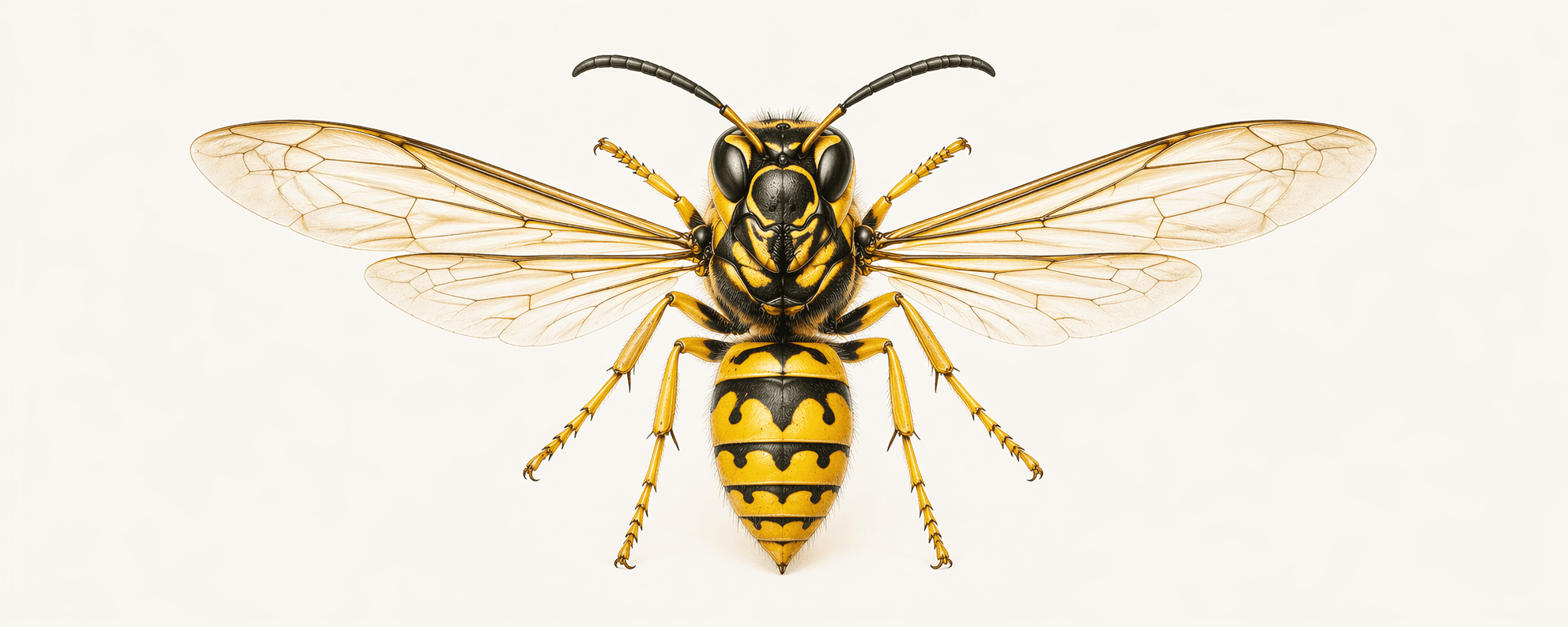
Common and German wasps build closed nests, often hidden in cavities: boxes, false ceilings, ground burrows, hollow walls. Populous colonies — several thousand individuals by late summer —, aggressive nest defence, ability to sting repeatedly. This is the profile most frequently encountered on terraces.
Paper wasps (polistes) form small, open, umbrella-shaped nests under parasols, tables and cornices. Small colonies, less aggressive behaviour, but a highly visible presence for guests because the nests sit at eye level.
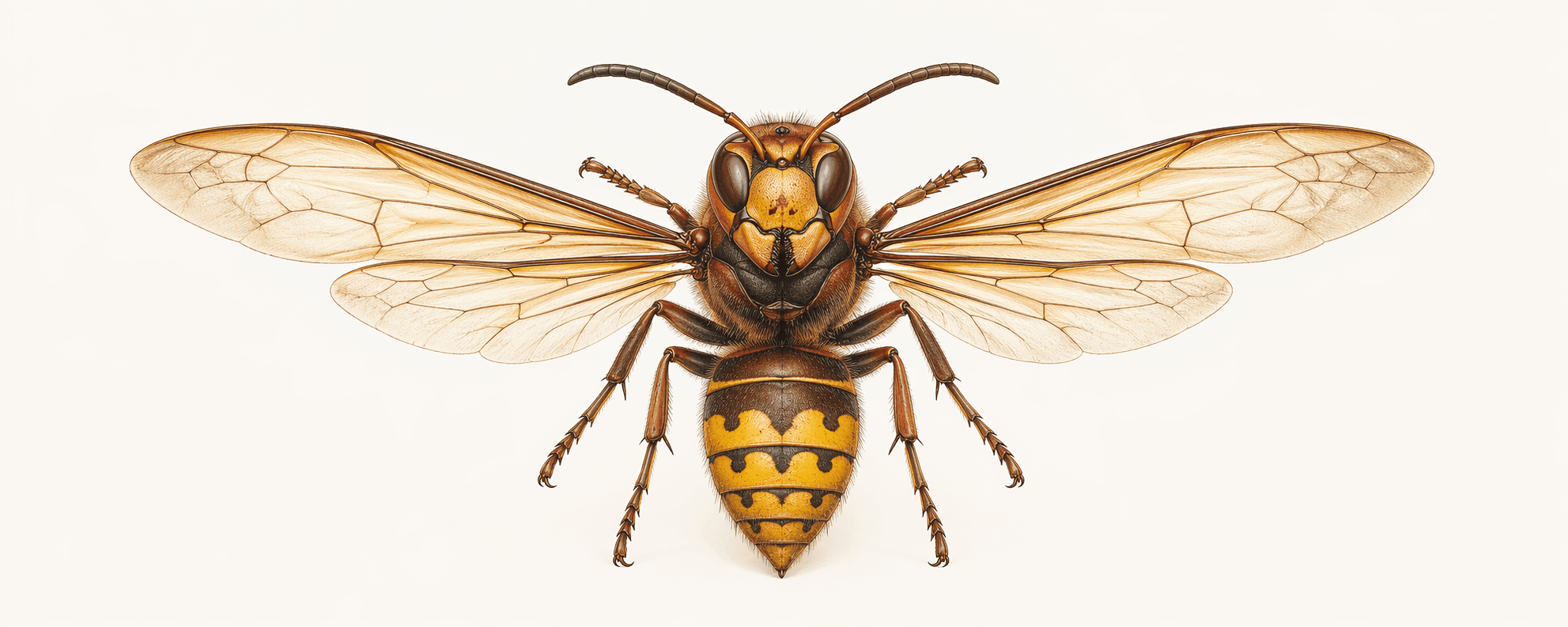
Hornets, whether European or Asian, demand a higher level of vigilance. The Asian hornet, now established along the entire coastline, readily nests in trees, tall hedges and under roof overhangs; its nests can exceed the size of a beach ball and shelter thousands of individuals. Any intervention on an Asian hornet nest is strictly the province of equipped professionals.
Before any action, one simple observation tells you a great deal: follow the flight paths. Insects converging in a straight line towards a fixed point — a façade joint, the underside of a roof, a planter — signal an active nest nearby. Insects wandering from table to table with no preferred direction signal a distant nest drawn by your food sources. This distinction shapes the entire treatment strategy, and it is the first thing our technician establishes upon arriving on site.
Emergency procedure: the first 30 minutes on the establishment's side
When a nest is discovered in the middle of an operating day, the first decisions shape everything that follows. Here is the procedure we recommend to our hotel and restaurant clients, to be built into your internal guidelines.
- Never treat it yourself. A consumer insecticide aerosol sprayed onto an active nest is the accident scenario: it triggers a massive defensive response from the colony, right in the guest area. Maintenance staff, however competent, must never be sent to deal with a nest.
- Neutralise the zone without dramatising it. Move the affected tables under an operational pretext ("reserved area", floor-plan reorganisation, maintenance). No sign mentioning wasps, no announcement: the goal is that guests never know there was an issue.
- Remove the attractants. Accelerated bussing, cloches over buffets, fruit baskets brought inside, zone bins closed. Reducing the available food lowers the pressure within minutes.
- Brief the staff in one sentence. No sudden movements, no waving napkins, calmly move worried guests away, and report every piece of information immediately: a guest declaring an allergy, a sting, the location of insect traffic.
- Document discreetly. Two or three photos of the traffic and the presumed nest location, taken by a manager, speed up our remote diagnosis and serve your internal file.
- Call your provider. Our 24/7 emergency line allows an immediate telephone diagnosis: depending on the nest's location and guest exposure, we determine together whether the intervention must take place within the hour or be scheduled for dawn the next day, before opening, for total discretion.
One specific point of attention: allergic individuals. A sting can trigger a severe reaction requiring immediate care. Your first-aid teams must be informed that a risk zone exists, even temporarily, and the location of the emergency kit restated to everyone.
Our ultra-discreet protocol: intervening without anyone knowing
Destroying a wasp nest is a technically well-mastered operation. What sets an intervention in a luxury establishment apart is everything around it: the timing, the appearance, the movement through the building, the communication. Our protocol was built with and for Monaco's establishments.
Timing. Barring immediate danger to guests, we intervene at dawn, before service opens, or at night. These windows combine two advantages: the absence of guests, and a colony gathered inside the nest, less active at low temperatures, which makes the treatment more complete and safer. A nest treated at 5:30 am is neutralised, removed, and the area returned to operation before the first guest arrives for breakfast.
Appearance. Our technician arrives in neutral attire, without branding, with equipment contained in a case or an unmarked bag. The vehicle can park away from the property or in the service car park. To an outside observer — an early-rising guest, a neighbour, a passer-by —, nothing distinguishes our intervention from a routine maintenance visit.
Movement. We enter through the service access agreed with your head of security, never through the lobby. Protective equipment is only donned once the intervention zone has been isolated. No full protective suit ever crosses a guest area.
Treatment. Depending on the configuration: injection of biocidal powder into cavity nests, telescopic-pole treatment for nests at height (up to more than twenty metres without a lift), mechanical removal of accessible paper-wasp nests. The nest is then removed whenever possible, because a dead nest left in place attracts other pests. All our interventions are carried out under Certibiocide certification No. 121134, using professionally licensed products applied at the minimum effective doses.
Verification. A perimeter check completes every intervention: a visible nest sometimes conceals a second one. We inspect neighbouring supports, boxes and cavities, and flag every point of vigilance for the rest of the season.
Coordinating with your teams: F&B, security, housekeeping
A successful intervention in an establishment is first and foremost a well-coordinated one. We work with a single point of contact — most often the technical director or the head of security —, but our protocol assigns a precise role to each department.
With the F&B manager, we align the intervention window with the real operating schedule: end of the last service, breakfast set-up times, private events. He or she decides, with us, whether a terrace zone should be neutralised for a few hours and under what commercial cover. We also hand over recommendations on attractants: buffet positioning, reinforced bussing protocol during peak periods, management of outdoor fruit baskets.
With the head of security, we organise access, badges, parking windows and the safety perimeter during treatment. In the case of a nest on a façade or roof, he also coordinates the temporary closure of the areas below.
With the executive housekeeper and the housekeeping teams, we tap into the best early-detection resource in existence: the floor staff. Room attendants open the balconies every day, operate the blinds, see the comings and goings of insects. One simple instruction — report any regular insect traffic towards a fixed point — turns housekeeping into a sensor network. Several of the nests we treat every summer are detected this way, at an early stage, before any guest exposure.
This organisation is formalised when the contract is set up: reporting channel, on-call contacts on both sides, a map of sensitive zones, and a season briefing in April to prepare for the summer.
Exportable documentation: your insurance, hygiene and audit file
In an establishment open to the public, a pest intervention does not end when the nest is removed: it ends when it is documented. Every intervention produces a structured report, exportable as a PDF, which includes:
- the date, time and duration of the intervention, with identification of the technician and his certification;
- the precise location of the nest (plan or annotated photo), the species identified and the estimated development stage of the colony;
- before/after photos;
- the products used, their licence numbers, the doses applied and the re-entry times for the area;
- the preventive recommendations specific to your site.
This documentation has three concrete uses. For your insurer, in the event of a sting reported by a guest, it demonstrates that the establishment reacted immediately and professionally — often a decisive element in the handling of a claim. For your hygiene audits and quality standards, it slots into your food-safety management plan and your supplier-monitoring files. For your internal records, it builds a multi-year map of your building's risk zones: an establishment that knows its west-facing shutter boxes are colonised every June can have preventive mesh fitted in May.
On request, we also provide a neutral certificate of attendance, with no mention of pests, usable in exchanges with third parties.
The annual contract: the guarantee of an intervention even at the weekend
Wasp nests have an acute sense of the worst possible moment: discovery typically happens on a Saturday in July, at the height of the season, when the terrace is fully booked and most providers are unreachable until Monday. Two days of waiting, at the peak of the colony's activity, means two days of guest exposure and reputational Russian roulette.
That is precisely what the annual contract eliminates. Our contract clients benefit from:
- an absolute intervention priority, including weekends and public holidays, with no blockage and no negotiation: the Saturday-morning call triggers the Saturday-evening or Sunday-dawn intervention;
- a preventive early-season inspection (April-May), which neutralises embryonic nests before they become colonies;
- summer monitoring of the identified sensitive zones, with wasp traps positioned away from guest areas to divert the pressure;
- a direct reporting channel for your teams, with a guaranteed fast response in season;
- the full exportable documentation described above, centralised in a single history.
For a seasonal establishment, the logic is simple: the annual effort of prevention bears no comparison with the cost of a single day of degraded terrace operations, a well-ranked one-star review or a sting claim. A quote request provides a proposal tailored to your site's configuration — outdoor surfaces, dining areas, pest history.
Field report: a nest above the pool bar, one Saturday in August
To illustrate this protocol, here is a real, anonymised case handled in a luxury establishment in Monaco.
One Saturday morning in August, the floor housekeeper reports unusual insect traffic, visible from the rooms overlooking the pool. The head of security sends us two photos before 9 am: the coming-and-going converges on the timber cladding of the pool bar pergola — the busiest zone of the property, three metres above the sun loungers.
Immediate telephone diagnosis: a German wasp nest in a cavity, colony estimated at maturity, several thousand individuals. The risk of guest exposure is real, but the nest is not in a triggered-aggression phase: together we decide to rule out a mid-day intervention, which would have required evacuating the pool area, and to schedule the operation for dawn the following day.
During the day, the F&B manager applies the mitigation protocol: the four sun loungers under the pergola are reserved "for maintenance", the bussing service is reinforced, the bar's fruit bowls are replaced with presentations under cloches. No guest is informed, no incident is recorded.
On Sunday at 5:15 am, our technician enters through the service access, in neutral attire. At 5:40, the zone is isolated and the injection treatment carried out; at 6:30, the cladding is taken down, the nest — thirty centimetres in diameter — is removed and taken away, the cavity preventively treated and closed again. At 7:00, the pergola is returned to operation. The full photographic report is delivered to the technical management before noon.
The outcome: zero guest witnesses, zero stings, zero reviews, zero trace. The cavity was fitted with mesh at the end of the season, and the following spring's preventive inspection was extended to all the cladding in the pool area. That is exactly what a well-managed crisis should look like: nothing.
What to remember — and where to start
A wasp nest near a hotel or restaurant terrace is neither a seasonal inevitability to be endured nor an incident to be handled in a panic. It is an identifiable, mappable and neutralisable operating risk — provided three things are in place before the summer peak: a preventive inspection of the critical zones, a clear internal guideline for the first thirty minutes, and a provider capable of intervening in complete discretion, including on an August weekend.
If your establishment already has a pest-control contract, check that it explicitly covers stinging insects under weekend emergency terms: that is far from always the case. If it does not, the best time to structure this protection is now — before the next nest is discovered. Our team operates throughout the Principality and on the Riviera, both as a 24/7 emergency service and for scheduled prevention, and your quote is free and without obligation.
Zones served in Monaco and on the Riviera
We operate in particular on Beaulieu-sur-Mer and Èze.
Frequently asked questions
- Should the terrace be closed when a wasp nest is discovered mid-service?
- Rarely in full. In most cases it is enough to discreetly neutralise the area beneath the nest and its immediate perimeter, under an operational pretext (reserved area, maintenance), and to remove food attractants. A complete closure is only necessary if the nest directly overhangs an unavoidable circulation area or if the colony shows aggressive behaviour. Our immediate telephone diagnosis helps you make that decision within minutes.
- Can you intervene without our guests noticing anything at all?
- That is the heart of our protocol. We intervene at dawn before opening or at night, in neutral unbranded attire, through the service entrance, with equipment carried in an unmarked bag. Protective gear is only donned once the zone is isolated, and the area is returned to operation before the first guests arrive. In the vast majority of cases, neither the guests nor most of the staff ever know an intervention took place.
- Can a nest discovered on a Saturday in high season really be treated that same weekend?
- Yes, for our annual-contract clients: intervention priority explicitly covers weekends and public holidays, with no blockage. A Saturday-morning call triggers an intervention on Saturday evening or at dawn on Sunday. Without a contract, we do our best via the 24/7 emergency line, but the guaranteed priority slot in high season is precisely one of the main benefits of the contract.
- What documents do we receive after the intervention for our insurance and audits?
- A structured report exportable as a PDF: date, time and duration of the intervention, identification of the technician and his certification, precise nest location with before/after photos, species identified, products used with licence numbers and doses, re-entry times for the area, and preventive recommendations. This file slots into your food-safety management plan, supports any claim with your insurer and feeds your internal history of risk zones.
- How can we make our terrace less attractive to wasps without degrading the guest experience?
- Four discreet levers do most of the work: accelerated bussing of glasses and plates during peak periods, cloches over buffets and fruit displays, rigorous waste management (washed containers, closed lids, enclosed refuse room) and, if necessary, diversion traps positioned away from guest areas. The single most effective measure, however, remains the preventive early-season inspection, which neutralises embryonic nests before summer.
- What should we do if a guest is stung on our terrace?
- Absolute priority to care: calmly move the guest away from the area, apply first aid, and watch for any sign of an allergic reaction (significant swelling, breathing difficulties, faintness), which requires alerting emergency services immediately. In parallel, document the incident (time, place, circumstances) for your internal register and your insurer, discreetly neutralise the area and contact us: a sting almost always signals an active nest nearby that must be located and treated without delay.