July 22, 2026 · 14-minute read
Wasp Nest by the Pool or Pool House: Villa Intervention — Monaco
Wasps around your villa pool or a nest in the pool house? Discreet early-morning treatment, bathing-water-safe biocides, no detectable residue after 24 h.
An infinity pool glittering in the sun, a shaded pool house, a table laid for lunch: this is exactly the setting wasps look for in summer. In the villas with gardens of Monaco and the Riviera, a wasp nest around the pool is never a minor nuisance. It is a direct risk to swimmers — children first —, a threat to every reception held at the water's edge and, in some cases, the trigger of a medical emergency. Unlike an isolated nest at the bottom of the garden, a nest lodged under a pool cover, in the pergola or in the ridge of the pool house puts the colony in daily contact with the occupants. At Monaco Pest Solutions, we handle these situations with a protocol designed for villas: discreet treatment early in the morning or at night, biocides compatible with bathing water, coordination with your household staff and a contractual guarantee against recurrence. Here is everything a villa owner needs to know.
Why your pool attracts wasps more than anything else in the garden
A worker wasp has two obsessions: water and sugar. A villa pool concentrates both within a few metres of each other, all summer long.
Water first. Between June and September, a mature colony consumes considerable quantities of water: the workers carry it back to the nest to hydrate the larvae and to cool the cells by evaporation during heatwaves. Contrary to popular belief, chlorinated water does not repel them at all. A pool offers a stable, accessible, continuously available water surface — an ideal drinking point. Wasps land on the wet copings, on the skimmers, on the first step of the submerged staircase, on floating toys, and fly back loaded towards the nest. A shuttle service sets in: if you notice regular back-and-forth traffic above the basin, the colony is rarely more than two hundred metres away, and often less than thirty.
Sugar next. Life around a villa pool is a permanent food source: fruit juices and sodas served to the children, cocktails, fruit baskets, ice creams, snacks left on the pool house table, sugary residue on glasses and straws. In late summer, when the colony is no longer feeding larvae, the workers switch massively to sugar and become insistent, even aggressive, around every drink served on the terrace.
Wood, finally. This is the least-known attractant. Wasps build their nests from cellulose fibres which they scrape off untreated or weathered wooden surfaces: teak or solid-wood garden furniture, pergolas, pool house cladding, fences, decorative driftwood. The paper wasp (Polistes), very common on the Riviera, is particularly fond of these surfaces: you can watch it methodically "planing" the slats of a table or a sun lounger, leaving fine greyish streaks. Solid-wood furniture around the basin thus acts as a double magnet: building material for the nest, and a sun-warmed perch under which paper wasps love to nest directly.
Typical nesting spots around a villa pool
After hundreds of interventions in private villas on the Riviera, we keep finding the same locations. A nest near a pool is almost always sheltered, dark, dry and close to resources.
- Under the pool cover. The most frequent and most dangerous case. The roller of a submerged or above-ground shutter, the cover housing, the underside of a folded bar cover or the casing of a telescopic enclosure all offer a dark, warm, rarely disturbed cavity. The nest grows a few centimetres from the water, invisible until the day someone operates the cover — and the colony erupts above an occupied basin.
- In the pergola. Hollow aluminium beams, the adjustable louvres of a bioclimatic pergola, joints between crossbeams, folded shade curtains: all perfect cavities. Paper wasps build their umbrella-shaped nests directly under the crossbeams, at the head height of your guests.
- In the ridge and roof of the pool house. The pool house is an annexe rarely occupied out of season: founding queens settle there in spring in complete tranquillity. Ridge line, roof overhangs, the space between tiles and underlay, roller-shutter boxes, false ceilings, the filtration plant room — a common wasp nest there can reach several thousand individuals by August.
- In the garden furniture. The undersides of solid-wood tables, hollow frames of sun loungers, cushion chests, folded parasols, the summer bar. Paper wasp nests there remain modest — a few dozen individuals — but their position, a few centimetres from hands and legs, makes them formidable.
- In the immediate surroundings. Dry-stone walls, rockeries, flowerbed banks, tree stumps: ground-nesting wasps dig underground nests whose discreet entrance sometimes sits right on the path between the house and the basin.
One clue never lies: steady insect traffic, always on the same axis, during the warm hours. Visually following the flight direction of workers leaving the coping is often enough to locate the nest area.
Common wasp, paper wasp or hornet: identify before acting
Not every yellow-and-black silhouette circling above a basin calls for the same response. Correct identification determines the protocol, the timing of the intervention and the level of precaution.
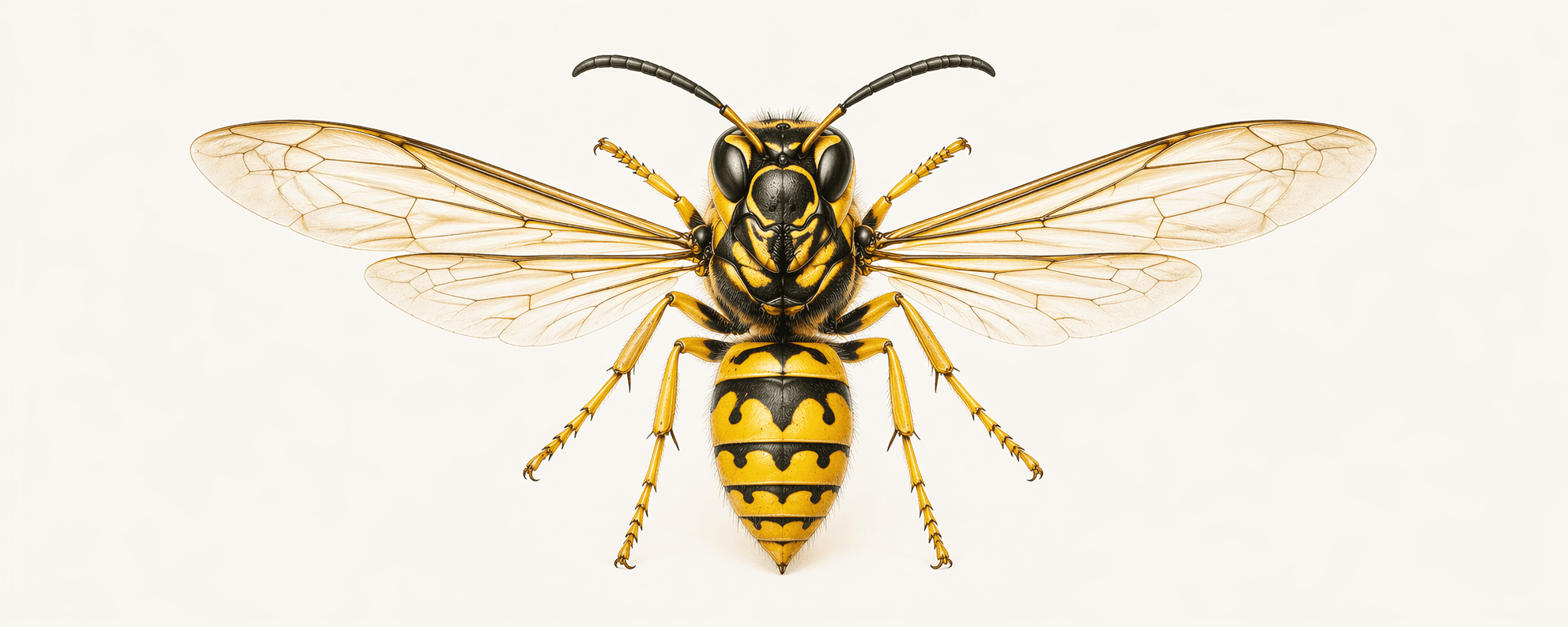
The common wasp and the German wasp build closed nests of grey paper, often hidden in a cavity (housing, ridge, ground). Large colonies, aggressive nest defence, possible multiple stings: these are the species that create genuine safety problems around a pool. The paper wasp, slimmer, with long legs dangling in flight, builds small open umbrella-shaped nests under pergolas and furniture. Less aggressive, it nevertheless stings without hesitation if you brush against its nest — which happens constantly when the nest is under a table.
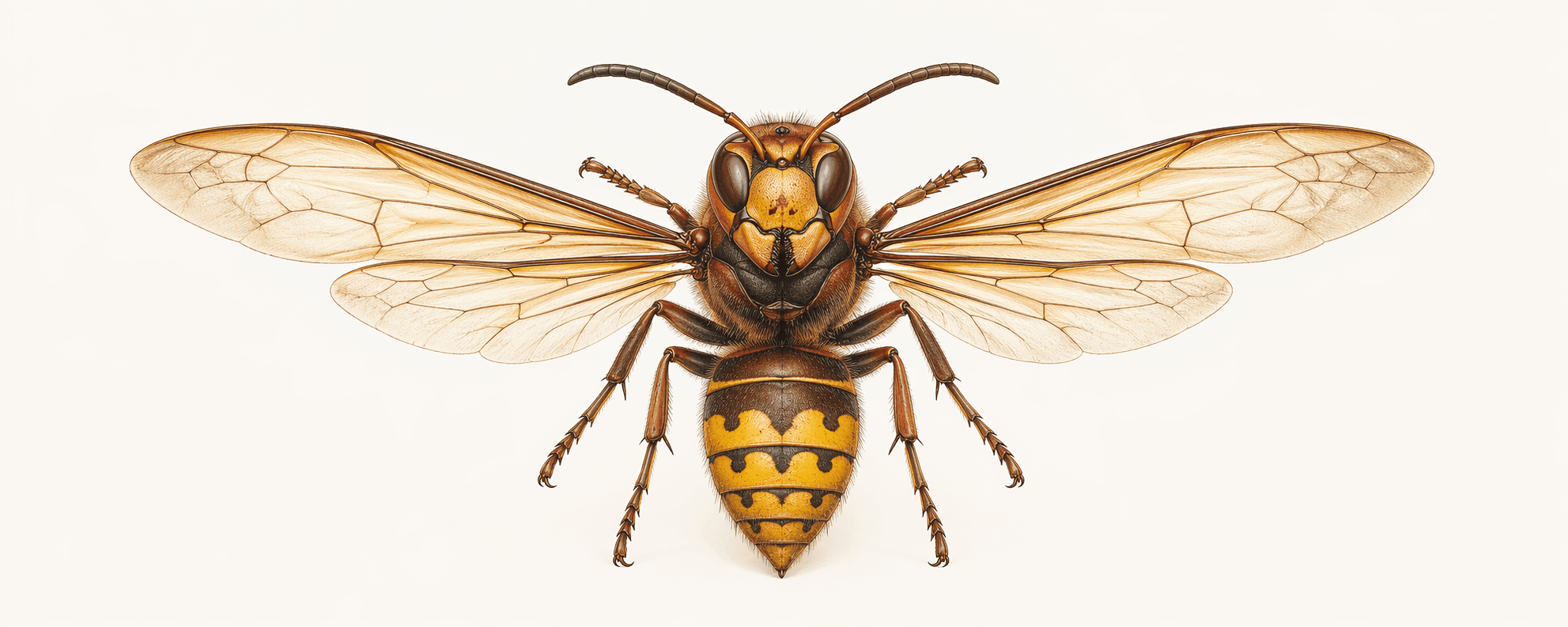
Then there are the hornets. The European hornet, larger and noisier, is regularly seen drinking on the copings. The Asian hornet deserves particular vigilance: it patrols above water points, preys on the bees of neighbouring gardens and sometimes installs its primary nest in a garden shed or pool house before migrating higher up. Its nest defence is brutal and its stings, in numbers, dangerous. If in doubt about the species, a photo taken from a reasonable distance and sent to our team is usually enough to settle the question — never approach to "check". Our dedicated wasps page details the identification criteria species by species.
A real risk for swimmers: children, guests, medical emergency
Around a pool, the circumstances aggravate every sting. First because swimmers are in swimwear, barefoot, bare-skinned: no barrier at all. Second because wasps land precisely where hands land — copings, ladder, edges, glasses. A wasp drinking on a submerged beach ends up under the palm of a child climbing out of the water. A worker fallen into the basin and apparently drowned can still sting when picked up.
Three scenarios concern us particularly:
- Children. They do not spot wasps resting on a wet coping, lift sugary drinks to their mouths without looking, and panic when stung — at the edge of a basin, panic itself is a danger.
- A sting at the water's edge. A sting on a wet pool deck triggers a sudden recoil on a slippery surface: falls, head injuries on stone copings, a startled person falling into the basin. A sting in the mouth or throat — from drinking out of a glass a wasp had slipped into — can cause swelling that obstructs the airways: this is an absolute medical emergency, even in a non-allergic person.
- Allergic individuals. An anaphylactic reaction unfolds in minutes. In a villa hosting guests whose allergy history is not always known, an active nest near the basin is a risk no host should accept.
Add to this the question of events. A garden party, a business lunch at the water's edge, a child's birthday: buffets, sweet drinks, perfumes and excitement multiply the interactions with worker wasps. A single sting incident is enough to cut short a reception prepared over weeks. This is why we systematically recommend an inspection of the pool surroundings in the days before any summer event.
Why improvised solutions fail around a basin
Faced with wasp traffic, the temptation to treat the problem yourself is strong. Around a pool, it is doubly a bad idea.
First, for safety. Spraying an insecticide aerosol at a nest lodged in a cover roller or a pool house ridge exposes you to an immediate counter-attack by dozens of workers, without protective equipment, on a slippery deck, with a basin at your back. Domestic accidents linked to amateur nest destruction are frequent and sometimes serious. Blocking a nest entrance only makes the colony more aggressive — and sometimes redirects it towards the inside of the pool house.
Second, for the water. Consumer insecticides sprayed near the basin contaminate the bathing water and the copings: surface residue, a greasy film on the waterline, product drawn by the skimmers into the filtration circuit. Sugar-baited wasp traps from garden centres attract more workers than they capture: placed near the pool, they intensify the traffic exactly where you want to reduce it. As for destroying a nest without a residual treatment suited to the configuration, it lets the workers who were absent during the operation return — and a new queen recolonise the same cavity a few weeks later.
Our villa protocol: an intervention invisible to your guests
An occupied villa, with staff, children, sometimes guests, cannot be treated like a building site. Our pool-area protocol rests on three principles: discretion, water safety, zero disruption to the life of the house.
The time slot. We prefer to intervene early in the morning, before the grounds are in use, or at night. These slots are not just about convenience: in the cool and in darkness, almost the entire colony is gathered in the nest, flight activity is nil, and the treatment neutralises all individuals in a single pass. At midday, a significant share of the workers is in flight: they would return to a destroyed nest and wander around the basin for days.
Equipment and method. Full protective suit, telescopic pole for ridges and high pergolas, injection of biocidal powder or gel directly into the cavity (cover housing, hollow beam, ridge), mechanical removal of accessible paper wasp nests. The nest is then extracted where the configuration allows, the cavity cleaned, and the entry points treated to prevent reinstallation.
Discretion. Unmarked vehicle on request, technicians in neutral clothing, no signage, no spectacular perimeter. Your guests of the week do not need to know an intervention took place — and in the vast majority of cases, they will not: when they wake up, the poolside is simply calm again.
Biocides compatible with bathing water: no detectable residue after 24 hours
It is the question every owner asks, and it is legitimate: what happens to the pool water?
Our answer comes down to three commitments. First commitment: product selection. Around a basin, we exclusively use professional biocidal formulations selected for their compatibility with a bathing environment — targeted application inside cavities, no broad spraying, no fogging near the water surface. Our technicians are certified for the professional use of these products (Certibiocide No. 121134), which are neither available nor authorised for the general public.
Second commitment: zero residue on contact surfaces. Copings, decks, ladders, outdoor shower, furniture: no application on any surface swimmers touch. The treatment is confined to the nest cavity. When a nest sits inside a submerged cover roller, we work with the cover deployed or removed, with the waterline protected, and we rinse the work areas at the end of the intervention.
Third commitment: the 24-hour rule. Our protocol is calibrated so that no detectable residue remains in the pool environment beyond 24 hours after the intervention. In practice: treatment in the evening, a simple no-swimming instruction passed to your staff, filtration running normally, and the basin is back in completely free use the next day. In the most common configuration — a nest in a ridge or pergola, with no contact with the water — swimming is only interrupted for the duration of the intervention itself.
Coordination with your staff: gardener, butler, housekeeper
In a villa, the best intervention is the one that slots into the existing organisation of the house without disturbing the owners. This is a dimension we have learned to handle with the same care as the technical side.
Concretely, we work hand in hand with your staff. The gardener is often the first to spot the worker traffic; he knows the technical access points, the watering schedules and the sensitive areas of the garden. The butler or housekeeper tells us the occupation slots of the house, the upcoming events, the property's own rules. Together we agree on an access window — service gate, technical entrance — that avoids any interaction with the family and guests. Intervention report sent to the person of your choice, before/after photos, written post-treatment instructions: your household management has everything, without you having to deal with any of it.
This organisation also applies to residences occupied only part of the year: we intervene in your absence, upon simple remote approval, and the house is ready for your return.
The annual villa contract: pre-season audit and recurrence guarantee
Treating a nest as an emergency in mid-August is always possible — we do it every week. But true peace of mind is won upstream. That is the point of our annual villa contract, designed for properties with a pool and garden.
The core of the contract is the pre-season audit, carried out in spring, at the precise moment when founding queens emerge from overwintering and look for a site. We methodically inspect every sensitive point: the housing and roller of the pool cover, pergolas, the ridge and roof space of the pool house, the plant room, garden furniture, chests, walls and rockeries. Every nest bud detected at this stage — the size of a golf ball, a few cells, a single queen — is eliminated in minutes, without heavy products, before the colony even exists. Nine summer nests out of ten can be avoided by this single visit.
The contract then includes monitoring visits during the season, the installation of traffic-management devices placed away from the basin when pressure from the neighbourhood requires it, and a priority line for any observation from your staff. Finally, the clause that matters: in case of recurrence in a treated area, we intervene again free of charge, no questions asked. A nest that re-forms in the same cavity during the season is our responsibility, not yours.
Field experience: what Riviera villas teach us
A few real situations, anonymised, illustrate better than any speech what is at stake around pools.
In a property in Saint-Jean-Cap-Ferrat, the staff reported wasps "appearing out of nowhere" every time the pool shutter was opened. The nest — twenty centimetres across — was attached inside the roller housing, ten centimetres from the water. Night intervention, cover deployed, targeted injection into the housing, nest extraction, rinsing: the basin was returned to swimming the following afternoon, without a single guest of the week noticing anything.
In a villa on the heights of Monaco, three paper wasp nests under the louvres of a bioclimatic pergola hung directly over the lunch table. The occupants had been brushed past at every meal for weeks, convinced the wasps "came from the hillside". Mechanical removal of the three nests at dawn, preventive treatment of the louvres, and installation of an alternative drinking point at the far end of the garden to divert the residual traffic: terrace meals were calm again within 48 hours.
Elsewhere on the coast, a pool house unused since autumn housed in its ridge a German wasp colony estimated at several thousand individuals, discovered one week before a reception for eighty people. Treatment six days ahead at dawn, control visit two days ahead, event held without the slightest incident.
The common thread of these experiences is always the same: the earlier the detection, the lighter, more discreet and more definitive the intervention. That is exactly what the pre-season audit delivers.
If you notice regular wasp traffic above your pool, a few immediate steps limit the risk without making it worse: cover sugary drinks and clear the table promptly after poolside meals, rinse the copings where glasses have stood, do not operate the pool cover if you suspect a nest in its housing, and above all attempt neither aerosol nor blocking on an active nest. Note the workers' flight axis: this simple piece of information will save our technicians precious time.
Then have a diagnosis carried out. Our team operates throughout the Principality and along the Riviera, from a simple paper wasp nest under a table to the colonised ridge of a pool house, always with the same protocol: species identification, treatment at the least disruptive time for the house, biocides compatible with the pool environment, no detectable residue after 24 hours, and a re-intervention guarantee. The request takes two minutes online via our free quote form — photos welcome — or by telephone for urgent situations, particularly where children are present or an event is coming up. A villa pool should remain what it was designed to be: a place for swimming, entertaining and relaxing. Not wasp territory.
Frequently asked questions
- Why are wasps attracted to my pool even though the water is chlorinated?
- Chlorine does not repel wasps. A pool offers the stable drinking point the colony needs all summer to hydrate its larvae and cool the nest. Add the sugary drinks and snacks served at the water's edge, plus the solid-wood furniture from which paper wasps scrape fibres to build their nests. Pool, sugar and wood form an almost irresistible triple attractant.
- Can we swim after a nest treatment near the pool?
- Yes. We use professional biocidal formulations compatible with a bathing environment, applied in a targeted way inside the nest cavity, never on copings or contact surfaces. Our protocol guarantees that no detectable residue remains beyond 24 hours: treatment in the evening, free swimming the next day. If the nest is away from the water, swimming is only interrupted during the intervention itself.
- Can you intervene without disturbing the family or guests?
- That is the core of our villa protocol. We work early in the morning, before the grounds are in use, or at night, when the colony is gathered in the nest. We coordinate access with your gardener, butler or housekeeper: service entrance, agreed time slot, unmarked vehicle on request, technicians in neutral clothing. In most cases, neither the family nor the guests notice our visit.
- We have an event planned by the pool: when should treatment take place?
- Ideally one week ahead. We inspect the pool surroundings — cover, pergola, pool house ridge, furniture — then treat any active nest at dawn, several days before the date, with a control visit 48 hours before the event. This lead time lets residual traffic dissipate and guarantees a calm poolside on the day, with no residue and no visible intervention during your preparations.
- The nest is in the pool cover housing or in the wooden furniture: how do you proceed?
- These are two classic configurations. For a nest in the cover roller or housing, we work at night, cover deployed, by targeted injection into the cavity, with the waterline protected, then nest extraction and rinsing. For paper wasp nests under tables or sun loungers, mechanical removal at dawn is usually sufficient, completed by a preventive treatment of the attacked wooden surfaces. Never operate the cover if you suspect a nest.
- What does the annual villa wasp contract include?
- A pre-season audit in spring — inspection of the pool cover, pergolas, pool house ridge, furniture and walls, with elimination of nest buds before the colonies even exist —, monitoring visits during the season, a priority line for your staff and one key guarantee: any recurrence in a treated area is handled again free of charge. Nine summer nests out of ten are avoided by the spring audit alone.