
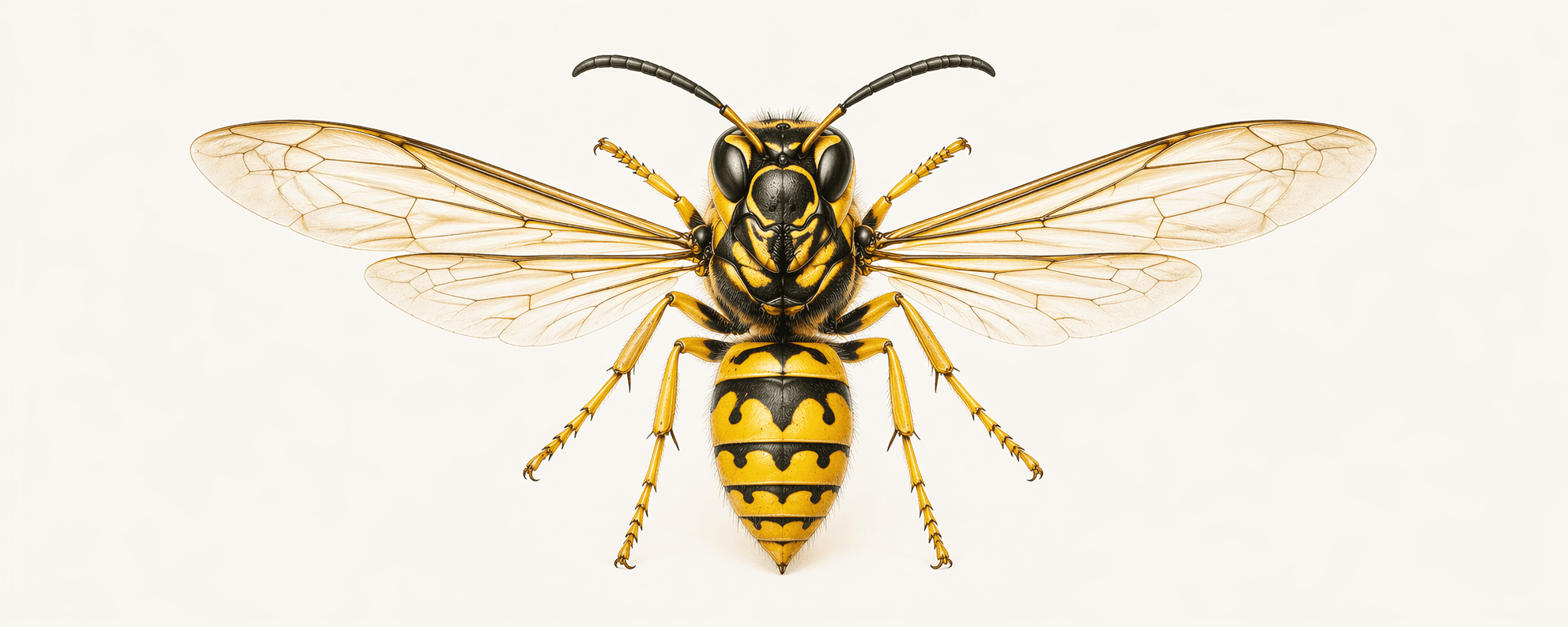
Identifying wasps: the signs that never lie
Three species are almost always encountered on the Riviera. The common wasp and the German wasp (genus Vespula) build enclosed papier-mâché nests, often invisible because they are lodged in a cavity. The paper wasp (Polistes dominula), more slender with yellow legs dangling in flight, builds an open, umbrella-shaped nest under a roof overhang, a roller shutter or a garden shed.
The signs to look out for:
- Regular comings and goings of workers at a single entry point (crack, vent, displaced roof tile, shutter housing)
- Scratching noises in a partition wall or suspended ceiling, especially in the evening
- Small woody shavings on the ground beneath a gnawed beam or joinery
- Wasps foraging repeatedly on fruit bowls, sugary drinks and meats on terraces (typical late-summer Vespula activity)
- A visible nest in the shape of a greyish sphere or a honeycombed disc
A mature common wasp nest can house several thousand individuals in August-September. Never approach within three metres without suitable equipment.
Health and material risks
The primary risk is the sting: unlike the bee, a wasp can sting several times without dying. In a sensitised individual, a single sting can trigger anaphylactic shock within minutes. Multiple stings, common during an accidental intrusion into a hidden nest (pruning, building work, a ball lost in a bush), are dangerous for everyone, allergic or not.
The second risk is material and hygienic:
- Colonisation of a shutter housing or an extractor hood: a nest that is difficult to remove, soiling, corrosion
- Contamination of a restaurant's open kitchen: Vespula frequent bins, raw meats and fish, with the potential transfer of bacteria
- Aesthetic degradation of listed façades (Monte-Carlo, La Condamine) by entry-and-exit marks
From a legal standpoint, a restaurant operator in Monaco engages their liability under food hygiene rules (HACCP approach) if flying pest insects compromise food preparation. A landlord or managing agent must ensure the salubrity of common areas: a nest in a stairwell or a cellar requires prompt intervention.
Why this pest thrives in Monaco and on the Riviera
The Mediterranean climate gives wasps a long active season, from March to November. Mild winters allow founding queens to overwinter under cover in the lofts, attics and garden sheds of Roquebrune-Cap-Martin, Cap-d'Ail and Beausoleil, then emerge early in the season.
Monaco's urban density multiplies the artificial cavities that are perfect for nesting: roller-shutter housings, expansion joints in buildings, service ducts, suspended terrace ceilings, the under-roofs of villas in Fontvieille and Larvotto. The wooded gardens of the Jardin Exotique, Cap-Ferrat and the Menton hinterland offer natural sites in parallel: hollow trunks, dry-stone walls, bramble thickets.
Finally, the Principality's hotel and restaurant ecosystem concentrates exceptional sources of attraction in summer: terraces with continuous service, outdoor buffets, bins rich in sugar and protein. A scout wasp quickly recruits nest-mates by pheromone, and a terrace can be colonised within a week if nothing is done.
The MPS protocol in five steps
- Diagnosis — species identification, locating the nest or nests (sometimes several on a single plot), assessment of the colony stage and the site's constraints (proximity of occupants, beehives, presence of children)
- Choice of method — mechanical extraction by vacuum when the nest is accessible and the substrate allows, or injection of a professional contact biocide into the nesting cavity when extraction is impossible
- Treatment — intervention at dawn or in the evening, when activity is reduced, in a full ventilated suit. Securing a perimeter, informing occupants, temporarily shutting down ventilation if necessary
- Inspection — verification visit a few days later: no residual activity, physical removal of the empty nest if accessible, sealing of the entry point
- Certification — delivery of an intervention certificate detailing products, dosages and treated areas, with prevention recommendations and a systematic NDA for private residences
Monaco Pest Solutions is certified Certibiocide N121134: every product used is approved, dosed and traced.
Mistakes to avoid
Improvised treatment attempts are the leading cause of the multiple-sting emergencies we are called to on the Côte.
- Consumer aerosol sprays: they partially empty the nest but leave aggressive workers outside, often for several days
- Blocking an entry point without treating: the wasps dig an alternative exit, sometimes into the interior of the home through a plasterboard wall
- Water or petrol: dangerous, ineffective and prohibited
- Waiting until autumn in the belief that "the nest will die on its own": Vespula become aggressive at the end of the season, and a fertilised queen will overwinter and rebuild the following year just a few metres away
- Confusing wasps with hornets: the Asian hornet (Vespa velutina) is an invasive alien species requiring a separate protocol
Intervention on a mature nest is a job for an equipped, insured professional.
A typical Monaco case
A seafront restaurant in Fontvieille contacted us on a Thursday in July: several customers stung on the terrace within three days, sustained activity around the bar. The diagnosis revealed two separate entry points under a zinc roof overhang — a German wasp nest lodged in the roof slope, invisible from outside. Intervention the following day at 6 am, outside service hours. Targeted injection through the two openings, perimeter secured with tape, return at 9 pm to remove the remaining disoriented wasps. Terrace reopened for lunch on the Saturday. Inspection at five days: zero activity. Sealing of the under-roof scheduled with the restaurateur's roofing company. HACCP-compatible certificate delivered to the front-of-house manager. NDA signed, no public communication.
Lasting prevention
Prevention is decided in spring, when the founding queen is searching for her nesting site. The effective measures:
- Annual inspection in April-May of lofts, shutter housings, garden sheds and technical huts
- Sealing of façade cracks, expansion joints and unscreened ventilation outlets
- Fine mesh screens (5 mm mesh) on air intakes, unused chimneys and basement vents
- Waste management: closed bins, rinsing of cans and bottles in summer, keeping containers away from service areas
- Decoy nests: of uneven effectiveness, they can discourage a new paper wasp colony from settling near a previous site
- Seasonal monitoring for sensitive establishments (restaurants, hotels, nurseries, serviced residences): a preventive visit in spring and follow-up at the height of summer
An annual monitoring contract avoids the late discovery of a mature nest in high season.
Regulatory framework
In Monaco as in France, native wasps (Vespula, Polistes) are not classified as regulated pest species: their treatment falls under the ordinary law of pest control, with an obligation to use authorised biocides and to employ a trained applicator (in France, the Certibiocide decree; in the Principality, the equivalent approval). MPS operates under Monaco trade registration RCI 26S10394.
Take care not to confuse species: the Asian hornet (Vespa velutina nigrithorax) is classified as an invasive alien species by the French ministerial order of 22 January 2013 and is subject to a separate treatment. The European hornet (Vespa crabro), protected in some German regions, is protected neither in France nor in Monaco, but any intervention follows an ethic of proportionality (a nest far from living areas is left in place).
On the HACCP side, a catering establishment must record every pest control intervention in its food safety management plan.
How long, how many visits
An accessible, correctly diagnosed wasp nest is treated in a single intervention in the great majority of cases. An inspection at three or five days confirms the absence of residual activity and allows physical removal of the nest if necessary.
Situations requiring an additional visit:
- A nest inaccessible at the first approach (deep wall cavity, sealed suspended ceiling) requiring partial dismantling
- Multiple colonies on the same plot (a wooded villa with several sites): sequenced treatment over two to three visits
- Re-occupation of the site the following year by a new founding queen: preventive intervention in spring
Complete resolution, including nest removal and sealing, generally takes one to three weeks, depending on the availability of any roofing or joinery companies involved. In high season (July-August), we carry out emergency interventions within 24 to 48 working hours in Monaco, Beausoleil, Cap-d'Ail, Roquebrune-Cap-Martin and Menton.
In any doubt? Our team responds within 2 working hours. +377 37 70 70 02 — or [request a free quote](/devis-gratuit).
When you are facing a wasp problem in Monaco, the first 24 hours shape everything that follows: our emergency guide details the immediate steps, the realistic resolution timeline and how a professional intervention unfolds.