August 11, 2026 · 8-minute read
Pantry moth problem in Monaco: what to do in an emergency? Complete guide
Moths in the kitchen, silky threads in the flour? Our 8 pantry moth emergency steps in Monaco: food triage, deep cleaning, pheromone traps, prevention.
What should you do if pantry moths appear in Monaco? Do not spray any insecticide near food: empty the affected cupboards completely, inspect every packet in good light, discard anything suspect in a sealed bag taken out immediately, then set pheromone traps to measure the scale. The visible moths are only the tip: the larvae inside your packets are the real infestation. Here is the full protocol our teams apply in palace pantries, yacht galleys and kitchens across the Principality.
Identify pantry moths: the unmistakable signs
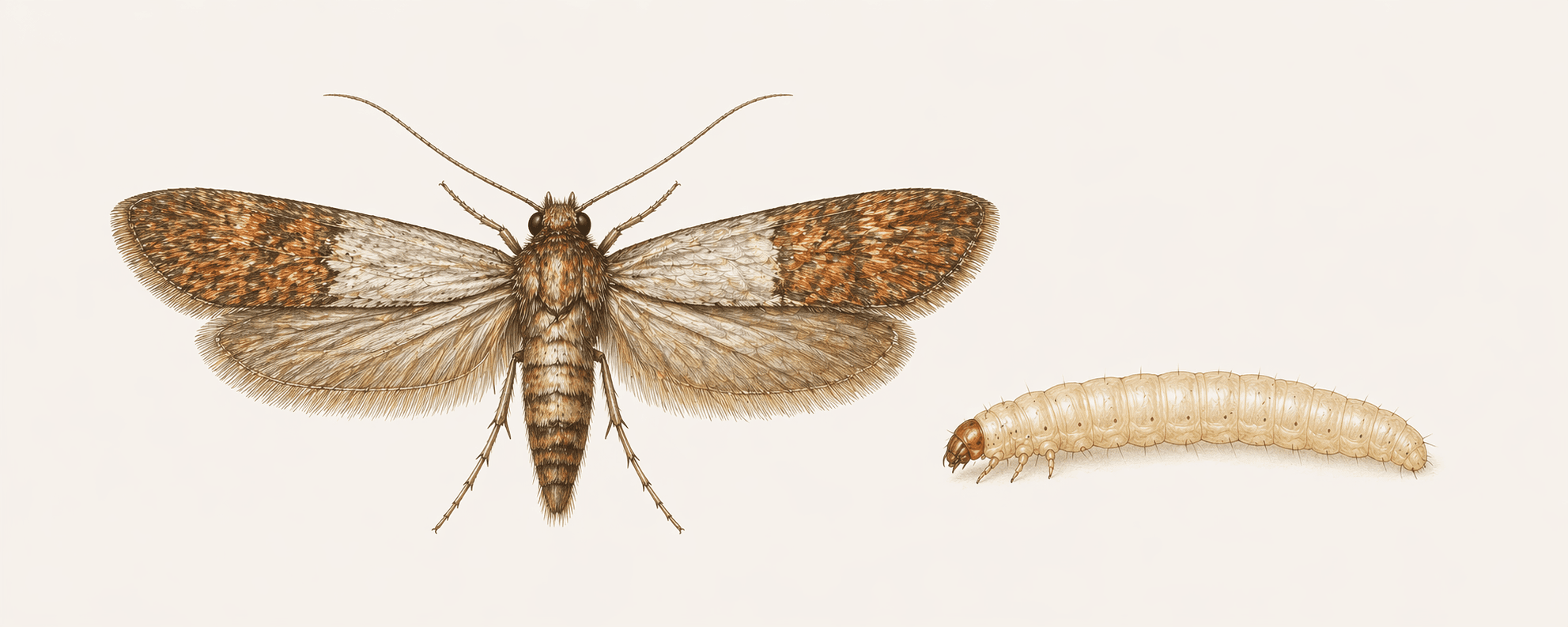
The most common food moth on the Riviera is the Indian meal moth: 8-10 mm, two-tone wings, beige at the base and coppery at the tip. Do not confuse it with the clothes moth, uniformly beige, which flies in wardrobes. Key clues: zigzag flight at dusk near kitchen cupboards; silky threads and clumps — flour binding into small blocks, fine webbing in the corners of cereal, rice, muesli, dried fruit or chocolate packets; pinkish-white larvae of 10-15 mm in food or climbing walls and ceilings to pupate; cocoons in cupboard corners, hinges and shelf-peg holes; target foods — flour, cereals, pulses, dried fruit, spices, tea, pet kibble, chocolate. Action: open every packet from the suspect cupboard over a light surface and inspect with a torch. One positively contaminated packet, with its purchase date, dates the infestation.
What NOT to do (mistakes that worsen the infestation)
Never spray insecticide inside food cupboards: contaminating food-contact surfaces creates a health risk greater than the moths themselves, and the larvae are protected inside the packets anyway. Do not just discard the one visible packet: the female lays up to 300 eggs across several neighbouring packets — partial triage guarantees relapse within four weeks. Do not decant uninspected food into clean jars: you seal the eggs in with the food. Do not swat the adults and stop there: each eliminated female has usually already laid; without treating the larvae, the next generation emerges within three to six weeks. Do not store new groceries in untreated cupboards. Action: treat the entire dry-storage area as suspect until fully inspected, not just the cupboard where moths fly.
Immediate first steps (secure everything in 15 minutes)
Minutes 0-5: empty the worst-hit cupboard entirely onto the worktop. Minutes 5-10: sort into three categories — contaminated (threads, clumps, larvae: knotted bin bag, taken out at once), doubtful (opened packet, no visible sign: freezer at -18 °C for 72 hours, which kills eggs and larvae), sound (tins, sealed new jars, bottles). Minutes 10-13: vacuum the empty cupboard with the crevice tool — corners, shelf-peg holes, hinges, shelf undersides; the adjustable-shelf holes are the cocoons' favourite nurseries; bin the vacuum bag immediately. Minutes 13-15: wash surfaces with hot vinegar or soapy water, working into the grooves; leave the cupboard open and empty to dry. Action: put nothing back for 48 hours and not before the monitoring pheromone traps are in place.
Isolate and contain to prevent spread
Quarantine the doubtful stock: every opened packet without visible signs spends 72 hours in the freezer in a sealed bag before returning to an airtight jar. Move flour, cereals, rice, dried fruit and kibble permanently into silicone-gasket glass jars or clip-lock boxes: larvae pierce cardboard, paper and thin plastic, never glass. Set one pheromone trap per cupboard and per storage room: they catch males, break the breeding cycle and give you an objective weekly count. Carry no food from the kitchen to the cellar, pantry or boat until traps have stayed empty for three weeks. Pet kibble is the classic forgotten primary focus — store it in an airtight bin, on board too. Action: date every refilled jar; if the moths return, traceability points straight to the guilty packet.
Call a certified professional: when and why
A limited domestic focus is often solved by triage and cold. Call a professional when trap catches rise again after six weeks, several rooms are affected, cocoons appear outside the kitchen (skirting, picture frames, light fittings) or the infestation hits a food business. Monaco Pest Solutions operates under Certibiocide N°121134 (RCI Monaco 26S10394) with means beyond the private toolbox: source diagnosis — in half of professional cases the primary focus hides outside the cupboards (kibble bag in the laundry, decorative pasta jars, a rodent cache, a contaminated delivery pallet); cold or anoxia treatment for valuable goods (fine teas, rare spices, cocoa) that cannot be discarded; targeted micro-spraying away from food contact on pupation zones (ceilings, cornices), compatible with HACCP requirements; biological control with trichogramma micro-wasps, natural parasitoids of moth eggs, invisible to the naked eye and entirely chemical-free — the option of choice for palace pantries and yachts; and full registers for professional kitchens. Our 24/7 emergency line also covers pre-inspection and pre-provisioning emergencies.
The MPS eradication protocol: 4 phases
Phase 1 — Storage audit (day one): inspection of all dry-goods zones (kitchen, pantry, cellar, laundry, galley), species and primary-focus identification, numbered pheromone trap network to map intensity. Phase 2 — Sanitation (day 1): assisted triage, cold or anoxia treatment of valuable goods, industrial vacuuming of furniture, micro-spraying of pupation zones away from food contact. Phase 3 — Cycle break (days 7-42): mating-disruption pheromone traps and, site depending, trichogramma releases every two weeks for six weeks to parasitise residual egg-laying. Phase 4 — Validation (days 42-60): three consecutive weekly zero-catch readings, end-of-treatment report and a personalised preventive storage plan.
Prevention so pantry moths never return
At purchase, inspect flour and cereal packets before shelving them (fine perforations, threads at the folds): moths almost always enter in a packet already contaminated at purchase. Preventive quarantine for risky goods (organic flours, loose dried fruit, spices): 72 hours in the freezer before final storage. Systematic airtight storage: gasket glass or clip boxes, nothing left in opened bags. First-in-first-out rotation, dated jars, no packet remnants kept beyond three months. A permanent sentinel pheromone trap per storage zone, renewed quarterly and read monthly: the alarm rings weeks before you see a moth. Bay leaves in jars add a mild repellent effect; refrigerating rarely used flours remains the absolute safeguard. Full life cycle on our pantry moth page.
Special cases: restaurant, palace hotel, yacht
Restaurant: the dry store is the critical point — open shelving, fast rotation, daily deliveries. We install a sentinel trap grid read at every visit, train the team to inspect deliveries (the contaminated flour pallet is the classic vector) and document everything in a register compatible with your HACCP plan. Palace: sensitive points are floor pantries, chocolate cellars and room-service stores; trichogramma biological control provides continuous, invisible treatment with no chemical molecule near exceptional produce. Yacht: seasonal provisioning brings massive volumes of dry goods into a confined, heated galley — ideal conditions. Protocol: preventive freezing of flours and dried fruit before boarding, airtight jars on board, a sentinel trap per dry hold, inspection before every charter. Next step: request your free quote for a storage audit, or call the 24/7 emergency line before an inspection or departure. Larvae in the cupboards but food intact? Check our guide on cockroach problems in Monaco to rule out confusion with roach evidence.
Zones served in Monaco and on the Riviera
We operate in particular on Moneghetti and Port Hercule.
Frequently asked questions
- Where do pantry moths come from in a clean kitchen?
- Almost always from a packet contaminated at purchase: flour, rice, dried fruit or kibble already containing invisible eggs. Kitchen cleanliness makes no difference; only packet inspection and freezer quarantine protect you.
- Can you eat food that has contained pantry moths?
- Not from any packet showing threads, clumps or larvae: discard it. Neighbouring packets with no visible sign can be sanitised by 72 hours at -18 °C, but for anything served to guests the professional rule is disposal when in doubt.
- Are pheromone traps enough to eliminate pantry moths?
- No: they only catch adult males and mainly serve as a barometer. Eradication requires food triage, cold treatment, cocoon removal and, on sensitive sites, trichogramma releases that parasitise the eggs.
- What are the trichogramma used against pantry moths?
- Micro-wasps under half a millimetre, harmless to humans and animals, that lay inside moth eggs and destroy them. Invisible to the naked eye and chemical-free, they are ideal for premium pantries, cellars and galleys.
- How long does a pantry moth infestation last without treatment?
- Indefinitely: at kitchen temperature the full cycle takes four to eight weeks and generations follow one another all year round. Without complete food triage and cycle disruption, the infestation renews itself continuously.