
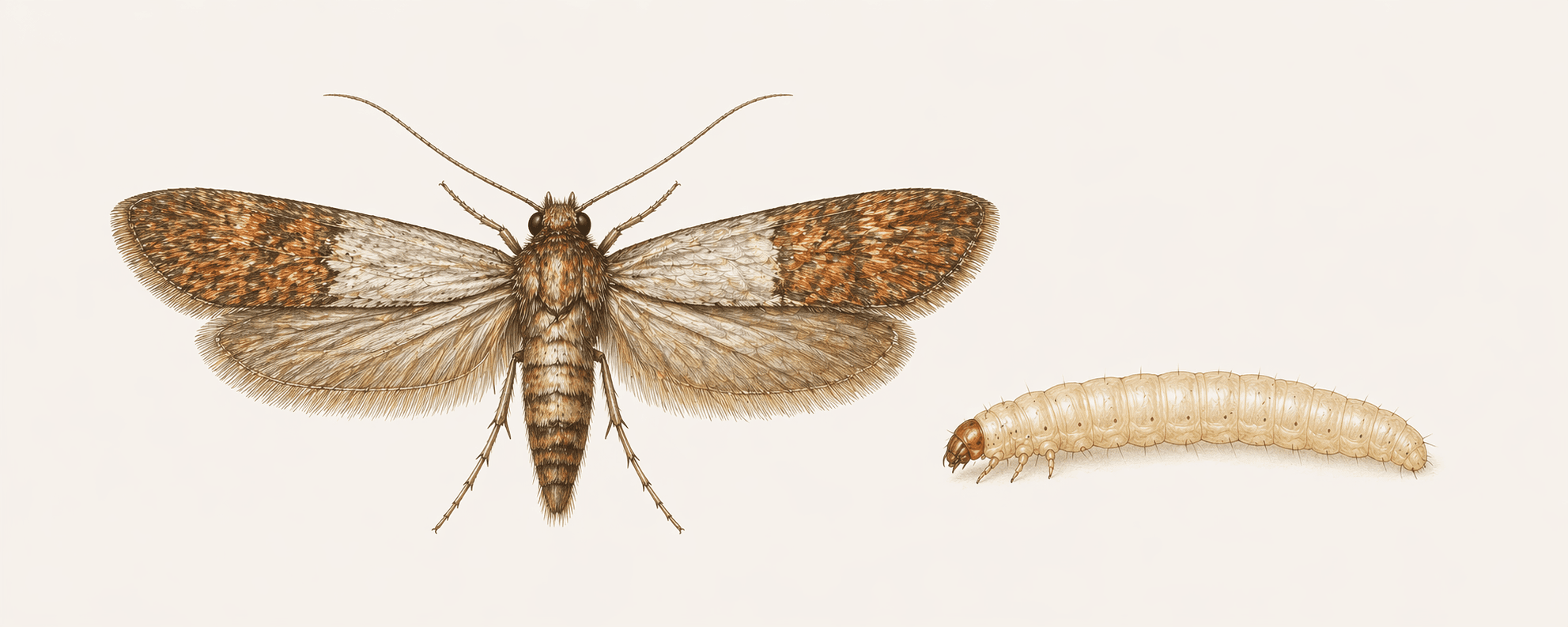
Identifying pantry moths: the signs that never lie
Plodia interpunctella is a small nocturnal moth measuring eight to ten millimetres long, with characteristically two-toned wings: the outer half coppery to reddish-brown, the inner half beige-cream. In flight, it is sometimes mistaken for a clothes moth, but its territory is exclusively the food cupboard.
The signs that should raise the alarm:
- Moths flying at dusk around kitchen lights, particularly near cupboards of dry goods
- Silken threads and cottony clumps on packets of rice, flour, pasta, muesli, dark chocolate and pet food
- Small whitish caterpillars with a brown head, five to fifteen millimetres, crawling on shelves or on cupboard ceilings — they migrate before pupating
- Silken cocoons stuck in the top corners of cupboards or in door-frame joints
- Clumped grains or abnormal fine dust at the bottom of open packets
- A slightly rancid smell in otherwise recently bought cereals
The complete life cycle lasts four to six weeks depending on temperature. By the time an infestation becomes visible, several generations already coexist — it is this overlap that makes eradication tricky without a structured method.
Health and material risks
The pantry moth is neither a disease vector nor a biter. The risk is of a different order — and often underestimated.
On the health side, the larvae and their droppings progressively contaminate foodstuffs: secretions, moults, cocoons and carcasses mix into flours and cereals. The allergens from the larval exuviae can trigger skin reactions, chronic rhinitis or a worsening of asthma in sensitised individuals. For an infant, a pregnant woman or an immunocompromised person, vigilance is essential.
On the material side, an ignored infestation destroys entire stocks: larders holding dried fruit, yacht pantries, restaurant stores. Exceptional spices, couverture chocolate and speciality flours represent real economic loss in a Monaco professional kitchen.
On the regulatory side, a catering establishment subject to the HACCP plan can have its compliance called into question in the event of proven contamination of a foodstuff intended for service. For a landlord or managing agent, the obligation to provide a decent dwelling includes the absence of chronic pests.
Why this pest thrives in Monaco and on the Riviera
Three combined factors explain the frequency of infestations in the Principality and its hinterland.
The Mediterranean climate — mild winters, hot summers, high humidity — allows Plodia interpunctella to complete several additional generations a year compared with more northerly latitudes. No seasonal respite durably breaks the cycle.
The urban, vertical density of Monte-Carlo, La Condamine and Larvotto favours the migration of adults between flats via service ducts, suspended ceilings and landing-door joints. An infestation in one dwelling can spread over several floors within a few weeks if it is not treated at source.
The high-end residential and commercial fabric — deliveries of fine groceries, yacht stores at Port Hercule, villa larders in Cap-d'Ail or Cap-Ferrat — involves large food stocks, often kept for a long time, sometimes forgotten during long out-of-season absences. It is in these conditions that the moth finds its ideal environment: warmth, quiet, abundant raw material. In Beausoleil and Menton, infestations frequently affect second homes reopened after several months of summer closure.
The MPS protocol in five steps
Our intervention rests on a rigorous, measured method, faithful to the spirit of integrated pest management: prevention and mechanical action before biocide.
- Entomological diagnosis — visual inspection of all cupboards, drawers and storage areas, formal identification of the species (Plodia is distinguished from Ephestia, in particular, by its wing colouration), assessment of the level of infestation and mapping of the primary and secondary hotspots.
- Removal and sorting of foodstuffs — systematic elimination of any contaminated or suspect product (open packets stored for several months, cereal products, dried fruit, cocoa, animal feed). Sound foodstuffs are transferred into rigid airtight containers after inspection.
- Thorough mechanical cleaning — high-power vacuuming of the eggs, invisible to the naked eye, lodged in shelf joints, cupboard corners and drawer grooves. Steam pass at around 180 °C on sensitive areas, destroying eggs and larvae with no chemical residue in food contact.
- Installation of sex-pheromone traps — capture of adult males, quantitative monitoring of the residual population, interruption of the reproductive cycle. Targeted application of an approved biocide only where necessary, away from direct food-contact areas.
- Inspection at fifteen days and delivery of a written report attesting to the return to a zero level of captures. Confidentiality governed by a systematic NDA.
Mistakes to avoid
Faced with an infestation, the temptation is strong to resort to consumer solutions that often make the situation worse.
- Aerosol insecticide sprays disperse the product into the air without ever reaching the eggs hidden in the joints. They needlessly contaminate food surfaces and do not interrupt the life cycle.
- Sachets of lavender, bay leaves and cloves have a marginal repellent effect, sometimes useful as light prevention, but no real action on eggs and larvae already established.
- Simply washing cupboards with soapy water does not reach the eggs, which are particularly resistant and lodged in the micro-cracks of the wood or laminate.
- Discarding only a visibly infested packet in the belief that this solves the problem: several neighbouring packets almost always harbour eggs invisible to the naked eye.
- Putting off the cleaning of shelf joints: this is the number-one vector of reinfestation.
- Using pheromone traps alone without removing the stock: they will capture adult males but let eggs, larvae and cocoons thrive.
A professional intervention treats the infestation across its complete life cycle.
A typical Monaco case: the store of a restaurant in Fontvieille
A Mediterranean restaurant in the Fontvieille district contacted us at the end of summer. The chef reported moths flying in the evening around the lights of the dry store, with no apparent connection to the dining room. On inspection, we found several bags of speciality flour, Italian rice and chopped almonds displaying the characteristic silken threads. The supplies had arrived several weeks earlier, probably already contaminated at source.
Our protocol was deployed in a single night-time intervention, outside service: complete removal of the affected stock, thorough vacuuming of the stainless-steel shelves, steam pass over joints and door frames, installation of six pheromone traps at strategic points. The inspection at fifteen days confirmed the absence of any new capture. A brief audit of the food safety management plan was proposed in order to incorporate a weekly visual check of deliveries. The establishment continued operating without interruption, the assignment having been carried out under contractual confidentiality.
Lasting prevention
Once eradication is achieved, a few habits are enough to prevent any re-establishment.
- Visually check every delivery — a packet of flour or dried fruit that has spent a long time in an import warehouse can arrive already contaminated at the egg stage.
- Systematically decant rice, pasta, flours, sugar, muesli, biscuits, dark chocolate and animal feed into rigid airtight jars or boxes (glass, stainless steel, thick food-grade plastic). Cardboard and paper bags are not barriers.
- Clean cupboard joints and corners at least once a quarter, paying particular attention to shelf grooves and the backs of drawers.
- Limit stocks to the quantities genuinely consumed within six months. A dormant store is a store at risk.
- Install a monitoring pheromone trap in large professional kitchens or yacht stores: a single captured adult gives warning before any visible infestation.
- Ventilate and keep cool — Plodia develops poorly below fifteen degrees and rarely above thirty-five.
Monaco Pest Solutions offers a light monitoring contract for high-stakes kitchens and second homes closed for several months a year.
Regulatory framework and food safety
Two distinct regimes apply to pantry-moth infestations depending on the establishment's location.
French and European framework — any establishment subject to HACCP regulations (the European food hygiene regulation) must guarantee the absence of contamination of foodstuffs intended for consumption. A proven infestation exposes the operator to a product recall, or even administrative closure in the event of a serious failing noted during a les services vétérinaires départementaux inspection. The food safety management plan must include a documented pest-control component, with traceability of interventions and written reports.
Monaco framework — catering establishments in the Principality are subject to the supervision of the les autorités sanitaires monégasques, whose hygiene requirements largely align with European standards while presenting their own specific features. Monaco co-owned buildings have, through their managing agent, an obligation to maintain the common areas that includes control of pantry pests when they spread from refuse chutes or plant rooms.
Monaco Pest Solutions (RCI Monaco 26S10394) systematically issues an intervention report compliant with HACCP documentary requirements, usable in the event of an inspection.
How long, how many visits
A pantry-moth infestation caught at a typical stage is generally resolved in two to three weeks. The first visit — diagnosis, removal, mechanical cleaning and installation of pheromone traps — lasts between two and four hours depending on the area concerned and the volume of stock to sort. An inspection visit at fifteen days is sufficient in the great majority of residential cases.
In medium-sized private homes, a single intervention resolves the matter for good. For professional kitchens and yacht stores, a second visit may be necessary in order to adjust the trapping strategy and check for the absence of a secondary hotspot in a neighbouring room or an adjacent service duct.
In the event of an occasional reinfestation through a contaminated delivery — the scenario of a failing supplier — an additional visit is offered at an adapted rate. Our commitment remains unchanged: pricing transparency from the quote onward, no overcharging during the assignment, NDA confidentiality over the entirety of the intervention.
In any doubt? Our team responds within 2 working hours. +377 37 70 70 02 — or [request a free quote](/devis-gratuit).