July 9, 2026 · 11-minute read
Rat problem in Monaco: what to do in an emergency?
Spotted a rat, droppings or night-time noises in Monaco? Here are the emergency steps, realistic timelines and professional protocol to regain control fast.
You've just seen a rat in Monaco: the 5 first actions to take within 24 hours
A shadow darting along a skirting board in the cellar, dark droppings behind the bin, night-time scratching from a suspended ceiling in Monte-Carlo: spotting a rodent rightly triggers a sense of urgency. Here are the five steps to take immediately, before even dialling a number.
- Secure your food. Transfer any accessible food (fruit, bread, pet kibble, rice sacks, the bin under the sink) into airtight containers made of glass, metal or rigid plastic. Cardboard and soft plastic packaging will not slow down a rodent.
- Do not sweep dry. Rat droppings contain pathogens that can become airborne when swept. Wear gloves, spray a disinfectant (diluted bleach), let it act, then wipe with paper towel and discard in a sealed bag.
- Photograph the clues. Tracks, droppings, suspicious entry points: every shot will help our technician map the infestation. Also note the exact times when noises occur.
- Do not block passages straight away. Plugging a hole without a diagnosis pushes rodents to seek other routes, often higher up in service ducts. Wait for the professional survey.
- Call a certified operator. In Monaco, the intervention must be carried out by a professional holding the Certibiocide (Monaco Pest Solutions: Certibiocide N121134, RCI Monaco 26S10394). A single call to +377 37 70 70 02 triggers an assessment the same day.
These five steps stabilise the situation without worsening the risk. They gain you what matters most: diagnostic time.
Early or established infestation: how to read the signs
The same Larvotto flat may harbour an opportunistic rat that came through a crawl space, or a colony that has been established for weeks. The difference changes everything: in the first case, targeted trapping is enough; in the second, a full-scale protocol is required.
Signs of an early infestation:
- One to three fresh droppings (black, shiny, soft), isolated and grouped in a single spot.
- A single point of visual observation (usually at dusk).
- Occasional night-time noises, over one or two nights.
- No characteristic urine odour.
Signs of an established infestation:
- Droppings in several locations, of different sizes (indicating several individuals and sometimes several generations).
- Dark, greasy smears along walls, skirting boards or pipework: these are the repeated runways of the rodents.
- Gnaw marks on wood, plastic, electrical conduits and food packaging.
- An ammonia-like smell in cellars, service ducts or lofts.
- Regular night-time noises, sometimes daytime too (a sign of a dense population that needs to feed more).
- Paw prints in dust or flour.
From three signs upwards, the colony is considered active. In Monaco, urban density, the proximity of the port and the many renovation sites all favour a rapid transition from one stage to the next — sometimes in as little as ten to fifteen days.
Three species to know in the Principality
The Principality is mainly home to three species of commensal rodents. Confusing them leads to treatment errors: each species has its own runways, preferred baits and entry points.
The black rat (*Rattus rattus*)
The climbing species par excellence. Slim build, large ears, tail longer than the body. It colonises lofts, suspended ceilings, vertical service ducts, palm trees and the hanging gardens of Monte-Carlo. In Monaco, it often uses shared rooftops to travel from one building to another.
The brown rat (*Rattus norvegicus*)
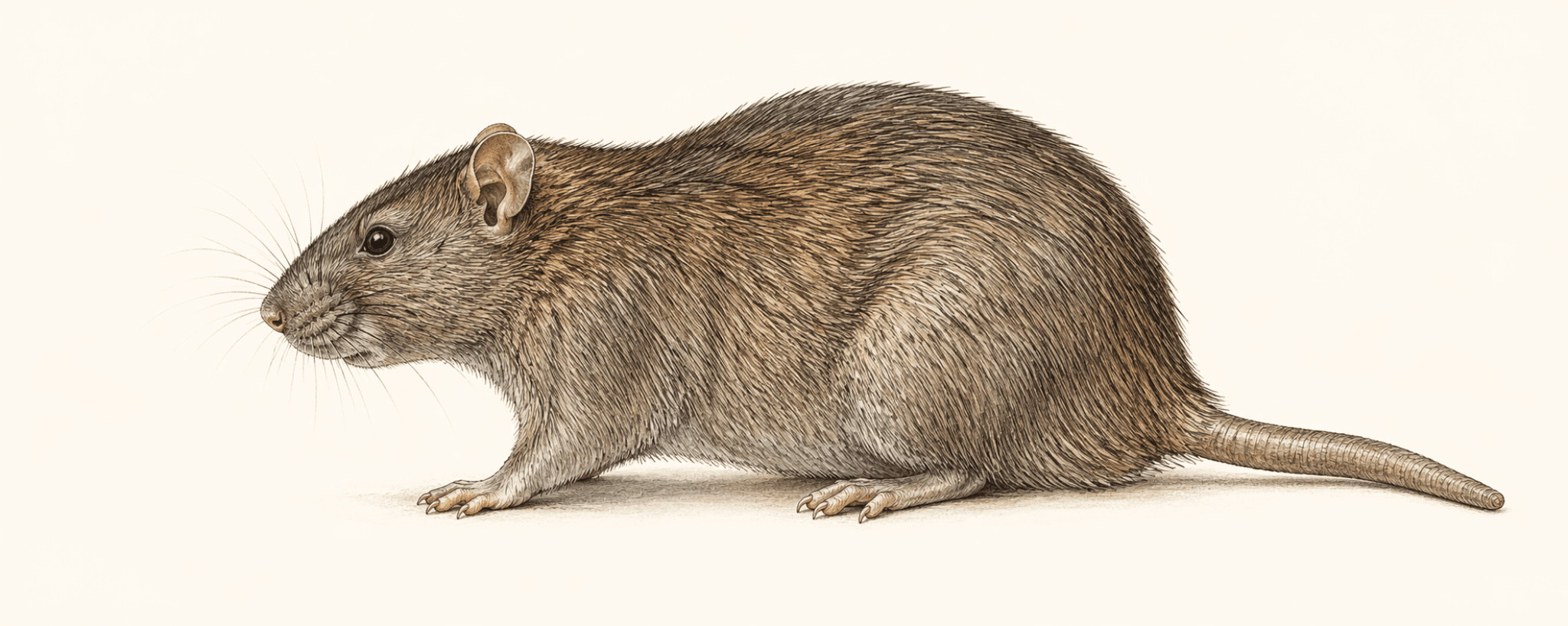
Also known as the Norway rat or sewer rat. Heavier, stockier, short ears. It is the rodent of basements, sewer networks, underground car parks, cellars and ground floors. It is very common in Fontvieille, La Condamine and around Port Hercule. An excellent swimmer, it can travel up through a poorly maintained toilet trap.
The house mouse (*Mus musculus*)
Often underestimated. Small, under twenty grams, but able to slip through a six-millimetre opening. It targets kitchens, pantries, larders and catering premises. In Monaco, it regularly appears in the professional kitchens of Monte-Carlo and in high-end flats, where the tiniest crumb of toast is enough to feed it.
An on-site diagnosis identifies the dominant species (droppings, tracks, runways), a prerequisite for choosing the right strategy.
The real risks: health, property, legal
A rat is not merely an eyesore. It represents a stack of risks that has to be faced squarely.
Health risks. Commensal rodents are reservoirs for several zoonoses. Leptospirosis, spread through urine, can survive for weeks in a damp environment (a cellar, a watered planter). Salmonellosis contaminates foodstuffs through indirect contact. Add hantavirus disease, rat-bite fever, and the passive carriage of ectoparasites (fleas, ticks, mites). A single cross-contamination in a kitchen can be enough to trigger a food-borne illness.
Property risks. Gnawed electrical conduits are one of the leading causes of fires of undetermined origin in cellars and car parks. In Monaco, where service ducts often serve several units in a co-owned building, a single gnawed cable can cut telephone, fibre or low-voltage circuits for an entire block. Add damage to insulation, furniture, food stocks, stored artworks and administrative records.
Legal risks. In Monaco, a restaurant operator, a building manager or a commercial landlord has an implicit duty of hygiene. The presence of rodents can trigger liability in the event of administrative closure, lease termination or litigation. The Monegasque framework requires biocide operations to be conducted by an operator holding the Certibiocide — for Monaco Pest Solutions, this is number N121134. Unlike France, where the rules fall under the Public Health Code and the les autorités sanitaires françaises, the Principality applies its own texts and administrative procedures, often more demanding in terms of traceability.
Why the supermarket blister pack almost never does the job
When the first rodent is spotted, the temptation is to rush out and buy a box of rodenticide bait at the supermarket. In nine cases out of ten, that is the wrong response.
A poorly chosen bait educates the rat. Rodents, especially the brown rat, develop food neophobia: they first sample a minute amount of any new food. If the retail bait is poorly placed, poorly dosed or not palatable for the target species, the colony learns to avoid it. You then create long-lasting complications for the professional who intervenes afterwards.
An unsecured station is illegal and dangerous. Since the European revisions of recent years, anticoagulant rodenticides must be placed in secured bait stations, inaccessible to children, pets and non-target wildlife (hedgehogs, cats, raptors). An open blister pack on a cellar shelf breaches these principles.
A poisoned rat that dies inside a partition creates a secondary nuisance. In Monaco, the smell of decomposition rising through a service duct or a suspended ceiling requires opening up, stripping out, disinfection and reinstatement — a cost bearing no relation to the initial intervention.
Finally, a one-off treatment does not address the cause. Without a survey of entry points, without species prioritisation, without well-planned sealing, the colony rebuilds within three to six weeks. That is why a professional intervention always fits within an integrated pest management approach: reducing the population, then physical exclusion, then prevention.
The Monaco Pest Solutions intervention protocol in 4 steps
All of our rat and mouse interventions in Monaco follow the same backbone. It guarantees a measurable, documented result — the prerequisite for lasting control.
Step 1 — Diagnosis and mapping (day 0). A certified technician attends within a short deadline (under 24 working hours for Monaco and neighbouring towns: Cap-d'Ail, Beausoleil, Roquebrune-Cap-Martin, Menton). They identify the species, runways, entry points, water and food sources, and map the infested area. A visual report is issued.
Step 2 — Targeted treatment. Installation of secured bait stations, locked, numbered and geolocated in the intervention plan. Active ingredients are chosen according to species and context (residential, catering, sensitive environments). Mechanical trapping supplements areas where biocides are prohibited (active professional kitchens, hotel rooms, nurseries).
Step 3 — Follow-up and validation. One to three check visits over two to four weeks, with bait consumption recorded, any carcasses removed and stations adjusted. A threshold of "stable zero consumption" over two consecutive visits confirms neutralisation.
Step 4 — Exclusion and prevention. Entry points are sealed with suitable materials (steel wool, specialised expanding foam, stainless-steel mesh, concrete pointing). Behavioural advice is given to the client (waste management, food storage, ventilation).
The whole process is backed by our contractual commitment to discretion: NDA as standard, technician in neutral attire, unmarked vehicle on request.
How long to regain calm: the realistic timeline
It is always the first question on the phone: "How long until this is over?" Here are the honest benchmarks, without a sales promise.
Within 24 to 72 hours: visible symptoms clearly decrease. Rodents alter their runways, reduce surface activity and often stop appearing at dusk. A word of caution: this lull does not mean the infestation is over. It is a sign the system is working, not a conclusion.
Within 2 to 3 weeks: the colony is neutralised. Anticoagulant biocides act on a delay (typically 4 to 10 days after sufficient ingestion) — this counter-intuitive latency is precisely what prevents rodents from linking bait with danger, keeping the bait palatable for the remaining individuals. That is the time needed for a full colony (breeding adults and weaned juveniles) to be treated.
Within 4 to 6 weeks: validation by blank check. Our technicians return to install consumption indicators with no active ingredient (tracer flour, non-toxic baits). Zero consumption over two visits confirms there is no resurgence.
Beyond: the prevention phase. The calendar switches to quarterly or half-yearly visits depending on the site. For a Monte-Carlo restaurant or a Fontvieille building exposed to the port area, an annual maintenance contract is often the only truly durable protection.
These timeframes apply to an intervention started at the earliest signs. An infestation that has been established for several months may require two to three months of full treatment.
Real cases encountered in Monaco
Three configurations recur regularly in the Principality. Each illustrates why an on-site diagnosis remains irreplaceable.
A building cellar in Monte-Carlo. A resident reports night-time scratching behind the partition of her private cellar. Diagnosis: a colony of brown rats settled in a communal space via a cracked slab connecting to an old service network. Treatment in three visits, concrete sealing and stainless-steel grating over the inspection chamber, quarterly contract rolled out across the whole building. No return of activity observed after six months.
A professional kitchen in Fontvieille. An operator calls urgently after spotting a mouse in the prep area, days before a food-safety inspection. Biocides are prohibited in an active kitchen: the intervention relies on intensive mechanical trapping, a documented protocol, and above all sealing of passages under fire-rated doors (stainless-steel door sweeps, brush seals). Resolved in 10 days, traceability file handed over to the operator.
A service duct in a mixed-use building in La Condamine. Converging complaints from three units (a ground-floor shop and two residential floors). Diagnosis: black rats travelling vertically through a shared electrical duct. Coordination with the building manager, out-of-hours intervention for the retail unit, floor-by-floor sealing, and fitting of anti-climb collars at the base of the duct. The case illustrates a Monegasque reality: the vertical movement of rodents often demands a building-wide response rather than a flat-by-flat one.
All three cases share one thing in common: without an initial diagnosis, none of these solutions would have been prescribed correctly.
After the intervention: locking down prevention
A successful intervention only holds if the environment remains hostile to rodents. Here are the measures we systematically recommend at the end of a job.
Physical closure. Seal any opening larger than 6 mm (mice) or 12 mm (rats). Stainless-steel mesh over air intakes, brush seals at the bottom of doors, sealant around cable and pipe penetrations. Check inspection chambers and gully gratings on balconies and terraces — frequent entry points in Larvotto and Fontvieille.
Food management. Dry goods in airtight containers. Pet kibble put away after each meal. Ripe fruit in the fridge. Bins closed and emptied daily, waste rooms cleaned with hot water and soap.
Water management. Avoid unnecessary permanent water sources: overfilled plant saucers, dripping traps, condensation from poorly drained air-conditioning units. A rat can survive several days without eating, rarely without drinking.
Vegetation. Prune plants touching the façades. In Monaco, palm trees and bougainvillea are motorways for the black rat. Do not leave fallen fruit on the ground in the gardens of Cap-d'Ail or Beausoleil.
Monitoring contract. For exposed shops, restaurants, hotels, residences and shared buildings, an annual contract with scheduled visits is the best health-safety insurance. Complete documentation is provided, ready to be produced during an inspection.
Reaching Monaco Pest Solutions in an emergency
Based at 29 Bd Rainier III, 98000 Monaco, Monaco Pest Solutions operates across the whole Principality and the neighbouring towns (Cap-d'Ail, Beausoleil, Roquebrune-Cap-Martin, Menton). Our technicians hold the Certibiocide N121134, and the company is registered with the RCI Monaco under number 26S10394.
Our commitments:
- Reply within 2 working hours to any urgent rat-control request.
- Intervention within 24 hours in most situations.
- Absolute contractual discretion: NDA as standard, staff in neutral attire, unmarked vehicle on request.
- A clear quote issued before any intervention, with no obligation.
- Full traceability: visit reports, station plans and safety data sheets available for your documentation obligations.
In doubt? Our team replies in under 2 working hours. +377 37 70 70 02 — or **request a free quote**.
Frequently asked questions
How long does it take to get rid of a rat infestation in Monaco?
Visible symptoms (sightings, noises) clearly diminish within 24 to 72 hours of the system being installed. Full neutralisation of a colony generally takes 2 to 3 weeks, due to the delayed action of anticoagulant biocides. A blank-check validation is carried out between the 4th and 6th week. For an infestation that has been established for several months in a shared building, an older property or a communal cellar in Monte-Carlo or La Condamine, allow 2 to 3 months for a complete cycle including sealing of passages and follow-up. A quarterly contract is often required for exposed sites (port area, catering, residences with gardens).
Can I buy rat poison at the supermarket and sort the problem out myself?
This is strongly discouraged. A retail bait that is poorly placed or poorly dosed teaches rodents to avoid it, creating long-lasting complications for any future professional intervention. Rodenticides must be placed in secured stations inaccessible to children, pets and non-target wildlife; an open blister pack in a cellar breaches these principles. Finally, a poisoned rodent that dies inside a partition or a service duct produces an odour nuisance that requires costly removal works. In Monaco, biocide operations must be carried out by a certified operator: Monaco Pest Solutions holds the Certibiocide N121134.
Are Monegasque regulations the same as French ones for rat control?
No, the Principality applies its own framework. Where France relies on the Public Health Code and bodies such as the les autorités sanitaires françaises, Monaco has its own legislation, administrative procedures and traceability requirements. The Certibiocide remains the reference qualification for operators, but its practical framework in Monaco comes with specific documentation obligations, particularly for public-facing venues, restaurants and hotels. Monaco Pest Solutions, a Monegasque company registered with the RCI under 26S10394, knows these specifics inside out and provides documentation ready to withstand an administrative inspection.
How can I tell a black rat, a brown rat and a mouse apart at home?
The black rat is slim, with a tail longer than its body and large ears; it climbs and favours lofts, suspended ceilings and elevated vegetation. The brown rat is heavier and stockier, with short ears; it occupies cellars, basements, underground car parks and sewer networks, especially in Fontvieille and near Port Hercule. The house mouse weighs under twenty grams and squeezes through six-millimetre openings; you find it mostly in kitchens. The droppings differ too: roughly 15 mm and pointed for the black rat, 18 mm and spindle-shaped for the brown rat, 5 to 8 mm for the mouse.
Are your interventions discreet for a private residence or a business?
Yes. Discretion is a standard contractual commitment. We sign an NDA on the client's request, our technicians attend in neutral attire, and our vehicles can be unmarked on request. Bait stations are concealed as far as possible and numbered according to a plan that stays internal. For hotels, restaurants, high-end residences and shared buildings in Monte-Carlo, Larvotto or Fontvieille, we adjust the schedule (outside service, outside opening hours) and coordinate with the concierge team or building manager. No external communication about our sites is produced without prior written agreement from the client.
How quickly can a technician be dispatched for an emergency in Monaco?
We reply to every enquiry in under 2 working hours. For an emergency in Monaco and the neighbouring towns (Cap-d'Ail, Beausoleil, Roquebrune-Cap-Martin, Menton), a technician is dispatched within 24 working hours, often the same day depending on the schedule. The first visit covers the diagnosis, mapping of the infestation, installation of the first secured stations and delivery of a visual report. To reach our team, one number: +377 37 70 70 02, or by email at contact@monacopestsolutions.mc.
*rat and mouse guide · coverage areas in Monaco · prevention tips*
Frequently asked questions
- How long does it take to get rid of a rat infestation in Monaco?
- Visible signs of rats (sightings, noises) drop sharply within 24 to 72 hours after the control devices are installed. Full neutralisation of a rat colony generally takes 2 to 3 weeks, due to the delayed action of anticoagulant biocides. A verification check is carried out between weeks 4 and 6. For a rat infestation established for several months in a co-owned building, an older block or a shared basement in Monte-Carlo or La Condamine, allow 2 to 3 months for a complete cycle, including sealing of entry points and follow-up monitoring. A quarterly contract is often necessary for exposed sites in Monaco: harbour areas, food service and residences with gardens.
- Can I buy rat poison in a supermarket and deal with the rats in Monaco myself?
- This is strongly discouraged. A consumer-grade bait that is poorly placed or poorly dosed teaches rats to avoid it, making any later professional treatment far more difficult. Rodenticides must be deployed in secured bait stations inaccessible to children, pets and non-target wildlife; an open blister pack in a basement violates these principles. Moreover, a poisoned rat that dies inside a partition wall or a service duct causes a persistent odour problem requiring costly removal work. In Monaco, biocide operations must be carried out by a certified operator holding the professional qualification required for rodent control, which guarantees safe placement and full traceability.
- Are rat control regulations in Monaco the same as in France?
- No, the Principality applies its own framework. While France relies on its national health law and regional health authorities, Monaco has its own texts, administrative procedures and traceability requirements. The operator certification for professional biocide use remains the qualification benchmark, but practising rat control in Monaco comes with specific documentation obligations, particularly for establishments open to the public, restaurants and hotels. A company registered in Monaco and familiar with these specificities can hand over documentation that is directly usable in the event of an administrative inspection, an essential guarantee for any rat control programme in the Principality.
- How can I tell a black rat, a brown rat and a mouse apart in my home?
- The black rat is slender, with a tail longer than its body and large ears; it climbs and favours attics, suspended ceilings and high vegetation. The brown rat is heavier and stockier, with short ears; it occupies cellars, basements, underground car parks and sewer networks, notably in Fontvieille and around the harbour in Monaco. The house mouse weighs under twenty grams and squeezes through a six-millimetre opening; it is mostly found in kitchens. Droppings differ too: around 15 mm and pointed for the black rat, 18 mm and spindle-shaped for the brown rat, 5 to 8 mm for the mouse. Correctly identifying the rats involved determines the choice of devices and the success of the treatment.
- Are your rat control interventions discreet for a private residence or business in Monaco?
- Yes. Discretion is a systematic contractual commitment. We sign a non-disclosure agreement at the client's request, our technicians work in neutral clothing, and our vehicles can be unmarked on demand. Bait stations targeting rats are concealed as far as possible and numbered according to a plan that remains internal. For hotels, restaurants, high-end residences and co-owned buildings in Monte-Carlo, Larvotto or Fontvieille, we adapt our schedules (outside service and opening hours) and coordinate with the concierge or the building manager. No external communication about our rat control operations in Monaco is ever produced without the prior written consent of the client.
- How quickly can a technician respond to a rat emergency in Monaco?
- We answer every request within 2 working hours. For an urgent rat situation in Monaco and the neighbouring communes (Cap-d'Ail, Beausoleil, Roquebrune-Cap-Martin, Menton), a technician is on site within 24 working hours, often the same day depending on the schedule. The first visit includes the diagnosis, mapping of the rat infestation, installation of the first secured bait stations and delivery of a visual report. To reach our team quickly, contact us by phone or through our online contact form: an emergency coordinator handles rat call-outs across Monaco every working day.