July 12, 2026 · 14-minute read
Rats in the Attic in Monaco: Detection and Eradication
Night-time noises overhead, tunnelled insulation, gnawed cables: how to detect and eradicate rats in Monaco attics, from diagnosis to follow-up.
Noises in the ceiling at night: the first signal to take seriously
It is 11 pm, the building has gone quiet, and a rapid pitter-patter crosses the bedroom ceiling. Scratching, light running sounds overhead, sometimes a steady gnawing against a beam: in the vast majority of cases, these night-time noises are the very first sign that rodents have moved into the attic. In Monaco, where older roofs often conceal converted attics or accessible roof voids, this scenario is far more common than people imagine — and far more urgent than they assume.
The rhythm and nature of the sounds already tell you something about the occupant. Rats are active mainly between dusk and dawn, with peaks in the early night and just before daybreak. A fast, light scurrying, punctuated by scratching and small knocks against the joists, points to a black rat moving across the attic floor or along the roof timbers. Heavier, slower movement may suggest a brown rat, rarer at height but by no means impossible in a building whose service ducts run all the way up to the roof. By contrast, cooing and daytime noises usually mean pigeons under the tiles, while loud galloping in the very early evening, in the hillside districts, may point to a dormouse or a stone marten.
Rule number one: do not wait. A pair of rats settled in a warm attic can produce a litter of six to ten young every three to four weeks under favourable conditions. What was an isolated noise in January becomes a structured colony by spring. As soon as the noises recur over several consecutive nights, an inspection is needed; and if smells or visible damage appear as well, our emergency team, available 24/7, can step in without delay.
Droppings, grease marks, tunnelled insulation: the signs that confirm it
Once the noises have raised the alarm, an attic inspection turns suspicion into certainty. Five physical clues come up again and again in our audit reports.
Droppings. Black rat droppings measure 8 to 12 mm, are spindle-shaped with pointed ends, and are usually scattered along travel routes rather than piled up. Brown rat droppings are larger (15 to 20 mm), with rounded ends, and grouped together. Black, shiny, soft droppings indicate active presence; grey, dry, crumbly ones show older activity. A rat produces up to 40 droppings a day, so their density is an excellent indicator of the level of infestation.
Grease marks. A rat's coat is loaded with sebum and dust. By always using the same routes along beams, purlins and tight passages, rats leave characteristic dark, shiny smears known as rub marks. In an attic you will find them along the timbers, around access holes and along ducts.
Damaged insulation. Mineral wool and insulation boards are ideal nesting material: rats dig galleries through them, compact whole areas into nest balls and soak the rest in urine. Insulation riddled with tunnels and shredded in places loses much of its thermal and acoustic performance.
Gnawed cables. Rat incisors grow continuously; the animals gnaw to wear them down. Stripped electrical sheathing, nicked copper wires, punctured multilayer pipes: this is the most dangerous damage of all, and we come back to it below.
Smell and footprints. A persistent ammonia smell betrays an established occupation. In the dust of attic floors, paw prints and tail drag marks are easy to read — if necessary, dust a thin band of talc across suspected routes. For a full overview of the signs by species, see our dedicated page on rats and mice.
Black rat or brown rat: identifying the species in your roof
Not all rodent infestations at height are treated the same way, and identifying the species is the first technical decision of any serious protocol.
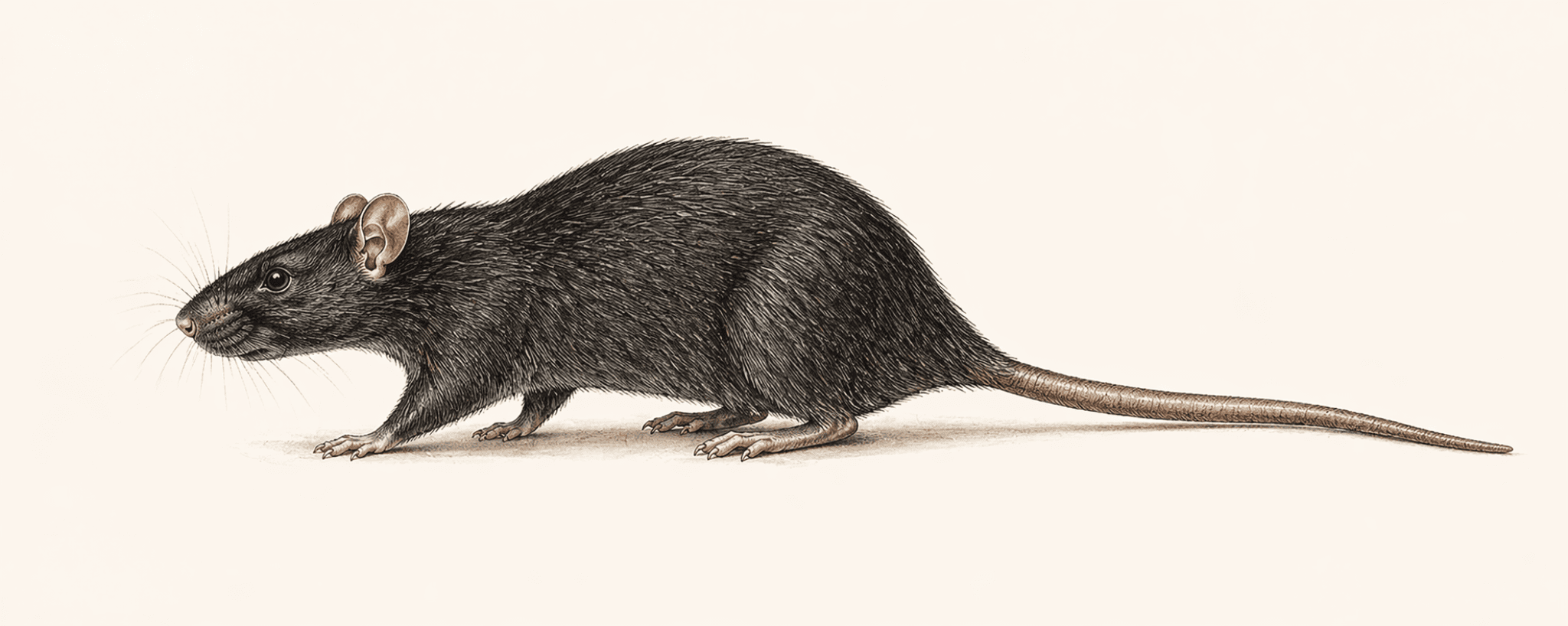
The black rat (Rattus rattus), also called the roof rat or attic rat, is the great specialist of roof spaces. Slender build (150 to 250 g), a tail longer than its body, large ears, a pointed muzzle: it is an exceptional climber, able to scale a rough facade, run along a taut cable and jump more than a metre horizontally. It nests at height — roof frames, false ceilings, dense vegetation — and readily feeds on fruit and seeds, which makes it perfectly at home in a Mediterranean environment planted with palms, pines and fruit trees. In Monaco's roofs, this is the species we encounter in the vast majority of cases.
The brown rat (Rattus norvegicus) is heavier (300 to 500 g), with a tail shorter than its body and small ears. It is a burrower: its domain is the sewer network, cellars, crawl spaces and embankments. It climbs less readily, but it is perfectly capable of working its way up a damaged soil stack or a service duct to the upper floors. Its presence in an attic almost always signals a defect somewhere on a network, and steers the investigation towards the pipework.
The distinction is not academic: the black rat is markedly wary of new objects (strong neophobia), nests at height and requires treatment of the roof, the vegetation and the aerial access routes; the brown rat instead demands control of basements and networks. Get the species wrong and you place your devices in the wrong locations — and lose several weeks.
How rats reach the rooftops: the entry routes in Monaco
A rat does not simply "appear" in an attic: it enters by an identifiable route that a methodical audit always ends up finding. Four families of access dominate our interventions in the Principality.
Poorly sealed dormers and roof openings. Old bull's-eye windows, roof windows with perished seals, ventilation openings without grilles, roller-shutter boxes: a black rat squeezes through an opening of barely 2 centimetres. On older roofs, the junctions between dormer and roof covering are a recurring weak point.
Trees and vegetation close to the facades. A pine or ficus branch touching the roof is a direct gangway. Palm trees, so common in the Principality's gardens, serve as daytime shelter for black rats, which move onto the roofs after dark. Dense climbing vegetation on a facade acts as the same kind of ladder.
Gutters and rainwater downpipes. A black rat climbs the inside or outside of a zinc or cast-iron downpipe without difficulty, especially where it runs along a rough corner of the facade. Gutters clogged with plant debris offer food and nesting material into the bargain.
Displaced tiles and roofing defects. A tile slipped after a windstorm, a lifted flashing at the verge, a cracked ridge: every gap of a few centimetres in the roof's weatherproofing is a doorway. Add to this poorly sealed cable and duct penetrations, and party walls: in a dense urban fabric, a colony can travel from roof to roof along the whole length of a block.
Belle Époque attics and hillside villas: why Monaco favours the roof rat
The Principality's urban configuration creates singularly favourable conditions for the roof rat. The Belle Époque buildings, numerous in the central districts, have attics that are both vast and complex: old timber roof frames, attic spaces sometimes converted into flats or studios, sometimes left as technical volumes crossed by ducting. A century of successive renovations has multiplied the construction voids, wall linings and service runs — so many discreet motorways for a rodent. When the attics are lived in, cohabitation quickly becomes unbearable: the rats then travel inside the linings, a few centimetres from the living rooms.
On the heights, the hillside villas add further factors: terraced gardens, lush vegetation all year round, fruit trees, composters, pools and water points, canal-tile roofs whose interlocking profiles offer dozens of potential passages. The mild climate plays a decisive role: with no harsh winter, breeding never really pauses, and a temperate, dry, quiet attic is a first-choice nesting site twelve months a year.
Finally, the exceptional density of the built environment means no roof stands alone: treating one attic without considering the adjoining buildings, the neighbouring vegetation and the networks often just moves the problem a few metres. This is one reason our protocols always begin with a reading of the whole site and its immediate surroundings.
Fire risk, health risk, material damage: what waiting really costs
An attic infestation is not merely a noise nuisance. Three families of risk justify rapid action.
The fire risk is the most serious. By gnawing the electrical sheathing that runs through attics — floor supplies, lighting circuits, mechanical ventilation, air conditioning — rats expose live conductors in direct contact with flammable materials: dust, dry roof timbers, insulation. A short circuit in an unseen, unmonitored volume can smoulder for a long time before being detected. A significant share of unexplained electrical fires is attributed to rodents: an infested attic is, quite literally, a fire risk above your head.
The health risk is real, even without direct contact. Rat urine can carry leptospirosis, and dust contaminated by dried droppings can be involved in transmitting certain viruses, including hantaviruses — which is why a soiled attic must never be dry-swept, nor the insulation handled without respiratory protection. Add salmonella and parasites (fleas, mites) that may migrate into the living areas, particularly after a badly conducted treatment.
Material damage accumulates in silence. Destroyed and soiled insulation to replace, ceilings stained by urine, punctured pipes, cables and sheathing to strip out and refit: the bill for reinstating a long-infested attic far exceeds the cost of early eradication. The rule we see confirmed job after job is constant: the later the detection, the more the "repairs" line outweighs the "treatment" line.
Professional detection: how we confirm and map the infestation
Before any treatment, our intervention starts with a full audit, because you can only eradicate properly what you have precisely located. The inspection covers three levels: the attic itself, the building envelope and its surroundings.
In the attic, the technician records and maps every clue: droppings (species, freshness, density), rub marks, urine trails, nesting areas in the insulation, gnawed materials, footprints. An endoscope explores the linings and inaccessible voids; non-toxic detection aids (tracking dusts, print plates) and, on sensitive sites, connected monitoring devices that time-stamp every passage, establish the intensity and the travel routes.
On the envelope, the roof inspection looks for displaced tiles, open flashings, degraded dormer junctions, unscreened vents, and follows the rainwater downpipes and facade cables. Around the building, we examine the vegetation in contact with the walls, the waste storage areas, the planted terraces and any potential food sources.
This diagnosis produces a written report with a location plan, photographs, an estimate of the infestation level and a prioritised list of entry points to treat. This document is what the protocol is built on — and, in a co-owned building, what allows the managing agent to decide quickly on objective grounds. The audit is always included in our free quotation, with no obligation.
Our four-step eradication protocol
Durably eradicating a colony established in an attic relies on a strict sequence, in which each step conditions the next.
1. Audit and action plan. As described above: species identification, mapping of the evidence, location of the access routes, risk assessment (electricity, insulation, occupancy). No bait is placed before this step.
2. Mechanical proofing of the access points. This is the heart of genuinely durable rodent control. Every identified entry point is closed with materials that defeat rodent incisors: fine-mesh stainless-steel grilles on vents and airbricks (never blocking the attic's ventilation), mortar and steel wool on penetrations, flashings refitted, brushes or sleeves on cable runs, displaced tiles put back in place. In parallel, we recommend pruning branches back to at least two metres from the roof.
3. Installation of secured stations. Capture or baiting devices are installed in locked, anchored stations, inaccessible to children and pets, positioned on the routes identified during the audit. Depending on the configuration — converted attic or not, presence of occupants, health constraints — we favour mechanical trapping (which avoids any risk of a carcass in an inaccessible void) or measured baiting, always compliant with biocide regulations and implemented by certified technicians (Certibiocide No. 121134). Managing the black rat's neophobia calls for patience and method here: pre-baited, unset devices first, then activation.
4. Monitoring and validation. Follow-up visits are scheduled at close intervals: recording of takes and captures, removal of carcasses, adjustment of positions, checking that the proofing has held. Eradication is only declared achieved after a clear check — no trace of activity across all monitoring points — generally between the fourth and eighth week. A closing report documents everything, and periodic monitoring can take over on exposed sites.
In a co-owned building: coordinating with the managing agent
In Monaco, a large share of the attics concerned are in co-owned buildings, and this legal dimension conditions the effectiveness of the treatment. Unconverted attics, the roof covering, the gutters and the service ducts generally belong to the common areas: a resident who hears noises above the ceiling usually has neither the access nor the standing to have the space treated on their own initiative.
The effective approach is as follows: report the nuisance to the managing agent in writing, describing the noises precisely (times, location, frequency) and any visible signs; request an inspection of the common areas concerned; and have a professional diagnosis drawn up that objectively establishes the infestation. Our audit report is designed for exactly this use: location of the evidence, photographs, a clear distinction between what falls under common and private areas, and costed measures. It enables the agent to commission the intervention quickly and, where necessary, have it ratified at the general meeting.
Our role includes the practical coordination: access to the attics and roof, informing residents, grouped interventions when several units are affected, and simultaneous treatment of cellars or waste rooms if the audit reveals vertical circulation through the building. Treating the attic alone, when rats are moving through the ducts from the basement, is never enough. For what to do in the first 48 hours and how responsibilities are shared, our guide what to do about a rat problem in Monaco walks through every step.
Preventing reinfestation: the habits that protect your roof for good
Once the attic has been cleared, prevention rests on a handful of simple measures to build into the routine maintenance of the building.
On the roof: a visual check of the covering after every strong wind event, immediate replacement of displaced tiles, an annual check of flashings, ridges and dormer junctions, and anti-intrusion grilles on all vents. On the vegetation: pruning that keeps branches at least two metres from the roof and facades, trimming of climbing plants, gutter cleaning at least twice a year. On usage: no food storage in the attic, cardboard kept to a minimum (nesting material), cable and duct penetrations kept sealed, and particular vigilance during roof works, when temporary openings sometimes remain accessible for weeks.
For buildings and villas already affected in the past, a surveillance contract with periodic visits and permanent monitoring stations remains the most reliable protection: it turns curative control into preventive watch and documents compliance for co-owned and rented properties. Our company, registered in the Principality (RCI Monaco 26S10394), operates in every district and in the neighbouring communes.
Hearing noises above your ceiling, or found droppings or damaged insulation? Do not wait for the colony to settle in: request your free quotation with an attic audit, or call our 24/7 emergency line if the situation demands it. Early detection is, by a wide margin, your best ally.
Zones served in Monaco and on the Riviera
We operate in particular on Jardin Exotique and Moneghetti.
Frequently asked questions
- How can I tell whether the noises in my ceiling are rats?
- Rats are active at night, especially in the early night and before dawn: fast, light scurrying, scratching and steady gnawing against the timbers. Daytime noises with cooing suggest pigeons instead; very loud galloping in the early evening, in the hillside districts, may indicate a dormouse or a stone marten. Confirmation comes from inspection: spindle-shaped droppings of 8 to 12 mm, grease marks along the beams, tunnelled insulation, an ammonia smell. If in doubt, a band of talc laid across a suspected route reveals footprints within one night, and a professional audit identifies the species with certainty.
- Can rats in the attic really cause a fire?
- Yes — it is the most serious risk of a roof-space infestation. Rat incisors grow continuously and the animals gnaw the electrical sheathing that runs through attics to wear them down. A bared conductor in contact with dust, dry roof timber or insulation can trigger a short circuit that smoulders for a long time in an unseen, unmonitored space. A significant share of unexplained electrical fires is attributed to rodents. After any attic infestation, we recommend having the circuits that pass through the space checked, and replacing any cable whose core is exposed.
- How long does complete eradication of rats in an attic take?
- Noises usually drop off markedly within 7 to 15 days of the devices being installed, but fully neutralising a black rat colony takes patience: their wariness of new objects (neophobia) slows acceptance of the stations. Allow 4 to 8 weeks between the initial audit and the clear check confirming a total absence of activity, mechanical proofing of the access points included. An old infestation in a large co-owned attic, with movement between floors or between adjoining buildings, can take 2 to 3 months, followed by periodic monitoring on exposed sites.
- Who pays for attic rodent control in a co-owned building in Monaco?
- It depends on the status of the spaces concerned. Unconverted attics, the roof covering, the gutters and the service ducts generally belong to the common areas: treatment is then ordered by the managing agent and apportioned among co-owners under the building's rules. If the attic is a converted private unit, its owner bears the share relating to that unit, but entry points located on the roof or facade usually remain the responsibility of the co-ownership. Our audit report distinguishes precisely what falls within each perimeter, which lets the managing agent decide quickly and prevents disputes over cost allocation.
- Can I put down poison in my attic myself?
- It is strongly discouraged, for reasons of both effectiveness and safety. Bait laid without a secured station exposes children and pets, and a poisoned rat may die inside a wall lining or an inaccessible void, causing stubborn odours for weeks. The most concentrated rodenticides are in any case restricted to certified professionals, and their use is governed by biocide regulations. Above all, poison solves nothing while the roof access points remain open: without mechanical proofing, new individuals recolonise the attic. Mechanical trapping in secured stations, combined with sealing, is almost always the best approach in roof spaces.
- How do I stop rats coming back into my roof after treatment?
- Lasting protection rests on three pillars. First, roof maintenance: a check after every windstorm, immediate replacement of displaced tiles, an annual inspection of flashings and dormer junctions, stainless-steel grilles on all vents. Second, vegetation management: branches kept at least two metres from the roof and facades, climbing plants trimmed, gutters cleaned twice a year. Third, surveillance: permanent monitoring stations, read during periodic visits, detect any attempted recolonisation before a nest can establish. For sites that have already been affected, an annual follow-up contract remains the most reliable option.