July 21, 2026 · 13-minute read
Hornet Nest Under a Roof or in Timber Framing: Monaco Response
Hornets under the tiles, in the attic or the roof frame in Monaco: warning signs, risks and nest destruction at height with a 20-metre telescopic pole.
A low, continuous humming in the attic, constant comings and goings along the ridge line, a few large insects slipping under the tiles in the late afternoon: observed together, these three signs almost always point to the same reality. A hornet nest has established itself under the roof or inside the timber frame. In Monaco and along the Riviera, where the old villas of Roquebrune-Cap-Martin stand beside the Belle Époque buildings of Monte-Carlo, this scenario repeats itself every summer. And it raises a problem few owners anticipate: the most dangerous nest is not the one hanging visibly from a branch, but the one growing silently between the rafters, fifteen metres above the ground, in a space nobody ever visits. Destroying a hornet nest at height, under a roof or inside a timber frame, combines three difficulties — altitude, confined space and the colony's aggressiveness — that make any amateur attempt not merely risky, but genuinely unreasonable. Here is how these nests take hold, how to detect them early, and how a professional intervention unfolds.
Why hornets choose roofs and timber frames
The choice of a nesting site is anything but random. In spring, a founding queen — whether the European hornet Vespa crabro or the Asian hornet Vespa velutina nigrithorax — looks for a location that meets three conditions: a stable temperature, protection from rain and wind, and absolute quiet during the first weeks, when the colony still numbers only a handful of vulnerable individuals.
A Mediterranean roof satisfies all three criteria better than almost any other site. The space between the tile covering and the underlay membrane, or between the battens and the attic insulation, forms a naturally tempered air layer: heated by solar radiation on the tiles during the day, it releases that warmth at night. For a colony whose brood develops optimally between 25 and 30 °C, it is a free incubator. The timber frame adds ideal anchoring points: the paper-mâché from which hornets build their nest — a blend of scraped wood fibres and saliva — adheres remarkably well to the raw wood of rafters, purlins and tie beams.
A factor specific to the Riviera comes on top: building density. Between Monte-Carlo, Beausoleil and Cap-d'Ail, roofs almost touch one another, gardens abound with food sources, and old timber frames, often ventilated and rarely inspected, multiply the accessible cavities. A queen exploring a roof slope in April finds, within minutes, an unsealed ventilation cowl, a loose ridge tile or a split sarking board. She needs nothing more.
The typical nesting zones under a roof
After several seasons of interventions on the roofs of Monaco and the neighbouring communes, certain locations recur with almost predictable regularity.
The under-roof space and the tile plane
This is the most frequent location when speaking of hornets under the tiles. The colony settles in the air layer between tiles and underlay, generally in the immediate vicinity of the entry point. The nest then follows the available geometry: instead of the classic sphere, it spreads out flat between two battens, which makes it undetectable from outside as long as the workers' traffic remains discreet.
The ridge and the verges
Ridge tiles sealed with mortar eventually crack under thermal cycling. Every crack wider than 6 millimetres is a potential doorway. Ridge nests are among the trickiest to treat: they sit at the highest point of the roof, where no ladder can be placed and where the slope forbids any progress without equipment.
Ventilation cowls, disused chimneys and ventilated attics
The ventilation cowl whose grille has disappeared, the chimney stack blocked at the bottom but open at the top, the aeration oculus of a gable: all are direct routes into dry, dark, quiet volumes. A disused chimney is a particularly serious case, because the nest can develop vertically over more than a metre, and the colony reaches considerable numbers there — several thousand individuals for a mature Vespa velutina nest in October. Ventilated attics, finally, offer the worst compromise for the occupant: a vast volume where the nest grows unconstrained, separated from the living rooms by a mere ceiling.
Recognising the signs of a nest in the roof
Early detection changes everything. A nest spotted in May is neutralised in a single visit; the same nest discovered in September represents a distinctly heavier operation. Three families of signs should raise the alarm.
The first is acoustic. An active nest in a timber frame produces a continuous noise, perceptible from the attic and sometimes from the top-floor bedrooms: a deep humming, similar to a distant electrical transformer, interspersed with dry scratching sounds. That scratching corresponds to workers scraping fibres from the structural timber to enlarge the nest — a behaviour which, incidentally, slowly damages the wooden members themselves. The noise intensifies at dusk and in hot weather, when workers ventilate the brood by beating their wings.
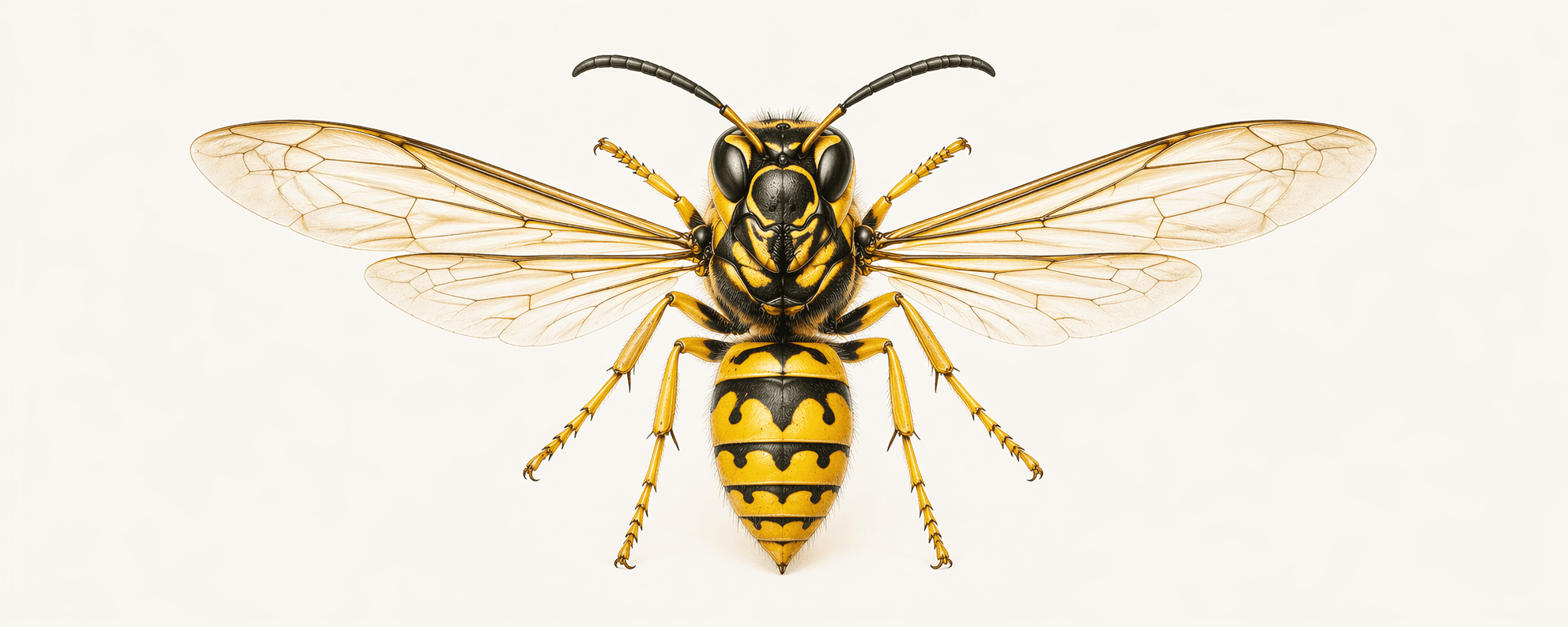
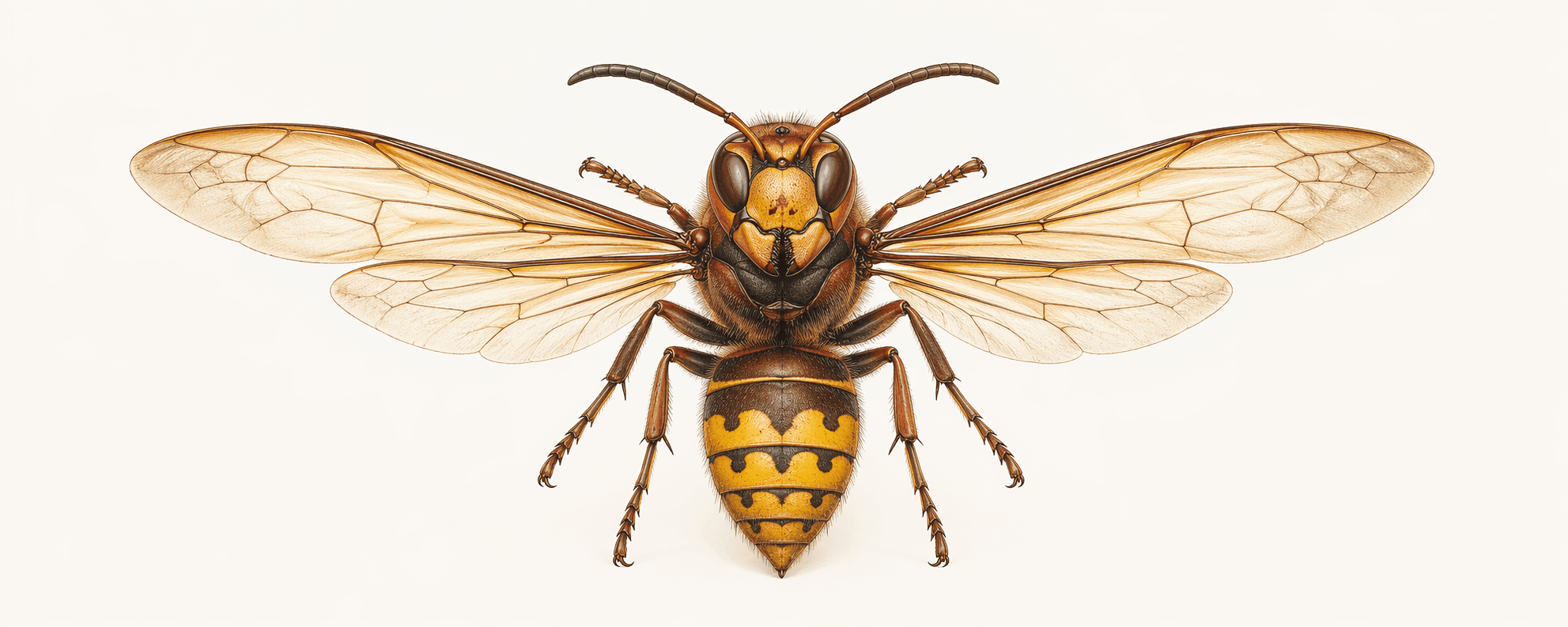
The second sign is visual. Position yourself at a distance, in late morning on a sunny day, and watch the roof lines. Regular insect traffic — several entries and exits per minute, always at the same point of the ridge, the verge or a ventilation cowl — signals an established nest. The Asian hornet is recognisable by its yellow legs and dark thorax; the European hornet, larger, sports a yellow abdomen striped with black. In both cases the flight path is direct and repetitive, quite unlike the erratic foraging of a lone wasp.
The third sign is read indoors: brown stains seeping through an attic ceiling, paper-mâché debris on the insulation, dead insects at the foot of a roof window. At that stage, the nest is generally already voluminous.
What happens if no one intervenes
Letting a hornet nest prosper inside a timber frame is never a neutral option. The first risk is mechanical: the nest falling into the attic. A mature nest weighs several kilograms; fixed to soft insulation, a plasterboard ceiling or a degraded sarking board, it eventually gives way under its own weight. The fall instantly releases hundreds of furious workers into an enclosed volume — a scenario nobody who has faced it ever forgets, and one that turns the attic into a no-go zone for days.
The second risk is propagation. A nest installed on a roof produces, at the end of the season, dozens of foundresses that will swarm out the following spring. These young queens overwinter nearby — under neighbouring tiles, in wall cracks, in woodpiles — then found their own colonies within a radius of a few hundred metres. In an urban fabric as dense as Monaco's or Beausoleil's, this concretely means that this year's untreated nest becomes next year's three nests in the neighbouring timber frames. We observe it regularly along rows of adjoining villas: the contamination literally follows the roof line.
The third risk is medical. The bigger the colony, the wider its defence perimeter. A September nest actively defends a radius of several metres around its entrance: the roofer who comes to replace a tile, the antenna installer, the chimney sweep or simply the occupant opening a roof window all become targets. Multiple hornet stings, beyond the case of allergic individuals, constitute a medical emergency in their own right.
Why an amateur intervention is impossible here
With a nest hanging from a low branch, the temptation of an improvised treatment already exists — and regularly ends in accidents. With a roof or timber-frame nest, the question does not even arise, for three reasons that compound one another.
Height, first. Working ten or fifteen metres above the ground, on an inclined plane covered with tiles that are sometimes a century old and slippery, is work at height in the strictest sense. Without a harness, lifeline and anchor points, a simple slip is a fall. Adding a swarm of attacking hornets to that situation means combining two dangers, either of which would suffice on its own.
Confined space, next. An attic or under-roof nest can often only be reached from inside, moving hunched between the roof trusses, over unboarded joists, in heat that frequently exceeds 45 °C under the tiles in summer. In that environment there is no quick retreat, no escape. A standard off-the-shelf hornet suit, designed for occasional outdoor use, offers insufficient protection against Vespa crabro workers whose sting exceeds 5 millimetres.
Aggressiveness, finally. A nest disturbed in an enclosed volume does not react like an outdoor nest: the hornets do not disperse, they saturate the space. The vibrations transmitted by the frame — a footstep on a joist, a knock on a rafter — are enough to trigger the collective defence before the intruder has even seen the nest. This is precisely the scenario behind the serious accidents recorded every summer in the region, from Menton to Nice.
Our method: the telescopic pole up to 20 metres
The core of our protocol for destroying a hornet nest at height rests on a simple principle: treat the nest without ever exposing the technician within the colony's reach. Our main tool is a carbon-fibre telescopic pole extendable to 20 metres, fitted at its head with a biocide powder injection nozzle. This technique, detailed in our article on hornet nests at height and the 20-metre pole, applies remarkably well to roofs.
In practice, the technician operates from the ground, from a terrace, or from a balcony below or opposite. The pole is extended to the nest's entry point — ridge junction, ventilation cowl, underside of a verge — and the insecticidal powder is blown directly into the cavity. The workers entering and leaving take charge of spreading the active substance to the heart of the nest, all the way to the queen. Within a few hours activity ceases; within 24 to 48 hours the colony is neutralised, including the workers out foraging at the time of treatment, who contaminate themselves on returning.
When the configuration demands direct access — a nest set deep inside an attic, an angled cavity that blocks remote injection — the technician climbs onto the roof in a full thick protective suit, mesh hood and reinforced gloves, secured by a fall-arrest harness whenever the roof is accessible and anchorable. Progress is slow and methodical, and every foothold is checked: on the Riviera's old roof coverings, a tile breaking underfoot is as real a risk as the hornets.
The pole's advantage is twofold: no heavy platform to mobilise in narrow streets, and same-day intervention possible, including through our 24/7 emergency service when the nest threatens a building entrance, a busy terrace or an ongoing worksite.
And when the roof is inaccessible: resorting to a lift platform
There remain cases — rare, but real — where neither the pole nor access through the attic suffices. A nest lodged under a verge overhanging a void, above a break in the slope, or on a roof section no anchor can secure. In these configurations we schedule an intervention with an aerial lift platform. It requires a little more logistics — scouting the parking area, temporary road occupation authorisation where needed, coordination with the building manager or caretaker — but it guarantees a stable working position, at a safe distance from the nest, with immediate retreat possible.
Across all our roof interventions, the lift concerns fewer than one case in ten. It is the last-resort solution, not the default method: the telescopic pole settles the vast majority of situations faster, more discreetly and without occupying the public highway — a point far from anecdotal in the winding streets of Monaco or Èze.
Field experience: the old timber frames of Riviera villas
The old villas of the coastline, from Cap-d'Ail to Roquebrune-Cap-Martin, account for a disproportionate share of our under-roof interventions. Their timber frames, often original, combine everything a hornet colony looks for: untreated solid wood providing both raw material and anchor points, tall ventilated attics, canal-tile coverings where every overlap leaves a passage, and the frequent absence of an underlay membrane — which, on recent constructions, at least blocks access to the air layer.
A typical case from last season: a Belle Époque villa on the heights, whose owners had for weeks been hearing a scratching noise attributed to rodents. Inspection of the attic revealed not rats, but a Vespa velutina nest nearly 80 centimetres in diameter, built astride a truss tie beam, nine metres above the attic floor. The treatment was carried out by pole injection from the access hatch, without any technician having to advance beneath the nest — an indispensable precaution, since the fall of a nest that size during treatment would have endangered anyone standing below.
These old frames also demand particular care in the choice of products: powders and aerosols must be applied in a targeted way, without needlessly impregnating timbers that are sometimes listed or fragile, and taking into account the possible presence of bats or nesting boxes nearby, frequent in the coastline's old attics.
After destruction: nest extraction and restoration
Neutralising the colony is only half the job. A dead nest left in a timber frame poses three problems: it retains pheromones likely to attract new foundresses the following spring; it contains brood and food stores which, as they decompose, attract carpet beetles, moths and rodents; and it holds moisture against the wooden members. Whenever access allows, we therefore carry out complete extraction of the nest after a safety delay, followed by a residual treatment of the anchoring point.
This is where an often neglected aspect comes in: coordination with building tradespeople. When the nest sits under the tiles or inside a ridge cavity, its extraction requires partially stripping the roof covering. We then work in tandem with the client's roofer — or a roofer familiar with our protocols — following a precise sequence: neutralisation of the colony, 48-hour safety delay, removal of the tiles by the roofer under our supervision, extraction and bagging of the nest, treatment of the cavity, then reinstatement of the covering with, while at it, mesh sealing of the identified access points. On old timber frames, a carpenter can be brought in if the workers' repeated scraping has eaten into the surface of the wood, which is assessed during extraction.
This coordinated approach avoids the classic back-to-front worksite: the roofer who uncovers an active nest while lifting a tile and finds himself facing the colony, ten metres above the ground, without protection.
Preventing reinstallation in the following seasons
A roof that has hosted a nest remains an attractive roof. Prevention rests on simple measures, to be scheduled off-season, between November and February, when the colonies are dead and the foundresses in diapause. Have the sealing of ridge and verge tiles checked; fit ventilation cowls and oculi with 5-millimetre mesh grilles; cap disused chimney stacks at the top; check the condition of the underlay membrane during any roofing work. In spring, a tour of observation of the roof lines in April and May makes it possible to spot primary nests — the size of a golf ball — at a stage where neutralising them is a formality.
For properties that have experienced repeated installations, an annual inspection visit at the start of the season offers a peace-of-mind-to-effort ratio that is hard to match: inspection of the attic, ridge lines and known entry points, with immediate treatment of any nest foundation detected.
What to remember before acting
A hornet nest under a roof or in a timber frame often only announces itself once the colony is well established: continuous humming in the attic, scratching in the frame, insect traffic at the ridge. At that stage, intervention at height cannot be improvised — altitude, confinement and the colony's reactivity forbid it. Our response combines the telescopic pole up to 20 metres, which treats most nests from the ground or the attic without exposing anyone, the full protective suit and harness when the roof must be traversed, and the lift platform for the rare inaccessible configurations. Extraction of the nest, coordinated with roofer or carpenter, and the securing of the roof complete the protocol.
If you observe these signs on your roof in Monaco or on the Riviera, do not climb up to look. Photograph the traffic from a distance, note the entry point, and request a free quote: the assessment is made from photos and intervention is generally possible within 24 to 48 hours — immediately via the 24/7 emergency service if the nest threatens a passageway or occupants. Interventions carried out under Certibiocide certification N°121134.
Frequently asked questions
- How do I know if a hornet nest is under my roof tiles?
- Three converging signs: a continuous humming audible from the attic, dry scratching sounds in the timber frame, and regular insect traffic entering and exiting always at the same point of the ridge, a verge or a ventilation cowl. Watch from a distance, in late morning on a sunny day: several passages per minute at the same spot indicate an established nest, even one totally invisible from outside.
- Can a hornet nest in the timber frame damage the wood?
- Yes, in two ways. Workers scrape fibres from the structural timber to make the nest's paper-mâché, slowly eating into the surface of rafters and purlins. And an abandoned nest holds moisture against the wooden members while attracting carpet beetles, moths and rodents through its decomposing stores. That is why extracting the nest after destruction is recommended whenever access allows.
- Can I destroy a hornet nest in the attic myself?
- No. This situation combines three prohibitive dangers: height, a confined space that rules out any quick escape, and a colony that saturates the volume at the slightest disturbance — the vibrations of a single footstep on a joist are enough to trigger an attack. Off-the-shelf suits do not protect against hornet stings. Photograph from a distance and call in an equipped professional.
- How do you treat a ridge nest without scaffolding or a lift?
- With a carbon-fibre telescopic pole extendable to 20 metres, operated from the ground, a terrace or the attic. A nozzle at the head of the pole blows a biocidal powder directly into the cavity; the workers spread it all the way to the queen and the colony is neutralised within 24 to 48 hours. The lift platform remains reserved for the rare genuinely inaccessible configurations, fewer than one case in ten.
- Should the nest be removed from the frame after destruction?
- Yes, whenever access allows. A dead nest retains pheromones that attract new foundresses in spring, contains stores that draw other pests as they decompose, and holds moisture against the wood. When the nest sits under the tiles, extraction is coordinated with a roofer: partial stripping of the covering under our supervision, bagging of the nest, treatment of the cavity, then mesh sealing of the access points.
- When should a roof hornet nest be treated, and when prevented?
- For destruction: as soon as it is detected, whatever the season — a nest grows fast and a September nest holds several thousand individuals. For prevention: between November and February, off-season, have the ridge, ventilation cowls and disused chimneys checked and fit 5 mm mesh grilles. In April and May, an observation tour of the roof lines makes it possible to spot primary nests while they are still easy to neutralise.