August 11, 2026 · 8-minute read
Dust Mites and Air Conditioning in Monaco: Why Indoor Humidity Fuels Infestation
Hot summers, sea air, constant AC: the trio feeding dust mites on the Riviera. Target humidity, HVAC maintenance and HEPA filtration explained.
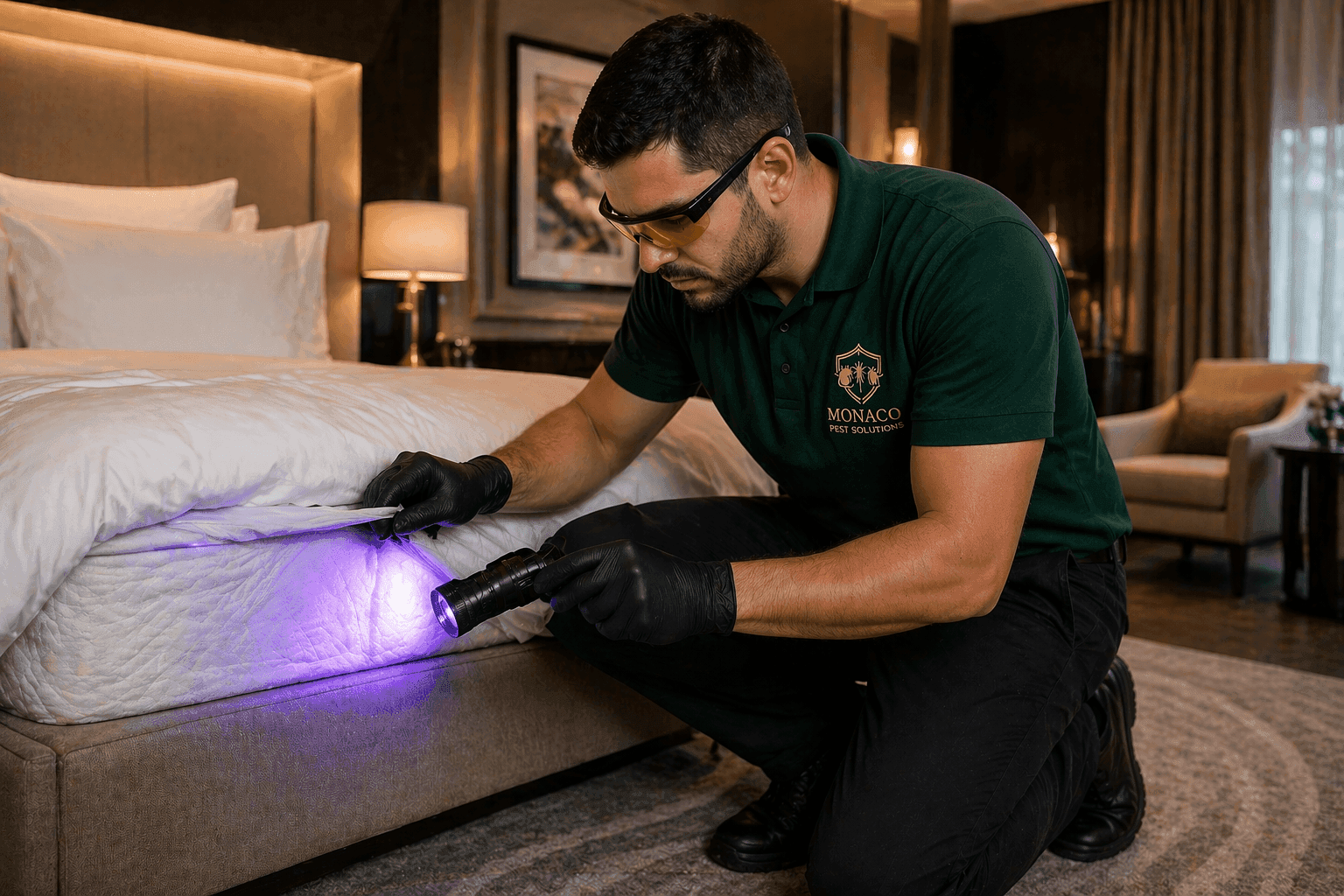
On the Riviera, air conditioning runs almost without interruption from May to October. Seafront villas, refurbished Belle Époque apartments, glazed penthouses: everywhere, conditioned air maintains a thermal comfort the climate no longer grants naturally in summer. Many owners conclude that their cool, closed interior is protected from dust mites. In most cases, exactly the opposite happens: a poorly adjusted or poorly maintained air-conditioning system turns the home into an incubator for Dermatophagoides pteronyssinus. This article, the prevention chapter of our dust mites guide, explains the mechanism and details the settings, maintenance and ventilation that reverse the trend.
Why is humidity the number-one driver of mite proliferation?
Dust mites do not drink: lacking any system for ingesting liquid water, they absorb moisture directly from the ambient air through their cuticle, via a specialised gland. This biological peculiarity makes hygrometry the most powerful control lever there is:
- above 65% relative humidity, the population doubles within weeks; egg-laying accelerates and the egg-to-adult cycle completes in around three weeks at 25°C;
- between 50 and 60%, mites survive but reproduce slowly;
- below 50% sustained, they dehydrate and die within days; only eggs and resistant stages persist for a while.
Temperature plays a secondary role: between 17 and 32°C, mites cope with anything. It is the water held in the air — and above all in the microclimate of textiles — that decides everything. And in Monaco and on the Côte d'Azur, outdoor air shows 60 to 80% relative humidity most of the year, with summer peaks whenever the sea breeze loads the atmosphere. Every opening of a bay window recharges the home with water vapour, which mattresses, sofas, rugs and curtains absorb like sponges.
Does air conditioning protect against mites or encourage them?
It depends entirely on how it is used. An air conditioner cools air by passing it over a cold exchanger, where part of the water vapour condenses: in theory, cooling dehumidifies. But three phenomena reverse that benefit in Riviera interiors:
- Short-cycling: an oversized unit — common in large glazed rooms — reaches the set temperature very quickly and stops. The air has been cooled but not dehumidified: relative humidity mechanically rises, because colder air saturates faster. A common August reading: 24°C and 70% humidity — the exact mite optimum.
- Peripheral condensation: cooled surfaces (walls behind furniture, floors under rugs, bedding in air-conditioned bedrooms) become cold spots where marine air moisture condenses as soon as you ventilate. Textiles resting on these zones keep a saturated microclimate.
- The unit itself: fouled condensate trays, filters saturated with organic dust, damp ducts — the inside of a neglected air conditioner combines standing water, warmth and nutrients. It becomes a mould reservoir on which some mites also feed, and a diffuser that resuspends dust and allergens with every cycle.
A properly sized, properly set and properly maintained system is, on the contrary, an excellent anti-mite tool. The difference comes down to three things: mode, maintenance, measurement.
What humidity level should you target to block mites?
The objective is simple and measurable: keep relative humidity below 50% in sleeping rooms, for at least several hours a day. That is the threshold below which D. pteronyssinus can no longer compensate its water losses. In practice on the Riviera:
- fit each bedroom with a reliable hygrometer, placed near the bed rather than near the supply vent;
- target 45-50% in summer, achievable with the dehumidification ("dry") mode of reversible units, which extracts water from the air more effectively than cooling mode;
- accept 50-55% in living areas, harder to dry when they open onto the outside;
- in the humid mid-seasons (October-November, March-April), when the AC no longer runs, a standalone dehumidifier takes over in the bedrooms.
An important point: the aim is not to dry the air continuously, which would be uncomfortable, but to create daily desiccation windows that mites — unable to store water — cannot survive. Measurement campaigns show that dropping below 50% for a few hours each day is enough to send a population into decline within weeks.
How should you maintain your air conditioning to limit mites?
HVAC maintenance is the most neglected link in prevention. The calendar we recommend for a Riviera home occupied year-round:
- Indoor unit filters: monthly dusting in season, full washing or replacement every quarter. A saturated filter no longer filters — it re-emits.
- Condensate trays and drains: inspection and disinfection at the start and end of the season. A partially blocked drain keeps a permanent film of standing water inside the unit.
- Exchangers and blower wheels: annual professional cleaning; this is where the organic film that feeds moulds and storage mites accumulates.
- Ducts and plenums (ducted systems): inspection every two to three years, with mechanical cleaning if deposits are found.
During our villa mite surveys, the master bedroom's AC unit is systematically inspected: in a significant share of the recurring infestations we treat, it turns out to be the reservoir reseeding the bedding after every treatment. Treating textiles without sanitising the airflow system is bailing water without closing the valve.
Are HEPA filters and air purifiers useful?
Yes, with an important nuance: live mites rarely leave their textiles, but their allergens — the Der p 1 and Der f 1 proteins contained in droppings — circulate in the air every time someone sits on a sofa, every night in a bed, every pass of a poorly filtered vacuum cleaner. It is this airborne fraction that filtration addresses:
- a HEPA-filtered purifier in the bedroom significantly lowers the allergen load breathed during sleep, provided it is sized for the room volume and runs overnight;
- a HEPA-filtered vacuum cleaner is essential: an ordinary vacuum captures mites but expels the fine allergens, worsening exposure during and after cleaning;
- entry-level AC filters do not stop the finest 10 to 40 micron allergenic particles; denser media filters exist for some ducted systems and should be validated by your installer to preserve airflow rates.
Filtration remains a complement: it reduces exposure but does not shrink the population in textile reservoirs. It belongs within the overall strategy we detail on our dust mites page.
How should you ventilate an air-conditioned villa or apartment on the Riviera?
Ventilation seems counter-intuitive in an air-conditioned home, yet it is indispensable: without air renewal, the moisture produced by occupants (showers, cooking, breathing — up to several litres a day for a family) accumulates and cancels out the air conditioner's work.
- Ventilate early in the morning (before 9am in summer), when outdoor air is at its lowest absolute humidity: fifteen minutes of full cross-draught renews the volume without durably recharging the textiles.
- Avoid evening ventilation in summer: the evening sea breeze carries the most water vapour.
- Check mechanical ventilation: in renovated apartments, bathroom extraction vents are often obstructed or undersized; a bathroom that keeps its mist for more than fifteen minutes feeds the hygrometry of the whole floor.
- Do not block air circulation under beds and behind headboards: a bed pressed against a cold, sea-facing wall is the typical condensation point we find during surveys.
What if the infestation is already established?
If allergy symptoms persist despite corrected humidity, the load accumulated in textiles must be treated: deposited allergens remain active for months even as the population declines. Our reasoned-control protocol, delivered by technicians certified under Certibiocide N°121134, combines deep HEPA extraction of the reservoirs, high-temperature dry steam and, under exceptional pressure, a targeted approved acaricide — with a systematic airflow check to prevent recolonisation. Private clients and managers of residences and establishments receive the same intervention standard, and our 24/7 service covers acute situations.
Want an objective picture of your home before autumn, the mites' comeback season? Request your free quote: a technician measures humidity room by room, inspects your air-conditioning installation and hands you a prevention plan quantified in control points, in Monaco and along the whole Riviera, from Saint-Tropez to Menton.
Zones served in Monaco and on the Riviera
Frequently asked questions
- What humidity level kills dust mites?
- Dust mites dehydrate and die when relative humidity stays durably below 50%: deprived of the ability to absorb water from the air, they survive only a few days. This level does not need to be maintained continuously: a few hours a day below the threshold are enough to send a population into decline within weeks, because mites cannot store water. Eggs are more resistant, which is why the effort should be sustained for several weeks to cover a complete development cycle.
- Is the AC's dry mode effective against dust mites?
- Yes — it is actually the most useful setting. In dehumidification mode, the unit runs its compressor at low speed, prioritising water vapour condensation over rapid temperature drops: it extracts more water from the air than cooling mode does, without short-cycling. Used a few hours a day in bedrooms, it reaches the 45-50% relative humidity window that dehydrates mites, while avoiding the icy-air sensation. Combine it with a bedside hygrometer to verify the target is actually met where you sleep.
- Can a dirty air conditioner spread mite allergens?
- Yes. A neglected unit accumulates three problems: its saturated filters release fine dust instead of retaining it, its fouled condensate tray maintains permanent moisture that feeds moulds and storage mites, and its blower wheel resuspends accumulated Der p 1 allergens at every restart. In the recurring infestations we diagnose in villas, the master bedroom's unit is regularly identified as the recontamination reservoir. Seasonal servicing — filters, tray, exchanger — breaks this cycle and is a core control point in our prevention plans.
- Is a dehumidifier enough to eliminate dust mites?
- It eliminates the conditions for their development, not the existing load. Kept below 50% relative humidity, a dehumidifier sends the population into decline within weeks: mites dehydrate and reproduction stops. But the allergens already deposited in mattresses, sofas and rugs remain biologically active for months. For a clinical result in an allergic person, hygrometric control must be paired with professional extraction: deep HEPA vacuuming and dry steam on the textile reservoirs, followed by encasings on the sanitised bedding.
- Should the AC be switched off at night to limit mites?
- No — but it must be set correctly. A night-time shutdown lets temperature and humidity rise in the bedding precisely during the hours when the sleeper feeds the mattress with water vapour and skin flakes: the worst possible scenario. Good practice is to programme a dehumidification mode or a moderate setpoint (24-25°C) continuously, with airflow that does not blow directly onto the bed. The objective is hygrometric stability below 50-55%, not cold: cool but saturated air remains favourable to mites and uncomfortable for sleepers.