August 11, 2026 · 7-minute read
Dust Mite Allergy in Monaco: Symptoms, Diagnosis and Anti-Mite Treatment
Rhinitis, asthma, eczema: Monaco's humid climate favours dust mites. Learn the symptoms, how diagnosis works and how to treat your home properly.
Dust mite allergy is the leading cause of persistent allergic rhinitis along the Mediterranean coast, and Monaco is no exception. Between the sea, hot summers and relative humidity that sits between 60 and 80% for much of the year, the Principality offers exactly the conditions in which Dermatophagoides pteronyssinus and Dermatophagoides farinae thrive — the two species behind most respiratory sensitisations. At Monaco Pest Solutions, we work every week in apartments, villas and residences where a medical allergy diagnosis has just been made and the home itself now needs treating. Here is what you should know to recognise the symptoms, confirm the diagnosis and restore a healthy indoor environment.
Why is Monaco's climate ideal for dust mites?
House dust mites are microscopic arachnids, invisible to the naked eye (0.1 to 0.5 mm), which feed on the skin flakes we shed every night. They do not bite, do not sting and transmit no disease: the problem lies in their droppings and body fragments, which contain highly allergenic proteins.
Their development depends on two parameters: temperature and relative humidity. The optimum sits between 20 and 30°C with humidity of 65 to 80%. That is precisely the climate profile of Monaco and the Riviera, from Saint-Tropez to Menton: mild winters that never impose a true biological pause, damp springs, and summers when sea air saturates interiors. Unlike continental regions where winter heating dries the air and naturally reduces populations, a Monaco apartment offers mites favourable conditions practically all year round. A single unprotected mattress can host several hundred thousand individuals, and one gram of bedding dust can contain more than a thousand.
How do I know if my allergy is caused by dust mites?
Several clues point strongly towards dust mites rather than pollens or moulds:
- Symptoms are perennial: they persist all year, peaking in autumn and late summer when humidity rises again.
- They dominate at night and on waking: blocked nose at bedtime, sneezing fits in the morning, itchy eyes when getting out of bed.
- They worsen in specific rooms: bedroom, dressing room, fabric sofas, carpeted areas.
- They intensify during housework: vacuuming, shaking the duvet or moving textiles puts allergens back into suspension.
- They ease at altitude: above 1,200 metres, dry air limits mites, and many patients notice clear improvement during mountain stays.
If several of these situations sound familiar, see a doctor: prolonged self-medication with antihistamines masks the symptoms without addressing the cause — which is quite literally in your bed.
Rhinitis, asthma, eczema: which symptoms should raise concern?
Dust mite allergy expresses itself through three main clinical pictures, sometimes combined:
- Allergic rhinitis: sneezing fits, clear nasal discharge, chronic nasal obstruction, partial loss of smell, associated conjunctivitis (red, watery, itchy eyes). This is the most common form.
- Allergic asthma: dry night-time cough, wheezing, chest tightness, breathlessness on exertion. In children, a cough that drags on night after night should always raise the question of mites. Untreated rhinitis progresses to asthma in a significant proportion of cases — the well-known "allergic march".
- Atopic dermatitis (eczema): red, dry, itchy patches, especially in the elbow and knee folds. Prolonged contact with allergen-laden bedding sustains flare-ups.
Add to this a set of less specific but highly disabling symptoms: fragmented sleep, chronic fatigue, snoring, reduced concentration. Many of our clients discover after their home has been treated just how much these problems were tied to their sleeping environment.
How is a dust mite allergy confirmed?
Diagnosis is a medical matter, handled by a general practitioner and then an allergist. It relies on two complementary tools:
- Skin prick tests: a drop of allergenic extract of D. pteronyssinus and D. farinae is placed on the forearm and the skin is lightly pricked. A wheal appearing within fifteen minutes confirms sensitisation.
- Blood testing for specific IgE: this quantifies the immune reaction against the major mite allergens, notably the proteins Der p 1 and Der f 1 (from droppings) and Der p 2 / Der f 2 (from mite bodies). Molecular testing also distinguishes a true mite allergy from cross-reactivity, for instance with shrimp or snails (the mite-crustacean syndrome linked to tropomyosin).
Once the diagnosis is established, the doctor may prescribe symptomatic treatment or allergen immunotherapy (desensitisation). But every recommendation converges on one point: allergen avoidance in the home is the first treatment. That is where we come in.
Do anti-mite mattress encasings really work?
Yes — provided you choose and fit the right equipment. A genuine anti-mite encasing is a very tightly woven fabric (pores under 10 microns) that fully wraps the mattress, pillow or duvet with a continuous zip. Mites trapped inside are cut off from their food and die; those outside can no longer colonise the mattress core, which is their main reservoir.
Three common mistakes cancel out their benefit:
- encasing only the mattress while forgetting pillows, bolsters and duvet;
- fitting the cover onto a heavily infested mattress without prior treatment, leaving months of active allergens on the surface;
- choosing an ordinary "breathable" mattress protector whose weave lets 10 to 40 micron allergens straight through.
Our recommendation: have the bedding professionally de-infested first, then fit the encasings onto a sanitised base. The clinical effect is then measurable within a few weeks for most sensitised patients.
How should the home be treated once someone is sensitised?
A serious treatment combines daily hygiene measures you can apply yourself with professional intervention for the established allergen load.
Everyday measures:
- wash sheets and pillowcases at 60°C weekly, duvets and pillows every two months;
- air the bedroom for 15 minutes morning and evening, even in summer, and keep the night temperature below 19-20°C;
- aim for relative humidity below 50% (hygrometer, dehumidifier if needed);
- limit dust traps: thick rugs, heavy double curtains, piles of soft toys, upholstered headboards;
- use a HEPA-filter vacuum cleaner twice a week, including bed base and skirting boards.
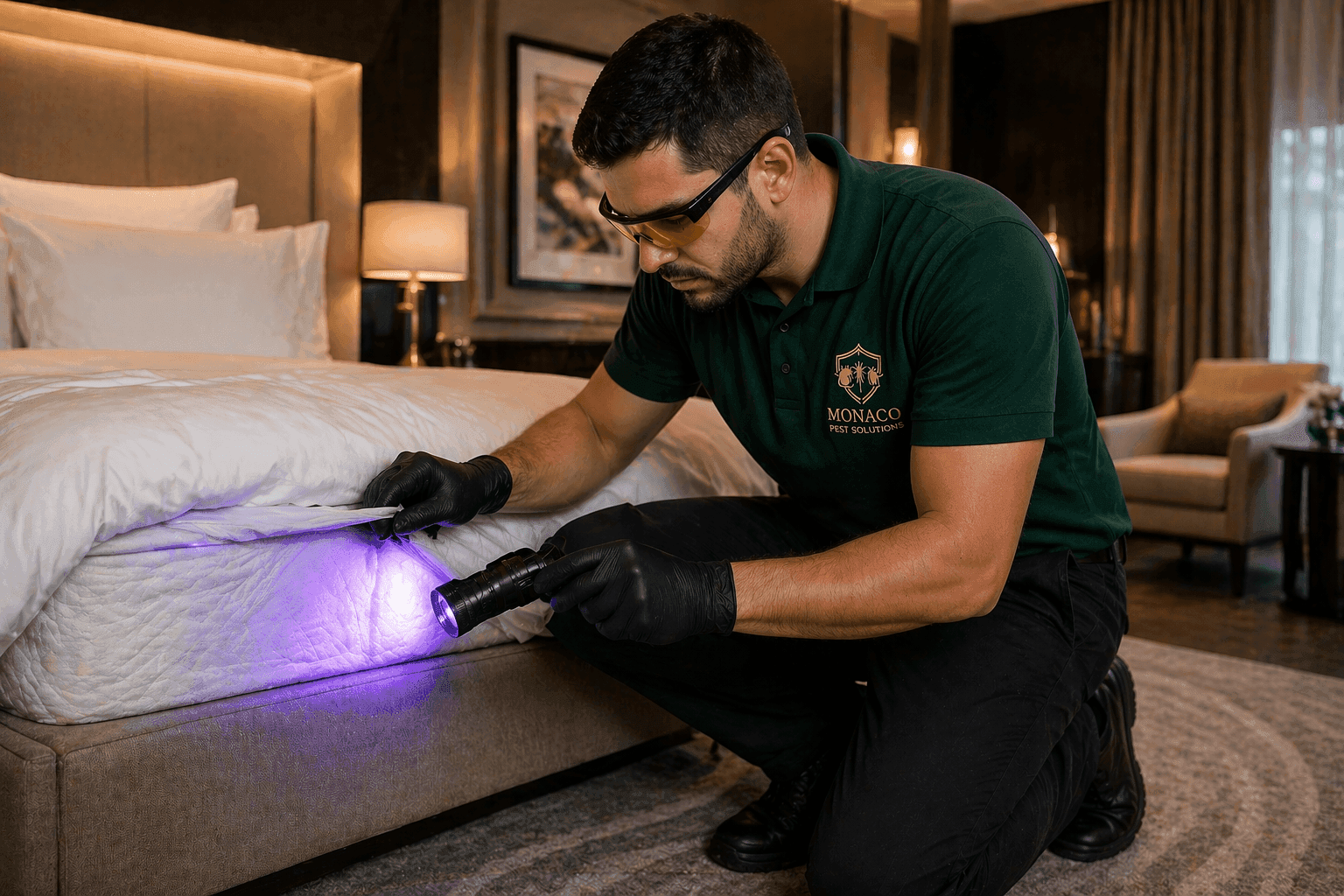
On the professional side, our reasoned-control protocol runs in four stages: a room-by-room survey with humidity measurement, deep mechanical extraction of bedding and upholstery by HEPA vacuuming, a high-temperature dry-steam shock that destroys mites and eggs without chemical residue, and — only where infestation pressure requires it — targeted application of an approved acaricide on reservoir zones. Our technicians, holders of Certibiocide N°121134, always favour physical methods: in a bedroom where children or asthmatic occupants sleep, that is non-negotiable. For acute situations — an asthma attack triggered by a saturated home, for example — our 24/7 emergency service provides rapid response across Monaco and the whole Riviera.
How long until the home is healthy again?
Live mites are eliminated immediately after the steam pass. However, Der p 1 and Der f 1 allergens already deposited remain active until they are physically removed: that is why deep HEPA vacuuming and textile washing are an integral part of the protocol. In practice, the allergen load of a treated bedroom drops sharply within the first week, and most patients report clear improvement of night-time symptoms within two to four weeks, alongside their medical follow-up. A humidity check and a verification visit at three months confirm that the conditions for reinfestation are not in place.
Have you been diagnosed, or has someone in your household just tested positive for dust mite allergy? Read our dedicated dust mites page to understand their biology, then request your free quote: a certified technician will assess your home, measure humidity levels and propose a protocol adapted to your clinical situation, in Monaco and along the entire Riviera, from Saint-Tropez to Menton.
Zones served in Monaco and on the Riviera
Frequently asked questions
- How do I know if there are dust mites in my home?
- Dust mites are invisible to the naked eye, so their presence is deduced from indirect signs: allergic symptoms at night or on waking (blocked nose, sneezing, cough), worsening in the bedroom or on the sofa, and indoor humidity above 60%. A heated, humid, textile-rich home almost always contains them. Only a professional survey, with humidity measurement and assessment of reservoir zones such as mattresses, rugs and curtains, can objectively establish the infestation level and guide treatment.
- What is the difference between Dermatophagoides pteronyssinus and farinae?
- They are the two most widespread dust mite species in homes. D. pteronyssinus, the European house dust mite, dominates in humid climates like Monaco's; D. farinae, the American house dust mite, tolerates drier, heated interiors better. Their major allergens, Der p 1 and Der f 1, are structurally very close and cross-react: most sensitised patients react to both species. From a pest-control perspective, the home treatment protocol is identical for both, combining HEPA extraction, steam and humidity management.
- Do dust mites bite the skin?
- No. House dust mites do not bite, do not sting and do not feed on blood: they consume only dead skin flakes. Skin lesions attributed to mites are in reality atopic eczema triggered by contact with their allergens, or come from other pests such as bed bugs, fleas or chiggers. If you notice genuine bites, aligned or clustered, when you wake up, bed bugs should be suspected and a professional differential inspection arranged quickly, since the two problems require completely different treatments.
- Is washing at 60 degrees enough to eliminate dust mites?
- Washing at 60°C kills mites and removes a large share of the soluble allergens on sheets, pillowcases and covers: it is an essential weekly habit. But it only treats washable textiles. The mattress core, bed base, rugs and heavy curtains — the real reservoirs — remain untouched. That is why a complete protocol combines high-temperature washing, deep HEPA vacuuming and professional dry steam on non-washable surfaces, together with humidity control to prevent the population from rebuilding within weeks.
- Is an anti-mite treatment safe for children and pets?
- Our protocol prioritises physical methods: HEPA vacuuming and high-temperature dry steam, which leave no chemical residue and therefore impose no restriction for children, pregnant women or pets. When an approved acaricide proves necessary on reservoir zones, our technicians, certified under Certibiocide N°121134, apply strict re-entry intervals and limit application to surfaces that occupants cannot touch. Precise safety instructions are provided in writing before every intervention, so the household knows exactly what to expect.