
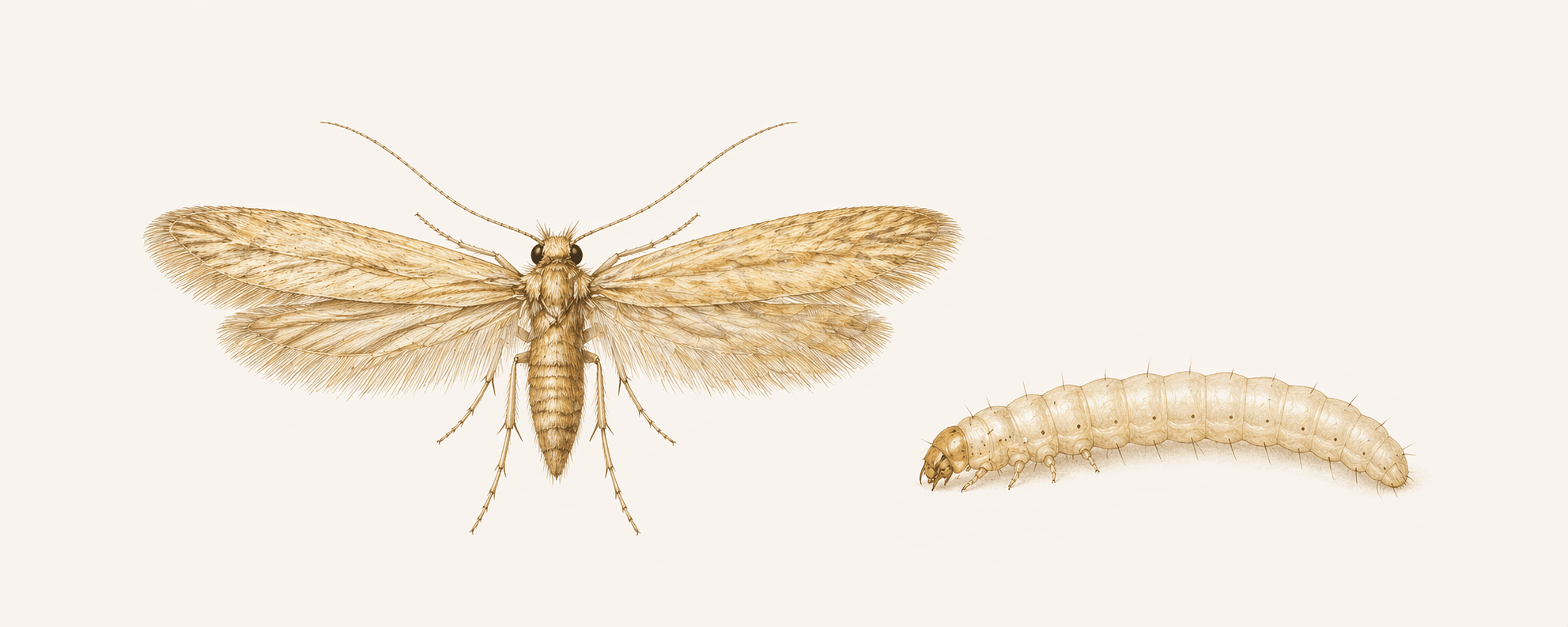
Identifying dust mites: clinical and environmental signs
Dust mites are invisible to the naked eye, measuring just 0.1 to 0.5 mm. Two species dominate indoor environments in Monaco and along the Côte d'Azur: Dermatophagoides pteronyssinus, the European house dust mite, and Dermatophagoides farinae, its more drought-tolerant American cousin. Neither bites, stings, nor transmits disease through contact — the problem is allergenic. These microscopic arthropods feed on human skin flakes, the dander every person sheds daily, and their droppings, rich in the proteins Der p 1 and Der f 1, rank among the most potent indoor allergens known to medicine.
How do you know whether your home is affected? The first clues are clinical: respiratory symptoms on waking, sneezing fits in the bedroom, flare-ups while cleaning or changing the sheets. The second set is environmental: a mattress older than five years, aged carpeting, indoor relative humidity above 55%, heavy textiles never washed at high temperature. A standard mattress can harbour 1.5 to 2 million mites; a single gram of bedding dust contains up to 10,000 individuals, along with twenty times their weight in allergenic faecal matter. During our diagnostic visit, technicians take targeted dust samples and measure humidity room by room, so any dust mite treatment in Monaco starts from objective data rather than guesswork.
Where dust mites thrive in Monaco: the high-risk hotspots
Monaco's climate is, unfortunately, a biological optimum for dust mites. They flourish at 20 to 25°C with relative humidity of 65 to 80% — precisely the conditions that prevail in the Principality for most of the year, from the Saint-Tropez coastline through to Menton. Humid sea air penetrates homes constantly, and the mild winters deny mite populations the seasonal die-back they experience in continental climates. The result: in Monaco, proliferation is continuous, peaking in spring and autumn. Where a Parisian or London apartment gets a natural respite when winter heating dries the air, a Monegasque bedroom rarely drops below the humidity threshold that keeps colonies expanding.
Certain settings concentrate the risk. Belle Époque apartments, with their generous volumes but often original, limited ventilation, trap moisture in bedrooms. Seafront residences live with near-permanent humidity above 60%. Villas air-conditioned year-round hold a uniform 22 to 24°C which, combined with poorly regulated humidity, turns bedding into an incubator. Aboard yachts, confined cabins, made-to-measure mattresses that are difficult to extract, and the marine atmosphere create ideal colonisation conditions.
Within the home itself, the main reservoirs follow a clear hierarchy: the mattress and upholstered bed base first, then pillows and duvets, carpets and thick rugs, fabric sofas and armchairs, curtains and drapes, padded headboards and the soft toys in children's rooms. Treating mites in a mattress or carpet in Monaco therefore has to be comprehensive: decontaminating the bed while leaving the surrounding textile floors untreated guarantees recolonisation within weeks.
Dust mite allergy symptoms: what to watch for
Roughly 20% of the population is sensitised to dust mites, making them the leading cause of perennial respiratory allergy — present all year round, unlike seasonal pollens. The most frequent manifestations are allergic rhinitis (bouts of sneezing on waking, a blocked or runny nose, nasal itching), conjunctivitis (red, watering, itchy eyes) and, more seriously, asthma: dry night-time cough, wheezing, chest tightness, breathlessness on exertion. In atopic individuals, chronic exposure also aggravates eczema and atopic dermatitis, particularly in children.
The timing of symptoms is a valuable clue. Discomfort that peaks at bedtime and on waking, then eases outdoors or at the office, points strongly to mites in the bedding. An attack triggered by vacuuming, shaking out a rug or opening a linen cupboard points to dust reservoirs. Children who sleep with soft toys, and anyone spending more than eight hours a night in a humid bedroom, are the most exposed. Long-term guests and crews sleeping in yacht cabins often report symptoms that appear within days of coming aboard and vanish on shore leave — a near-diagnostic pattern in itself.
Medical diagnosis belongs to the allergist, who confirms sensitisation through skin-prick tests or blood analysis. But medical treatment alone is not enough: as long as the allergen load in the home remains high, symptoms persist despite antihistamines. Professional dust mite decontamination of the home is the environmental measure practitioners recommend alongside therapy — and it is exactly the service Monaco Pest Solutions delivers across the Principality and the Alpes-Maritimes.
Our 4-phase dust mite eradication protocol
Phase 1 — Diagnosis and measurement. Every intervention starts with a full inspection: mapping of textile zones, humidity and temperature readings in each room, dust sampling from suspect reservoirs. This phase quantifies the infestation, identifies structural causes — insufficient ventilation, damp bridging, ageing bedding — and calibrates the treatment precisely.
Phase 2 — HEPA mechanical extraction. Before any treatment, the mite and allergen load is physically reduced using professional vacuum equipment with HEPA H13 filtration. Mattresses on all faces, bed bases, skirting lines, carpets, rugs, sofas and curtains are worked methodically. High-efficiency filtration captures allergenic particles instead of resuspending them into the air — the decisive difference from a household vacuum cleaner.
Phase 3 — Dry steam and targeted acaricide. Superheated dry steam above 100°C kills mites, eggs and larvae instantly, deep within the fibres, without soaking the materials — an essential point, since residual moisture would invite recolonisation. On surfaces that warrant it, an approved acaricide is then applied in a targeted, measured way, under Certibiocide licence No. 121134. There is no blanket spraying: biocides are used only where thermal treatment alone cannot reach, in line with our reasoned-control approach and the product's label conditions.
Phase 4 — Humidity optimisation and follow-up. Dust mites die of desiccation below 50% relative humidity, so the final phase corrects the terrain itself. Ventilation recommendations, air-conditioning adjustments, dehumidification where needed, and a bedding maintenance plan. A control visit is scheduled four to six weeks after treatment to measure the residual load and confirm there is no recolonisation.
Lasting prevention: keeping a home mite-free
Eradication only holds if the environment stops being favourable. The most effective measures, ranked by real-world impact, are as follows. First, full mite-proof encasements with tightly woven fabric on mattresses, pillows and duvets: they physically isolate the sleeper from the main reservoir. Second, weekly washing of bed linen at 60°C — the temperature that kills mites and denatures their allergens; a 30 or 40°C cycle merely dislodges part of the population.
Third, humidity control: aim for under 50% relative humidity in bedrooms, through ten to fifteen minutes of cross-ventilation daily, proper maintenance of mechanical ventilation and, in seafront homes, a dehumidifier during the humid season. Keeping the bedroom around 18–19°C rather than 23°C also slows the reproduction cycle. Fourth, shrink the reservoirs: choose hard flooring over carpet in bedrooms, limit heavy non-washable textiles, place soft toys in the freezer at -18°C for 24 hours and then wash them. Finally, expose bedding to air and light regularly: a bed left open in the morning dries out, while a bed made immediately seals in the night's warmth and moisture — exactly what mites depend on. Each sleeper releases up to half a litre of water vapour per night into the mattress; giving it time to evaporate is the simplest anti-mite habit there is.
Special focus: palaces, yachts and luxury hotels
Prestige hospitality concentrates three risk factors: suites richly furnished with textiles — drapes, padded headboards, deep-pile rugs, bedspreads —, a continuous rotation of international guests, a significant share of whom are sensitised, and an absolute requirement for discretion. A complaint about rhinitis or a night-time asthma attack in a suite bears directly on an establishment's reputation. Our hotel protocols are built accordingly: room-by-room interventions outside occupancy, coordination with executive housekeepers, complete documentation for quality audits, and preventive decontamination plans for floors with ageing bedding stock.
Yachts impose constraints of their own: made-to-measure cabin mattresses that are costly to replace, confined volumes, limited mechanical ventilation and permanently high marine humidity. Our teams work dockside or during refit, using steam processes adapted to tight spaces and products compatible with immediate life on board. For villas and large residences along the Riviera, often air-conditioned year-round, the work covers both treatment and the humidity settings of the installations themselves, in liaison with property managers and household staff.
Do you suspect a dust mite problem in your apartment, your suites or your cabins? A confidential assessment — humidity readings and dust sampling included — establishes the facts before any decision is made. Request your free quote or contact our certified technicians: we operate throughout Monaco and the Alpes-Maritimes, from Saint-Tropez to Menton.