
Identifying pigeons: the signs that never lie
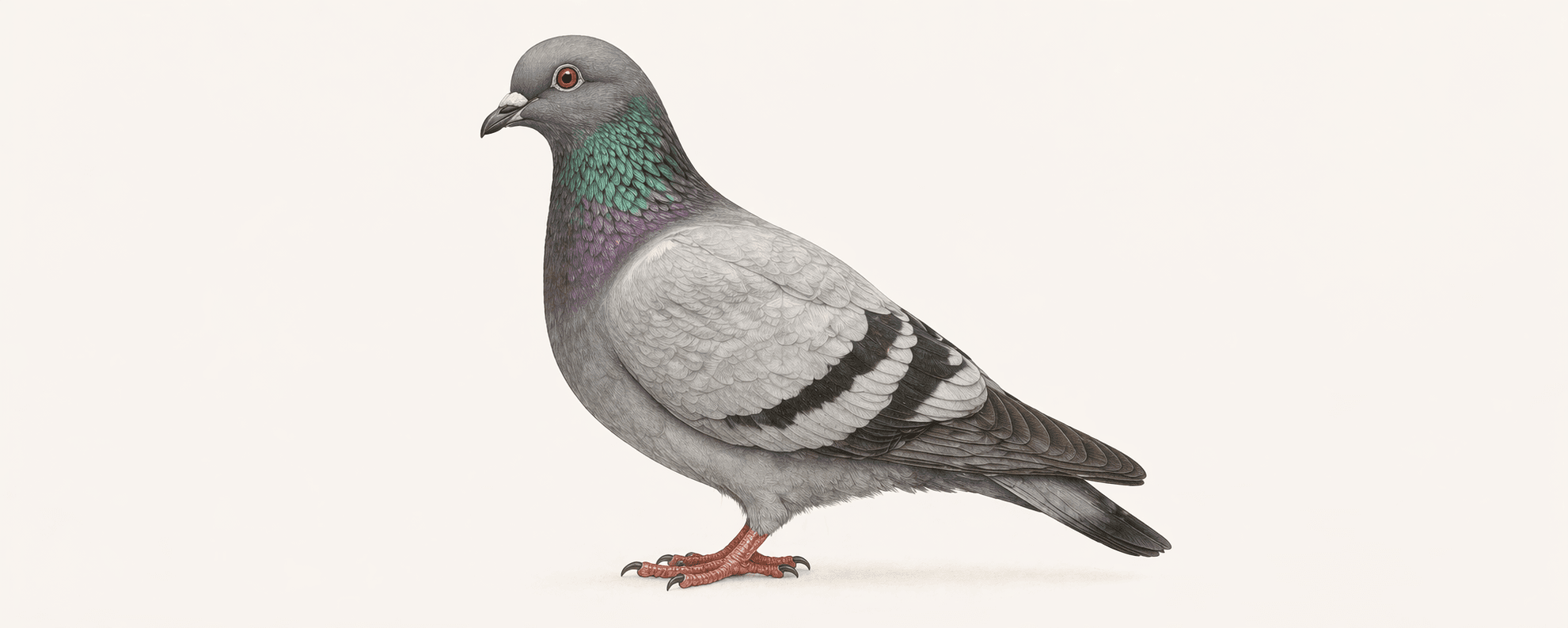
The feral pigeon (Columba livia) measures around 30 to 35 cm, ash-grey with two black wing bars, iridescent green-violet neck plumage and an orange eye. In town, colour variants are numerous (white, brown, mottled) but the morphology remains constant. It is a gregarious bird, active from dawn.
Signs of infestation to watch for: - Concentrated droppings at the foot of buildings, on balconies, air-conditioning units, window sills and gutters - Feathers and down accumulated in shaded corners - Low-pitched cooing and heavy wingbeats in the early morning - Rough nests made of twigs, often in mechanical ventilation ducts, under solar panels or at the top of rainwater downpipes - A persistent ammonia smell in confined spaces - Organic debris (eggs, carcasses, dermestid larvae) betraying an already well-established colony
In Monaco, the bird exploits stone balustrades, corbelling, sculpted cornices and the cavities of Belle Époque buildings. Fresh, still-damp droppings indicate active roosting; a thick, dry layer points to long-standing occupation, often over several consecutive seasons.
Health and material risks
The urban pigeon is not merely a nuisance: it concentrates several well-documented risks.
Health. Dry droppings crumble into respirable aerosols. They can carry Chlamydia psittaci (ornithosis-psittacosis), Salmonella enterica and Cryptococcus neoformans (pulmonary cryptococcosis), as well as bird mites and lice that migrate into human dwellings. Immunocompromised people, young children and the elderly are particularly exposed.
Material. The highly corrosive uric acid in droppings attacks limestone, polished marble, zinc, anodised aluminium and paintwork. In Monaco, where Belle Époque façades and sculpted balustrades constitute genuine heritage, the assault is twofold: aesthetic deterioration and loss of property value. Nests block gutters, valley gutters and ventilation ducts, and trigger rising damp.
Legal. Landlords and managing agents are bound by a duty of maintenance and salubrity. Catering premises open to the public operating under an HACCP food safety management plan can be penalised in the event of contamination of a rooftop, a customer terrace or an exposed outdoor storage area.
Why this pest thrives in Monaco and on the Riviera
Several structural factors explain the proliferation observed between the Principality and the hinterland.
Mild Mediterranean climate. Winters without prolonged frost allow near-continuous breeding; several broods a year are possible, which sharply accelerates local population growth.
Built density. The buildings of Monte-Carlo, La Condamine, Fontvieille and Beausoleil offer a multitude of refuges: cornices, corbelling, roof terraces, glass canopies, balcony undersides. Every crevice becomes a potential nesting site.
Abundant food resources. Open-fronted restaurants, terraces, markets (La Condamine, Menton), beach litter at Larvotto, and unauthorised feeding by a few residents despite the by-laws. An urban pigeon never needs to travel more than a few hundred metres to eat.
High-end building stock. The Principality's hotels, the prestigious residences of Fontvieille and Cap-d'Ail, and the villas of Roquebrune and Saint-Jean-Cap-Ferrat combine deep balconies, photovoltaic panels and outdoor air-conditioning units — all ideal platforms for the bird.
Seasonality. Activity peaks from spring to late summer, with a nesting peak in April-May and a second cycle at the end of the season. Anticipating at the end of winter remains the most effective strategy.
The MPS protocol in five steps
Our intervention follows a rigorous sequence, calibrated for the seafront.
- Technical diagnosis — On-site visit, often with cherry-picker or rope access on high façades. Precise mapping of perching and nesting points. Assessment of marine exposure, degree of soiling and access for future maintenance.
- Preparatory treatment — Manual removal of nests, carcasses and soiled materials, with respiratory protective equipment (FFP3 mask), nitrile gloves and disposable overalls. Disinfection of surfaces with an approved TP3 biocide.
- Installation of deterrent equipment — Marine-grade AISI 316 stainless-steel spikes (resistant to the bay's marine chloride), UV-treated polyethylene netting in an appropriate mesh, tensioned stainless-steel wires, low-voltage electrostatic systems on areas of high aesthetic value. Fixings on neutral silicone to protect the stone.
- Quality control — Mechanical strength testing, verification of fixing points, complete photographic acceptance record.
- Certification and follow-up — Detailed intervention report, contractual guarantee and scheduled inspection visits. All our interventions are covered by Certibiocide certification N121134.
Mistakes to avoid
Do-it-yourself attempts often compromise the final result.
- Removing an active nest yourself. Exposure to dry droppings and parasites (lice, dermestid beetles, argasid ticks) without suitable PPE represents a genuine health risk.
- Using low-grade repellent gels. They lose their effectiveness under UV and leave sticky marks on the stone.
- Fitting plastic or 304 stainless-steel spikes. On the seafront, corrosion appears quickly; only AISI 316 stainless steel lasts against the sea spray.
- Relying on a sound scarer alone. Pigeons habituate to repetitive stimuli within a few days; an isolated acoustic device is almost always circumvented.
- Feeding, then trying to drive away. Stopping all food provision, even occasional, on neighbouring balconies is an essential prerequisite — otherwise the colony inevitably returns.
- Skipping decontamination. Fitting spikes onto dropping-covered surfaces locks in the pathogens without neutralising them. Prior disinfection is non-negotiable.
A typical Monaco case
A Belle Époque co-owned building in the Carré d'Or contacted us in spring: two top-floor balconies had become unusable, droppings were being drawn as aerosols into the air-conditioning, and the managing agent was receiving weekly complaints. A cherry-picker inspection revealed three active nests in the corbelling of the running cornice, an accumulation of droppings over several dozen linear metres and the partial blockage of two valley gutters.
We coordinated the intervention with the managing agent, obtained prior authorisations from the les autorités urbanistiques monégasques and scheduled the works outside periods of high occupancy. After nest removal and complete decontamination, we fitted a run of AISI 316 spikes along the entire cornice, discreet netting along the street-side balcony edge and two tensioned wires on the ornamental copings. The photographic acceptance record was delivered to the managing agent; an inspection visit at the end of the year confirmed no re-perching. The whole project was carried out under NDA, discretion being a systematic contractual requirement of our interventions.
Lasting prevention
Pigeon control does not end with the installation of equipment. Three lines of action extend the result achieved.
Everyday habits. - Never leave standing water (saucers, pet bowls) or food on balconies and terraces - Bring in pet food and kibble as soon as mealtime is over - Close bin bags and keep containers under cover
Technical maintenance. - Check the condition of spikes and netting annually, particularly after a south-easterly storm - Clean valley gutters and inspection chambers at the end of winter - Check mechanical ventilation grilles and the undersides of solar panels, favourite nesting sites - Fill any new cavity as soon as it appears
Monitoring. An annual follow-up contract makes it possible to spot recolonisation attempts before they take hold. Two visits a year — end of winter and late summer — are generally enough to secure a treated building. For hotels and premises open to the public, we maintain a health logbook documenting every visit, which serves as supporting evidence for the relevant inspection services.
Monaco regulatory framework
The legal framework for pigeon control in Monaco is strictly protective of the bird.
In the Principality. A municipal by-law prohibits any form of culling, poisoning or lethal capture of urban pigeons. Feeding on the public highway is also prohibited and may give rise to a fine. Authorised interventions are limited to mechanical deterrent devices (spikes, netting, wires), scarers, sterilisation programmes controlled by the municipal services and nest removal outside the brooding period. Any work on a façade must comply with the planning and highway authorisations issued by the les autorités urbanistiques monégasques.
In neighbouring France. The domestic feral pigeon is not classified as a protected species, but its culling is regulated by prefectural order and rarely practised in dense urban areas. The Riviera communes (Cap-d'Ail, Beausoleil, Roquebrune-Cap-Martin, Menton) likewise favour non-lethal methods, consistent with the Monaco framework.
We comply with these frameworks without exception. No lethal operation is ever undertaken by our teams; our Monaco trade registration RCI 26S10394 covers exclusively services compliant with these requirements.
How long, how many visits
Realistic timeframes depend on the scale of the infestation and the area to be secured.
- Small balcony or isolated terrace: diagnosis and intervention often on the same day, in a single visit. Effective resolution within a week.
- Complete building façade: generally two to three visits — technical survey, installation works (one to three cherry-picker days depending on the linear length), acceptance inspection. Full cycle over two to three weeks.
- Catering premises or hotel: close coordination with operations, works often at night or outside the tourist season. Three to four weeks from first visit to final acceptance.
- Large co-owned building with several façades: a multi-year plan is possible, prioritising the areas most exposed to prevailing winds and nesting.
In the majority of cases, a well-prepared project ends with no re-perching the following season. A mid-course inspection visit validates the mechanical hold and identifies areas to reinforce before a new colony can re-establish itself.
In any doubt? Our team responds within 2 working hours. +377 37 70 70 02 — or [request a free quote](/devis-gratuit).