
September 4, 2026 · 4-minute read
Young pigeons in spring: why your balcony attracts them
In spring, pigeons fresh out of the nest explore balconies across Monaco. How to discourage them before they settle in, without any cruelty.
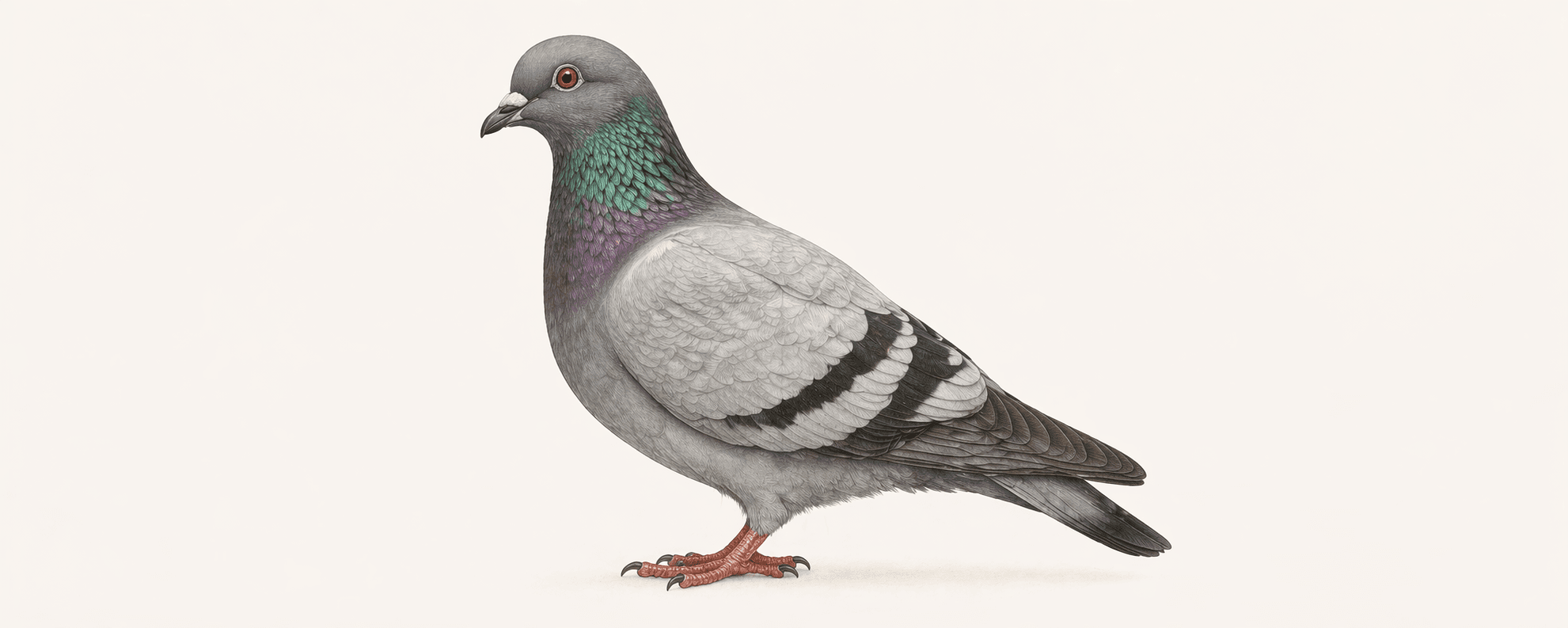
Every spring, the same scene plays out on balconies across Monaco and the Riviera: two or three dull-feathered pigeons land on the railing, come back the next day at the same time, then slip in behind the air-conditioning unit. They are almost always juveniles fresh out of the nest, looking for somewhere to perch, and then somewhere to nest. This exploration phase lasts a few weeks: it is the best moment to act, simply and without cruelty.
Why young pigeons turn up in spring
In the mild Mediterranean climate, the feral pigeon breeds almost all year round, with a marked peak in spring. The female usually lays two eggs, incubated for about eighteen days, and the young leave the nest at around four weeks. The juvenile then has neither territory nor partner: it scouts ledges, loggias and neighbouring roofs in search of shelter, water and food.
A few months later, it will look for a nesting site of its own. And pigeons are extremely loyal to their site: a pair that has nested somewhere returns to it stubbornly. Hence what is at stake: discouraging a juvenile that is exploring is easy, while dislodging an established pair is far harder.
How to recognise a juvenile pigeon
- Duller plumage, with little sheen on the neck.
- Dark eyes, whereas adults have an orange iris.
- A small cere (the bump at the base of the beak) rather than a white, swollen one.
- Hesitant landings and high-pitched squeaks rather than cooing.
What makes your balcony so attractive
- Shelter: the space behind an air-conditioning unit, the underside of an awning, a cluttered loggia or the traditional génoise eaves of a villa.
- Food: breakfast crumbs, a pet bowl left outside, seed from a bird feeder.
- Water and peace: saucers under plant pots and, above all, a home that is rarely occupied. In Monaco, many residences stay closed for part of the year: a balcony that remains silent for weeks is an open invitation.
Signs that pigeons are about to settle
- The same birds come back every day, often at the same times.
- A pair forms: the male coos and struts.
- Droppings always build up in the same spot.
- Twigs or feathers appear in a corner: eggs may follow within days.
What to do right now, without cruelty
- Remove food and water: put pet bowls away, empty saucers, clean the terrace after meals. Feeding pigeons is in fact prohibited in many municipalities.
- Clean droppings carefully: wear gloves and a mask, dampen the deposits before removing them so as not to raise dust, then disinfect. Being acidic, droppings damage stone and metal, and they can carry pathogens.
- Make nooks uncomfortable: declutter the loggia and close off the gap behind the air-conditioning unit, without affecting how it works.
- Use the space: a juvenile not yet attached to the balcony is quickly discouraged if it is often disturbed there.
- Note what you see: times, number of birds, photos of the corners they use. This speeds up the diagnosis.
What not to do
- Poison, glue or traps: cruel and dangerous for other animals, they are out of the question.
- Blocking an occupied nest: the chicks would die where they are, bringing smells and parasites (mites, pigeon ticks) that can migrate indoors. Wait until they have flown, then clean and proof the spot.
- Relying on gadgets: fake birds of prey and hanging CDs soon lose their effect as pigeons get used to them, and ultrasound has no proven effect on birds.
- Fitting spikes in a hurry: if they are the wrong type or badly spaced, they can even end up supporting a nest.
In apartment buildings, act on the scale of the façade
In a building, protecting a single balcony often just moves the problem next door, because pigeons think in terms of the whole façade. When several residents are affected, an approach coordinated by the managing agent works better, especially as visible nets on a façade may require the approval of the co-owners. Our approach for co-ownerships and managing agents takes these constraints into account.
How MPS deals with a colonised balcony
Everything starts with a free on-site audit: identification of the species (feral pigeon, dove or another bird, because the response differs), and mapping of perches, nesting sites and whatever is attracting the birds. You then receive a personalised action plan.
For birds, this plan favours mechanical, non-lethal solutions suited to the layout and the look of the façade: nets, spikes or tensioned wires, for example. That is the principle behind our pigeon control solutions, which respect biodiversity. After the intervention, a report signed electronically, with photos, is available in your online client area, ready to be forwarded to the managing agent. To find out more, see our page on urban pigeons and our seasonal prevention advice.
A peaceful balcony before the next brood
Are young pigeons coming back every day, or are twigs appearing behind the air-conditioning unit? Do not wait for exploration to turn into a nest: the on-site audit is free, as is the detailed quote, with no obligation.
Request your free quote or call +377 37 70 70 02: reply within 6 hours.
Frequently asked questions
- How can I tell whether the pigeons on my balcony are juveniles?
- A juvenile has duller plumage, a dark eye rather than an orange one and a cere that is still small. It hesitates when landing and often returns at the same times.
- Can a pigeon nest with chicks in it be removed?
- An occupied nest must not be blocked off: the chicks would die where they are, bringing smells and parasites. Wait until they have flown, about four weeks after hatching, then clean, disinfect and proof the spot.
- How much does it cost to protect a balcony against pigeons?
- It depends on the layout: surface area, height, access and façade constraints. After a free on-site audit, you receive a detailed quote, free and with no obligation; call +377 37 70 70 02 to arrange the visit.