July 14, 2026 · 15-minute read
Wasp Nest in a Monaco Apartment: Emergency Steps to Take
Visible or hidden wasp nest in your Monaco apartment? Detection signs, immediate steps, mistakes to avoid and emergency nest removal by certified experts.
Wasps in Your Monaco Apartment: Why Every Hour Counts
A persistent back-and-forth outside the living-room window, two or three wasps found against the glass every morning, a muffled droning behind the roller-shutter box: when these signals appear in an apartment, they are almost never passing visitors. In the vast majority of cases, a wasp nest has established itself in the apartment itself or in direct contact with it — balcony, façade, shutter housing, wall cavity or service duct. And in Monaco, where housing is dense, vertical and often historic in its upper levels, a wasp nest in an apartment rarely concerns a single home: the neighbours above, below and along the stairwell are exposed as well.
The decisive factor is time. A wasp colony grows exponentially: a few dozen workers at the start of the season, several hundred at the height of summer, sometimes several thousand at the end of the cycle for cavity-nesting species. A nest detected early is neutralised in one short, discreet visit; the same nest ignored for six weeks becomes a voluminous structure, defended by an aggressive population, sometimes lodged in the heart of a partition wall. Add to this the health risk: multiple stings, stings to the face or throat and severe allergic reactions make wasps one of the rare pests that justify a genuine emergency. In an apartment, the space is enclosed, escape routes are limited and children or pets cannot always move away: the tolerance threshold must be far lower than in a garden.
The good news: a wasp nest in a Monaco apartment can be dealt with quickly and thoroughly, provided the right diagnosis is made and the classic mistakes that make things worse are avoided. This guide explains how to tell a visible nest from a hidden one, how to locate it, what to do — and above all what not to do — while waiting for the intervention, and how an emergency wasp nest removal in a residential building actually unfolds.
Visible Nest or Hidden Nest: Two Very Different Emergencies
The first question to ask yourself: can you see the nest, or only the wasps? The answer changes everything, from the immediate level of risk to the treatment technique.
The visible nest is the easiest case to assess. It typically sits under the slab of the balcony above, in the corner of a window frame, under a planter, behind a folded awning, on the ceiling of a loggia or under a window sill. You can make out a structure of grey-beige papier-mâché: either a small open umbrella-shaped comb attached by a stalk, with the cells exposed — the signature of the paper wasp — or a closed ball that grows week after week. A visible nest has the advantage of being unambiguously located; it has the disadvantage of often being a few dozen centimetres from your living space, on a balcony you can no longer use.
The hidden nest is more insidious and, in Monaco, more common than people imagine. Cavity-nesting wasps — the German wasp first among them — need only an opening a few millimetres wide: a degraded façade joint, a crack in the render, a cable passage, a vent, a duct outlet, a roller-shutter box, a void between a partition and a load-bearing wall, a false ceiling, a disused flue. The nest itself develops inside the cavity, invisible from the home and from the street alike. In Belle Époque buildings as in recent residences, construction voids offer volumes the colony exploits to the full: some cavity nests reach the size of a large ball or more without any structure ever appearing to the naked eye.
This distinction dictates everything that follows. A visible nest is assessed and treated with direct access; a hidden nest first requires precise localisation — without which any treatment is a stab in the dark. It is also the hidden nest that produces the most dangerous situations when the occupant tries to block or spray it themselves, as we will see below.
German Wasp and Paper Wasp: The Two Dominant Species in Monaco Apartments
In the field, two species account for the overwhelming majority of apartment interventions on the Rock and in the Principality's residential districts.
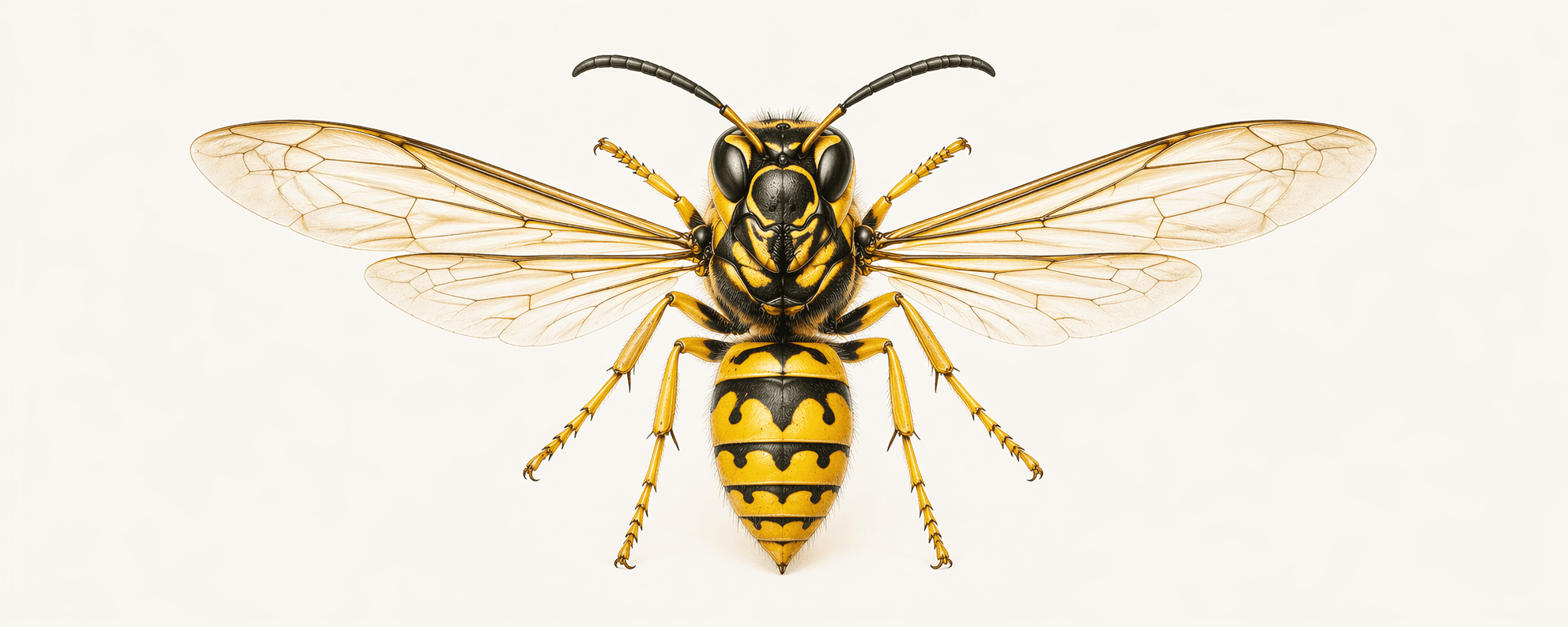
The German wasp (Vespula germanica) is the cavity-nesting species par excellence. Yellow and black, stocky and very fast, it establishes its colony in enclosed volumes: wall cavities, shutter boxes, ducts, roof spaces, crawl spaces. It is the one you hear behind a partition, and the one that causes the most serious problems in residential buildings: its colonies are among the most populous, several thousand individuals by late summer, and it defends its nest with determination. Each worker can sting several times, and the colony recruits reinforcements when it perceives an attack — including the mere vibration of a drill in the adjoining wall. It is also drawn to sweet and meat-based foods, which multiplies kitchen incursions late in the season.
The paper wasp (Polistes) is the specialist of visible balcony nests. Slimmer, with long legs dangling in flight, it builds small open combs of a few dozen cells, fixed under sheltered horizontal surfaces: the underside of a slab, a cornice, a housing, terrace furniture, a window frame. Its colonies are modest — rarely more than a few dozen individuals — and its temperament is less aggressive. But a paper wasp nest fifty centimetres from a sliding door you open every day remains incompatible with normal use of the home, particularly with children around, and its immediate proximity makes accidental stings frequent.
Other hymenoptera sometimes enter the diagnosis — the common wasp, the European hornet, and of course the Asian hornet, whose primary nests appear on balconies in spring. Identifying the species is not an academic detail: it determines the probable size of the colony, its dangerousness, the location of the nest and the removal technique. Our dedicated page on wasps and their treatment details the identification criteria; when in doubt, a simple photo sent to us is often enough to settle the question.
Recognising a Hidden Nest: The Signs That Never Lie
Locating an invisible nest requires no equipment, only a few minutes of methodical observation — preferably late morning or early afternoon, when flight activity peaks.
The first sign is the repetitive flight path. A foraging wasp wanders, zigzags, lingers. A wasp returning to its nest flies in a fast, taut line, always along the same axis, and always disappears at the same spot. Stand at the window or on the balcony and watch the façade: if every thirty to sixty seconds a wasp appears or vanishes at the same point — a joint, a hole in the render, the corner of a shutter box, a ventilation grille — you have found the colony's entrance. Traffic of one wasp every ten seconds or less indicates an already populous nest.
The second sign is acoustic. In the quiet of the evening, a colony installed in a partition or a housing produces a continuous droning, sometimes dry scratching sounds: the workers gnaw at materials — plasterboard, insulation, wood — to enlarge the cavity and produce the paper pulp for the nest. The noise intensifies if you tap the wall lightly (do it once, briefly: repeated vibrations agitate the colony). A localised rustling or humming behind a wall, ceiling or box is a near-certain clue.
Third sign: wasps inside the home with no window open. When workers regularly emerge near a recessed spotlight, a socket, a skirting board or an air vent, the nest is communicating with the interior volume — a priority situation, because it heralds a possible mass breakthrough. Other clues complete the picture: small deposits of gnawed material on the floor, an unexplained damp patch on a ceiling (large nests generate condensation), lethargic wasps found dead at the windows, and traffic that clearly increases from week to week.
Wasps in the Apartment: What to Do Immediately, Before Any Intervention
You have identified a nest or an active entrance? Here is the safe, simple course of action for the next hour.
First, cut off the access routes to your living space. Close the windows and shutters on the affected side, including in adjoining rooms: a lowered roller shutter in front of a closed window forms a highly effective double barrier. If wasps are emerging from an interior point — spotlight, skirting, vent — isolate the room: door closed, a rolled towel along the bottom of the door, and keep the room off-limits until the intervention. Keep children and pets away from the affected areas.
Next, reduce attractants. Leave no fruit, sugary drinks or food waste in the open, on the balcony or in the kitchen. In the evening, limit lighting near the entry point, which disorients late-returning workers.
Then, document without exposing yourself. From indoors or at a safe distance, photograph or film the entry point and, if possible, the traffic. Note the time, the frequency of passage, the exact location. These elements dramatically speed up the diagnosis and allow the intervention to be scoped before the technician even arrives. If a dead wasp can be collected without risk, keep it: it allows the species to be identified.
Finally — and this is the essential point — treat nothing yourself. No spraying, no plugging the hole, no water, no vacuum cleaner. Confine, observe and call. In the event of a sting followed by significant swelling, breathing difficulty, faintness, or any sting inside the mouth or throat, call the emergency medical services immediately: a severe allergic reaction is the true life-threatening emergency in this scenario. For an overview of wasp-related emergencies in the Principality, see our guide on what to do about a wasp problem in Monaco.
The Mistakes That Turn an Incident into a Crisis
Almost all the dramatic situations we encounter in apartments share one thing: an amateur treatment attempt that went wrong. Three mistakes come up constantly.
The insecticide aerosol into a cavity is mistake number one. An off-the-shelf spray discharged into the entrance hole of a hidden nest kills the few workers present in the first centimetres — and instantly alerts the rest of the colony, which may number thousands of individuals entrenched beyond the product's reach. The result: a surviving, furious colony looking for emergency exits. And in a hollow wall, the nearest emergency exit is often… the inside of your apartment. Dozens of wasps pouring out of the living-room spotlights an hour after a burst of aerosol: we see this scenario every summer.
Blocking the entrance too early is mistake number two, and probably the most counter-intuitive. Sealing the hole with filler, expanding foam or adhesive tape does not kill the colony: it imprisons it. Deprived of their exit, the wasps explore the cavity in every direction and end up gnawing through the nearest weak point — a plasterboard panel can be breached in a few hours. The outdoor nest then becomes an indoor problem. The absolute rule: an access point is never sealed until the colony has been neutralised. Sealing is the last step of the treatment, never the first.
The third family of mistakes: physical interventions. Knocking down a paper wasp nest with a racket or a broom, vacuuming up the wasps, hosing the nest, banging on the partition to "scare them off", or climbing on a chair at the edge of a balcony to spray at arm's length — every one of these initiatives has sent people to hospital. On upper floors, the risk of falling is added: a single sting to the face at the wrong moment, against a guardrail, can have dramatic consequences. As for popular remedies — smoke, burnt coffee, decoy nests, ultrasound — they simply have no effect on an established colony.
Our Apartment Intervention: Acoustic Diagnosis, Targeted Injection, Nest Extraction
Emergency wasp nest destruction in a residential building follows a precise protocol, adapted to the configuration of the apartment.
Everything starts with fine localisation. For a visible nest, the assessment is direct: species, size, height, immediate surroundings. For a hidden nest, the technician cross-references three sources of information: observation of flight paths to confirm the entry point or points, acoustic diagnosis — a methodical listening survey of the walls that pinpoints the heart of the colony behind a partition, a housing or a false ceiling — and, where the configuration justifies it, thermal imaging, since a large active nest gives off heat measurable through certain materials. This phase conditions everything else: treating the right spot, first time.
Then comes neutralisation. For cavity nests, the reference technique is the targeted injection of biocidal powder directly into the cavity, through the natural entrance hole or, if necessary, through a discreet micro-drilling made as close as possible to the nest. Powder has a decisive advantage over liquids and aerosols: workers returning to the nest walk through the deposit, pick it up and spread it themselves to the heart of the colony, all the way to the queen and the brood. The entire colony is neutralised within hours, including foragers absent at the time of treatment, which contaminate themselves on their return. The technician works in full protective equipment, with professional gear and approved professional-use products — our company holds Certibiocide certification No. 121134 and is registered with the Monaco RCI under number 26S10394.
The final step, too often neglected: extraction of the nest. About five days after treatment, once all activity has ceased, we return to remove the empty nest where it is accessible or can be made accessible. A dead nest abandoned inside a partition is not harmless: decomposing larvae and dead wasps give off odours, attract other pests — dermestid beetles, moths, flies, even rodents — and the paper structure retains moisture. This day-five visit also allows us to verify the total absence of residual activity, to treat the cavity preventively and, only then, to seal the access points cleanly.
Fast, Discreet Intervention: A Service Designed for Monaco Residences
A wasp nest in an apartment cannot wait a week. Our organisation is calibrated for same-day or next-day response during business hours across the whole Principality and its districts — Monte-Carlo, La Condamine, Fontvieille, Monaco-Ville, Les Moneghetti — with immediate telephone triage: photos, location of the entry point, presence of allergic individuals, access configuration. High-risk situations — wasps inside the home, an allergic person on the premises, a nest in a busy passage area — are treated as absolute priorities; our 24/7 emergency service takes over outside standard hours.
Discretion is part of the service. In a residence, nobody wants a pest-control intervention to become the building's topic of conversation. Our technicians arrive in neutral attire, with compact equipment, coordinating the schedule with you — and with the concierge where useful. Indoors, surfaces are protected, any drilling is minimal and cleanly refilled, and the apartment is returned in its original condition, with reoccupation instructions for the treated room.
Finally, coordination with the building manager is a reflex we take on when the situation requires it. If the entry point is on the façade, or the nest occupies a shared construction void, a communal service duct or the outdoor side of a shutter box, the intervention may fall under the common areas. We know how to document the situation — photos, precise location, technical report — so that the building's manager can validate and trigger the intervention without delay, and we work equally at the request of an occupant or of a managing agent on behalf of the co-ownership. In every case, the rule is the same: safety first, questions of responsibility second.
Tenant or Owner: Who Should Act When Facing a Wasp Nest?
In an apartment, the question always comes: "Is it up to me to pay for the intervention?" Without going into the detail of legal texts, a few common-sense reference points bring clarity — each situation ultimately depending on the lease and the building's rules.
The tenant's first reflex is notification. As soon as a nest or an active entrance is detected, inform the owner or the agency in writing, with photos, mentioning the date. This prompt notification protects everyone: it establishes that the occupant acted diligently, and it allows the owner to take a position quickly. Conversely, a nest reported late, after it has had time to damage a partition, always complicates the discussion.
On the substance, the usual logic distinguishes three scenarios. A nest installed in an element belonging to the dwelling and linked to its everyday use generally falls to the occupant. A nest lodged in the building's structure — wall cavity, façade, duct, roof — concerns the fabric of the building and tends to fall to the owner, or to the co-ownership if the element is communal. Finally, a nest in the common areas (façade, courtyard, shared roof spaces, service shafts) is a matter for the building management. Between these clear-cut cases, mixed situations are frequent: a nest in a shutter box, for example, can involve both the dwelling's equipment and the façade.
Our advice, born of experience: never let a debate over responsibility delay making the premises safe. A prompt intervention always costs less — in damage, in risk, in neighbourly tension — than a nest thriving while the exchanges drag on. Our detailed intervention report, specifying the exact location of the nest, its entry point and the nature of the elements concerned, then serves as an objective basis for everyone to assume their share.
After Destruction: Securing the Apartment Against a New Colony
A destroyed nest does not come back — wasps do not reuse an old nest from one year to the next. However, a site that appealed to one founding queen offers, by definition, everything the next one is looking for: shelter, orientation, access. Prevention therefore consists of making the apartment less welcoming before the following spring.
The central measure is sealing the access points, carried out after complete neutralisation and extraction of the nest, never before. Cracked façade joints adjoining the dwelling, cable passages, gaps in roller-shutter boxes, degraded ventilation grilles: every opening wider than a few millimetres deserves to be sealed or finely meshed, without ever blocking the ventilation the dwelling needs. On balconies, insect screens on frequently opened windows and furniture inspected at the start of the season markedly reduce the risk.
The key period is spring. From April to June, founding queens emerging from hibernation scout for nesting sites: this is when ten minutes of observation per week can change everything. A lone queen inspecting a housing, a nest bud the size of a golf ball under the balcony slab: at that stage, removal is immediate, risk-free and without consequence. The same nest discovered in August requires a full protocol.
For residences and occupants who prefer to delegate this vigilance, we offer seasonal inspection visits — balconies, accessible façades, roof spaces and ducts at the start of the nesting season — which intercept foundations before they become colonies. And if doubt creeps in one morning at the sight of suspicious traffic along the façade, the reflex remains the same as on day one: touch nothing, observe, photograph, and contact us. Our team assesses the situation remotely and offers you a rapid intervention slot, with a free quote and no obligation.
Frequently asked questions
- How do I know if a wasp nest is hidden in my wall or a duct?
- Three converging signs never lie: fast, repetitive flight paths that always end at the same point on the façade (joint, crack, shutter box, ventilation grille), a continuous droning or scratching audible behind the wall in the quiet of the evening, and wasps appearing inside the home with no window open, near a spotlight or a skirting board. Traffic of one wasp every ten seconds indicates an already populous nest. Our acoustic diagnosis then pinpoints the nest precisely.
- Can I plug the hole the wasps use to get in and out?
- No — never before the colony has been neutralised. Sealing the entrance does not eliminate the wasps: it traps them inside the cavity. Deprived of their exit, they gnaw through the nearest weak point — often a plasterboard panel, breached within hours — and the outdoor nest becomes a problem inside your apartment. Sealing the access points is the very last step of the protocol, carried out after treatment and extraction of the empty nest.
- Can an off-the-shelf wasp spray destroy a nest inside a partition wall?
- No — and it is the most dangerous mistake you can make in an apartment. The spray only reaches the first wasps in the entrance channel; the heart of the colony, out of reach, is instantly put on alert and starts looking for emergency exits — often towards the inside of the home, through spotlights, sockets and skirting boards. Only a targeted injection of professional biocide into the cavity, after precise localisation of the nest, neutralises the entire colony, queen and brood included.
- How quickly do you intervene for a wasp nest in a Monaco apartment?
- Same day or next day during business hours across the whole Principality, after immediate telephone triage based on your photos and the location of the entry point. High-risk situations — wasps inside the home, an allergic person on the premises, a nest in a busy passage area — are treated as absolute priorities, and our 24/7 emergency service takes over outside standard hours. The intervention is discreet: neutral attire, compact equipment, schedule coordinated with you and the concierge if needed.
- Who should handle the intervention: the tenant, the owner or the building manager?
- In practice, everything depends on the nest's location. A nest linked to an element belonging to the dwelling generally falls to the occupant; a nest lodged in the building's structure (wall cavity, façade, duct) tends to concern the owner; a nest in the common areas is a matter for the building management. In every case, the tenant should report the situation in writing without delay, with photos, and making the premises safe must never wait for the outcome of the discussion. Our detailed intervention report then serves as an objective basis for allocating responsibility.
- Why do you come back to extract the nest five days after the treatment?
- Because a dead nest abandoned inside a partition is not harmless: decomposing larvae and wasps give off odours and attract other pests — dermestid beetles, moths, flies, even rodents — while the paper structure retains moisture. The day-five visit, once all activity has ceased, allows us to remove the empty nest, verify the absence of residual activity, treat the cavity preventively and, only then, cleanly seal the access points to prevent any re-colonisation.