July 15, 2026 · 9-minute read
Wasp or hornet? Identifying a nest and reacting on the Riviera
Four species dominate the summer reports between Monaco and Menton. Visual criteria, safety distances and a triage protocol before the intervention on a nest.
Unusual air traffic beneath the bougainvillea
Late July, Roquebrune-Cap-Martin. On a south-facing terrace, the sea below and the Cap Martin pine wood as a backdrop, the owner of a villa is pruning his bougainvillea when he notices a steady coming and going of dark insects. All of them converge on a fixed point, beneath the overhang of the pool house roof. Stepping a few paces closer, he makes out a greyish-beige structure, spherical, the size of a handball. The question that then arises is anything but academic: wasps or hornets. The answer determines the safety distance to keep, the degree of urgency of the intervention and the real risk to the children playing ten metres away.
This scenario is one the Monaco Pest Solutions team comes across every summer in similar forms between Cap-d'Ail, Beausoleil and Menton: a paper wasp nest under a south-facing cornice in Èze, a colony of European hornets settled in the garden shed of a terraced garden in La Turbie, an Asian hornet nest perched in a parasol pine above a swimming pool. In the vast majority of cases, a reliable identification can be made from a distance, in around thirty seconds, from three simple criteria: size, dominant colour and flight behaviour.
One point must be made first: whatever the species, an occupied nest is never to be dealt with yourself, still less with a general-purpose aerosol. The real question is not whether a professional should intervene, but within what timeframe, and what precautions to apply in the meantime. That is precisely what this article sets out.
Four species, four risk profiles
Along the coastal strip that runs from Nice to Menton, four social hymenopterans account for the bulk of summer reports. Two wasps, two hornets, and very different levels of danger.
The two wasps: common and paper
The common wasp (Vespula germanica) measures 12 to 17 mm and bears sharp, strongly contrasted black-and-yellow stripes. Its flight is fast, nervous, unpredictable. It nests under cover — a wall cavity, a loft, a hole in the ground — and a mature colony can exceed several thousand individuals by the end of the season. It is the one that invites itself to the table: sugar, meat, drinks.
The paper wasp (Polistes dominula) is slimmer, with an elongated silhouette and a pronounced wasp waist. Its distinctive sign is read in flight: the long hind legs dangle beneath the body, clearly visible against the light, where the common wasp flies with its legs tucked in. Its nest is open, umbrella-shaped, with visible cells, and rarely exceeds a few dozen individuals. It is by far the most peaceable of the four species.
The two hornets: European and Asian
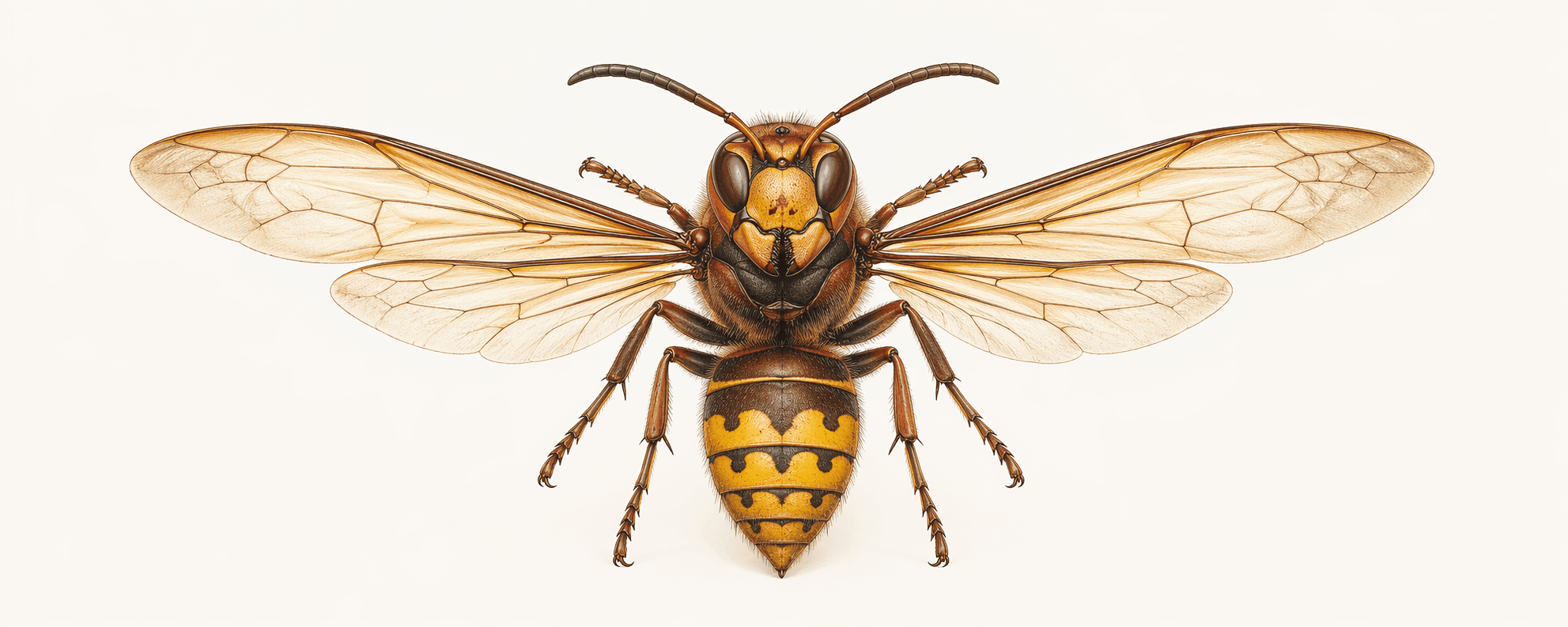
The European hornet (Vespa crabro) is the largest: 25 to 35 mm, thorax and abdomen tending towards brownish-orange, russet head, heavy flight with a deep hum. Contrary to its reputation, it is fairly tolerant as long as one does not approach the nest. A useful feature for diagnosis: it also flies at night and comes to bump against lit windows.
The Asian hornet (Vespa velutina), known as the yellow-legged hornet, measures 20 to 30 mm — smaller than the European species, but markedly darker. Three markers give it away: a matt black thorax, a dark abdomen crossed by narrow yellow-orange bands with a single broadly orange segment, and the tips of the legs a bright yellow. It is the most dangerous species on the coast: its defence of the nest is collective and triggered within a radius of 5 to 10 metres.
Identification in thirty seconds: three questions
Faced with insects in flight near a nest, three questions are enough to decide without approaching. First question: does the size clearly exceed 2 cm. If not, it is a wasp; dangling legs in flight mark out the paper wasp, bright stripes and a nervous flight the common wasp. If so, second question: what is the dominant colour. A russet-orange insect, bulky, with a loud flight, points to the European hornet. An insect that appears almost black from a distance, with pale leg-tips, points to the Asian hornet. Third question: is the nest visible and where. An open umbrella a few centimetres across under a cornice suggests the paper wasp; a sphere of papier-mâché high up, in a tree, suggests Vespa velutina; traffic entering a hole in a wall, a roof void or a hollow trunk suggests the common wasp or the European hornet. A telephoto photograph, taken from a window, then allows the technician to confirm the species even before travelling out.
The topography of nests on the Riviera
Each species has its preferred addresses, and the built environment of the Côte d'Azur serves them all. The paper wasp chooses warm, south-facing mineral supports: the underside of a cornice, roller-shutter boxes, hollow railings — the façades of Beausoleil and the villas of Èze offer them in abundance. The European hornet prefers dark, sheltered volumes: the hollow of an old olive tree, a seldom-visited attic, a garden shed, which explains its frequency in the terraced properties of La Turbie and the Menton hinterland. The Asian hornet, for its part, builds in spring a low, discreet primary nest (a canopy, a garden shelter), then the colony moves in summer to a high-perched secondary nest: the top of a pine or a palm between 10 and 25 metres, or a sheltered overhang of cliff or roof. On the Riviera, the peak activity of Vespa velutina runs from July to October; by late summer, a mature nest can house more than 2,000 individuals, and that is precisely the period when it becomes most defensive.
Stings: what the venom really changes
Unlike the bee, wasps and hornets have a smooth sting: each individual can sting several times in succession without dying. In hornets, the sting is longer — it goes through light clothing — and the volume of venom injected per sting is greater. For a healthy adult, an isolated sting remains painful but benign. Three situations, however, are medical emergencies: the systemic allergic reaction, which can occur even after a common wasp sting and progress to anaphylactic shock within minutes; multiple stings, typical of a nest-defence attack by hornets; and any sting in the mouth or throat, often linked to an insect that has fallen into a glass. In these three cases, the call to 112 comes before everything else. Facial swelling, breathing difficulty, faintness: these are not symptoms to monitor from home.
Why the supermarket aerosol makes things worse
The most widespread reflex is also the most counterproductive: spraying an insecticide can from the ground towards the nest. The jet almost never reaches the heart of the colony, but it kills a few workers on the periphery, which release alarm pheromones as they die. The result: the colony shifts into a defensive posture and the radius of aggressiveness widens abruptly, sometimes for several days. The jet of water from a garden hose and the attempt to burn the nest produce the same effect, with the added risk of fire in a pine wood in the middle of summer. Another classic mistake: sealing with filler the entry hole of a common wasp nest lodged in a wall. Deprived of an exit, the workers gnaw through the internal partitions and eventually emerge into the living areas. An occupied nest is neutralised neither from below, nor blindly, nor by confining it.
The triage protocol before the call
While waiting for the technician to come by, the course of action on the client's side comes down to five steps, in this order.
First, establish a graduated safety distance according to the presumed species: 5 metres for a paper wasp nest, 10 metres for a European hornet, 15 metres for an Asian hornet — and mentally mark out this perimeter for the whole household. Next, close the windows situated on the flight paths, particularly at the end of the day, when European hornets are drawn to interior lights. Third step: keep children and animals away from the perimeter, a dog barking under a nest being a documented attack trigger. Fourth step: suspend any source of vibration nearby — lawnmower, hedge trimmer, pressure washer — for colonies react to it as to an aggression. Finally, photograph the nest and the insects with a zoom from a sheltered spot, without flash, then send the images: this simple photo makes it possible to confirm the species, to calibrate the equipment and often to quote a firm price before travelling out.
The Monaco Pest Solutions intervention, step by step
Remote identification and access assessment
The technician always begins with a reading from a distance, with binoculars or from a photo: species, nest size, intensity of entry traffic, height and access constraints. This step conditions everything — a paper wasp nest under a cornice in Cap-d'Ail and a Vespa velutina nest 18 metres up in a pine call for neither the same equipment nor the same time window.
Neutralisation at the end of the day, removal at D+2
On an occupied nest, the reference procedure is dusting the nest entrance at the end of the day, when almost the entire colony has returned. The insecticidal powder, applied under a full-body suit and, where required, with a telescopic pole, is spread through the nest by the workers themselves. Mechanical removal of the nest takes place at D+2, once the colony is extinct: leaving it in place would attract foundresses the following year and leave residues above a terrace or a swimming pool. For Asian hornet nests at the top of a tree, access is by long pole or aerial platform, never by pruning an active nest.
Realistic cost and regulatory framework
In the Monaco area and neighbouring communes, an intervention on a wasp or hornet nest varies depending on configuration, varying above all on two factors: accessibility and height. A paper wasp nest at head height is dealt with quickly; a Vespa velutina nest 20 metres up requires a specialised pole or an aerial platform, and sometimes a second check-up visit. This type of treatment calls for biocides reserved for professional use: Monaco Pest Solutions operates under Certibiocide certification N121134, and the company is registered with the Monaco Trade and Industry Register under the number 26S10394. A useful point on the French side of the border: the Asian hornet is classified as an invasive alien species, and any nest spotted in Menton, Roquebrune or Beausoleil deserves to be reported on the dedicated national platform, alongside its destruction.
Late summer, the time for vigilance
From July to October, the Riviera's colonies reach their maximum size and their peak of defensiveness, at the very moment when terraces and gardens are most occupied. Remembering the essentials is enough: under 2 cm, a wasp; over 2 cm and russet, the European hornet; over 2 cm and dark with yellow legs, the Asian hornet — and in every case, distance, photo, call. For an identification from a photo or an intervention on a nest, the team can be reached on +377 37 70 70 02 or in writing at contact@monacopestsolutions.mc. A free quote request with a photo of the nest most often allows a costed reply within the day.
Frequently asked questions
- How do you tell an Asian hornet from a European hornet?
- The European hornet (*Vespa crabro*, 25-35 mm) is the largest and appears russet-orange, with a russet head. The Asian hornet (*Vespa velutina*, 20-30 mm) is smaller and much darker: matt black thorax, narrow yellow-orange abdominal bands and, above all, bright yellow leg-tips, visible even in flight.
- How far should you stay from a hornet nest?
- Allow 5 metres for a paper wasp nest, 10 metres for a European hornet and 15 metres for an Asian hornet, whose collective defence is triggered within a radius of 5 to 10 metres. Keep children and animals away, close nearby windows and avoid any vibration (lawnmower, hedge trimmer) near the nest.
- Can you destroy a wasp nest yourself with an insecticide can?
- It is not advisable. A jet from the ground does not reach the heart of the colony but kills a few workers, which release alarm pheromones: the nest becomes more aggressive for several days. Hornets sting several times in succession and a group attack can be serious. An occupied nest is a matter for professional treatment.
- Is a hornet sting dangerous?
- For a non-allergic adult, an isolated sting is painful but generally benign, even though the hornet injects more venom than a wasp. Three situations require calling 112: an allergic reaction (facial swelling, breathing difficulty, faintness), multiple stings during a nest attack, or a sting in the mouth or throat.
- Where does the Asian hornet build its nest on the Côte d'Azur?
- In spring, the foundress builds a low, discreet primary nest (a canopy, a garden shelter). In summer, the colony moves to a spherical secondary nest high up: the top of a pine or a palm between 10 and 25 metres, or a sheltered overhang. On the Riviera, peak activity runs from July to October, with mature, highly defensive nests in late summer.
- How much does it cost to destroy a wasp or hornet nest near Monaco?
- The indicative range is varies depending on the configuration depending on the species, accessibility and height of the nest. A paper wasp nest under a cornice is dealt with quickly; an Asian hornet nest at the top of a tree requires a telescopic pole or an aerial platform. A photo of the nest most often makes it possible to obtain a firm quote before travelling out.