
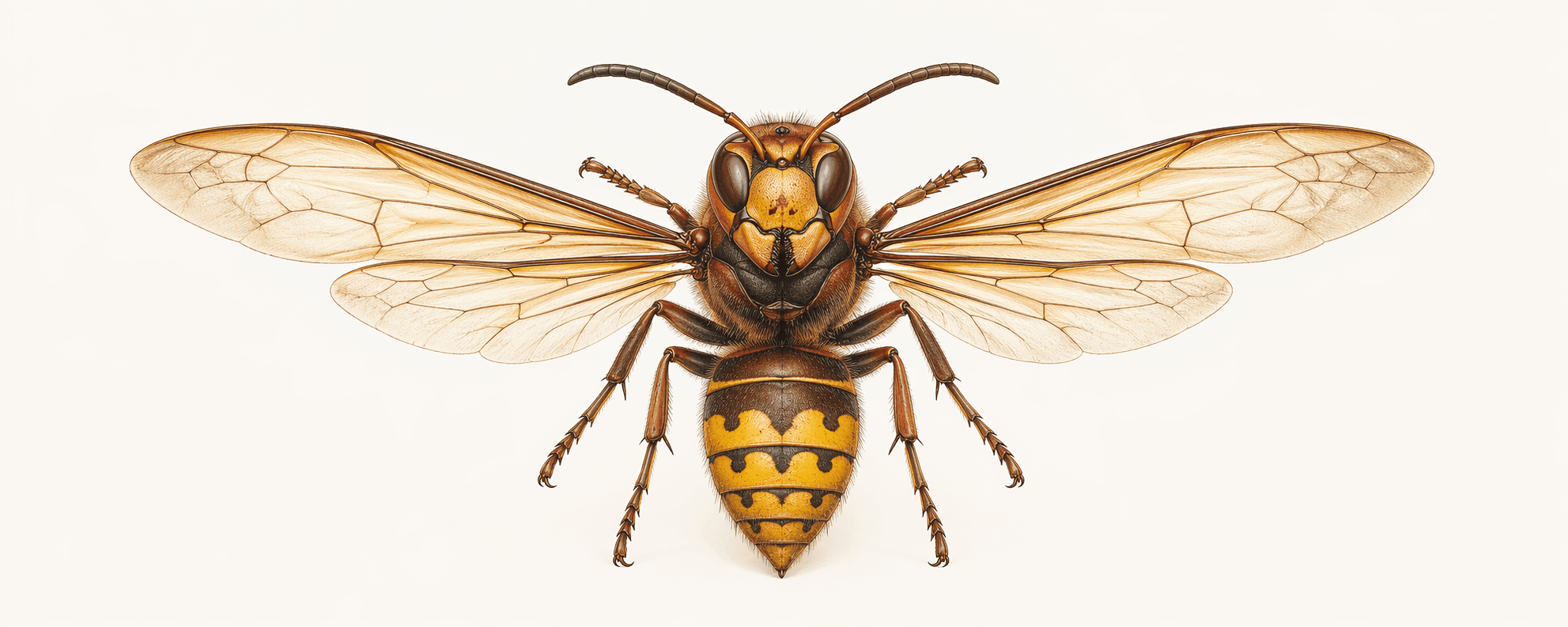
Identifying the Asian hornet: the signs that never lie
The *Vespa velutina is clearly distinguishable from its European cousin (Vespa crabro). It measures between 17 and 32 mm, its thorax is entirely velvety black, its dark brown abdomen is barred with a single orange band on the fourth segment and, above all, its yellow-tipped legs* are the most reliable identification marker. By contrast, the European hornet displays predominantly yellow-russet tones and brown legs.
The signs of its presence are numerous:
- Characteristic hovering flight in front of beehives or windows that attract insects
- Low, continuous buzzing near a high point (tree, cornice, open suspended ceiling)
- Discovery of a primary nest in spring: the size of an orange, often under a low shelter (garden shed, eaves, technical outbuilding)
- Discovery of a secondary nest in summer: a greyish papier-mâché structure, balloon-shaped, often more than ten metres above the ground
- A sudden drop in bee populations among beekeepers in the hinterland
Any sighting should trigger an immediate call, without any attempt to approach.
Health and material risks
The Asian hornet does not attack spontaneously, but becomes extremely defensive within a five-metre radius of its nest. Its stings are painful and inject a venom liable to cause:
- Extensive local reactions (oedema, redness, heat)
- Severe allergic reactions, up to and including anaphylactic shock in sensitised individuals
- A cardiovascular risk for elderly or frail people in the event of multiple stings
Material damage mainly concerns roof timbers and cladding into which the nest can anchor itself, as well as insulation perforated during cavity nesting. Beekeepers in the region suffer significant colony losses.
From a legal standpoint, a managing agent of a co-owned building has a duty of safety towards occupants and visitors: the presence of a nest in the common areas engages their liability. For premises open to the public (hotel, restaurant, private beach), the discovery of a nest requires immediate intervention under the general duty of safety.
Why this pest thrives in Monaco and on the Riviera
The Mediterranean climate offers the Asian hornet ideal conditions: mild winters allowing founding queens to survive, early springs accelerating the establishment of primary nests, and long summers extending the production of workers and future queens. The Principality combines several aggravating factors:
- Vertical plant density: clipped hedges, palm trees, the umbrella pines of Fontvieille, the hanging gardens of Monte-Carlo, the dense vegetation of the Rocher
- The proliferation of flowered balconies and tree-lined terraces offering discreet nesting sites at height
- An abundance of sugary sources: fruit trees in the hinterland, catering waste bins, fruit bowls on terraces
- The immediate proximity of the hinterland (Cap-d'Ail, Beausoleil, La Turbie, Roquebrune-Cap-Martin), where queens establish their colonies before migrating into the urban area
Seasonality is pronounced: reports surge from July to October, the period during which secondary nests reach their maximum size and become visible to the naked eye.
The MPS protocol in five steps
Our method follows the principle of measured pest control: act precisely, once, and well.
- On-site diagnosis within 24 working hours. Confirmation of the species, exact location of the nest, height measurement, identification of access risks (neighbouring properties, electrical cables, glass roofing).
- Securing the perimeter. Moving occupants, animals and vehicles away. Communication with the managing agent or concierge where necessary.
- Neutralisation by telescopic pole (8 to 15 metres depending on the configuration). Injection into the heart of the nest of a biocide approved by les autorités sanitaires françaises, at the end of the day to maximise the presence of workers.
- Removal of the nest where its location allows. An abandoned, intact nest can be colonised the following year by other hymenoptera.
- Post-intervention inspection within eight days and delivery of a signed report specifying the product used, the dosage, the technician, and the Certibiocide certificate (N121134).
Every intervention is covered by a systematic confidentiality agreement.
Mistakes to avoid
When facing a nest, do-it-yourself initiatives are the leading cause of serious accidents. Absolutely to be avoided:
- Spraying a supermarket insecticide onto the nest: the range is insufficient, the hornets pour out en masse and attack as a swarm
- Blocking the entrance of a cavity nest (wall, chimney): the hornets exit through another opening inside the building
- Using a water jet or attempting to dislodge the nest by hand, even from a ladder
- Using beer or vinegar traps at the height of summer: they capture large numbers of non-target insects (pollinators, butterflies) without reducing the colony
- Waiting for winter in the belief that the nest will die on its own: the founding queens will already have left the nest to overwinter and found new colonies elsewhere in spring
Burning the nest directly is also strictly prohibited, both for fire-safety reasons and because of the dispersal of panicked insects.
A typical Monaco case
A managing agent responsible for a prestigious residence in La Condamine contacted us on a Friday in September: a cleaner had just been stung three times while opening the shutters of an unoccupied flat. Diagnosis carried out on the Saturday morning: a secondary nest the size of a basketball, attached under the sixth-floor cornice, invisible from the street but perfectly concealed on the inner-courtyard side. Intervention on the Saturday evening at dusk, 12-metre pole from the neighbouring terrace, neutralisation in under thirty minutes. Nest removed on the Monday. Report delivered to the managing agent on Tuesday morning, including a recommendation for six-monthly cornice inspections across the entire co-owned building. No occupant was informed of the intervention apart from the co-ownership council, in accordance with the signed confidentiality clause.
Lasting prevention
Prevention relies on the early detection of the primary nest between April and June, the period during which the founding queen is alone and the nest is no bigger than a tennis ball. Practical recommendations:
- Spring inspection of garden sheds, technical outbuildings, balcony undersides, eaves and shutter housings
- Checking lofts and suspended ceilings at the slightest unusual buzzing
- Limiting open-air sugary sources in summer (closed bins, covered fruit bowls)
- Immediate reporting to the technical services of the les services communaux monégasques for public spaces, or to MPS for private properties
- Setting up a seasonal monitoring contract for co-owned buildings, hotels and residences with extensive outdoor areas
A primary nest destroyed in May means a colony of three to four thousand workers avoided in October.
Regulatory framework
The Asian hornet is classified as an invasive alien species by the French the French ministerial order on hornets, supplemented by the European regulation on invasive alien species. Its destruction is encouraged, but it must be carried out with approved biocides and by a trained professional.
In Monaco, there is no specific legislation dedicated to Vespa velutina, but intervention falls within the general framework of public health and personal safety. Owners and managing agents are responsible for treatment on their private premises. The les autorités environnementales monégasques can be contacted to report nests on public land.
Any intervention using a biocidal product in the Principality must be carried out by an operator holding Certibiocide certification (MPS: N121134). A compliant intervention report may be required in the event of a health inspection or an insurance claim.
How long, how many visits
For a primary nest (April-June) accessible at under three metres, a single visit is sufficient in the vast majority of cases, with resolution in under 48 hours.
For a secondary nest at height (July-October), pole intervention resolves the situation in one visit, provided the heart of the nest is reached. A post-intervention inspection at eight days confirms the complete mortality of workers returning from foraging. In complex cases (nest in a wall cavity, access obstructed by a balcony, double nest), a second visit can be scheduled.
Average time between the call and complete resolution in the Monaco / Riviera area: from a few hours to around ten days, depending on urgency, accessibility and weather conditions (strong wind and rain rule out pole intervention).
In any doubt? Our team responds within 2 working hours. +377 37 70 70 02 — or [request a free quote](/devis-gratuit).