July 14, 2026 · 12-minute read
Chemical-free mosquito traps: Monaco 2027 guide
Chemical-free mosquito trap: how CO2 attractant trapping protects children, pets and biodiversity. The Monaco 2027 guide to organic garden mosquito control.
The paradox of Riviera summer evenings
A Mediterranean garden in July, in Monaco as along the whole coastal strip from Cap-d'Ail to Menton, brings together everything that makes life pleasant: watered lawns, flowering beds, a pool, a few ornamental water features, the shade of olive trees and oleanders. That same setting also unwittingly brings together everything a mosquito needs to thrive: moisture, cool hiding places during the day, and a supply of hosts to bite as soon as evening falls. Therein lies the paradox. The more beautiful and well-watered a garden is, the more hospitable it becomes to the tiger mosquito and the common mosquito.
For a long time, the only answer offered to homeowners was spraying insecticides over the vegetation. This approach works for a few hours, sometimes a few days, but it carries a cost that is not visible at the time: it strikes indiscriminately at everything that flies or crawls, including the garden's valuable beneficial creatures, and it leaves residues where children play and pets roam. It is precisely to escape this dead end that chemical-free attractant trapping has established itself as the reference for demanding gardens. This 2027 guide from Monaco Pest Solutions explains how a chemical-free mosquito trap works, how it differs radically from conventional treatments, and why it forms the central building block of a genuinely sustainable organic garden mosquito strategy.
How an attractant trap works without biocide
The principle of an attractant trap rests on a simple idea: instead of poisoning the environment to reach the mosquito, it mimics the signals that, in nature, guide the female to her target. For it is indeed the female that bites, and she does so to nourish her eggs with blood proteins. To find a host, she leaves nothing to chance: she follows a very precise chemical and physical trail, which a well-designed trap answers point by point.
The first lure is carbon dioxide. Every living being that breathes exhales CO2, and a mosquito detects this gas from dozens of metres away. A sentinel trap releases a calibrated plume of CO2 that reproduces the breathing of a mammal and draws in approaching females. The second lure is heat: human skin gives off a characteristic thermal signature, and a source of gentle warmth, combined with slight humidity, finishes convincing the insect that it is nearing a real host. The third register involves olfactory attractants, sometimes described as pheromones or body-odour lures: small cartridges release molecules that reproduce the smell of skin and perspiration and reinforce the device's appeal.
Once the female is drawn into contact with the trap, she is sucked in by a downward airflow and held in a capture grid, where she dehydrates. There is no insecticide, no toxic gas, and no electrified grid that zaps everything passing by. This absence of non-selective electrocution is a crucial point: the well-known blue discharge lamps, long sold as a miracle solution, mainly kill moths and harmless insects and let most mosquitoes through, since mosquitoes are not drawn to light. An attractant trap, by contrast, specifically targets host-seeking females and leaves the rest of the garden's fauna in peace.
Installed in the right spot, this type of device interrupts the reproductive cycle without ever releasing any active substance into the air, water or soil. It works continuously, day and night, throughout the season, where a spray protects for only a few hours.
The real difference with conventional chemicals
To understand the gap between the two approaches, you have to look at what happens after the intervention. A contact-insecticide spray deposits a film of active matter on foliage, low walls and furniture. This film kills the mosquitoes present at that instant, but also the bees foraging the flowers, the ladybirds, the butterflies, the spiders and a host of insects that naturally regulate other pests. Once the shock effect has passed, the product degrades under sun and watering, and new mosquitoes recolonise the garden from neighbouring properties. You then find yourself treating again, over and over, in a costly, environmentally harmful flight forward.
Attractant trapping reverses the logic completely. It does not seek to create an instant toxic barrier, but to lastingly reduce the female population by capturing it night after night. The curve is slow to start — it often takes two to three weeks to feel real relief — but it is deep and stable over time, because each female captured is a hundred eggs that will never be laid. Where chemicals offer an immediate and fleeting result, trapping offers a gradual and lasting one, without ever degrading the environment.
We must be honest on one point: trapping alone does not do everything. Its full effectiveness requires pairing it with the removal of larval breeding sites, which we discuss below. But unlike chemicals, it creates no environmental debt, no resistance, no risk to occupants. It is a tool you can leave running all season with no second thoughts, including in gardens where children and animals live. For a reminder of emergency reflexes when pressure becomes intense, our article on what to do about a mosquito problem in Monaco usefully complements this in-depth approach.
Safe for children and pets
This is often the first question families ask, and it is a legitimate one. A garden means children walking barefoot on the lawn, putting their hands to their mouths, picking a blade of grass or a flower. It also means dogs sniffing the ground and cats hunting in the beds. Any persistent product deposited on the vegetation becomes, for them, a source of repeated exposure whose cumulative effects are poorly understood.
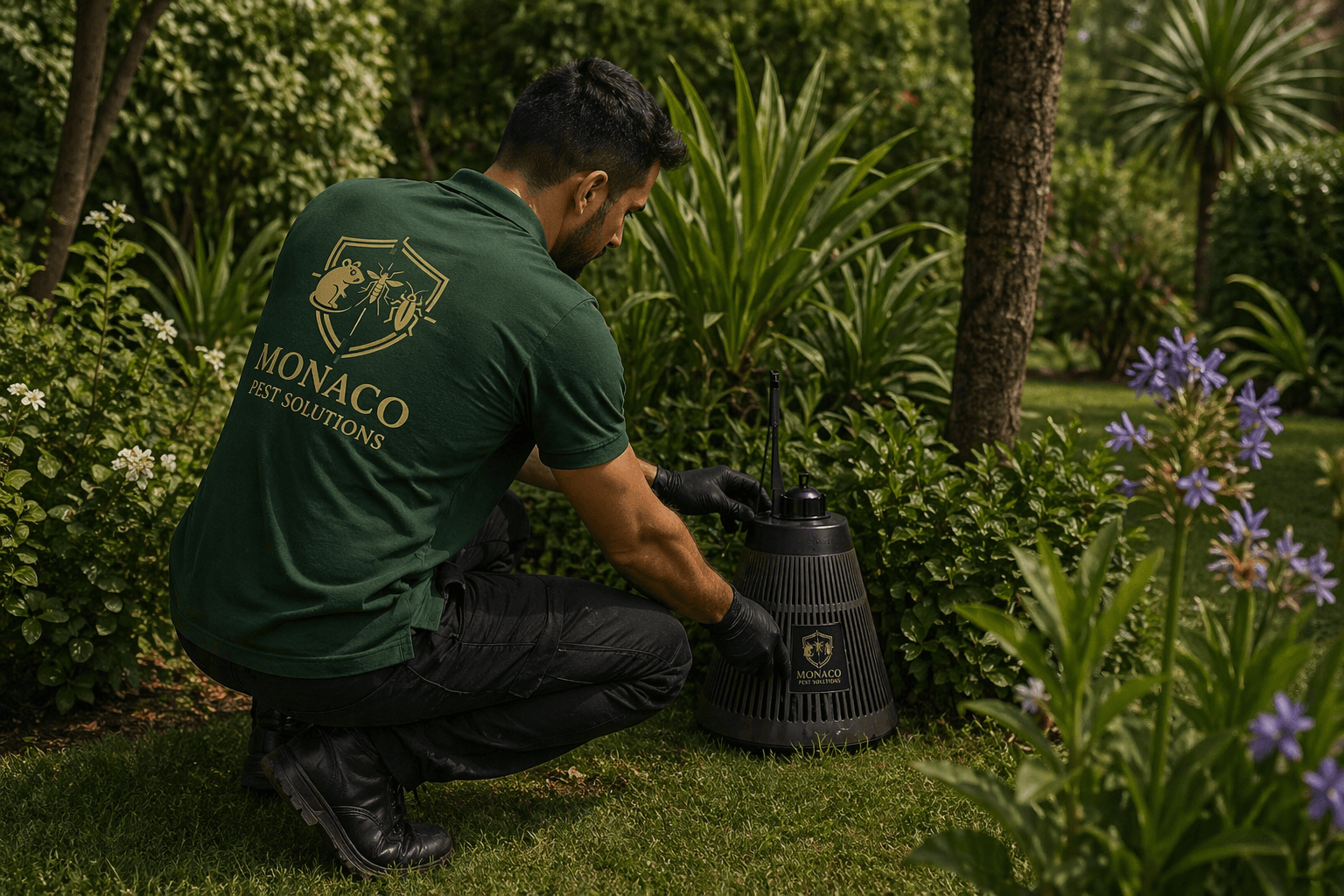
Attractant trapping removes this risk at the root, because it deposits nothing. CO2 is the gas we all exhale; the warmth given off is gentle; the attractant cartridges are enclosed within the device and do not spread into the environment. A child can play nearby, a dog can walk past, with no consequence whatsoever. The trap is deliberately placed away from living areas — at the edge of the garden, near the mosquitoes' entry points — precisely to draw them away from terraces and play areas, not towards them.
This harmlessness changes the very way you inhabit the garden. You no longer have to wait for a re-entry period after treatment, you no longer wonder whether the terrace cushions have caught a mist of insecticide, you no longer rinse the toys left outside. Protection becomes invisible and permanent, and above all compatible with a lifestyle where the garden is an extension of the home.
Protecting biodiversity: bees, geckos, hedgehogs
A Riviera garden is not a sterile space: it is a small living ecosystem. Bees and bumblebees pollinate the flowers and fruit trees. Geckos, those little lizards that dart across the warm walls in the evening, devour quantities of insects. Hedgehogs, discreet, patrol the ground at night and regulate slugs and invertebrates. Each of these beneficial creatures is weakened by broad-spectrum insecticides, whether through direct contact or through the poisoning of their prey.
Attractant trapping respects this balance because it is selective. It attracts and captures host-seeking female mosquitoes, and practically nothing else. Bees are not drawn by CO2 and body heat; they seek nectar and pollen, and so they ignore the trap. Geckos and hedgehogs keep their prey and encounter no toxic residue in the garden. In this way you maintain the natural regulators that themselves help keep other pests in check.
This ecological dimension is not merely a comfort argument: it has a practical effect. A garden where biodiversity functions is a more resilient garden, less prone to cascading invasions. By preserving the beneficial creatures, you rely on free and permanent allies. That is the whole point of an organic garden mosquito approach, which aims less to eradicate than to rebalance.
Tiger mosquito and common mosquito: two targets, one strategy
On the Riviera, two species concentrate the nuisance. The common mosquito (Culex pipiens) is active mainly at dusk and at night; it readily develops in stagnant water rich in organic matter — drains, gullies, water butts — and its bite is above all a sonic and cutaneous annoyance. The tiger mosquito (Aedes albopictus), recognisable by its black and white stripes, is of an entirely different order: it bites in broad daylight, aggressively, breeds in tiny volumes of water — a pot saucer, a forgotten toy, a fold of tarpaulin — and has been colonising the territory for several years. It is this mosquito that has turned a simple summer nuisance into a genuine issue of comfort and health.
The good news is that attractant trapping works on both species, because both respond to the same signals of CO2, heat and body odour. The strategy does not change in principle, but it adjusts in the details: the positioning of the traps, their number, and the frequency of checks depend on the dominant species and the layout of the ground. To learn everything about this species that has become emblematic of the region, our dedicated file on the tiger mosquito details its biology, its habits and the appropriate control methods. One thing is certain: chemical-free tiger mosquito control in Monaco is no longer a gamble, it is a proven method.
The indispensable building block: audit and removal of larval sites
No trap, however effective, replaces the removal of egg-laying sites. This is the point we hammer home at every intervention, because that is where the essential battle is fought. A female tiger mosquito needs only a little water in the bottom of a saucer to lay her eggs, and a productive site can generate hundreds of individuals per week. Multiplying traps without drying up the source is like bailing out a boat without plugging the leak.
That is why our approach always begins with a complete audit of the grounds. We methodically survey the property to record every point of water, even the most discreet: pot saucers, clogged gutters, drains and gullies, watering reserves, tarpaulins forming pockets, tree hollows, parasol bases, children's play equipment. Each site is then removed, emptied, covered or treated according to its nature. Only once the sources are dried up do the attractant traps take on their full meaning: they capture the adult females coming from neighbouring properties, while the removal of the sites prevents the local population from rebuilding.
This audit-plus-trapping pairing is the heart of an effective seasonal prevention strategy. It fits into the long span of the season, from the appearance of the first mosquitoes in spring to the last warm spells of autumn, with regular visits to check that no new site has formed after rain or careless watering. Without this component, trapping plateaus; with it, it delivers its full potential.
Where chemical-free trapping is the obvious choice
Some environments lend themselves particularly well to this approach. Co-owned residences with green spaces are the textbook example. There you find children, animals, sometimes sensitive residents, and a strong requirement to preserve a pleasant shared garden. Spraying insecticides on communal areas raises exposure questions for everyone; trapping, by contrast, protects all residents without exposing them, and is easily managed within an annual maintenance contract handled by the property manager.
Family villas follow the same logic. A private garden where children grow up and animals live calls for permanent, residue-free protection. The trap, discreet and silent, is installed along the edge and works without you thinking about it, all while preserving the flowering beds that give the place its charm.
Finally, hotels and establishments with terraces have a particularly direct interest in this solution. A clientele dining or relaxing outdoors tolerates neither bites, nor the smell of a chemical treatment, nor the idea of being exposed to products. Attractant trapping offers real comfort without compromising the image of an establishment mindful of the environment and of its guests' well-being. In all these cases, the discretion of the device and the total absence of nuisance make it a premium answer.
Cost-effectiveness: annual contract versus one-off interventions
There remains the question of cost, often poorly framed. People spontaneously compare the price of a one-off spray with that of an annual trapping contract, and the former appears cheaper. But it is an optical illusion, because the spray settles nothing lastingly. It must be repeated every two to three weeks throughout the fine season to maintain a semblance of protection, so that the sum of the one-off interventions ends up far exceeding the cost of continuous support — for a result that remains mediocre and an environmental footprint that accumulates.
The annual contract, by contrast, includes the initial audit, the installation and maintenance of the traps, the regular checks, the renewal of the attractants and the seasonal verification of the sites. It smooths the expense over the year and, above all, it delivers a result that progresses month after month instead of starting from scratch at each visit. Over a full season, the trapping approach most often works out cheaper than the stacking of one-off treatments, while offering superior comfort and a peace of mind that chemicals never provide. The right question is not how much an intervention costs, but how much an entire season of poorly managed nuisance costs. To draw up an estimate suited to your grounds, simply request a free quote: every configuration is different and deserves an on-site assessment.
Our method and our commitments
At Monaco Pest Solutions, we treat each garden as a particular case. The audit always precedes the proposal, and the proposal systematically favours the solution with the least impact on the environment and occupants. Our technicians work within a declared and regulated activity: the company holds the Certibiocide approval N°121134 and is registered with the Monaco Trade and Industry Register under number RCI 26S10394. This administrative rigour goes hand in hand with a requirement for results and discretion, indispensable in the residences and establishments we support.
Chemical-free attractant trapping is not a fad: it is the culmination of a way of thinking about pest control that puts the environment, health and durability at the centre. On the Riviera, where the garden is a living room in its own right and where biodiversity is part of the scenery, it represents the most coherent answer to the twin challenge of the tiger mosquito and the common mosquito. Well designed, well positioned, coupled with the removal of larval sites, it lastingly transforms the comfort of an outdoor space without ever sacrificing anything of what makes a Mediterranean garden beautiful.
Frequently asked questions
- Is a chemical-free mosquito trap really effective?
- Yes, provided it is used correctly. The attractant trap captures females night after night using CO2, heat and body-odour lures. The effect is gradual: it often takes two to three weeks for real relief, but it lasts because each captured female represents around a hundred eggs never laid. Its maximum effectiveness requires pairing it with the removal of larval breeding sites.
- Does trapping pose any danger to my children or pets?
- No. The trap deposits no persistent product in the garden: it releases CO2, gentle warmth and attractants enclosed within the device. Children can play and animals move nearby without risk, and there is no re-entry delay to observe as there is after a spray. The trap is deliberately placed away from terraces to draw mosquitoes away from living areas.
- Does the trap harm bees and other beneficial insects?
- No, because it is selective. It attracts host-seeking female mosquitoes via CO2 and body heat, signals of no interest to bees, which seek nectar and pollen and ignore the trap. Geckos, hedgehogs and other garden helpers keep their prey and encounter no toxic residue. That is the whole point of an approach that preserves biodiversity.
- Is trapping enough, or must stagnant water also be removed?
- The two are inseparable. Trapping captures adult mosquitoes, but a female tiger mosquito lays in the slightest pool of water, and a productive site generates hundreds of individuals per week. Without removing stagnant water, the population constantly rebuilds. Our approach therefore always begins with an audit of the grounds to record and remove every site, before installing the traps.
- Does trapping work against the tiger mosquito as well as the common mosquito?
- Yes, on both. The tiger mosquito bites in broad daylight and lays in tiny volumes of water, while the common mosquito is mainly active at dusk and develops in larger bodies of stagnant water. Both respond to the same signals of CO2, heat and body odour, so the attractant trap captures either one. Only the number and positioning of the traps adjust according to the dominant species.
- Is an annual contract more cost-effective than one-off interventions?
- Most often, yes. A one-off spray appears cheaper but must be repeated every two to three weeks all season, so the total far exceeds continuous support, for a result that stays mediocre. The annual contract includes the audit, installation, checks and renewal of attractants, smooths the expense and delivers a result that improves month after month. Request a free quote for an estimate suited to your grounds.