July 11, 2026 · 13-minute read
Mosquito problem in Monaco: what to do in an emergency?
Aggressive daytime tiger mosquito or culex ruining your evenings in Monaco? Here are the emergency steps, real timelines and the pro protocol.
A mosquito problem in Monaco: the first 5 actions within 24 hours
A mosquito problem in Monaco is never solved by waiting for summer to pass. A terrace made unwelcoming from the very first aperitif, bites in the middle of the afternoon by the pool, a high-pitched whine that wakes you at night: the sudden surge in pressure rightly triggers an emergency reflex. Whether the problem concerns a villa with a garden, a restaurant terrace or a residence with decorative fountains, the emergency response always follows the same logic: drain, isolate, document, treat. Here are the five actions to take immediately, even before dialling a number.
- Empty every accessible larval breeding site. The mosquito reproduces in the smallest pool of stagnant water. Tip over flowerpot saucers, empty buckets, watering cans, children's toys, ashtrays, rainwater tanks, poorly stretched tarpaulins and air-conditioner drip trays. Clear gutters clogged with leaves where water stagnates. Every emptied container deprives an entire generation of a laying site.
- Inspect permanent water points. Unfiltered pools, ornamental ponds, decorative fountains, drainage inspection chambers and downpipe bases deserve a meticulous check. Water that no longer circulates becomes a breeding ground within a few days.
- Photograph the suspect breeding sites. A container forgotten behind a planter, an overflowing gutter, a sagging tarpaulin: each photo will help our technician map the source. Also note the time slots of the bites, a valuable clue for distinguishing species.
- Isolate bedrooms and terraces. Check window screens, close openings at dusk, protect living and sleeping areas. A powerful fan on a terrace hinders the flight of adults while the diagnosis is being made.
- Call a certified operator. In Monaco, the intervention must be carried out by a professional holding the Certibiocide (Monaco Pest Solutions: Certibiocide N°121134, RCI Monaco 26S10394). A simple call to +377 37 70 70 02 triggers an assessment within the day, including in emergency situations before an event.
These five actions stabilise the situation without worsening the risk. They win you the essential: diagnostic time, and often a good part of the population avoided even before treatment.
Isolated bite or established population: reading the pressure
Faced with a mosquito problem in Monaco, everything comes down to reading the pressure: an isolated bite at the end of the day has nothing to do with a terrace made unusable from morning to night. Understanding the insect's cycle allows you to gauge the real level of urgency.
A single female can lay around two hundred eggs over her lifetime, in several layings spaced a few days apart. These eggs, deposited on the damp walls of a container rather than directly in the water, show remarkable resistance: those of the tiger mosquito survive dry for several months, sometimes up to six months, waiting for rain or watering to bring them back into contact with water so they can hatch. This explains why an apparently treated garden can see pressure return after a simple summer storm.
The full cycle, from egg to flying adult, closes in just seven to fourteen days depending on temperature. In the full Monaco heat of July and August, it tends towards the lower end: a generation can renew itself in a week. This speed changes everything in assessing urgency.
Signs of emerging pressure:
- One or two isolated bites at the end of the day, with no daily recurrence.
- An occasional whine in the evening, indoors.
- No notable daytime nuisance on the terrace.
Signs of an established population:
- Repeated bites in broad daylight, including in the shade, as soon as you sit outside.
- Terrace or poolside becoming unusable during the pleasant hours.
- Simultaneous presence of daytime nuisance (daytime aggressiveness) and nocturnal buzzing.
- Discovery of larvae — small wriggling worms coming up to breathe — in a saucer, a bucket or a gutter.
As soon as the nuisance becomes daily and diurnal, we consider that one or more productive breeding sites are active in the immediate vicinity. In Monaco, the density of the built environment, the abundance of planted terraces and ornamental water points favour a rapid transition from one stage to another, sometimes in about ten days.
Two species to know on the Riviera
The Riviera is mainly home to two species that ruin evenings and terraces. Confusing them leads to strategic errors: they do not bite at the same hours and do not reproduce in the same waters.
The tiger mosquito (*Aedes albopictus*)
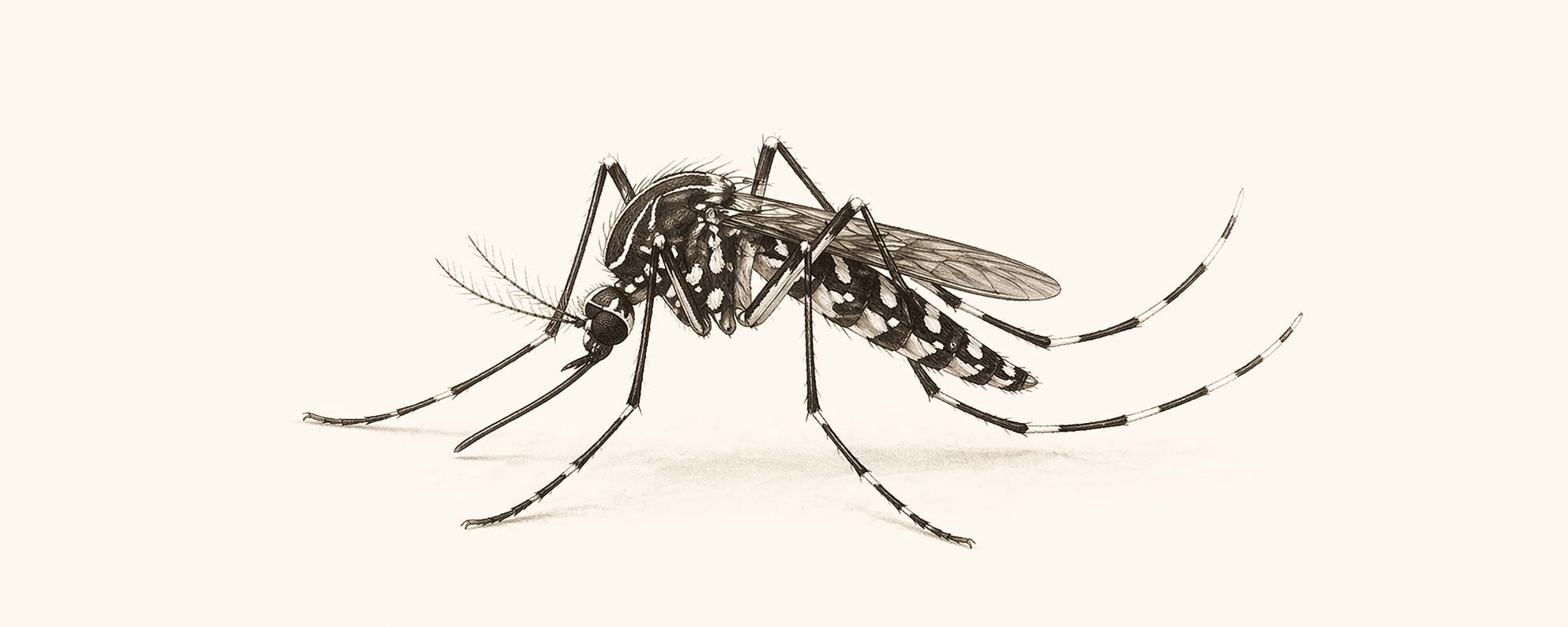
This is the species that changed the game. Endemic on the Riviera since the early two thousands, it has settled durably into the urban fabric. Small, dark, recognisable by its fine white stripes on the body and legs, it bites aggressively during the day, with activity peaks in early morning and late afternoon. It flies little, rarely beyond one hundred to one hundred and fifty metres from its birthplace: the source is therefore almost always in the garden, on the balcony or at the immediate neighbour's. It favours very small-volume breeding sites — a saucer, a fold of tarpaulin, the bottom of a vase — which makes it typically urban and domestic.
The culex (*Culex pipiens*)
The common mosquito, active from dusk to dawn. More discreet during the day, it announces itself by its nocturnal flight and that characteristic high-pitched sound near the ear that prevents sleep. It prefers stagnant water richer in organic matter: sanitation inspection chambers, water reserves, poorly maintained ponds, flooded cellars. It is the one that, in the evening, invites itself into bedrooms through a window left open.
A field diagnosis makes it possible to identify the dominant species from the nuisance hours and the breeding sites found, an essential condition for choosing the right treatment strategy.
The real risks: well-being, arboviruses, tourist image
A mosquito problem not treated as an emergency never remains a mere nuisance: it weighs on three fronts that must be faced squarely.
Daily well-being. Numerous bites ruin the very use of outdoor spaces. A terrace, a poolside, a garden that make all the value of a property in Monaco become unliveable during the most pleasant hours. Evenings retreat indoors, children no longer play outside, meals are cut short. For a high-end residence, this loss of use directly affects quality of life.
Arboviruses. The tiger mosquito is a potential vector of dengue, chikungunya and zika. It does not carry these viruses spontaneously: it must first bite an already-infected person, returned for example from a zone where these diseases circulate. But once the virus is acquired, the insect can transmit it locally. Autochthonous cases of dengue and chikungunya, contracted without travel, have been recorded in recent years in the nearby Alpes-Maritimes. Reducing the tiger mosquito population means reducing this risk of local transmission.
The tourist and hotel image. In Monaco, perception matters. A restaurant terrace where guests scratch themselves, a hotel room invaded at dusk, an open-air reception ruined by bites leave a lasting impression and get talked about. For hospitality and catering, controlling the tiger mosquito is now a matter of service quality on a par with cleanliness or comfort.
Why candles, ultrasound and consumer repellents fail
Faced with the first bites, the temptation is to multiply shelf solutions: citronella candle, ultrasound device, repellent spray. In the vast majority of cases, these responses disappoint, for precise reasons.
The citronella candle lacks power. Its real range is limited to a narrow halo around the flame, easily dispersed by the slightest draught. On an open terrace, it creates no effective barrier against a determined tiger mosquito that bites in broad daylight.
Ultrasound is scientifically ineffective. The devices supposed to repel mosquitoes with inaudible frequencies have never demonstrated any real effect in serious studies. The mosquito does not flee these sounds, and the device in no way reduces the population.
The individual spray does not treat the pressure. A skin repellent protects the person who applies it, for a few hours, and that is useful as a backup. But it does nothing against the larval breeding site from which new adults emerge every day. As long as the source produces, pressure returns as soon as protection fades.
The common point of these solutions: they attack the symptom, never the cause. Yet an established mosquito problem is solved by eliminating reproduction, not by pushing back one by one the insects already born. That is why a professional intervention always fits into a source-control logic: first the larvae, then only the adults if the emergency demands it.
The Monaco Pest Solutions intervention protocol in 4 steps
Our response to a mosquito problem in the Principality follows a four-step protocol, calibrated for the summer emergency and adapted to Monaco's built environment, rich in planted terraces, hanging gardens and ornamental water points.
Step 1 — Inspection of larval breeding sites (day 0). A certified technician travels within a reduced timeframe. He methodically searches for each laying site: pot saucers, clogged gutters, folds of tarpaulins, reserves and water butts, inspection chambers, air-conditioner drip trays, fountains and ponds. Each identified breeding site is mapped. This step is decisive: removing or treating the source is better than chasing the adults.
Step 2 — Biological larvicide treatment. Application of a larvicide based on Bacillus thuringiensis israelensis, known as Bti, on breeding sites that cannot be removed. This biological treatment has a major asset: it is selective to the targeted species. It acts on mosquito larvae without impact on bees, birds, fish or the non-target fauna that shares the garden. It is the heart of responsible control, compatible with an inhabited and planted environment.
Step 3 — Targeted adulticide if urgent. When an event approaches — a wedding, a reception, an open-air dinner — and the adult population is already established, a targeted adulticide treatment on the resting vegetation can be applied as a complement, in a localised and reasoned way, to make the terrace usable by the desired date.
Step 4 — Follow-up and prevention. A control return visit to measure the effect, adjust the treatment of residual breeding sites and hand the client a prevention plan adapted to their site. On an exposed garden or an establishment open to the public, this follow-up is part of a seasonal contract.
The whole is covered by our commitment to discretion: technician in neutral attire, unmarked vehicle on request, coordination with the concierge or staff according to the desired hours.
How long to get a peaceful terrace back: the timing
This is the question that comes up first on the phone: how long before you can enjoy the terrace again? Here are the honest benchmarks, with no commercial promise.
Within 24 to 48 hours: the impact of the larvicide is felt. Once the breeding sites are treated with Bti, the larvae stop developing into new adults. The source's production stops. The adults already born continue to fly for a few days, but no replacement takes their place.
Over 4 to 6 weeks: durable effect of the treatment. A larvicide application generally protects for four to six weeks depending on the weather, exposure and type of breeding site. A summer storm that refills dried-out sites, or the appearance of new containers, can shorten this window, hence the value of a maintenance visit.
Seasonal contract from April to October. The mosquito season on the Riviera runs in practice from May to October, with an ideal setup from April. For a villa with a garden, a restaurant with a terrace or a residence with water points, a seasonal contract with scheduled visits remains the only truly continuous protection all summer. It prevents pressure from rising again between two one-off interventions.
These timeframes apply to an intervention carried out at the first signs. A very established population, on a site with multiple breeding sites, may require two closely spaced visits before a terrace is fully peaceful again.
Concrete cases in Monaco
Three configurations regularly recur in the Principality and in the neighbouring communes. Each illustrates why a breeding-site inspection remains irreplaceable.
**Villa with garden in Cap-d'Ail. A family reports bites in the middle of the afternoon that make the garden unusable in July. Inspection: gutters blocked by leaves, holding stagnant water all along the façade, invisible from the ground. The source fed a tiger mosquito population without any apparent container being at fault. Clearing the gutters, larvicide treatment with Bti** on the residual points, and setting up a seasonal control plan. The garden became usable again within a few days.
**Restaurant terrace at Larvotto.* An operator calls in an emergency: guests complain of bites from the lunch service. Inspection: the decorative potted vegetation, heavily watered, left every saucer permanently full of water, offering dozens of small sites ideal for Aedes albopictus*. Removal of the saucers, revised watering instructions, treatment of the resting areas, and weekly follow-up in high season. The terrace regained its outdoor service.
Residence in Monte-Carlo with decorative fountains. Converging complaints from several occupants bothered in the evening. Diagnosis: ornamental fountains whose water circulation was cut off out of season offered stagnant bodies of water conducive to the culex. Restarting circulation, larvicide treatment of the ponds that could not be emptied, and discreet coordination with the residence manager. The nocturnal nuisance clearly receded.
These three cases share a common point: without a breeding-site inspection, none of these solutions would have been correctly prescribed, and the pressure would have returned within a few days.
After the intervention: active prevention
A mosquito problem resolved in an emergency calls for active prevention, week after week, to prevent the cycle from restarting at the first storm.
Empty every container each week. This is the most effective, and the simplest, action. Every saucer, bucket, watering can, toy, ashtray or dish likely to hold water must be emptied and turned over at least once a week. A weekly inspection of the garden and balcony is enough to deprive the tiger mosquito of most of its breeding sites.
Control the vegetation. Dense, over-watered vegetation retains moisture and offers resting areas to adults. Reasoned watering, airy foliage and the absence of full saucers under pots clearly reduce pressure.
Cover or circulate water points. Pools covered out of season, fountains and ponds kept in circulation, water reserves closed with a fine mesh: water that moves or is closed off no longer serves as a laying site.
Place copper in gutters and water butts. Regular gutter maintenance remains a priority to prevent water from stagnating. A wire or plate of copper in areas hard to empty limits larval development in residual water points.
Take out a seasonal follow-up. For a villa, a restaurant or an exposed residence, a contract from April to October with scheduled visits remains the best guarantee of a summer without nasty surprises. The documentation provided is usable for an establishment open to the public.
A mosquito problem now? Reach Monaco Pest Solutions in an emergency
Monaco Pest Solutions operates throughout the Principality and neighbouring communes, with expertise dedicated to the tiger mosquito and the culex throughout the summer season. Our technicians hold the Certibiocide N°121134, and the company is registered under RCI Monaco 26S10394.
Our commitments:
- Rapid response to any urgent intervention request, including before an open-air event.
- Complete inspection of larval breeding sites from the first visit, the heart of durable control.
- Biological Bti treatment, selective to the species, without impact on bees, birds and non-target fauna.
- Discretion: staff in neutral attire, unmarked vehicle on request.
- Seasonal contract from April to October for continuous protection all summer.
Is a mosquito problem already ruining your terraces? Our team responds fast and travels in an emergency in Monaco. Write to contact@monacopestsolutions.mc, dial +377 37 70 70 02, or make your **free quote request. For a situation that cannot wait, our 24/7 emergency** line remains reachable.
New-generation chemical-free traps
Complementing targeted treatments of larval breeding sites, we deploy new-generation traps that are highly effective and 100% chemical-free. Safe for children, pets and gardens, they integrate naturally into co-ownerships with green spaces, family villas and hotels with terraces. This technology completes our considered pest-management approach by further reducing the chemical footprint on Mediterranean biodiversity.
*mosquito guide · coverage areas in Monaco · prevention tips*
Frequently asked questions
- How long to get a mosquito-free terrace or pool back in Monaco?
- The impact of the Bti larvicide treatment is felt within 24 to 48 hours: the source stops producing new adults, even if the mosquitoes already born still fly for a few days. An application then protects for four to six weeks depending on the weather and exposure. For a terrace or poolside in Monaco exposed all summer, a seasonal contract from April to October with scheduled visits remains the only truly continuous protection, because a summer storm can refill dried-out breeding sites and restart the pressure. In an emergency before an event, a complementary targeted adulticide makes the space usable by the desired date.
- Are citronella repellents and candles really effective?
- As a backup only. A skin repellent protects the person who applies it for a few hours, which is useful occasionally, but it does nothing against the larval breeding site from which new mosquitoes emerge every day. The citronella candle creates only a narrow halo, dispersed by the slightest draught, with no real effect on an open terrace. As for ultrasound devices, they have never demonstrated effectiveness in serious studies. None of these solutions treats the cause: as long as the source produces, pressure returns. Only the removal of breeding sites and larvicide treatment durably solve a mosquito problem.
- Does the tiger mosquito transmit diseases in Monaco?
- The tiger mosquito (*Aedes albopictus*), endemic on the Riviera since the early two thousands, is a potential vector of dengue, chikungunya and zika. It does not carry these viruses spontaneously: it must first bite an already-infected person, often returned from a zone where these diseases circulate. Once the virus is acquired, the insect can transmit it locally. Autochthonous cases of dengue and chikungunya, contracted without travel, have been recorded in recent years in the nearby Alpes-Maritimes very close to Monaco. Reducing the tiger mosquito population around one's home directly diminishes this risk of local transmission.
- Are your treatments dangerous for my animals or plants?
- Our reference treatment is a biological larvicide based on Bacillus thuringiensis israelensis, known as *Bti*. It has the advantage of being selective to the targeted species: it acts on mosquito larvae without impact on bees, birds, fish or the non-target fauna that shares your garden, and without danger for pets or plants. This is what makes it a responsible solution, suited to the inhabited and planted gardens of Monaco. When a targeted adulticide is required in an emergency before an event, it is applied in a localised and reasoned way, on the resting areas only, with the usual precautions.
- Can I take out a seasonal contract for my villa or restaurant?
- Yes, and it is strongly recommended for any exposed site. The mosquito season on the Riviera runs from May to October, with an ideal setup from April. A seasonal contract provides scheduled inspection and treatment visits of the larval breeding sites throughout the summer, which prevents pressure from rising again between two one-off interventions. For a villa with a garden, a restaurant terrace or a residence with water points in Monaco, it is the formula that best guarantees a summer without nasty surprises. The documentation provided at each visit is usable for an establishment open to the public.
- How quickly can a technician travel to an emergency in Monaco?
- We handle any urgent request as a priority and a technician travels quickly to Monaco and the neighbouring communes, often the same day depending on the schedule load. The first visit includes the complete inspection of the larval breeding sites, the mapping of the sources and the appropriate larvicide treatment. In an emergency before an open-air event, a wedding or a reception, we adjust the schedule so that the space is usable by the desired date. For a situation that cannot wait, our 24/7 emergency line remains reachable, and a simple call to +377 37 70 70 02 triggers the assessment.