July 22, 2026 · 12-minute read
Tiger mosquito in a villa garden: prevention and breeding sites
Tiger mosquito in a Monaco villa garden: breeding-site audit, 100 % chemical-free new-generation traps and Bti on ponds. Lasting prevention for a Mediterranean garden with children and pets.
Why a villa garden is the tiger mosquito's ideal terrain
Spraying without results? That is normal. Along the Riviera, from Cap-d'Ail to Menton, 90 % of tiger-mosquito work lies in removing breeding sites — and seven of them almost always escape even an attentive owner's inspection. The tiger mosquito villa garden Monaco problem is not a problem of missing insecticide: it is a problem of forgotten standing water.
A Mediterranean villa garden gathers, without anyone intending it, everything Aedes albopictus needs to thrive. A lawn watered each morning, flowering beds, a pool, one or two ornamental water features, terracotta pots resting on their saucers, the cool shade of olive trees and oleanders, and above all a family out in the garden from dusk onward. The paradox is simple: the more beautiful, watered and alive a garden is, the more welcoming it becomes for the tiger mosquito. It is precisely in the best-kept properties, where watering is generous and the beds are dense, that we find the most stubborn infestations.
The reason lies in the insect's biology. Unlike the common mosquito, which travels long distances, the tiger mosquito is sedentary: it is born, bites and lays within a radius of a few dozen metres. In other words, if it bites you on the terrace, it developed in your garden, not next door. That is good news. It means most of the solution is in your hands, on your own plot, provided you identify the right sources.
Aedes albopictus: biology of a daytime, sedentary mosquito
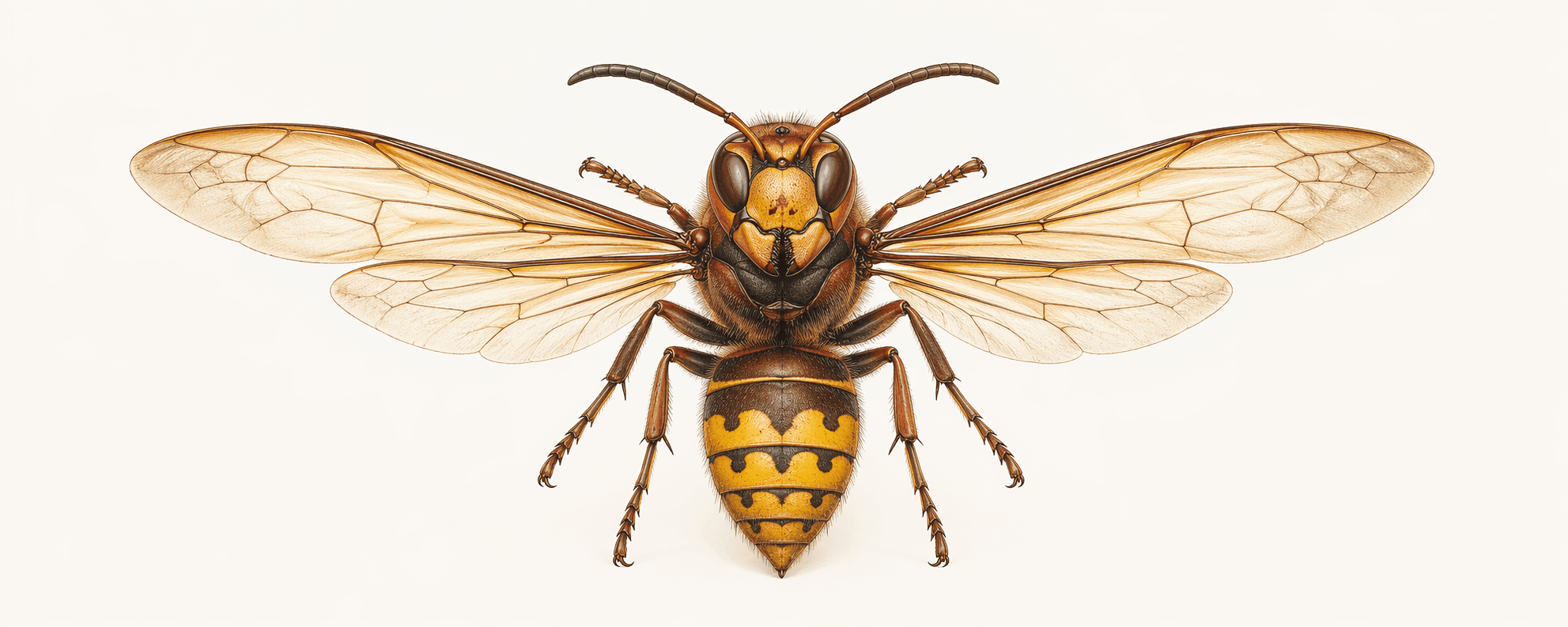
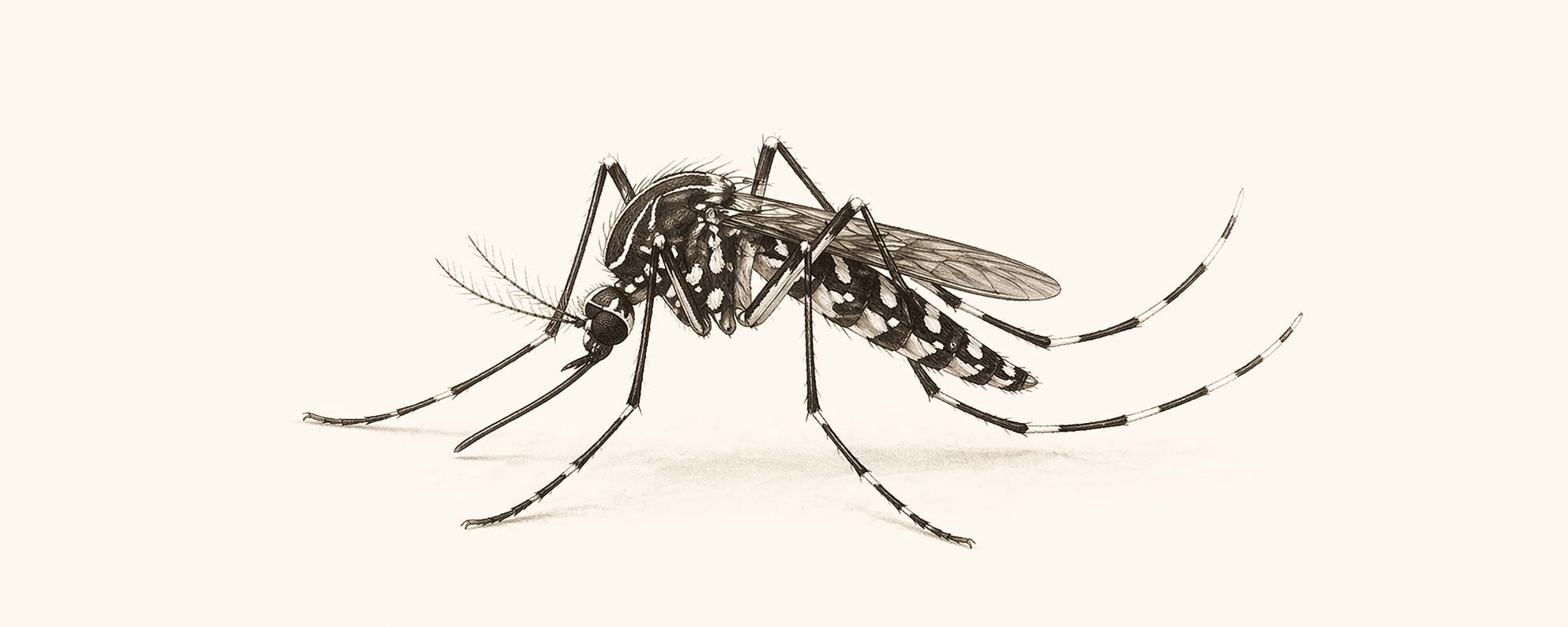
Understanding the Aedes albopictus Mediterranean garden means understanding why the reflexes inherited from the common mosquito do not work against it. This mosquito, recognisable by its black-and-white stripes and small size, has several traits that dictate the whole prevention strategy.
First, it bites by day. The common mosquito is mostly active at night; the tiger attacks in broad daylight, with two peaks of aggression in late morning and late afternoon. That explains why a family gets bitten around the pool at midday or during a five o'clock drink, just when no one is thinking about mosquitoes yet.
Next, its reproduction depends on water, but not just any water. The female does not lay in the water: she lays above the waterline, on the damp walls of a container, just above the level. The barely visible eggs withstand desiccation for months. A single rain, watering or refill is enough to raise the water, drown the eggs and trigger hatching. The larvae then develop in just a few days in the heat: from egg to adult mosquito can take barely a week in high summer. A saucer emptied then forgotten for three days can thus produce a fresh generation of biters.
Finally, the tiger needs very little water. Where the common mosquito seeks ponds, the tiger makes do with the bottom of a saucer, a fold in a tarpaulin, a bottle cap or the hollow of a toy left in the grass. A volume no larger than a coffee cup is enough to produce dozens of larvae. It is this frugality that makes the tiger mosquito villa garden Monaco so hard to eradicate by spraying alone: you treat the leaves where the adults rest but leave intact the micro-reservoirs where the next generation is born. To go further into the species' behaviour and identification, our dedicated page on the tiger mosquito details its distinctive signs.
The specific breeding sites of a villa garden
This is where it all plays out. A serious audit means combing the garden to list every point where water can stagnate for more than three or four days. In a villa with a large garden, these sources fall into clearly identified families, and each calls for a different response.
Saucers under pots are breeding site number one, by far. Every flowerpot, every planter, every potted olive on its saucer holds water after watering or rain. Multiplied by the dozens of containers in a well-kept garden, these reservoirs become a genuine nursery. The rule is simple: remove the saucers where possible, fill them with sand to protect the terrace, or empty and scrub them twice a week. Scrubbing matters as much as emptying, because eggs stuck to the wall survive a mere tipping-out of water.
Gutters and drains form the second front, the most insidious, because they are invisible from the ground. A gutter clogged with olive leaves or pine needles no longer drains: it forms a run of stagnant pools up high, out of sight, where the tiger lays undisturbed. Drainage points, gullies and courtyard traps hide the same surprise. Checking the roof and downpipes at the start and mid-season is essential in a villa.
Automatic watering and water storage form the third family. Rainwater butts, tanks, watering cans forgotten at the back of the vegetable plot, misters, the gardener's buckets, furniture covers that sag into a bowl: any container that receives and holds water is a potential site. Rainwater collectors must be covered with a fine, airtight mesh. Covers must be stretched taut or pierced so they form no pockets.
Ornamental water features and the amenity pond call for special attention, because you cannot simply empty them. A fountain, a lily pond, a water mirror or a decorative basin are the soul of a Mediterranean garden, but they become a problem as soon as the water goes stagnant. A pond where the water moves, filtered or stirred by a pump, and above all stocked with fish that devour larvae, is rarely a breeding site. An abandoned pond, with no movement or predator, almost always is.
The pool itself is rarely the problem when it is in service: chlorine and filtration prevent any larval development. The danger comes from the cover. The winter or safety cover holds rainwater on its surface, in its folds, and that stagnant film becomes one of the property's biggest breeding sites. Tiger-mosquito prevention around pond and pool is therefore less about treating the pool itself than about managing what surrounds it: the cover, the plant room, the footbath, hollow coping and the overflow.
The family audit: thinking of children and pets
In a villa lived in by a family, the audit cannot stop at a technical list of containers. It must take in the garden's real uses, because those create the most unpredictable sites. A child's toy left in the grass, a sandpit bucket, a half-deflated paddling pool, a slide whose base holds water, a scooter lying down: each of these everyday objects becomes a micro-reservoir after rain.
Pets bring their own sources. The dog's water bowl left outside, the hens' drinker, the cat's dish on the doorstep, the bottom of a kennel: all points of water renewed for the animal but exploited by the mosquito between two refills. The instruction here is to change the water every day rather than top it up.
This family audit has a second, equally important dimension: the safety of the chosen solution. When children play barefoot in the grass and pets rummage through the beds, dispersing residual insecticides over the vegetation and soil becomes unacceptable. The choice of method is therefore not only a question of effectiveness but of responsibility toward those who live the garden every day. It is this observation that guides our entire approach.
New-generation traps: 100 % chemical-free
This is our strongest commitment and the centrepiece of our system: we deploy new-generation traps that are 100 % chemical-free, harmless to children, pets and the garden. Where spraying strikes indiscriminately at everything that flies or crawls and leaves residues where people live, attractive trapping does exactly the opposite: it targets the biting female, and nothing else.
The principle imitates the signals that, in nature, guide the female to a host. A calibrated plume of carbon dioxide reproduces a mammal's breathing and draws females in from several dozen metres. A source of gentle heat and a slight humidity finish convincing her she is approaching real skin. Olfactory lures, sealed inside the device, reproduce body odour. Once in contact, the female is drawn in by a downward airflow and held in a capture grid. Night after night, day after day, the trap intercepts females before they bite and, above all, before they lay: every female captured is an entire lineage that will never see the light.
The decisive advantage in a family villa is total harmlessness. The trap leaves no residue on the lawn, the beds or the coping. Children can play, pets can roam and you can pick your herbs with no particular precaution. The garden's beneficial biodiversity — bees, butterflies, ladybirds, geckos, hedgehogs — is spared, because the device specifically attracts the mosquito and not pollinators. We detail the workings and use cases of this technology in our guide to chemical-free mosquito traps.
Placed methodically at the garden's strategic points — downwind of living areas, at the edge of shady beds from which mosquitoes emerge, away from where people gather so as not to draw the insect toward guests — these traps drive down biting pressure week after week. The effect is gradual, not instant: it often takes two to three weeks to exhaust the local population, but the result is lasting because it strikes at the engine of reproduction, not just the adults of the moment.
Bti: treating ponds and water features without harming aquatic life
Some breeding sites can neither be removed nor drained: an amenity pond, a water mirror, a technical reserve, a drain that stays damp. For these situations, tiger-mosquito prevention around pond and pool relies on a remarkable biological ally: Bti, or Bacillus thuringiensis israelensis.
Bti is a bacterium naturally present in soils, whose larvicidal power is used in a targeted way. Ingested by mosquito larvae that filter the water, it blocks their digestive system and halts their development before they become adults. Its great quality lies in its specificity: Bti acts on mosquito larvae and a few related flies but spares fish, amphibians, dragonflies, bees and the pond's entire fauna. An ornamental water feature stocked with fish can therefore be treated without endangering its balance.
Applied at the right dose and renewed according to the hatching rhythm, Bti turns a problem pond into a neutralised site while preserving its aesthetic and ecological role. It is the natural complement to trapping: the trap intercepts flying adults, Bti sterilises the incompressible aquatic sources. This combination covers both ends of the cycle without ever resorting to a synthetic insecticide scattered through the garden.
Coordinating gardener and pest control: the key to a large garden
In a villa with a large garden, often over five hundred square metres, grounds upkeep and mosquito control cannot be run in silos. The gardener and the pest-control operative act on the same ground, with actions that constantly interact. A poorly set irrigation system that leaves permanent puddles at the foot of a bed cancels the benefit of an audit. Conversely, an informed gardener becomes prevention's best ally.
Coordination means folding mosquito control into routine upkeep. Cleaning gutters and drains goes into the gardener's calendar. Watering is reviewed to avoid zones that never dry. Saucers are removed or filled with sand when pots are set out. Water stores are covered with mesh at each installation. Equipment — watering cans, buckets, covers, tubs — is stored upside down or under shelter so nothing fills up.
On our side, we map the breeding sites, position and maintain the traps, apply Bti to the incompressible water points, and hand the gardener a list of watch-points suited to the season. This collaboration is what distinguishes a lastingly protected villa from one that relapses every summer. The garden is a living system: you do not master it with an isolated intervention but with a shared routine.
Field experience: Riviera villas with large gardens
On the Riviera's large properties, one pattern recurs steadily. The owner first multiplied the sprayings, sometimes several times a month, with brief relief followed by a systematic return of the nuisance. The reason is always the same: the source was never treated, only the adults visible at that instant.
The audit changes everything. On a villa with a garden of more than five hundred square metres, we routinely list twenty to forty active or potential sites, the vast majority of which come down to invisible details: a gutter blocked in a roof corner, a chain of saucers behind the hedge, a fold in the pool cover, the bottom of an abandoned decorative pond, an uncovered rainwater collector at the back of the vegetable plot, a pet bowl never emptied. Once these sources are removed or neutralised, the population collapses. Trapping takes over to catch the residual adults and the females coming from the property edges.
The contrast, after a few weeks, is stark: a terrace becomes usable by day again, a pool can be enjoyed without being bitten, an evening dinner is no longer interrupted by mosquitoes. And above all, that result is achieved without a gram of insecticide scattered where children play and pets roam. The families who live in these gardens immediately measure the difference between a lingering chemical smell and a garden simply made liveable again. If the situation is already established and felt as urgent, our guide on what to do about a mosquito problem in Monaco sets out the first reflexes to adopt without delay.
Our method and our commitments
Our approach to the tiger mosquito villa garden Monaco comes down to one sentence: remove the cause before treating the symptom. Concretely, it unfolds in four stages. A full audit of the property first, mapping every site, from saucers to gutters, from pond to pool cover. Then removal or neutralisation of the sources, with Bti for the incompressible water points. The deployment of new-generation traps that are 100 % chemical-free to intercept females and durably drive down biting pressure. Finally, seasonal follow-up coordinated with the gardener, because a garden evolves and a site can reappear.
This environmental commitment is not a side argument: it is the heart of our trade. We refuse the reflex of systematic spraying because it destroys the garden's biodiversity and exposes those who live in it, for a fleeting result. We prefer a targeted, biological and mechanical fight that respects the balance of the place. Our interventions rest on certified expertise, Certibiocide N°121134, a guarantee of compliant, controlled use of biocontrol products and methods.
Every garden is different, in its size, exposure, water features and the family's uses. That is why we draw up a personalised diagnosis before any intervention. To obtain an assessment suited to your property, request your free quote: we study your garden, identify its specific breeding sites and propose a lasting prevention strategy, with no chemical scattered about, designed so your family and your pets can fully enjoy their garden all summer.
Frequently asked questions
- Why isn't insecticide spraying enough against the tiger mosquito in my garden?
- Because it only hits the adults present at the time of treatment, on the leaves where they rest, without touching the source. Yet 90 % of the fight is decided at the breeding sites: the micro-reservoirs of water where the female lays her eggs. As long as those sites stay active, a new generation emerges within a week and the nuisance returns. Spraying brings relief for a few days, then the infestation rebuilds. That is why we always start with an audit and the removal of breeding sites before any trapping.
- Are mosquito traps safe for my children and pets?
- Yes, completely. Our new-generation traps are 100 % chemical-free: they leave no residue on the lawn, the flower beds or the pool coping. The device attracts females with CO2, gentle heat and body-odour lures sealed inside the unit, then captures them mechanically. Children can play barefoot, pets can roam the beds and you can pick your herbs with no special precaution. It is precisely for this safety that we favour this method in family gardens.
- How can I protect my ornamental pond and pool without harming aquatic life?
- For a pond stocked with fish or a water feature that cannot be emptied, we use Bti, a biological larvicide derived from a natural soil bacterium. It destroys mosquito larvae but spares fish, dragonflies, amphibians and bees. For the pool, the real breeding site is almost never the chlorinated, filtered water, but the cover that traps rainwater in its folds, the plant room and hollow coping stones. Prevention therefore means managing the water that stagnates around the pool rather than the pool itself.
- Which breeding sites are most often overlooked in a villa garden?
- The seven most commonly missed are: saucers under pots and planters, blocked gutters and drains up high, the folds of the pool cover, uncovered rainwater butts, abandoned ornamental ponds with no movement or fish, pet bowls that are never emptied, and hollow toys or objects left in the grass. What all these sites share is that they escape the eye: they are up high, hidden behind a hedge, or so ordinary that no one links them to mosquitoes. Listing them one by one is exactly what the audit is for.
- How long before the garden becomes liveable again?
- Once the breeding sites are removed, the population collapses within a few weeks, because no new generation renews it. Trapping then takes over to catch residual adults and females drifting in from the property edges; its effect is gradual and usually needs two to three weeks to exhaust the local population. The result is lasting because it targets the engine of reproduction, not just the current adults. In a large garden, seasonal follow-up then maintains that level of comfort all summer.
- Why coordinate the gardener and the mosquito-control specialist on a large property?
- Because they work on the same ground with actions that constantly interact. A poorly set irrigation system that leaves permanent puddles cancels the benefit of an audit, whereas an informed gardener becomes prevention's best ally. Coordination folds mosquito control into routine upkeep: clearing gutters, adjusting watering to avoid zones that never dry, removing saucers, covering water stores, storing equipment out of the rain. In a garden over five hundred square metres, this shared routine is what separates a lastingly protected villa from one that relapses every summer.