
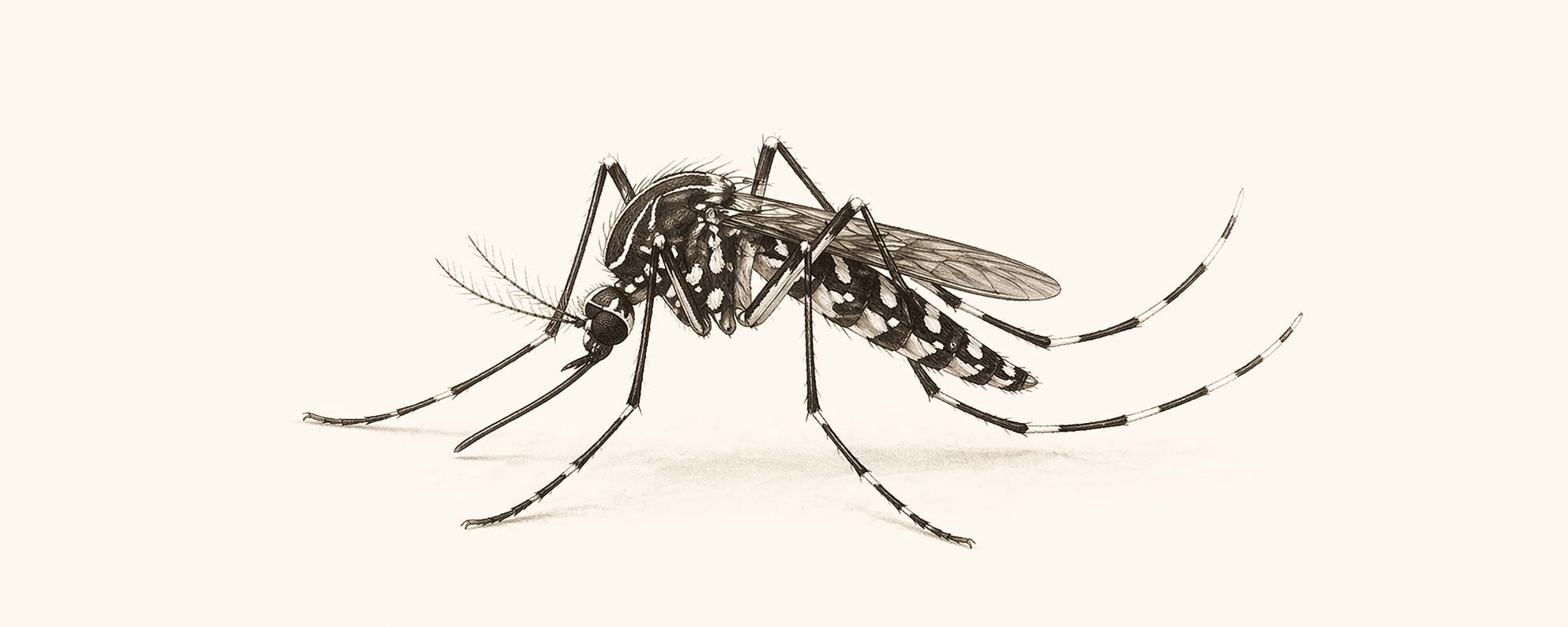
Identifying the tiger mosquito: the signs that never lie
Aedes albopictus stands out clearly from the common mosquito (Culex pipiens) through several visual and behavioural markers.
- Physical appearance: small size (about half that of a classic mosquito), a deep black body striped with sharp white bands, a single clear white line on the thorax, legs ringed with white at their tips.
- Biting behaviour: aggressive in broad daylight, with two activity peaks at sunrise and sunset. It bites at the ankles, calves and elbows, often in a cluster of closely spaced bites.
- Flight: silent, low, fast, which makes it hard to spot before the bite.
The indirect signs are just as telling: the presence of thread-like larvae that writhe vertically in pot saucers, vases, blocked gutters, forgotten buckets or air-conditioner drip trays. On a Larvotto terrace or a La Condamine patio, it is enough to turn over two or three pots to confirm that a breeding site has established itself.
If your guests complain of bites in the middle of the afternoon when no itching appeared two summers earlier, the presence of Aedes albopictus is likely.
Health and material risks
The tiger mosquito is classified as an invasive species of concern by the French and Monégasque health authorities. Three levels of risk coexist.
Health: it is a potential vector of dengue, chikungunya, Zika and yellow fever. It only transmits these diseases if it has previously bitten an infected person, but locally acquired cases have been identified on several occasions on the Côte d'Azur in recent years. The bites also cause marked skin reactions — a hot red patch, tenacious itching that can last several days — and severe allergic reactions in susceptible people, notably young children.
Operational impact: for a hotel, a terrace restaurant in Fontvieille, a beach club or a yacht moored at Port Hercule, the nuisance empties the outdoor spaces from dusk and weighs directly on customer satisfaction.
Regulatory framework: in France, tiger mosquito surveillance falls to the les autorités sanitaires françaises and is the subject of a national plan. In Monaco, the Directorate of Health Action provides comparable monitoring. Co-ownerships and landlords have a general safety and sanitation obligation that includes controlling larval breeding sites in the common areas.
Why this pest thrives in Monaco and on the Riviera
The Principality and its hinterland tick every box for an ideal habitat for Aedes albopictus.
- Warm, humid Mediterranean climate: the mild temperatures from April to November, combined with sustained humidity, extend the activity season to seven or eight months. A mild winter is now enough to preserve some of the eggs, which resist desiccation.
- Vertical urban density: Monte-Carlo, La Condamine and Beausoleil concentrate flowered balconies, hanging window boxes, watering saucers and drip irrigation systems — so many micro-breeding-sites rarely inspected.
- High-end residential fabric: the villas of Cap-d'Ail, Cap-Ferrat and Roquebrune-Cap-Martin combine infinity pools, decorative fountains, ponds, automatic watering and shaded pool houses. Each unmaintained body of water becomes an incubator.
- Premium commercial sector: restaurants with wooded terraces, hotels with enclosed gardens, yachts at Port Hercule with covers and holds retaining rainwater.
Five millilitres of standing water is enough for a female to lay her eggs. A saucer forgotten under a potted olive tree becomes, within ten days, an active nursery.
The MPS protocol in five steps
Our intervention follows a structured method, consistent with the principles of integrated pest management that MPS (RCI Monaco 26S10394) applies systematically.
- Complete plot-by-plot diagnosis: methodical inspection of each outdoor and indoor area (laundry rooms, basements, ventilated stairwells), mapping of active and potential larval breeding sites, discussion with the caretaker or household staff to reconstruct the history.
- Mechanical elimination: systematic emptying of saucers, unblocking of gutters, turning over or covering of containers, drainage of residual water areas. This is the most cost-effective step, and often the most neglected.
- Biological larvicide treatment: targeted application to bodies of water that cannot be removed (ornamental ponds, technical reservoirs) with products based on Bti (Bacillus thuringiensis israelensis), selective and without impact on non-target wildlife.
- Residual adulticide around the perimeter: reasoned spraying on the identified resting areas (hedges, undersides of furniture, shaded foliage) with authorised biocides, applied at the minimum effective doses.
- Check and certification: a verification visit, a detailed intervention report, a personalised prevention plan handed over in person or by secure email.
All our interventions are carried out by a Certibiocide N121134 technician and covered by a systematic NDA.
Mistakes to avoid
The fight against the tiger mosquito has generated a parallel market of marketing solutions whose real effectiveness varies greatly. A few classic traps.
- Citronella candles: a very localised ambient repellent effect, no action on the population. Useful for a one-off dinner, useless for treating a breeding site.
- Electric anti-mosquito plug-ins: designed for the nocturnal Culex, they miss Aedes albopictus, which bites by day outdoors.
- Consumer CO2 traps: they can capture a few individuals but cannot rival the reproduction rate of an untreated breeding site.
- Manual spraying of household insecticides: rarely correctly dosed, often applied to the wrong surfaces, it creates resistance and gives a false impression of resolution.
- Treating only the adults: without destroying the larval breeding sites, the population reconstitutes itself within one to two weeks.
The cardinal mistake remains underestimating the inspection: a single forgotten saucer behind an olive-tree planter can re-feed a whole garden.
Typical Monaco case
At the end of June, a private residence in the heights of Roquebrune-Cap-Martin contacts us: the owners can no longer dine on the main terrace after 6 pm, despite the intensive use of candles and sprays. The diagnosis reveals a classic accumulation: a gutter blocked by pine needles retaining three centimetres of water since the last rains, saucers under about ten citrus pots, a decorative pond with a faulty filter, and a pool-furniture cover forming an invisible pocket of water.
Our technician empties and cleans the whole lot, applies a Bti larvicide to the pond, and sprays a residual adulticide on the identified resting areas (laurel hedges, the underside of the pergola). A check carried out eighteen days later confirms the absence of new larvae. A monthly maintenance plan is proposed to the household staff for the season. Outdoor meals resume from the following week.
Lasting prevention
Without weekly discipline, no treatment holds over time. The habits that really count.
- Empty every week all saucers, watering cans, buckets, outdoor toys and terrace ashtrays.
- Clear the gutters at least twice a season, more on properties bordered by pines or olive trees.
- Cover watertight the rainwater butts and storage drums with fine mosquito netting.
- Maintain the ponds: keep the water circulating, introduce larva-predator fish (mosquitofish) where the layout allows.
- Treat the drainage chambers and terrace traps with a monthly Bti larvicide.
- Check covers and furniture: fold away the tarpaulins, turn over the chairs, avoid any point of water retention after rain.
On large properties, a seasonal MPS follow-up contract (April to October) organises these checks for you, with complete traceability.
How long, how many visits
A standard intervention on a villa with a garden or a co-ownership takes half a day on site, including diagnosis, mechanical treatment, larvicide and adulticide. The drop in pressure is generally noticeable within five to seven days; a stable resolution takes two to three weeks, the time for the larval cycle of the eggs already laid to run its course without a new viable generation.
For a moderate residential breeding site, an initial visit followed by a check is enough in the vast majority of cases. For a high-pressure commercial site (a hotel with a large garden, a restaurant on a wooded terrace), a plan of treatments spaced across the season is more appropriate. Our seasonal contracts typically include four to six visits between April and October.
In any doubt? Our team responds within 2 working hours. +377 37 70 70 02 — or [request a free quote](/devis-gratuit).
When you are facing a mosquito problem in Monaco, the first 24 hours shape everything that follows: our emergency guide details the immediate steps, the realistic resolution timeline and how a professional intervention unfolds.