July 7, 2026 · 10-minute read
Tiger mosquito in Monaco: what to do before summer
Aedes albopictus is now endemic on the French Riviera. Before temperatures trigger the breeding season, here are the actions that do 90% of the work — and…
Why 2026 will be another season to watch
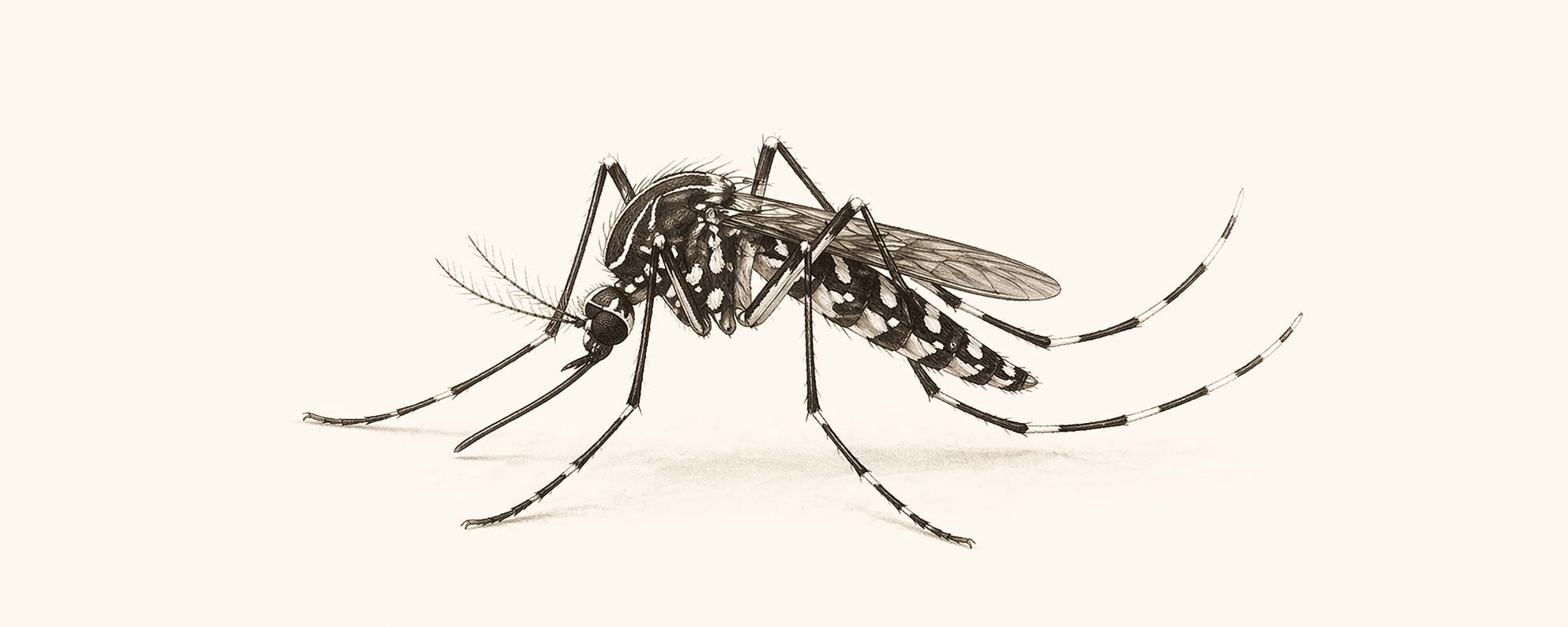
The tiger mosquito (Aedes albopictus) has been established in the Alpes-Maritimes since the early 2000s. Its spread across the Monaco — Cap-d'Ail — Beausoleil — Èze — Beaulieu-sur-Mer arc follows a simple logic: the more small pockets of stagnant water there are, the more mosquitoes. A flowerpot saucer, a clogged gutter, a bucket left out in a garden — every body of water can produce several hundred larvae in a week.
The season on the French Riviera typically starts between late March and early May, as soon as night-time temperatures stay above 10–12 °C, and continues until the first frosts (a rare event in Monaco).
The actions that do 90% of the work
The fight against the tiger mosquito is won almost entirely through the elimination of larval breeding sites — not through spraying. Here are the spots to check at home, in your garden or in the common areas of your building:
- Flowerpot saucers and dishes: empty once a week, or fill with sand.
- Gutters and eaves troughs: clean every spring. A gutter clogged with leaves holds water and turns into an ideal breeding site.
- Manholes, gullies, siphons: inspect them; garden manholes can be treated with biological Bti-based larvicides.
- Tyres, toys, buckets, tarpaulins: anything capable of holding 1 cm of water for 7 days must be turned over, emptied or covered.
- Ornamental ponds: where possible, introduce fish (mosquitofish, golden orfe) that feed on larvae.
- Rainwater collectors: fit a lid or a fine mesh screen to the outlet.
When should you call in a professional?
Professional intervention becomes worthwhile in the following cases:
- You manage a residential building or a hotel with outdoor areas accessible to many residents and cannot guarantee a weekly audit of breeding sites.
- You notice an abnormally high density of mosquitoes despite the apparent removal of breeding sites: a hidden focus (manhole, pit, high-level gutter) is almost certainly at play.
- You are hosting an outdoor event (wedding, reception, hotel season opening) and want to reduce mosquito pressure over a specific window.
Our three-step protocol: a full audit of the property, biological treatment with Bti (no impact on other organisms), and — only as a last resort — targeted adulticide fogging in confirmed resting zones.
What we do not do
We do not routinely spray gardens "as a preventive measure" at the start of the season. This practice, still common among some operators, wipes out pollinators as well as mosquitoes and encourages insecticide resistance among the survivors. Our method always starts by removing the cause before treating the symptom.
*Do you live in Monaco or a neighbouring town and would like an audit before the season? Request a free quote — we come out promptly.*
The questions our clients ask most
How long does the intervention take? On average 90 minutes for an audit + 2 to 4 hours for a standard treatment in a flat or a villa. For complex sites (palace hotels, restaurants in operation, multi-stairwell buildings), the intervention can be split across several night-time slots to accommodate your activity. The schedule is always agreed in advance, never imposed.
Is the space quickly usable again? For the vast majority of our treatments (bait gel, dry steam, mechanical installation), re-occupation is immediate or after 1 to 2 hours of ventilation. For approved residual treatments, we systematically state the recommended waiting time (typically 2 to 4 hours). For aerosol biocides, the waiting time rises to 6 hours and we issue a re-occupation certificate.
Which legal documents and certificates do you issue after the intervention? After every intervention, you automatically receive in your client portal a signed digital report with before/after photos, a treatment certificate that stands up to audits, safety commissions and insurers, and an updated register of the biocides applied (exportable at the request of the French and Monegasque health authorities).
Is there follow-up after the intervention? Yes, systematically. Depending on the service, a follow-up visit is scheduled at D+7, D+14 or D+21 based on the biological cycle of the species treated. Under 360° monitoring contracts, follow-up is continuous, with quarterly reports and immediate response to any alert you raise.
The cost compared with doing nothing
An untreated infestation typically costs ten times more in curative treatment than in preventive action. A few concrete examples from the French Riviera:
- An Asian hornet primary nest destroyed in April:à chiffrer–250. The same nest at the secondary stage (August):à chiffrer–1,200. The same colony wiping out a nearby apiary: thousands of euros of loss for the beekeeper + biodiversity impact.
- A palace hotel room closed for 72 hours for an in-season bed bug treatment:à chiffrer,400 of lost revenue + reputational damage. The same incident detected pre-season:à chiffrer of treatment, zero operational impact.
- A premium gastronomic restaurant kitchen closed for 5 days by a safety commission over cockroaches: >sur devis,000 of lost revenue + risk of an HACCP downgrade. An annual 360° contract:à chiffrer,800–3,500.
- A residential building that discovers an advanced longhorn beetle infestation:à chiffrer,000–50,000 of repair works + curative treatment. A preventive acoustic diagnosis every 5 years:à chiffrer per visit.
The rule is universal: an audit always costs less than a repair.
Our environmental commitment
All our protocols are designed to minimise the impact on Mediterranean biodiversity. In concrete terms, that means: refusing routine preventive spraying, selecting the biocides with the most favourable environmental profile in their category, giving priority to mechanical and biological methods whenever available, protecting non-target species (bees, geckos, hedgehogs, insectivorous birds, bats), and keeping an up-to-date, exportable register of the biocides applied for the authorities.
We also commit to explaining these choices to our clients. Integrated pest management is not a marketing line — it is a discipline that demands time for diagnosis and explanation. On sites where a request for "preventive spraying without diagnosis" is put forward, we systematically propose an alternative: monitoring, audit, targeted treatment of proven risk zones.
For professionals: regulatory compliance
Our documentation is designed to make audits by your quality partners straightforward. Our intervention reports are compatible with the international hotel rankings, the independent luxury hotel alliances, the high-end hotel groups and hôtels de luxe indépendants standards in hospitality, and with third-party certification bodies and an environmental certification body audits in catering and the food industry. The biocide register complies with the French decree of 28 June 2017 and European the European framework on professional biocides.
For charter yachts, our documentation is translated into English and accepted by the main management companies (the leading yacht management groups, the leading yacht management groups, the leading yacht management groups). A contractual NDA is standard. No establishment, owner or yacht name appears in our external communications.
The culture of premium service
Our technicians come from the 5-star service sector, from yachting and from prestige hospitality. This culture of discretion and premium service is our signature. No resident client should ever see a technician in a "pest control" uniform. No identifying photograph ever leaves our perimeter. No yacht name, no client name, no identifying detail appears in our external communications.
This stance is not a commercial argument — it is a contractual obligation to our high-end clientele. And it is the standard we apply to private clients too, because premium service is defined by consistency, not by intermittence.
Practical printable checklist
For professionals who want to run the first line of defence themselves, here is a checklist of 10 concrete points to apply each month on your site, with the aim of detecting issues as early as possible — before the infestation becomes visible and costly:
- Visual inspection of mattress seams in 2 randomly selected rooms per floor (5 minutes per room).
- Check the seals of walk-in cold rooms in the kitchen. Any damaged seal must be replaced immediately.
- Check the skirting boards at the foot of beds and the electrical sockets on the bedside. Photograph any anomaly.
- Inspect laundry bags in the laundry room. Linen must never sit open for more than 4 hours.
- Audit of flowerpot saucers on terraces and balconies (tiger mosquito breeding sites). Empty weekly.
- Check gutters and rainwater downpipes. Any blockage creates a breeding site.
- Inspect technical spaces (boiler rooms, refuse rooms, crawl spaces). Look out for any trace of droppings.
- Check the state of the bait stations in place. Station number + photo + inspection date.
- Inspect attics, green terraces and roof access points. Detect primary hornet nests before June.
- Monthly briefing of department heads: one sign spotted in time is worth a thousand curative interventions.
Getting in touch to go further
For clients on a 360° contract, this checklist is built into your client dashboard and automatically feeds into your quarterly report. For one-off clients, on request we offer a one-hour on-site training session for your housekeepers, department heads or in-house technicians — free of charge for clients on an annual contract.
All our contracts include 24/7 access to our proprietary digital platform, where you can retrieve at any time the full history of your interventions, before/after photos, treatment certificates, the biocide register and the safety data sheets (SDS) of the products used. Documents can be downloaded as many times as needed for your audits, commissions and insurers.
For emergencies (hornets near a terrace, suspected bed bugs in an open hotel, cockroaches in a professional kitchen), we commit to a swift call-back, 7 days a week, with rapid intervention where possible. +377 37 70 70 02.
Mid-August 2026 update: why vigilance is still critical
Summer 2026 confirms the trend of previous years: the tiger mosquito is now a permanent resident across the entire Côte d'Azur. France's Directorate General of Health (DGS) has classified Monaco and Alpes-Maritimes as an active dengue virus circulation zone since 2019, with several autochthonous cases confirmed in 2023-2025 in the department. Extreme July-August 2026 temperatures (34-38°C) accelerate the larval cycle: from 10-15 days in May to only 4-7 days currently.
Concretely, a flower pot saucer left forgotten during 3-week holidays has produced 3 complete generations of mosquitoes. Multiply by the number of balconies/terraces in a condominium = nuisance peak as soon as residents return.
Return from holidays: the 15-minute checklist
Coming back from holidays? Immediately do this walkthrough:
- Empty all saucers under flower pots, including under elevated planters
- Turn over buckets, watering cans, empty pots stored on balcony/terrace
- Check gutters — leaves + stagnant humidity = giant larvarium
- Check balcony drainage inlets (often blocked by debris)
- Empty outdoor sink traps rarely used (barbecue, laundry)
- Check inflatable children's pools stored and pool covers loose
- Check rainwater collectors — lid well screwed, anti-mosquito mesh
- Treat decorative fountain with anti-larval tablet if present
A villa with garden in Cap-Ferrat or Beaulieu can contain 15-25 larval sites if no control has been done during 3 weeks of absence.
MPS tiger mosquito professional treatment
Our 3-step protocol:
1. Larval site diagnosis (2h average villa) Systematic inspection of all possible water points (garden, terraces, balconies, outdoor kitchens, laundries). GPS mapping of identified sites. Action recommendations at D+0 to eliminate existing sites.
2. Biological larvicide treatment For water points that cannot be eliminated (collector, fountain, decorative basin): application of **Bacillus thuringiensis israelensis (Bti)**, biological larvicide non-toxic to humans, animals, fish, bees. Efficacy 4-6 weeks per application.
3. Targeted adulticide + traps Residual spray on adult resting zones (under foliage, under garden furniture) with Certibiocide biocides + installation of **discreet CO2 mosquito traps** on frequented terraces. Reduction of adult individuals by 70-85% in 2 weeks.
Cost of an intervention in Monaco
The package varies according to surface (60m² apartment with balcony vs 500m² villa with garden), number of detected sites and desired recurrence (one-off intervention vs May-October seasonal contract). Transparent quote within 24h after first phone exchange. No price displayed on site — every situation is different.
Priority Monaco and Riviera zones
Monte-Carlo (high-end real estate with suspended gardens), Larvotto (seafront residences), Jardin Exotique (residential zones), Fontvieille, Cap d'Ail, Saint-Jean-Cap-Ferrat (large garden villas), Roquebrune-Cap-Martin, Beaulieu-sur-Mer.
Related resources
- Tiger mosquito — complete pest page
- Mosquito problem Monaco emergency
- Mosquito traps without biocide 2027
- Villa garden pool mosquito audit
*Monaco Pest Solutions, Monaco-based company Certibiocide N°121134, tiger mosquito specialist in the Principality and Alpes-Maritimes. May-October seasonal contracts. Contact: +377 37 70 70 02 — free quote.*
Frequently asked questions
- What are the signs of tiger mosquito infestation in Monaco?
- Multiple daytime bites (especially morning and late afternoon), presence of small black-and-white striped mosquitoes (5-10 mm), intense itching. If you see 3-4 aligned bites on arms/legs in summer in Monaco, strong suspicion.
- What is the intervention time for a tiger mosquito treatment?
- In Monaco and Alpes-Maritimes, average 24-72h for a complete treatment (breeding site audit + Bti larvicide + targeted adulticide + CO2 traps). In verified emergency (severe allergy, sick child), intervention within 4-8h possible via on-call +377 37 70 70 02.
- Can the tiger mosquito transmit dengue in Monaco?
- Technically yes: Aedes albopictus is a vector for dengue, chikungunya, Zika viruses. Monaco and Alpes-Maritimes are in active circulation zone since 2019 with autochthonous cases confirmed 2023-2025. Individual risk remains low but real — hence the importance of prevention (larval site elimination).
- Are the products used dangerous for pets and children?
- No for Bti (Bacillus thuringiensis israelensis) — biological larvicide 100% non-toxic to humans, animals, fish, bees. The adulticide (authorised Certibiocide biocide) is applied by targeted spraying on resting zones, not on living zones. No risk after drying (~30 minutes). You can enjoy the garden normally the next day.
- Annual contract or one-off intervention: what to choose?
- May-October seasonal contract recommended if: villa with garden > 300 m², young children or allergic persons, frequented terraces/pool. One-off intervention sufficient if: small apartment/balcony, high mosquito tolerance, occasional resident. Seasonal contract costs ~30-40% less than adding 3-4 one-off interventions over the season.