July 27, 2026 · 13-minute read
Tiger mosquito: why 2027 could be a record season on the Riviera
The annual cycle of Aedes albopictus, why 2027 looks risky and why everything is decided in June: pre-season audit, larval site treatment, chemical-free traps and year-round monitoring.
A season decided before it even begins
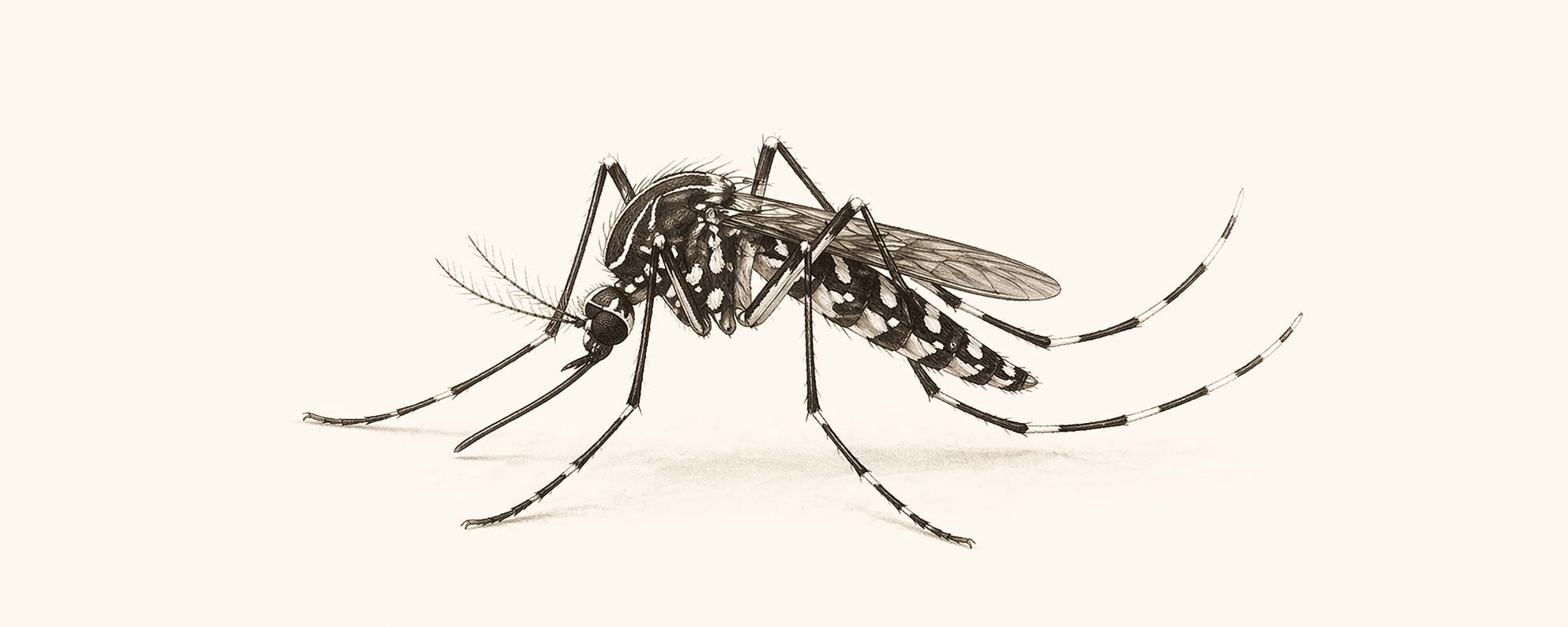
Every summer, the same scene plays out along the whole Riviera coastline, from Cap-d'Ail to Menton and across the gardens of Monaco: terraces abandoned at dusk, dinners cut short, children hurried indoors, everyone fleeing the same tiny, tenacious opponent, the tiger mosquito. And every year, owners react at the same moment, which is to say too late, once the insect has already colonised the garden and the only option left seems to be emergency spraying. Yet the truth of a tiger mosquito season is decided long before the peak. It is decided in spring, in the way each water point, each damp corner, each potential breeding site is prepared, or not.
The 2027 season deserves particular attention. Several factors are converging towards stronger-than-usual pressure, and anticipating is no longer a comfort option but the only genuinely effective strategy. This guide sets out the annual cycle of Aedes albopictus, explains why 2027 looks like a season at risk, and above all why everything is decided in June. It then presents the underlying method: villa and co-ownership audit before the peak, larval breeding-site treatment protocol, chemical-free next-generation traps, and an annual seasonal monitoring contract. For an overview of the pest and its biology, the dedicated tiger mosquito page usefully complements this reading.
Understanding the annual cycle of Aedes albopictus
You can only fight well what you understand. The tiger mosquito does not appear by spontaneous generation on the first barbecue evening: it follows a rigorous annual cycle, and each stage of that cycle offers a precise window for action. It all begins the previous autumn. Before the first cold, females lay resistant eggs on the damp walls of small containers: pot saucers, gutters, drains, water stores — anywhere stagnant water has left a mark. These eggs do not die in winter. They enter diapause, a slowed form of life that lets them withstand cold and dryness for months, stuck to their support, invisible.
In spring, when temperatures rise durably and the first rains rehydrate the walls, the eggs hatch. Out come aquatic larvae that live a few days in the water, feeding on micro-organisms, before moving to the pupal stage and emerging as adult mosquitoes. The complete cycle, from egg to adult, takes only one to two weeks in warm weather. This speed explains summer's "snowball" effect: each female lives several weeks, lays repeatedly, and each laying launches a new generation. In a few cycles, a handful of spring individuals becomes an unmanageable summer population.
The strategic consequence is clear. Killing an adult mosquito treats one symptom among thousands. Preventing eggs from hatching and larvae from developing cuts the cycle at the root. The whole logic of successful prevention lies in this shift of focus: from the insect that bites in the evening to the breeding site that silently produced it.
Why 2027 looks like a season at risk
Predicting a season's intensity is no magic: you simply observe the factors that feed the population. Three of them converge for 2027 and justify heightened vigilance. The first is thermal. Increasingly mild winters reduce the mortality of diapausing eggs: where a sharp cold once destroyed part of the winter stock, a mild cold season lets more viable eggs through to spring. The population's starting point is therefore higher. Add an early, warm spring that brings forward the first hatchings: the earlier the season starts, the more cycles are possible before autumn, and the higher the summer peak.
The second factor is hydric. The alternation of intense rainy episodes and dry spells, ever more marked on the Mediterranean coast, creates an ideal regime for the tiger mosquito: rains fill the micro-containers and trigger mass hatchings, then warm spells accelerate larval development. Every summer storm is a starting signal for a new wave.
The third factor is structural and distinctly local. The density of buildings, the multiplication of watered gardens, pools and ornamental ponds, and above all the ageing of part of the building stock — clogged gutters, cracked drains, slow outlets, terraces whose slopes retain water — multiply potential breeding sites. A poorly maintained older co-ownership can on its own feed a whole neighbourhood. These three dynamics, thermal, hydric and structural, do not cancel out: they add up. That is why tackling the 2027 season like the previous ones, reacting piecemeal, amounts to chasing a wave that keeps on growing.
June, the month that decides the whole summer
If there is one idea to take from this guide, it is this: the season is won in June. At that time of year, the mosquito population is still low. The first generations emerge, but they have not yet multiplied. Acting in June means intervening on a few hundred individuals and a few dozen sites, whereas acting in August means facing tens of thousands of mosquitoes from sites scattered throughout the environment. The same effort yields a radically different result depending on the date.
In practice, start of season means fieldwork before the heat installs the peak. You map the sites, treat or remove them, and set up trapping devices to capture the first females before they lay. Every female intercepted in June is a hundred eggs that will never be laid, and therefore a whole generation that will never see daylight. The leverage is immense because it acts on the lower part of the exponential curve, where each action avoided upstream saves an explosion downstream.
June is also when coordination plays out, essential in co-ownership. A garden treated in isolation stays vulnerable if the neighbouring plot, or the common areas, keeps producing mosquitoes that recolonise the property within days. The tiger mosquito moves little — often less than a hundred metres around its breeding site — but that low mobility is precisely what makes the collective approach so effective: treating a whole block at the start of the season deprives the population of its launch bases. Waiting for July means missing the window where minimal effort produces maximal effect.
The villa and co-ownership audit before the peak
Serious prevention always begins with a diagnosis, never with a treatment. Before treating anything, you must know where the breeding sites hide, and experience shows they are almost always where you do not look. The pre-season audit consists of methodically walking the property, garden and building included, to list every real or potential source of standing water. On a villa with garden and pool, the inventory holds surprises: saucers under pots, tarpaulin folds, forgotten children's toys, watering cans, hollow parasol bases, rainwater stores, terrace drains, pool copings, drip irrigation systems, not to mention drains and gullies. A single bottle cap full of water is enough to host larvae.
In co-ownership, the audit takes on another dimension. Common areas concentrate the most productive and most neglected sites: gutters clogged with leaves, poorly drained technical terraces, damp bin rooms, collective planters, ornamental ponds, underground car parks where run-off stagnates in the drains. These sites escape residents' vigilance because they belong to no private lot, and that is precisely why they thrive. A co-ownership audit maps these zones, ranks priorities and gives the managing agent and co-owners a clear view of what must be corrected before the heat arrives.
An audit's deliverable is not a mere finding: it is an action plan. It distinguishes what can be removed — a container turned over, a saucer taken away, a gutter cleaned — from what must be treated because it cannot be dried out, such as a permanent drain or a pond. This distinction is fundamental, because it limits the use of treatment to the strict minimum. To organise this over time, a framework of seasonal prevention makes it possible to schedule the audit at the right moment, that is in spring, before the population takes off. You can request an assessment of your property via a free quote tailored to its configuration.
The larval breeding-site treatment protocol
Once the sites are identified, two routes present themselves, and the order of priority is always the same: remove first, treat second. Physical removal is the primary measure because it is definitive and has no impact on the environment. Turning containers over, emptying and storing away everything that can hold water, clearing gutters, restoring terrace drainage, replacing saucer water with damp sand, hermetically covering rainwater stores: each of these gestures removes a breeding site from the count, permanently. A removed site will never produce a mosquito, whatever the season.
That leaves the sites that can neither be emptied nor removed: permanent drains, gullies, ornamental ponds, technical reserves. For these, targeted anti-larval treatment takes over. It relies on biological larvicides applied directly into the water, acting specifically on mosquito larvae without harming other organisms. The principle is surgical: you treat the water point, and it alone, at the right dose and the right moment of the larval cycle, rather than spraying all the vegetation blindly. This approach preserves the garden's beneficial insects, pollinators and pond fauna, and leaves no residue where children play and animals roam.
Site treatment follows a cadence. Because the larval cycle is short and new sites can form after every rain, a single application is not enough: monitoring and treatment of non-removable water points must be renewed at regular intervals throughout the season. This is where the logic shifts from one-off intervention to continuous follow-up. Handling the products used, their dosing and their application fall under a competence framed by professional certification — Certibiocide N°121134 — precisely because a poorly calibrated treatment is either ineffective or needlessly heavy on the environment.
Next-generation chemical-free traps
Removing and treating sites tackles the source, but there are always adult females coming from the neighbourhood or from undetected sites. This is where next-generation traps come in, and their major benefit fits in one sentence: they capture mosquitoes without releasing any chemical into the environment. The principle rests not on poison but on deception. An attractant trap mimics the signals that, in nature, guide the female towards a host to bite: a plume of carbon dioxide reproducing a mammal's breathing, a source of gentle heat evoking skin, sometimes body-odour lures. The female, deceived, approaches, is drawn in and captured. No insecticide is released.
The advantage of this approach is twofold. First, selectivity: unlike spraying, which strikes indiscriminately everything that flies, the attractant trap targets host-seeking female mosquitoes without decimating bees, butterflies and other beneficial insects. Second, the durability of the effect: each female captured before laying means a hundred fewer eggs, so an effect that amplifies over the weeks instead of fading as a shock treatment does. A trap does not act within hours — clear relief often takes two to three weeks — but its effect is cumulative and lasting.
Well positioned, these devices form a protective belt around living areas: terrace, dining corner, play area. They are the visible building block of a strategy whose essentials play out upstream, on the breeding sites. To understand their operation, installation and maintenance in detail, the guide to chemical-free mosquito traps explores every technical aspect. The key point here is that a trap is never a standalone solution: it complements site removal, it does not replace it.
The July-August peak: managing the critical period
Despite the best preparation, July and August remain the months of maximum tension. Heat accelerates cycles, storms restart hatchings, garden use peaks and tiger mosquito pressure reaches its summit. A property well prepared in June faces this period in entirely different conditions from a neglected one: the major sites have been neutralised, the traps have been running for weeks and have already dented the population, monitoring is in place. The peak becomes manageable instead of endured.
During this critical period, the logic is no longer to install but to maintain. After every rainy episode, you must re-inspect the low points, empty what has filled up, check that treated drains stay treated, and monitor and maintain the traps. The tiger mosquito exploits the slightest lapse: a saucer forgotten after a shower can locally relaunch a small population in just ten days or so. It is the consistency of follow-up, more than the intensity of an isolated intervention, that makes the difference at the height of summer.
It is also the period when unprepared owners discover the scale of the problem and seek solutions in a hurry. Yet at the peak, no miracle intervention instantly restores calm: you can reduce the nuisance and lower the pressure, but you cannot make up in a few days for weeks of sites left to develop freely. If you are already in this situation, the article on handling a mosquito invasion in an emergency details the actions that bring quick relief and those that must follow to stop the problem recurring. The lesson, year after year, stays the same: what is endured in August is prepared in June.
The annual seasonal monitoring contract
Treating one season is useful; securing every season durably requires another timescale. That is the point of an annual seasonal monitoring contract, which turns a succession of one-off interventions into continuous, coherent management of mosquito risk. The logic mirrors the insect's annual cycle. In autumn, you prepare the ground by removing the sites where resistant eggs will be laid, thus reducing the winter stock. In spring, you carry out the start-of-season audit and put treatments and traps in place before emergence. In summer, you ensure close follow-up, trap monitoring and re-treatment of non-removable water points at the rhythm of the rains.
The value of an annual contract lies not only in the regularity of visits: it lies in site memory. From one year to the next, you know where the recurring breeding sites are, which low points fill up after each storm, which building features pose a chronic problem. This accumulated knowledge makes each season easier than the last, because you act on known points rather than rediscovering everything each year. Prevention becomes more and more effective as follow-up settles over time.
For a villa as for a co-ownership, this framework also offers valuable peace of mind: the certainty that the matter is handled at the right moment, without having to think about it, with interventions timed to the insect's biology rather than to felt urgency. Organising your season around a structured seasonal prevention plan is, to date, the most reliable way to approach summers we know will be ever more demanding.
A season under control rather than a season endured
The tiger mosquito is not an inevitability of the Mediterranean summer: it is a problem you can anticipate, map and master, provided you act at the right moment and in the right order. Understanding the annual cycle of Aedes albopictus means understanding that everything is decided upstream of the peak, in removing and treating larval sites rather than chasing the adult. Recognising that 2027 looks like a season at risk gives one more reason not to wait. And making June the month of action turns a modest effort into a major result.
The method is coherent end to end: villa and co-ownership audit before the peak, priority removal then targeted treatment of larval sites, next-generation chemical-free traps to capture females without polluting, and an annual seasonal monitoring contract to anchor prevention over time. To go further on the insect's biology and behaviour, the tiger mosquito page remains the reference, and requesting a free quote lets you tailor this method to your property before the next season settles in.
Frequently asked questions
- Why could 2027 be a more intense tiger mosquito season?
- Three factors converge: milder winters that allow more diapausing eggs to survive, an early warm spring that brings forward the first hatchings and lengthens the season, and the alternation of intense rain and dry spells that multiplies breeding sites and speeds up larval development. Add to this the ageing of part of the building stock, a source of neglected breeding sites. These dynamics add up rather than cancel out, hence a pressure potentially higher than in previous seasons.
- Why act in June rather than at the height of summer?
- Because in June the population is still low: you deal with a few hundred individuals and a few dozen breeding sites, whereas in August you face tens of thousands of mosquitoes from scattered sites. Tiger mosquito growth is exponential: each female intercepted early means a hundred eggs never laid and therefore a generation avoided. The same effort produces a far greater result when it acts on the lower part of the curve, before the heat sets in the peak.
- What does an anti-mosquito audit of a villa or co-ownership involve?
- It is a methodical pre-season diagnosis covering garden and building to list every real or potential source of standing water: saucers, gutters, drains, tarpaulins, ponds, water reserves, poorly drained terraces, and in co-ownerships the often neglected common areas. The deliverable is an action plan that distinguishes what can be removed from what must be treated, and ranks priorities. The audit always precedes treatment: you can only treat effectively what you have first identified.
- How are breeding sites treated without harming the environment?
- The rule is remove first, treat second. You take away or dry out everything possible: containers turned over, gutters cleared, saucers replaced with damp sand, water reserves covered. For water points that can neither be emptied nor removed, such as a permanent drain or a pond, a biological larvicide is applied directly into the water, acting only on mosquito larvae without affecting other organisms. Treatment is targeted, at the right dose, and repeated in step with rainfall rather than spraying the whole of the vegetation.
- Is a chemical-free mosquito trap really effective?
- Yes, provided it is combined with removing breeding sites. The attractant trap mimics the signals of a host — carbon dioxide, gentle heat, sometimes body odour — to draw in and capture females without releasing any insecticide. Its effect is gradual: it often takes two to three weeks for clear relief, but it is lasting, because each female captured before laying means a hundred fewer eggs. Unlike spraying, it is selective and does not wipe out pollinators or the garden's beneficial insects.
- What does an annual seasonal monitoring contract provide?
- It turns one-off interventions into continuous management aligned with the mosquito's cycle: removing breeding sites in autumn to cut the winter egg stock, auditing and installing devices in spring before emergence, and close monitoring plus re-treatment of non-removable water points in summer in step with rainfall. Its main strength is site memory: from one year to the next you know the recurring breeding sites and problematic low points, which makes each season easier than the last. It is the most reliable way to face increasingly demanding summers.