July 15, 2026 · 12-minute read
Bed bugs in Monaco hotels: the early-detection protocol
Three minutes per room are enough for a trained housekeeper to detect an emerging infestation. Where to look, what to see, and the full early-detection protocol for bed bugs in Monaco luxury hospitality.
Early detection: everything is won before the incident in Monaco hospitality
In high-end hospitality in Monaco and on the Riviera, the bed bug is not a hygiene problem: it is a reputation problem. A single guest report, a single online review mentioning "bed bugs" in a classified establishment, and an image built over decades starts to wobble. The good news is that this pest betrays itself long before it becomes visible to the guest. The bad news is that without a method, that window of several weeks passes completely unnoticed.
Three minutes per room are enough for a trained housekeeper to detect an emerging infestation. Here is exactly where to look, what to see, and what to do in the sixty seconds that follow. What we describe here is not theory: it is the early-detection protocol for bed bugs that we deploy in establishments where mistakes are not permitted, where a room blocked in peak season represents a considerable loss of revenue, and where discretion comes before everything.
The logic is simple. A female bed bug lays a few eggs per day. A population starting from one or two individuals brought in a suitcase takes several weeks to become perceptible to an occupant. Throughout that time, it leaves traces: droppings, exuviae, eggs, stains. Whoever can read those signals wins the race. Whoever waits for the first bitten guest has already lost it.
Cimex lectularius versus Cimex hemipterus: know the adversary precisely
We commonly speak of "the" bed bug as if it were a single species. In reality, two species now coexist in the international hotel circuit, and their differences have concrete operational consequences.
Cimex lectularius, the common bed bug, is the historically dominant species in Europe and the Mediterranean basin. It tolerates temperate climates well, shelters in crevices close to the host, and withstands long periods of fasting — several months for an adult in cool conditions. It is the one most often encountered in Monaco bedding.
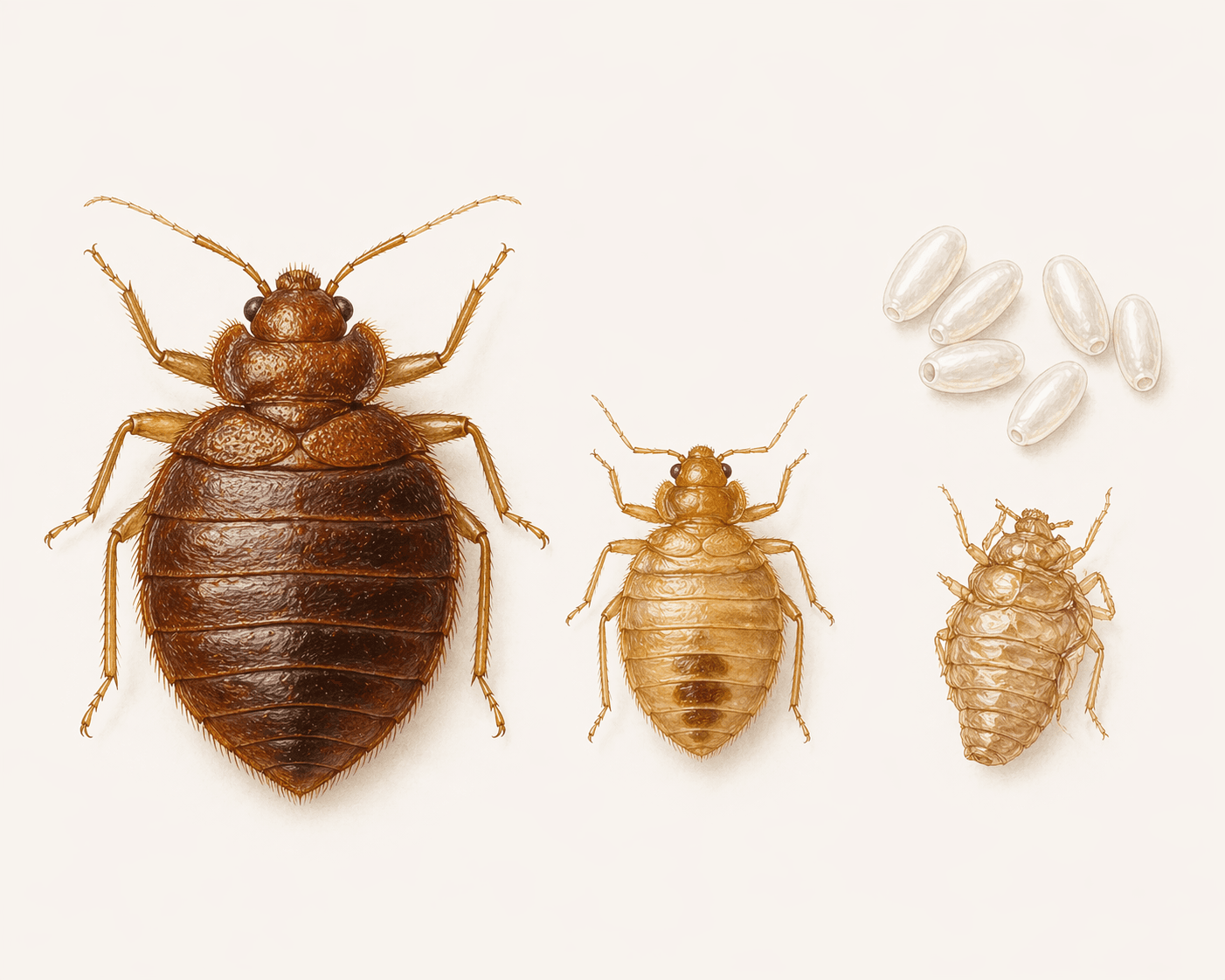
Cimex hemipterus, the tropical bed bug, was historically confined to warm regions, but the globalisation of travel has spread it widely. A Riviera establishment welcoming an international clientele — the Gulf, Southeast Asia, Africa, the Americas — regularly imports it via luggage. Morphologically, the two species look very similar to the naked eye: flattened oval body, mahogany-brown hue, the size of an apple pip for the adult. The fine distinction is made at the pronotum, wider and with raised edges in lectularius, narrower in hemipterus.
Why does this distinction matter? Because Cimex hemipterus often shows greater metabolic resistance to pyrethroid insecticides, and an ability to climb smooth surfaces that defeats certain pitfall traps designed for the common species. Identifying the species present guides the choice of targeted biocides and the interceptor placement strategy. This is the first reason a sample must always be kept and identified, never crushed and thrown away. A captured bug is information; a bug destroyed in panic is lost data.
The housekeeper's three minutes: visual detection at turnover
Early detection does not rely on a spectacular annual visit. It relies on the repetition of a short gesture, built into the room turnover protocol, at every guest departure. Turnover is the real vigilance point, because it is the moment when the bedding is stripped, the corners are accessible, and the room is empty.
The inspection route follows a precise order, from most to least likely. Start with the headboard and box spring, which concentrate the overwhelming majority of harbourages, the bug positioning itself as close as possible to the sleeper. Inspect the seams and piping of the mattress, especially on the side faces and corners, lifting the mattress to reach the strap of the upholstered base. Then examine the back and fixings of the wall-mounted headboard, the slots of the bed frame, the screws and the wooden joints.
What to see comes down to four signatures. Droppings: tiny black dots, as if drawn with a fine pen, that bleed slightly on light fabric and do not wipe off with a fingernail. Exuviae: translucent, golden, empty moults left at each growth stage. Eggs: whitish, elongated, a millimetre long, glued in clusters in the seams. Blood stains: small rust-coloured spots on the sheets, the crushing of gorged individuals. And of course, the living individual itself, fleeing the light.
The sixty-second rule that follows a discovery is as important as the detection itself. Do not spray. Do not give the room to the next guest without recording the harbourage. Do not shake the bedding in the corridor, which would disperse the harbourage to neighbouring rooms. Isolate: suspect linen goes directly into a sealed hermetic bag, the room is set to "blocked" status in the reservation system, a sample is kept, and the coordination channel with the pest-control provider is triggered. An infestation treated at the single-harbourage stage remains invisible to guests. The same infestation discovered three weeks later mobilises an entire floor.
Canine detection and visual detection: two tools, one strategy
Visual detection has a limit: it sees what is accessible and what is already installed. It is excellent at turnover, but it misses an isolated individual hidden in a skirting-board crack or behind a frame. This is where canine detection comes in.
A detection dog does not look for stains: it looks for an odour, the olfactory signature of live bugs and viable eggs. Its major advantage is sensitivity at low density. Where the human eye needs an established harbourage to spot anything, a properly trained and regularly re-validated dog signals the presence of a few individuals, including in cavities inaccessible to visual inspection. Its speed is also a decisive asset: a handler-dog team covers a floor far faster than an exhaustive manual search.
The two approaches do not compete, they complement each other on a simple principle. Visual detection, daily and built into housekeeping, provides continuous, free surveillance of every room at turnover. Canine detection, occasional and scheduled, serves as a safety net: a control audit after a report, clearing doubt before reopening a treated room, a screening campaign on a high-risk floor after a group stay. A canine alert must always be confirmed by a targeted visual inspection at the indicated spot, before any treatment. The dog directs; the human confirms and documents.
Training housekeepers: the hotel's first sensor
An establishment's best detection system is not a piece of equipment, it is its floor team. Housekeepers and room attendants touch every bed, every day, in every room. Properly trained, they form a sensor network whose coverage no technology can match. Untrained, they miss the signals every day, or worse, unknowingly spread a harbourage from one room to another via the linen trolley.
The training we provide rests on three pillars. First, recognition: knowing how to distinguish a bug dropping from a simple stain, an exuvia from a piece of lint, a bug egg from a sewing residue. This skill is transmitted through images and the handling of reference samples, not through a mere lecture. Second, the reflex gesture: the sixty-second sequence, the order of the inspection route, the use of the hermetic bag, the absolute ban on improvised spraying. Third, the alert channel: to whom to report, how, and with what traceability, so that a doubt from a chambermaid at seven in the morning rises immediately without being filtered or minimised.
This training is not a one-off event. Floor-team turnover in seasonal hospitality is high, and an unmaintained skill degrades fast. We favour short, repeated sessions timed to seasonal recruitment, with visual aids that can be posted in the housekeeping office and a refresher before each high season. A housekeeper who has once seen, under magnification, what a cluster of eggs in a piping really looks like never forgets it.
Housekeeping and pest management coordination: the decisive link
The earliest detection in the world is useless if the information stays stuck between the floor and technical management. The weak link in a hotel bed-bug system is almost never technical: it is organisational. It is the coordination between housekeeping, which detects, and pest management, which treats.
This coordination rests on an information circuit with no grey zone. A report must have a single, identified recipient, a guaranteed handling time, and written traceability that survives changes of team and shift. In concrete terms, that means a room status shared between the reservation system and pest-control tracking, a consultable incident register, and an on-call capacity able to trigger a discreet intervention at any moment. A pest report at eleven at night cannot wait for offices to open on Monday: this is precisely the role of a contracted 24/7 emergency line, which guarantees a response without last-minute price negotiation.
The turnover protocol formalises this coordination. Each treated room does not go back on sale on the provider's word alone: it follows a documented cycle — harbourage identified, treatment applied, action delay respected, doubt-clearing control, reopening recorded. This cycle protects the establishment on two fronts: it avoids putting a still-active room back on sale, and it constitutes the documentary proof of risk control, usable before a guest as before an insurer.
High-temperature steam, encasings and targeted biocides: reasoned treatment
Once the harbourage is confirmed, treatment obeys a principle we never compromise on: remove the cause before treating the symptom, and systematically favour physical methods before chemical ones. The bed bug is fought first by heat and mechanics, chemistry intervening only as a targeted complement.
High-temperature dry steam is the first-line weapon. Beyond a lethal thermal threshold, all bug stages — from egg to adult — are destroyed instantly, without residue and without possible resistance: no population has ever developed resistance to heat. Steam treats mattress seams, box springs, headboards, furniture slots and skirting boards, where harbourages lodge. Its advantage in luxury hospitality is decisive: it allows the room to be quickly returned to service and leaves no odour or film on fine fabrics.
Full anti-bug encasings for mattresses and box springs form the second pillar. A sealed-zip cover with certified mesh encloses any individuals present in the mattress, deprives them of access to the host and condemns them to fasting, while preventing any new colonisation of the bedding. It is a lasting barrier, invisible under the sheets, that turns a mattress — usually the hardest control point — into a smooth, inspectable surface. On a new bedding fleet, the systematic fitting of encasings is the best preventive investment there is.
Targeted biocides intervene only as a last resort, in the crevices steam cannot reach and to create a safety residual. The choice of molecule takes into account the identified species — the lectularius versus hemipterus point raised above takes on its full meaning here — and known resistances. Application is localised, never ambient spraying, and always in compliance with re-entry delays. This chemical sobriety is at once a regulatory requirement, an environmental commitment and a service imperative: a palace cannot reopen a suite that smells of insecticide.
Our four-stage protocol
We reject the "spray and see" logic. Every intervention follows a structured four-stage sequence, identical from the studio to the top floor of a classified establishment.
First stage, diagnosis. Methodical visual inspection, supported if necessary by canine detection, species identification from a sample, mapping of harbourages and assessment of scale — isolated harbourage, single room, or spread to adjacent premises. Nothing is treated before the real extent is known.
Second stage, containment. Isolation of the rooms concerned and premises at immediate risk, closed-circuit linen management, blocking of rooms in the system, protection of neighbouring zones to prevent any migration during treatment.
Third stage, reasoned treatment. High-temperature steam in the front line, fitting of encasings, targeted biocides localised on residual crevices, in compliance with action and re-entry delays.
Fourth stage, control and doubt-clearing. No room reopens on a mere presumption of success. A scheduled control — visual, canine, or by interceptors — validates eradication before return to sale, and the whole cycle is documented. This traceability feeds the free quote and the contract that follows: every action is planned, priced and enforceable.
Field experience in luxury hospitality: discretion and anticipation
What years spent alongside establishments where excellence is non-negotiable have taught us comes down to a few principles. The first is that discretion is part of the treatment. Intervention in civilian dress, neutral vehicles and equipment, visits during low-occupancy slots, coordination with the rooms division so no guest is exposed: fighting bed bugs, in this context, is as much a logistical operation as a technical one. A technically perfect treatment that a guest can see is a failure.
The second principle is that anticipation always costs less than repair. A room blocked for several days in peak season, a commercial upgrade gesture, the full dry-cleaning of a guest's belongings, the night-time mobilisation of management: the cost of a mishandled incident far exceeds that of a preventive system. And it bears no comparison with the literally incalculable cost of an online review mentioning bugs and left indexed for years. The rule is universal: the audit always costs less than the repair.
The third principle is that regularity beats intensity. A protected establishment is not the one that treats hard once a year, it is the one that inspects a little every day, trains its teams every season, and has an alert channel that never sleeps. We detailed this permanent-system philosophy in our analysis of the zero-fault annual pest-control contract for palaces, which naturally extends the early-detection logic set out here.
Compliance, safety and environmental commitment
Our technicians operate under Certibiocide certification (N°121134), a guarantee that biocide application, storage and traceability protocols meet current requirements. This certification is not a mere document on display: it structures how each product is chosen, dosed, applied and recorded, and it guarantees the establishment enforceable documentation in case of a hygiene audit or inspection. Our registration with the Trade and Industry Register (RCI 26S10394) also attests to the regularity of our activity on Monegasque territory.
Our environmental commitment flows directly from the method. By placing high-temperature steam and physical barriers in the front line, and reserving biocides for targeted, localised use, we drastically reduce the chemical load in spaces where guests sleep and teams work. It is a public-health requirement as much as a conviction. To go further, get in touch via our free and confidential quote: we establish a precise diagnosis of your exposure to bed-bug risk and an early-detection plan suited to your establishment, before any intervention.
The bed bug is not fought in emergency. It is fought through knowledge of the species, the trained eye of the housekeeper, the complementarity of canine detection, the flawless coordination between housekeeping and pest management, and a reasoned treatment that protects guests as much as reputation. Detecting early means never having to manage a crisis.
Zones served in Monaco and on the Riviera
We operate in particular on Fontvieille and Larvotto.
Frequently asked questions
- How can a housekeeper spot bed bugs in a few minutes during turnover?
- The route follows a precise order, from most to least likely: headboard and box spring first, then mattress seams and piping on the side faces and corners, finally the bed frame and wall fixings. She looks for four signatures — small black dropping dots that do not wipe off with a fingernail, translucent golden moults, whitish clustered eggs in the seams, rust-coloured spots on the sheets. Three minutes are enough if the gesture is built into every guest departure and if the team has been trained on reference samples.
- What is the difference between Cimex lectularius and Cimex hemipterus, and why does it matter?
- Cimex lectularius is the common bed bug, dominant in Europe and the Mediterranean, suited to temperate climates. Cimex hemipterus is the tropical species, regularly imported via the luggage of an international clientele. To the naked eye they look alike, the distinction being made at the pronotum. The stake is operational: hemipterus often shows greater pyrethroid resistance and climbs smooth surfaces that defeat certain traps. Identifying the species guides the choice of biocides and the interceptor placement strategy, hence the importance of keeping a sample rather than crushing the individual.
- Is canine detection more reliable than visual inspection?
- The two do not compete, they complement each other. Visual detection, daily and free, ensures surveillance of every room at turnover but only sees what is accessible and already installed. Canine detection picks up an odour, the signature of live bugs and viable eggs, and flags a few individuals even in cavities inaccessible to the eye, while covering a floor far faster. It serves as a safety net: audit after a report, doubt-clearing before reopening. A canine alert must always be confirmed by a targeted visual inspection before any treatment.
- Why favour high-temperature steam over insecticides?
- Because the bed bug is fought first by heat and mechanics, chemistry intervening only as a targeted complement. Beyond a lethal thermal threshold, dry steam instantly destroys all stages, from egg to adult, without residue and without possible resistance: no population has ever developed resistance to heat. In luxury hospitality, it allows the room to be quickly returned to service and leaves no odour on fine fabrics. Targeted biocides serve only in localised form, on crevices inaccessible to steam, and never as ambient spraying.
- What are anti-bug covers (encasings) on mattresses and box springs for?
- A full sealed-zip cover with certified mesh encloses any individuals present in the mattress or box spring, deprives them of access to the sleeper and condemns them to fasting, while preventing any new colonisation of the bedding. It is a lasting barrier, invisible under the sheets, that turns the mattress — usually the hardest control point to inspect — into a smooth surface immediately checkable at turnover. On a new bedding fleet, the systematic fitting of encasings is the best preventive investment, as it drastically reduces the risk of a harbourage establishing.
- How should coordination between housekeeping and the pest-control provider be organised?
- The weak link in a bed-bug system is almost never technical, it is organisational. Coordination rests on an information circuit with no grey zone: a report with a single identified recipient, a guaranteed handling time, and written traceability that survives shift changes. Concretely, a room status shared between the reservation system and pest-control tracking, a consultable incident register, and a 24/7 on-call able to trigger a discreet intervention at any hour. The turnover protocol documents each treated room — harbourage identified, treatment applied, doubt-clearing control, reopening recorded — before any return to sale.