July 8, 2026 · 14-minute read
Bed bugs in a Monaco hotel: a discreet intervention protocol
Bed bugs in a Monaco hotel: discreet protocol, 21-day monitoring, plain clothes and systematic NDA, delivered by Certibiocide-certified operators across the…
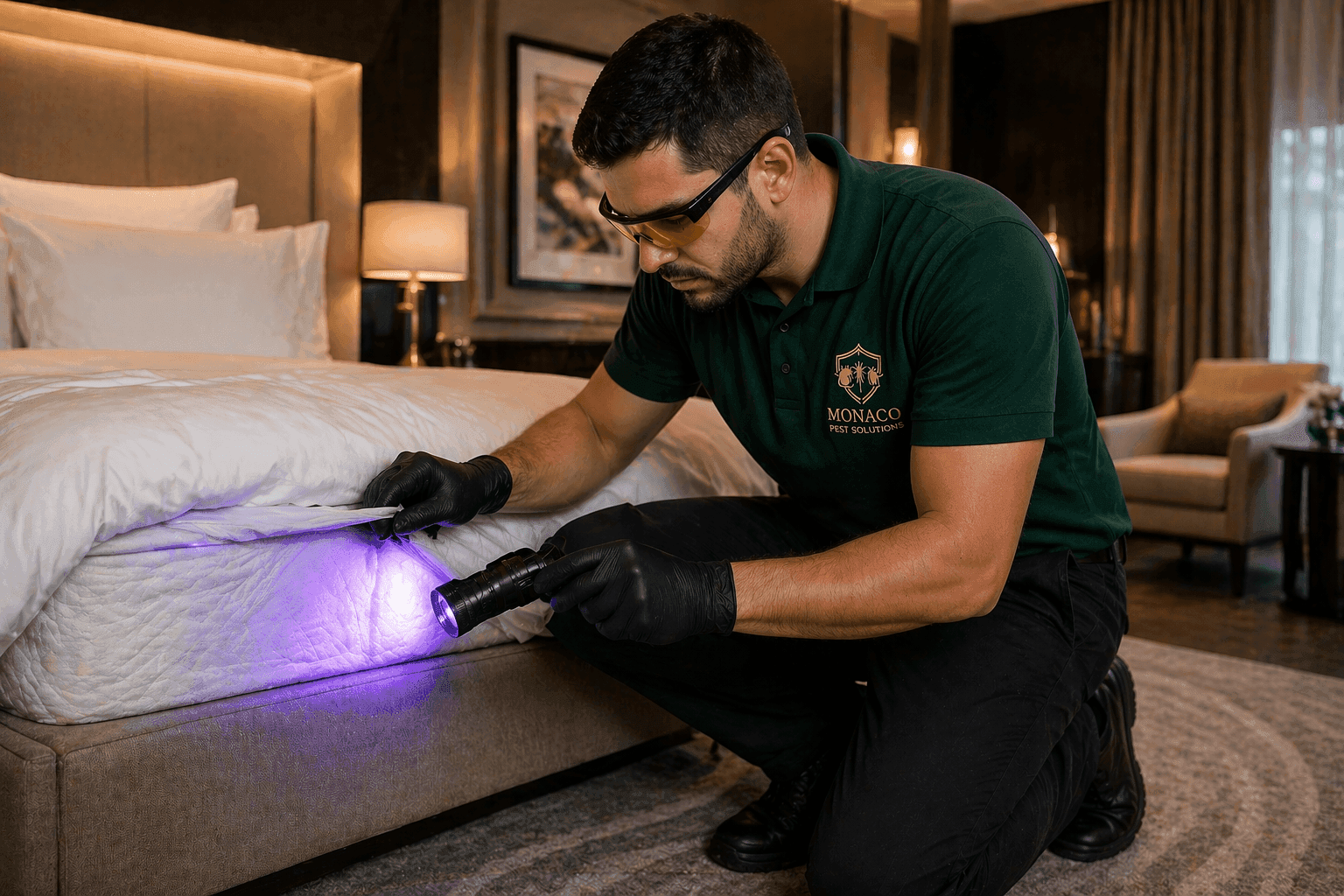
The dreaded scenario: a bed bug spotted in a [Monte-Carlo](/zones/monte-carlo) room
It is 23:47. A guest returns from the Opera, switches on the bedside lamp and spots a 5 mm brown insect on the sheet. He photographs it, sends the image to reception and demands another room straight away. Over the next 48 hours, the hotel director plays a tight score: rehousing the guest with no public admission, tracing the room's last fourteen days of occupancy, identifying the adjoining rooms, and triggering an intervention without floor staff or neighbouring guests understanding that the issue is Cimex lectularius.
What is at stake goes beyond the insect itself. It is the review posted on the platforms on Monday morning, the guest's WhatsApp message to his circle, the concierge's ability to respond to the next VIP requests. In Monte-Carlo, as in Fontvieille or La Condamine, a poorly timed treatment, a team in visible white coveralls in a corridor, a piece of luggage sealed in a plastic bag in front of witnesses — and the incident becomes a reputational affair.
Monaco Pest Solutions handles this type of situation every season across the Principality and out as far as Cap-d'Ail, Beausoleil, Roquebrune-Cap-Martin or Menton, under systematic NDA. None of our hotel clients is identifiable in our public communications or in our commercial references. Discretion is not a marketing pose: it is the first line of the brief.
Early detection: the three pillars of a reliable set-up
Detection is the only lever that separates a contained incident from a crisis spread over three floors. Three methods complement one another; none of them is sufficient on its own.
Expert visual inspection relies on a thorough knowledge of refuge zones: mattress seams, upholstered box spring, headboards screwed to the wall, skirting boards behind the bedside table, picture frames, electrical socket housings. A trained operator identifies telltale signs in under twenty minutes — exuviae, black droppings, one-millimetre eggs lodged in micro-cracks. To the naked eye, a guest sees only a tiny fraction of these.
The detection dog is the reference tool for clearing a room in five to seven minutes, without dismantling anything. A certified handler-dog team can cover a full floor in a morning. Discretion is total: the dog passes for an assistance dog and its harness carries no sector-related insignia.
Passive monitors — interception traps slipped under bed feet, CO2 or pheromone detectors — are deployed for continuous surveillance in at-risk rooms: connecting rooms, rooms near the luggage store, suites hosting high international turnover. They flag an emerging infestation before any guest experiences it. In a 200-room Monte-Carlo palace hotel, an intelligent monitoring plan covers the hotspots without any visible deployment.
Single-room protocol: quarantine, steam, 21-day monitoring
As soon as a room is confirmed positive, the protocol unfolds in five strict phases.
Quarantine. The room is blocked in the PMS under a neutral reason ("technical maintenance"). The rooms adjacent to the left, right, above and below are placed under enhanced observation. No textile leaves the room without hermetic packaging.
Extraction and thermal treatment of linen. Sheets, duvets, pillows and curtains go through a wash cycle at a minimum of 60 °C, followed by a hot tumble dryer. Delicate items (velvet, silk, leather) go into a dry-heat chamber on a validated cycle.
Dry steam at 180 °C. The front-line tool. Slow passes over seams, skirting boards, the dismantled box spring and the removed headboard. Steam kills eggs and adults on instant contact, with no chemical residue, no lingering odour and no risk to premium finishes.
Targeted application of contact and residual insecticides. Only on non-textile areas, using biocidal products authorised in the Principality. Monaco Pest Solutions applies these products under Certibiocide certification N121134, which guarantees substance-by-substance traceability and adherence to approved doses.
21-day monitoring. The bed bug's biological cycle requires two follow-up visits: D+10 to detect nymphs hatched from residual eggs, D+21 to confirm eradication. No room is returned to unreserved sale until the intervention supervisor has signed off in writing.
Floor-level protocol: mapping and coordination with housekeeping
A positive room is almost never an isolated case. Bed bugs migrate laterally through service ducts, vertically through plumbing risers, and travel on linen trolleys or in shared vacuum cleaners.
Star-pattern mapping. Starting from the index room, we systematically inspect the eight surrounding rooms: adjoining, above, below, and diagonally through the ducts. Each room receives a status — positive, suspect, clear. Suspect rooms move into intensive monitoring.
Order of intervention. The classic mistake is to treat the index room and then, three weeks later, discover a contaminated neighbouring room. We reverse the logic: mapping precedes treatment, and we then intervene from the most contaminated room to the least, never the other way round, to prevent the insects from fleeing into a clear zone under the effect of the products.
Housekeeping coordination. The head housekeeper receives a confidential briefing. Chambermaids follow an adapted routine without always being told the exact nature of the problem: gloves as standard, trolley swaps between suspect rooms, a dedicated vacuum cleaner with the bag discarded after each pass, and linen transported in sealed water-soluble bags.
Luggage room and linen room. These two areas are inspected in parallel. A single contaminated suitcase left in the luggage room can reinfect a treated room fifteen days later.
Operational discretion: plain clothes, unmarked equipment, 10:00–15:00 slots
A palace hotel cannot afford a van livered with "pest control treatment" parked at the main entrance. Discretion is a technical constraint in its own right, built into the brief from the very first call.
Plain clothes. Dark trousers and polo shirts, no visible logo. No full white coveralls in the corridor. PPE — respiratory mask, nitrile gloves — is put on inside the room being treated, doors closed.
Unbranded equipment. Neutral technical trunks, professional vacuum cleaner without sector markings, steam generator transported in a dark flight case. Our vehicles park in the delivery zone or an underground car park, never in front of the property's main entrance.
10:00–15:00 slots. We favour the middle of the day, between guest check-out (11:00) and late-afternoon return (16:00). This window avoids lift crossings with VIPs, lets the housekeeper air the room before it is returned to sale, and gives residual products time to dry.
Plain-language communication under NDA. All correspondence goes through the hotel director or a named head housekeeper. Our internal reports mention a coded case number, never the name of the establishment. In Monte-Carlo, Larvotto or Fontvieille, this informational containment is non-negotiable.
Traceability: encrypted PDF report and per-room history
Discretion does not preclude documentary rigour. It demands it. A hotel handling an infestation must be able to prove, month after month, that the problem was managed by the book — whether facing a guest dispute, a health inspection or an audit by the hotel group's head office.
Encrypted intervention report. Each visit produces a signed PDF, encrypted with a password sent separately. It contains the timeline, the products applied with batch numbers, the doses, the areas treated with a scaled plan, timestamped before/after photographs, and the signature of the certified operator.
Per-room history. We maintain an internal database in which every room of the hotel has its own log: intervention dates, reason, product used, outcome, operator. In the event of a recurrence, this history helps identify patterns — a recurring connecting room, a peak-turnover season, a repeated international origin.
Chain of accountability. Monaco Pest Solutions, RCI Monaco 26S10394, registered office at 29 Bd Rainier III, holds Certibiocide certification N121134. Each operator is individually authorised, trained annually, and named on the intervention report. This traceability protects the establishment in the event of a claim: the provider is identified, the operator is identified, the product is identified, the dose is justified. It is the minimum documentary foundation of serious hotel pest control in the Principality.
Prevention: mattress encasements, linen team training, luggage-room protocol
Treatment is surgical. Prevention is structural. A hotel that has been through crisis management puts in place, over the following months, a permanent prevention set-up. Three axes structure that set-up.
Full anti-bed-bug encasements. Mattresses and box springs receive zipped, fine-mesh encasements, tested against Cimex lectularius. Any residual infestation trapped inside dies without being able to contaminate a new guest. These encasements stay in place for at least eighteen months after an incident, with a six-monthly inspection of the zips.
Linen and housekeeping training. A short training session (two hours) teaches the head housekeeper and the night teams to recognise the signs: black marks on sheets, exuviae in seams, eggs in electrical sockets. Early reporting shortens the treatment protocol by several days and limits the spread across a whole floor.
Luggage-room protocol. The most underestimated area. We recommend a luggage room with a smooth floor, metal shelving that is easy to inspect, powerful lighting and a monthly visual inspection routine. Long-term luggage is placed in sealed encasements or heat-treated before storage. Whether at the scale of a Monte-Carlo palace hotel or a boutique hotel in La Condamine, this protocol prevents a contamination brought in by a passing guest from resurfacing three months later, once everyone has forgotten the origin.
Anonymised case: a five-star Monegasque palace hotel, 200 rooms
Here is a real case, anonymised in line with our standard NDA. The establishment is a five-star palace hotel in the Principality, roughly 200 rooms, with very high international turnover during peak season.
Report. A guest states they have been bitten. The housekeeper inspects and finds droppings marks on the headboard. The director contacts us at 14:00 on a Saturday. A team arrives at 16:30, in plain clothes, in through the delivery entrance, equipment in flight cases.
Extended diagnosis. Index room positive, two suspect rooms (adjoining room to the left and the room above), all other rooms on the floor inspected the next day with a detection dog. Final diagnosis: four positive rooms, six suspect rooms.
Treatment. The ten rooms are blocked gradually in the PMS to avoid triggering a visible over-booking. Steam treatment, then residual insecticide, over five days on rotation, with relocated guests moved to other floors without any communication of the real reason.
Monitoring. Follow-up visits at D+10 and D+21. Two rooms remain under extended passive monitoring until D+45 as a precaution. No recurrence detected at three months.
Discretion. No staff outside the management team and the head housekeeper was told the exact nature of the problem. No negative guest review was recorded over the period concerned. The establishment maintained its occupancy rate, its overall score and its ranking in the excellence guides. That is what a well-executed hotel protocol should produce.
Real cost of a treatment vs the cost of a bad review
The budget question always comes up. It deserves to be turned around: what is the cost of a compliant treatment, and what is the cost of a treatment ducked?
Cost of a compliant treatment. It depends on the number of rooms, the type of intervention (steam only, steam + insecticide, extended monitoring), the degree of urgency, and the discretion constraints. A single-room treatment with 21-day monitoring stays well below the price of a single night in a suite at the palace hotel concerned. A full-floor treatment with mapping, five rooms treated and two follow-up visits stays within the order of magnitude of one peak-season weekend.
Cost of a bad review. A detailed guest review on the hotel platforms remains visible for years. In a Monte-Carlo palace hotel, the overall rating is a metric tracked by tour operators, international concierges and excellence guides. Even a marginal drop weighs on the average prices commanded in the premium segments — and that effect settles in over the long term.
Cost of a badly done treatment. The worst-case financial scenario is neither the compliant treatment nor the isolated negative review. It is the recurrence. A poorly treated infestation that returns six weeks later, this time with several guests affected simultaneously, creates a reputational file whose cost far outstrips any initial quote-comparison logic. Cutting costs on the provider is almost always the most expensive calculation error.
Checklist: the questions to put to your provider
Before signing a maintenance contract or commissioning a curative intervention, these questions effectively separate serious providers from improvisers.
- Do you hold a valid Certibiocide certification? Ask for the number. Ours is N121134.
- Are you registered in the Principality? Verify the entry with RCI Monaco. Monaco Pest Solutions is registered under number 26S10394, with its registered office at 29 Bd Rainier III.
- Do you sign an NDA before any assignment? A serious hotel provider offers one spontaneously.
- What is your steam protocol? Temperature, dwell time, brand of generator. An operator unable to answer precisely lacks the required technical grounding.
- How many follow-up visits are included in your treatment? Below two, refuse. The biological cycle requires D+10 and D+21 as a minimum.
- What is your dress and vehicle policy? A litmus test of genuine operational discretion.
- Do you provide an encrypted report for each intervention? A signed PDF, with a scaled plan and timestamped photographs, is the standard.
- Do you work outside the 10:00–15:00 slots if necessary? Indispensable flexibility if a VIP is on an extended stay.
- Do you train my housekeeping teams? Prevention runs through the field teams, not through the provider alone.
Any doubts? Our team responds within 2 business hours. +377 37 70 70 02 — or **request a free quote**.
Frequently asked questions
Is there an obligation to declare a bed bug infestation to any authority in the Principality?
The Principality of Monaco applies its own health framework, distinct from the French one. To our knowledge, there is no systematic obligation to declare a case of Cimex lectularius to the Monegasque authorities for a private hotel establishment, provided the establishment handles the incident by the book. That said, any biocidal product applied in the Principality must be applied by an authorised operator and at the approved doses — which our Certibiocide certification N121134 guarantees. We systematically recommend that hotel management keep a complete intervention file, available in case of a health inspection, a guest dispute or an internal group audit. This documentary rigour protects the establishment well beyond the single incident treated.
Can a detection dog really go unnoticed in a palace hotel corridor?
Yes, provided the intervention is prepared with management. We favour calm and unobtrusive breeds, typically Labrador or Springer, fitted with a neutral harness bearing no sector-related markings. The handler-dog team enters through the delivery or staff access, moves alongside a member of security or the concierge in line with the establishment's codes, and clears a room in under seven minutes with doors closed. A guest passing in the corridor sees an assistance dog, never a detection dog. Our handlers sign the same NDA as our technicians and are trained to the codes of Monegasque palace hotels: radio silence in public areas, no verbal exchange in front of a guest, and discreet management of the animal's needs at the end of the mission.
How long does a room remain unavailable after treatment?
A treated room is physically returned to full order within twenty-four to forty-eight hours of the visit. It can technically receive a guest the next day, once products have dried and the room has aired. However, our protocol recommends keeping it under observation for the full twenty-one days of monitoring, with two intermediate follow-up visits, before returning it to unreserved sale. Many hotels choose an intermediate solution: immediate return to sale, flagging the room as a priority for internal surveillance, with a dedicated trolley and dedicated linen until the D+21 follow-up. This approach preserves the occupancy rate without compromising the protocol, and remains compatible with the demanding standards of a Monte-Carlo palace hotel.
Can we treat with steam only, without chemical insecticide?
Technically yes, in certain configurations. Dry steam at 180 °C instantly kills eggs, nymphs and adults on direct contact. A wholly thermal treatment is conceivable on an emerging, very localised infestation, with full access to every refuge zone. It has the advantage of leaving zero chemical residue, which appeals to palace hotels attentive to guest comfort and premium finishes. Its limit: areas inaccessible to steam — behind a sealed skirting board, inside an electrical conduit, under a nailed hardwood floor — go untreated. For durable safety, we generally combine steam on the front line with a residual biocide targeted at areas not exposed to the guest, under Certibiocide certification N121134.
What if a guest formally asks to see the intervention report?
That question falls under the establishment's communication policy, not the provider's. We supply management with an encrypted PDF report, transmissible or not according to the hotel's decision. In practice, most managements handle the guest request through a dedicated legal channel, without passing on the raw document. The report indeed contains sensitive information: the scaled room plan, the history of prior interventions, the floor map — none of which is meant to circulate. A guest-facing version can be drafted at management's request, confirming the treatment's compliance, respect for best practice and monitoring in progress, without disclosing internal operational data or information relating to other rooms.
Do you also work on the French side, in Beausoleil, Cap-d'Ail or Menton?
Yes, our hotel intervention area covers the Principality and its immediate surroundings: Beausoleil, Cap-d'Ail, Roquebrune-Cap-Martin, Menton, with the same standards of discretion and traceability as in the Principality. We do adapt to the applicable regulatory framework: on the French side, biocidal products must comply with French authorisations and the framework of the Public Health Code; on the Monegasque side, the Principality's own regulatory framework applies. Our Certibiocide certification N121134 lets us operate in compliance with both frameworks, with the authorised operator named on every report. This operational continuity is valuable for hotel groups running establishments on either side of the border.