
Identifying bed bugs: the signs that never lie
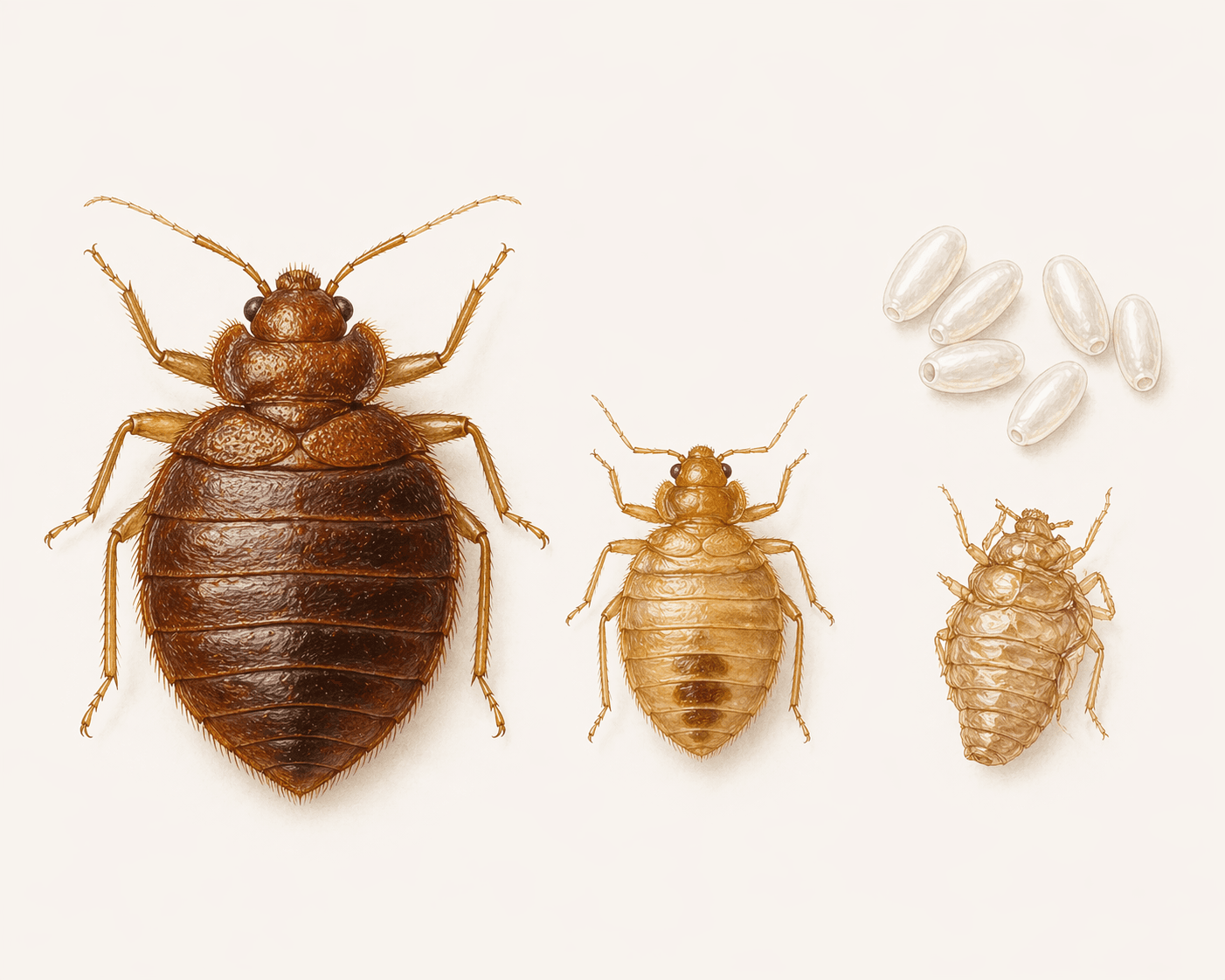
The adult bed bug measures 4 to 7 mm, has a flattened oval shape and a reddish-brown colour that turns mahogany after a blood meal. Nocturnal, it hides during the day in mattress seams, the bed base, padded headboards, skirting boards and even electrical sockets. Its presence is rarely revealed by direct observation.
Indirect clues are more reliable:
- Bites in a line on areas left uncovered during sleep (arms, shoulders, back, legs), grouped in threes or in a straight line.
- Black spots of droppings on sheets, the pillow or mattress seams.
- Small blood marks left after an accidental crushing during the night.
- Translucent, amber-coloured moults, corresponding to the exuviae shed by the larvae across the five stages of development.
- A sweetish odour reminiscent of a damp cellar or coriander in cases of advanced infestation.
Early detection remains the single most decisive factor in the cost and duration of a treatment. Any suspicion warrants a professional inspection rather than an empirical treatment that risks scattering the harbourages.
Health, material and legal risks
The bed bug is not currently recognised as a proven vector of infectious diseases transmissible to humans under ordinary residential conditions. The real risk lies elsewhere:
- Skin reactions: bites can cause intense itching, hives, localised oedema and secondary infection from scratching, particularly in children.
- Psychological impact: sleep disturbance, anxiety, social isolation, embarrassment at having guests. These symptoms are frequently underestimated but sometimes persist after eradication.
- Material impact: mattresses, bed bases, sofas, suitcases and sometimes complete bedding may have to be encased or discarded, causing significant financial loss on high-end furnishings.
On the legal front, in France as in Monaco, the landlord is required to provide decent accommodation free of pests when the tenant moves in. In the commercial sector — hotels, serviced residences, furnished tourist lettings, luxury seasonal rentals — the discovery of an infestation engages the operator's liability towards the guest and triggers an obligation to treat immediately, with the associated reputational consequences.
Why this pest thrives in Monaco and on the Riviera
Three combined factors explain the constant pressure on the Principality and its hinterland:
- Intense international flows — Monaco concentrates a clientele in constant rotation between palace hotels, seasonal residences, yachts and jets. Luggage, garment bags and cabin bags are the main vector for spreading bed bugs from one continent to another.
- Vertical urban density — tall co-ownership buildings in Monte-Carlo, Fontvieille and Larvotto: the insects migrate through service ducts, ventilation conduits and party walls when an infestation becomes active in a neighbouring dwelling.
- Temperate Mediterranean climate — indoor temperatures remain favourable to the development of the species all year round. The egg-to-adult cycle accelerates above 20 °C, which explains the absence of marked seasonality on the Riviera.
The high-end residential and hotel fabric, from Cap-d'Ail to Menton by way of Beausoleil, Roquebrune and Cap-Ferrat, presents the same exposure. Properties with high textile density (antique rugs, wall hangings, large dressing rooms, libraries) offer bed bugs a considerable number of potential refuges and call for a methodical inspection protocol.
The MPS protocol in 4 steps
- Complete diagnosis and mapping — room-by-room inspection of sensitive areas: bedding, upholstered furniture, skirting boards, sockets, frames, hanging textiles. Depending on the surface area and the sensitivity of the case, we deploy a specialist canine detection team to confirm active harbourages without systematic dismantling.
- Combined treatment — application of dry steam at 180 °C to all textile surfaces and crevices: eggs and adults are destroyed by thermal shock within seconds. This is followed by an approved residual contact insecticide selected for its low residual toxicity in occupied environments. Mattress encasement where it provides a technical benefit.
- Three-week follow-up — a second visit checks for the absence of any resurgence after any residual eggs have hatched, supported by passive monitoring traps set during the initial treatment.
- Certification and recommendations — detailed intervention certificate, prevention advice tailored to the property treated, an optional follow-up plan for hotels and seasonal residences.
Monaco Pest Solutions is registered with the RCI Monaco under number 26S10394 and holds Certibiocide N121134.
Mistakes to avoid
Certain instinctive reactions worsen the infestation instead of containing it:
- Moving infested furniture into another room or up to the attic: the contamination spreads across the whole living area within a few days.
- Using consumer aerosol insecticides: they scatter the colonies without killing them, encourage the emergence of resistance and contaminate the indoor air.
- Washing at low temperature: only a machine at 60 °C minimum, followed by a hot tumble dry, neutralises eggs and adults in linen and bedding.
- Emptying rooms without sealing items: taking a mattress into the lift or onto the landing seeds the harbourages throughout the entire building.
- Delaying professional intervention: each female lays hundreds of eggs over her cycle, and every week of waiting makes remediation heavier and more costly.
- Relying on internet tips (essential oils alone, diatomaceous earth without a protocol, partial freezing): inadequate against an established infestation.
A professional diagnosis, by contrast, makes it possible to target the harbourages precisely and to preserve furniture where it can be saved.
Typical Monaco case
Upmarket flat in a co-ownership building in Monte-Carlo, occupant recently returned from a stay abroad. Night-time bites initially attributed to mosquitoes, then the appearance of black marks on the white fitted sheet and persistent itching on waking. The owner contacts us at the end of the day.
Our inspection the following morning identifies two active harbourages: the side seams of the main mattress and the back of the padded headboard. No sign of spread to neighbouring rooms. Combined steam and residual insecticide treatment carried out the same day on the bedroom and adjoining dressing room, with the mattress encased in a certified cover. Monitoring traps set in every living space.
Three-week follow-up: traps empty, no new bites reported. Certificate issued, confidential information passed to the managing agent on the value of checking the adjoining dwellings, without disclosing the origin. NDA respected, the residence's reputation preserved, case closed within a month.
This type of scenario — early detection, localised harbourage, rapid resolution — represents the majority of residential interventions when the occupant reacts within the days following the first signs.
Lasting prevention
Once the harbourage has been neutralised, a few habits sharply limit the risk of recurrence:
- Systematic luggage checks on returning from travel: visual inspection of seams and outer pockets before entering the bedroom, tumble-drying of suitcase textiles where possible.
- Full anti-bed-bug encasement on mattress and bed base, particularly recommended in seasonal rental properties and guest rooms.
- Reinforced weekly vacuuming of skirting boards, bed bases and headboards, emptying the vacuum bag immediately outside the dwelling.
- Vigilance with second-hand furniture: refuse any bedding, sofa or upholstered armchair without clear traceability.
- Passive monitoring in premises open to the public: interception traps under bed legs, checked monthly.
For hotels, serviced residences and yachts, we offer an annual monitoring plan with scheduled visits, training of housekeeping staff in recognising the signs, and a documented containment procedure in case of suspicion. This preventive approach is often more economical than a curative emergency intervention, and infinitely more discreet.
Regulatory framework: France and Monaco
In France, the Regional Health Agencies (les autorités sanitaires françaises) monitor bed bugs in collective housing and can require the landlord or manager to act in the case of substandard housing. The law also frames the landlord's obligation to provide decent accommodation, free of pests when the tenant moves in, and penalises misleading commercial practices around treatment.
In Monaco, the Principality regulates the professional use of biocides through its own authorisation and approval regime. Any application is the responsibility of an accredited operator, in compliance with the principles of integrated pest management: prior diagnosis, priority given to mechanical and thermal action, targeted biocide as a complement. Monaco Pest Solutions applies this hierarchy on every job.
In the Principality's hotel and catering sectors, the discovery of an infestation requires the licence holder to take documented and traceable action. Archiving intervention certificates and the monitoring register becomes a key element during quality, health or insurance audits.
How long, how many visits
For a residential property with a localised harbourage, a case is generally resolved with one main visit followed by a three-week follow-up. This interval corresponds to the hatching cycle of any residual eggs that may have escaped the initial treatment.
For an extended infestation — several rooms, bulky furniture, multiple reservoirs or a co-ownership with contaminated adjoining dwellings — two to three visits may be necessary, spaced two to three weeks apart. The protocol remains the same: diagnosis, combined treatment, monitoring, follow-up.
For hotels and yachting, operational urgency requires a rapid intervention, often outside operating hours. We favour night-time slots or turnaround days, with the room or cabin generally back in service within 24 hours. Pricing transparency is part of our commitment: a detailed quote is provided before any intervention, with no surprises during the job.
In any doubt? Our team responds within 2 working hours. +377 37 70 70 02 — or [request a free quote](/devis-gratuit).