
Sectors
Property Management
Annual prevention contracts for condominiums: cellars, parking lots, garbage chutes, technical ducts. Digital reporting for management boards, interventions coordinated with concierges and managers.
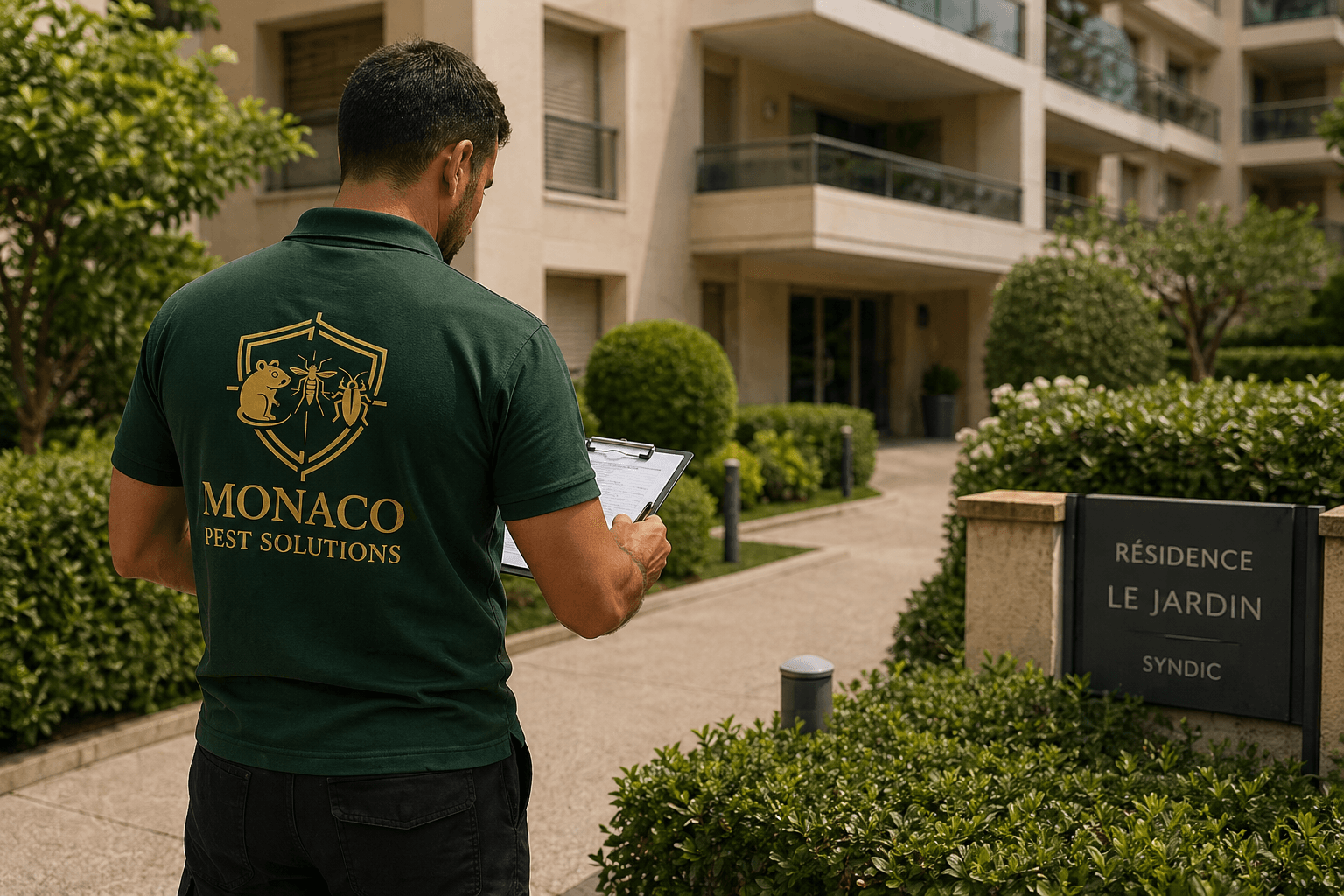
The co-owned buildings and managing agents sector: what a premium setting demands
From the towers of Larvotto to the prestigious apartment buildings of Fontvieille and La Condamine, Monaco's co-owned properties concentrate — within a few thousand square metres — cellars, car parks, refuse chutes and service ducts adjoining other buildings: an untreated infestation next door becomes a collective problem within weeks. For the managing agent, the stakes are twofold: meeting the obligation to maintain the common areas on behalf of the co-owners, and being able to demonstrate at the general meeting a documented prevention contract rather than scattered, costly curative call-outs.
Priority pest threats
The brown rat (Rattus norvegicus) rises from the sewer networks into cellars and bin rooms, with a risk of damage to cabling and pipework. The oriental cockroach (Blatta orientalis) colonises refuse chutes and damp ducts, then migrates into the flats on the lower floors. The feral pigeon (Columba livia) fouls façades, balconies and rooftop equipment, degrading the building's image. The house mouse (Mus musculus) exploits meter rooms and the suspended ceilings of the common areas.
Typical point of contact and engagement protocol
The contract is built with the property manager, in liaison with the co-owners' council and the concierge — an indispensable link on site. Typical annual formula: four to six scheduled visits covering all common areas, preventive rodent control in basements and car parks, treatment of refuse chutes and service ducts, and one-off intervention within 48 hours between visits, triggered by a simple report from the concierge or a resident. The managing agent receives a digital report per building, ready to present at the general meeting.
What sets MPS apart in this sector
Our digital reporting per building, with a plan of numbered bait stations and a history of readings, gives the managing agent traceability that stands up before the co-owners. Biocides are applied under Certibiocide N°121134, in compliant secured stations in areas accessible to residents and animals. For pigeons, we favour non-lethal methods: deterrence, sealing of access points, and dissuasion devices at perching spots. Registered with the RCI Monaco 26S10394, the company manages multi-building portfolios from Beausoleil to Cap-d'Ail with a single point of contact and consolidated invoicing per agency.
---
See also: [our full pest catalogue](/nuisibles) · [all our coverage areas](/zones)
Frequently asked questions
Your questions, our answers
- How do you treat common areas without alarming residents?
- Our technicians work in plain uniforms, arrive in unmarked vehicles and carry equipment in closed cases. Tamper-resistant bait stations are locked, numbered and positioned out of sight in service ducts, cellars and basements. Visits are scheduled during quiet hours agreed with the building manager. No notices are posted without the managing agent's approval; a time-stamped report is issued after every visit, including a layout plan of all devices installed. Our applicators hold Certibiocide certification N°121134.
- What do you offer for infested bin rooms and refuse chutes?
- Container storage rooms are treated against cockroaches and flies using targeted gel bait and an insect growth regulator, completed by surface disinfection following an HACCP-style hygiene protocol. Refuse chutes are handled by inspecting the hopper doors on every floor and treating the shafts from the terminal rooms. We recommend monthly service during the warm season and bi-monthly service in winter, with the frequency adjusted according to the monitoring counts documented at each visit in the site logbook.
- Rats have been reported in the boiler room: how do you achieve a lasting result?
- Our approach follows integrated pest management: we diagnose the entry routes (cable penetrations, floor drains, pipe junctions), deploy mechanical traps and secured stations, then permanently seal the openings with stainless-steel mesh, mortar and sleeves fitted to the conduits. Rodenticides are used only as a second resort, by applicators holding Certibiocide certification N°121134. Follow-up inspections at fifteen and thirty days confirm the absence of activity before the case is closed, with a photographic report of every sealed point handed to the building manager.
- Does the annual contract include informing co-owners in several languages?
- Yes. The annual contract includes scheduled visits, a monitoring logbook available to the owners' council and information notices drafted in French, English, Italian, German and Russian, ready for the managing agent to circulate. Every intervention produces a dated summary specifying the areas treated, the products used and our recommendations. The managing agent therefore holds everything required to fulfil the duty of keeping co-owners informed and to answer residents' questions, whatever language they speak, without any additional drafting work.
- An infestation is discovered on a Saturday evening: how quickly do you respond?
- Our on-call service operates 24/7, including weekends and public holidays. For an emergency within the Principality — a wasp nest on a shared terrace, a rodent in a lobby, cockroaches flushed out by renovation work — a technician is dispatched within two to four hours depending on the nature of the report. The building manager receives immediate written confirmation, followed by a time-stamped intervention report on the next working day, usable with the co-ownership's insurer. The on-call number is stated in every annual contract.
A question, an infestation, a preventive audit?
Our experts reply as soon as possible. Free quote, fast intervention in the Principality of Monaco and across the French Riviera.