July 29, 2026 · 5-minute read
How to identify a primary Asian hornet nest in April
In April, the founding queen builds a nest the size of an orange, often at head height. At that stage, destroying it costs ten times less than in July and…
The April window: why now is the moment
The annual cycle of the Asian hornet (Vespa velutina nigrithorax) follows a calendar of near-military precision. In March-April, a single foundress queen, having emerged from her solitary winter shelter in a protected cavity, begins to build the colony's first nest — known as the primary nest. This nest is initially the size of a walnut, then of an orange. At this stage the queen builds it alone, defends it alone, and lays the first eggs that will produce the first workers.
This temporal window is crucial. Destroying a primary nest in April takes 20 to 30 minutes, costs typically between 150 andà chiffrer, and prevents the development of a colony that would have numbered several thousand individuals by August. Conversely, destroying a secondary nest in July is an at-height intervention, in full protective dress, with a telescopic pole, often at sundown to minimise worker aggression. Cost: 450 to 1,à chiffrer on configuration.
The annual cycle of Vespa velutina
On the French Riviera the species is now well established at every altitude below 1,500 m: Monaco, Cap-d'Ail, Èze, La Turbie, Beausoleil, Roquebrune-Cap-Martin, Mougins, Saint-Paul-de-Vence and Vence are particularly affected. Private gardens on the heights (Tête de Chien, Moneghetti, Jardin Exotique) are favoured sites for primary nests.
The primary nest is typically located in a sheltered spot, at head height: under an eave, in a shed, in a half-open garage, around a window frame, beneath a balcony, in a garden shelter, behind a rarely-opened shutter, in a meter cabinet, in a carport roof, beneath an awning soffit. Proximity to a water source and moderate human activity appears to favour installation.
Where to look for the primary nest
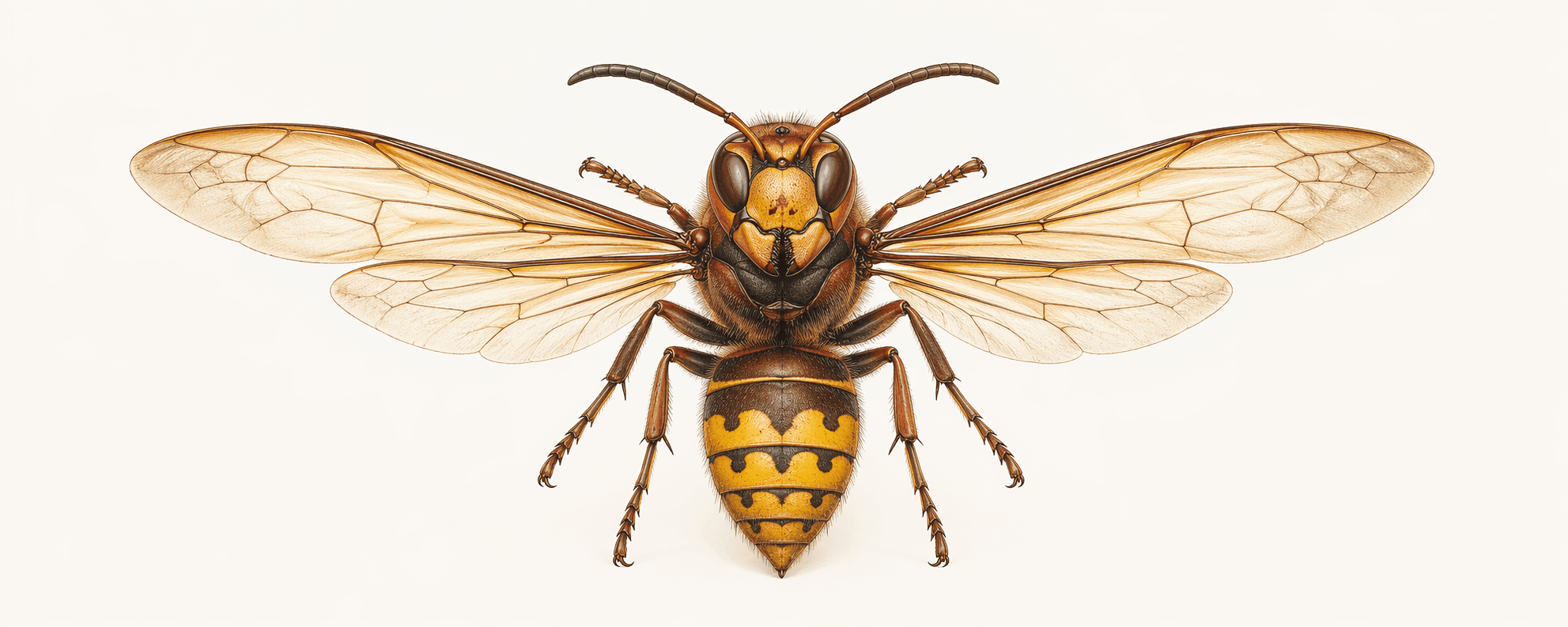
The Asian hornet is recognisable by its black thorax, its abdomen mostly black with a fine orange band at the rear, and its yellow leg tips. It is slightly smaller than our European hornet (Vespa crabro) and almost always darker. It should also be distinguished from the common wasp: the wasp is paler, smaller, and its nest is in open grey papier-mâché.
How to identify without getting closer
In the field, the primary nest of Vespa velutina is easy to recognise: regular spherical shape, walnut-to-orange size, light ochre colour (fresh papier-mâché), small opening pointing downwards, presence of a single queen with calm behaviour — few visible movements. The opposite of a common wasp nest: less regular, greyer, lateral opening, several adults from April onwards.
Why never to attempt it yourself
First absolute rule: do not approach within 5 metres. Even alone, the foundress queen defends her nest with surprising virulence. The sting is no more toxic than that of a wasp for most people, but it is very painful — and several stings can trigger anaphylactic shock in allergic individuals. On the French Riviera, where villas are often surrounded by vegetation, this is the leading cause of incidents.
Second rule: never attempt removal with a broom, a water jet or a domestic insecticide. The broom breaks the nest without killing the queen — who survives and rebuilds elsewhere within a few days. The water jet only disperses. The domestic insecticide is under-dosed and prompts the queen to flee. Worse still: these attempts expose you to multiple stings without neutralising the threat.
Third rule: photograph from a distance and call a Certibiocide-certified professional licensed to intervene. Note the precise location (height, accessibility, presence of children or animals nearby, prevailing wind). Our intervention typically lasts 20 to 30 minutes: securing of the zone, injection of an regulatory-compliant biocide into the heart of the nest with a telescopic pole, removal of the nest at D+7 (to intercept any emerging workers that might have survived).
Our intervention in 4 stages
Vespa velutina is a formidable predator of bees. A developing colony can decimate an entire apiary within weeks, hovering in front of the hives to intercept returning foragers. Destroying a primary nest in April means protecting tens of thousands of foraging bees over the summer. It also means protecting all wild pollinators — bumblebees, hoverflies, solitary bees — whose collapse imperils Mediterranean biodiversity.
The benefit for bees and local biodiversity
Our approach is part of an integrated pest management philosophy. We intervene on confirmed nests, with a minimum effective dose, in a temporal window that maximises impact on the target colony and minimises impact on surrounding beneficial wildlife. All our interventions are documented, traceable, and the applied biocides register is exportable on request by the health authorities.
*Have you spotted a suspect nest in Monaco, on the French Riviera or in the hinterland? Report it to us, we intervene as soon as possible and the April bill bears no comparison to the July one.*
On seasonal dynamics
The life cycle of Vespa velutina strictly follows seasonality: in March-April, the queen alone builds the first nest; in May-June, the first workers emerge; in July-September, the colony reaches its maximum size (often several thousand individuals); and in October-November, future queens leave the nest to overwinter. We recommend that owners and property managers on the French Riviera systematically inspect their properties from mid-March onward — 30 minutes of monthly inspection is enough to spot a primary nest in time.
Commitment to bees
Vespa velutina is one of the main causes of the decline of honey-bee colonies on the French Riviera. An average secondary colony consumes 11 kg of bees over the summer, equivalent to around three beehives. By having a primary nest destroyed on your property, you protect not only your family but also the ecological balance of the entire Riviera. We work regularly with local beekeepers who alert us to activity near their hives — a mutual collaboration we actively encourage.