July 25, 2026 · 15-minute read
Mosquito audit of a villa with a pool and large garden
Villa with pool and large garden on the Riviera: mapping breeding sites (basin, saucers, gutters, irrigation), new-generation 100 % chemical-free traps and an annual seasonal contract. Field experience from Cap-Ferrat and Cap-Martin.
Why a villa with a pool and a large garden concentrates mosquitoes
You keep spraying and lighting citronella candles, yet the moment the sun goes down your terrace becomes uninhabitable again? On the Riviera this scenario is anything but rare: on large estates it is the rule. The bigger, more irrigated and more planted a property is, the more perfectly it suits the tiger mosquito's breeding needs. A serious villa garden mosquito audit starts from this simple observation: on a property of more than a thousand square metres, the problem is never one or two water points but a constellation of scattered micro breeding sites that no one ever has the time to inventory.
A large villa garden with a pool brings together, quite unintentionally, absolutely everything the female tiger mosquito requires. A pool and its coping, one or more ornamental basins, a fountain, an automatic irrigation system that leaves puddles in the borders, dozens of terracotta pots resting on their saucers, long gutters running around an extensive building, drainage inspection chambers, a technical room, a vegetable garden, a citrus orchard. Taken individually, each of these features seems harmless. Added together across a large plot, they form a breeding network of formidable efficiency.
The paradox is cruel for the careful owner: it is precisely in the best-kept gardens, where watering is generous, the borders dense and the shade abundant, that we record the most stubborn infestations. A dry, mineral garden shelters few mosquitoes; a lush Mediterranean garden, watered every morning, harbours them by the thousand. The beauty of the place and its hospitality to the insect sadly go hand in hand. This is why managing a large estate calls for a specific approach, very different from that of a small town garden, and it is the whole focus of our work for private villas.
Mapping the breeding sites of a large estate
The first and by far the most important step is to map every breeding site on the property. On an extensive estate this inventory demands a rigorous method, because the breeding hotspots often hide exactly where the eye never falls. Here are the points we inspect systematically, zone by zone.
The ornamental basin is the number-one suspect on large estates. A decorative body of water, if it holds no fish or if its circulation is insufficient, becomes an open-air nursery. Shallow banks, dense aquatic vegetation, corners where water stagnates: all are refuges for larvae, sheltered from predators and current. A fountain whose pump is switched off in summer to save water turns into a major breeding site within days.
The saucers under pots are the most underestimated site and, on a richly planted villa, the most numerous. Every terracotta pot resting on its saucer holds, after each watering and each rain, a film of water that is enough for egg-laying. Multiply that by the dozens, sometimes hundreds, of pots that adorn a large Mediterranean terrace, and you have on their own a permanent source of infestation. The tiger does not lay in open water: it deposits its eggs on the damp wall, just above the waterline, where they wait for weeks before hatching at the next rise in level.
The gutters are the Achilles heel of extensive buildings. On a long villa, the downpipes and channels accumulate leaves, pine needles and debris that create retention zones. Water stagnates there after every summer storm, invisible from the ground. A single plug of leaves in a corner of the roof can feed an entire population on its own.
Automatic irrigation is the most insidious site, because it artificially recreates the conditions for egg-laying every single day. Leaking drippers, low areas of the borders where water pools, valve chambers where humidity persists, waterlogged mulch: the timer, watering generously at dawn, maintains a permanent moisture that indefinitely extends the breeding season. Fine-tuning the irrigation is an integral part of the fight.
To this are added the less obvious but equally active sites: rainwater inspection chambers and traps, children's play equipment and garden furniture that hold water, pool and furniture covers whose folds form small pockets, hollow parasol bases, decorative vases and jars, tree hollows, forgotten buckets and watering cans, the humid technical room of the pool. On a property of more than a thousand square metres, we routinely record between thirty and fifty potential sites, the vast majority of which entirely escaped the occupants' attention.
The villa garden mosquito audit: method and process
An anti-mosquito Riviera villa audit is nothing like a simple visit. It is a structured diagnosis that follows a logical progression and ends in a concrete action plan. Our method is built around several stages.
We begin with a full tour of the property, plan in hand, dividing the estate into sectors: pool surroundings, terraces, borders, paths, vegetable garden, building surroundings, technical points. This sectorisation ensures that no zone is forgotten, which is the primary risk on a large plot. Every site identified is located, photographed and classified according to its risk level: active site with larvae present, potential site to monitor, or point to eliminate permanently.
Next comes the larval inspection itself. We sample and examine the water of the suspect points to confirm the presence of larvae and assess population density. This step distinguishes a serious audit from a mere glance: it makes it possible to prioritise interventions and to concentrate resources where they are genuinely useful, rather than treating blindly.
Finally, we observe the family's habits and how the garden works. At what time is the terrace occupied? Where do the children play? Where do the animals rest? How is the irrigation programmed? Who maintains the garden and how often? This information is essential, because the prevention strategy must fit into the real life of the place, not the other way round. A plan that ignores the occupants' habits never lasts.
The audit ends with a debrief: an annotated map of the property, the prioritised list of sites, the eliminations to carry out, the points to treat and the recommended follow-up calendar for the season. The owner then has a clear, documented picture of their situation, rather than a vague sense of having been "treated".
The tiger mosquito on the Riviera: why a villa is vulnerable
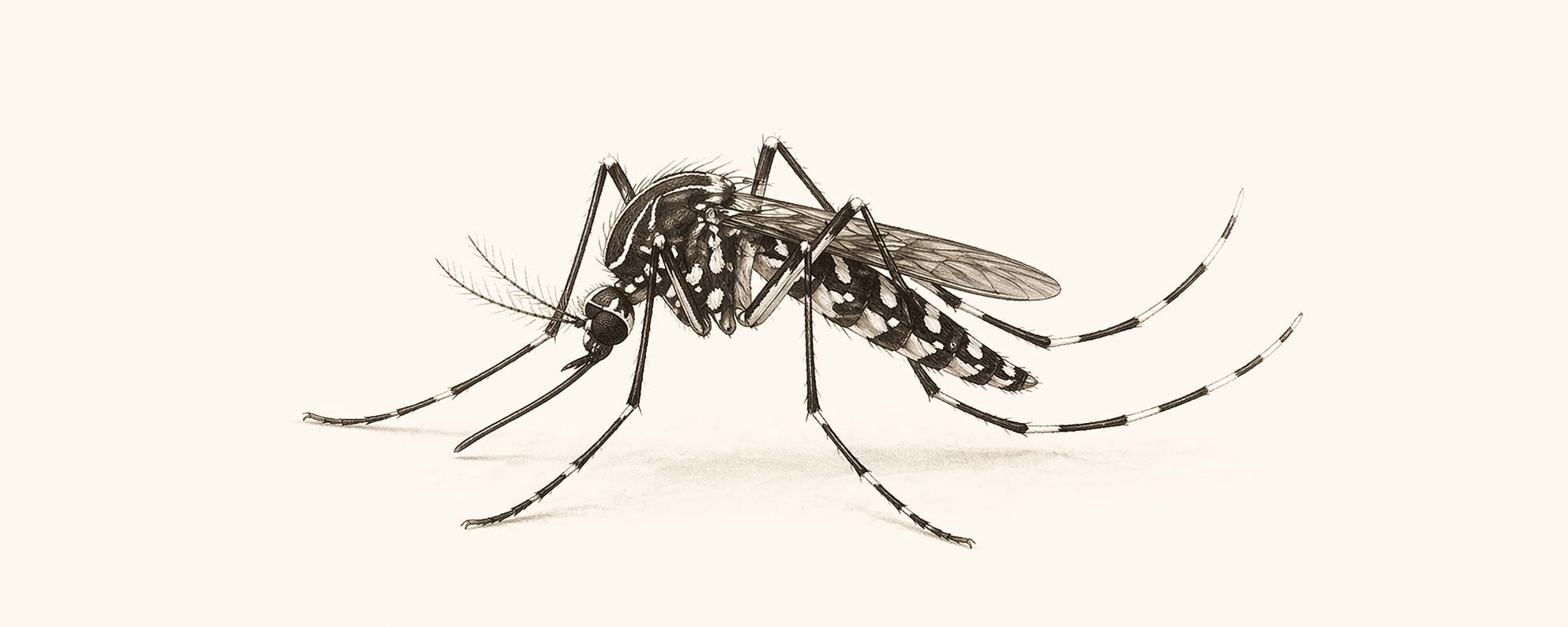
To understand why a large villa garden with a pool becomes a special case, you need to know the insect's biology. The tiger mosquito, recognisable by its black-and-white stripes and its small size, behaves very differently from the common mosquito, and that difference governs the whole strategy. You will find a detailed presentation of its cycle and behaviour on our page devoted to the tiger mosquito.
First decisive trait: it is sedentary. Unlike the common mosquito, which can travel several kilometres, the tiger is born, bites and lays within a radius of a few dozen metres. The consequence is crucial for a large property: if it bites you by the pool, it developed on your plot, not elsewhere. The bulk of the solution therefore lies within your own walls, which is excellent news, provided the right hotspots are identified. On a vast enclosed estate, this sedentary nature also means that each sector can shelter its own local population, hence the importance of sectorisation.
Second trait: it bites by day. Whereas the common mosquito is active mainly at night, the tiger attacks in broad daylight, with two peaks of aggression in late morning and late afternoon. It is precisely at the hours when the garden is enjoyed, from the midday swim to the evening drink, that bites multiply. This daytime activity makes the insect particularly troublesome on a property designed for outdoor pleasure.
Third trait: its reproduction relies on very small quantities of water. A film in a saucer, a fold in a cover, a hollow in a gutter is enough. The female does not lay in open water but glues her eggs to damp walls, just above the level. These eggs withstand drought for several months and hatch as soon as they are submerged again. This is why emptying a container is not enough: it must be scrubbed or turned over permanently. This resistance of the eggs also explains the rapid reinfestations after a mere surface treatment, and justifies a deep approach centred on the durable elimination of sites.
New-generation traps: 100 % chemical-free
Our signature, on large estates as elsewhere, comes down to one conviction: a garden where children, animals, pollinators and fish live must not be doused with insecticides. This is why we favour new-generation traps, a 100 % chemical-free solution that forms the heart of our preventive approach.
The principle is as elegant as it is effective: rather than killing adult mosquitoes by contact with a product, they are lured towards a device that captures them. The best-performing traps imitate the signals that guide the female towards her target: heat, humidity, the carbon dioxide we exhale, certain olfactory signatures of the skin. Drawn in, the female is captured before she can bite and, above all, before she can lay. And it is the female that bites and perpetuates the population: by removing her from the cycle, the next generation collapses.
On a large villa garden with a pool, these traps offer decisive advantages. They work continuously, day and night, without intervention. They disperse no substance into the air, into the pool or basin water, or onto the vegetable garden's plants. They completely spare bees, butterflies and other beneficial insects, unlike sprays that strike indiscriminately. They are harmless to children playing on the lawn and to animals exploring the borders. Distributed intelligently across the most frequented sectors, forming a barrier around the living areas, they durably reduce pressure without turning the garden into a treated zone. We have detailed the workings, the selection criteria and the positioning of these devices in our guide to chemical-free mosquito traps.
This approach only makes sense if it is accompanied by the elimination of breeding sites: a trap installed in the middle of a garden that produces thousands of larvae will never carry the day. Trap and audit are two sides of the same strategy. It is their combination that gives a lasting result, not one or the other taken alone.
Treating permanent water points without harming aquatic life
Some water points cannot be eliminated: an ornamental basin stocked with fish, a decorative fountain, an irrigation reservoir are an integral part of the garden. For these permanent sites, elimination is impossible, but treatment remains essential. The solution rests on biocontrol, a biological approach that specifically targets mosquito larvae without harming the rest of aquatic life.
The agent we use is a bacterium naturally present in soils, whose crystals, ingested by the mosquito larva, cause its death within a few hours. Its specificity is remarkable: it acts on the larvae of mosquitoes and a few related flies but spares fish, amphibians, dragonflies, bees, aquatic plants and human beings. It can therefore be applied to a basin stocked with goldfish or carp without endangering them, which makes it the reference solution for a villa's ornamental water points.
Biological treatment does, however, require regularity. Its action persists only briefly in water, which calls for repeated applications throughout the season, timed to the insect's breeding cycle. This is precisely where regular follow-up takes on its full meaning: a basin treated once in June will be colonised again in July. The consistency of the protocol, more than the intensity of a one-off treatment, makes the difference.
For the pool itself, the logic is different: properly filtered, chlorinated and circulating water harbours no larvae. The risk comes from the neglected pool, from the cover that holds rainwater in its folds, from the humid technical room and clogged skimmers. A living pool is not a breeding site; a neglected pool, or its cover, becomes a formidable one. The audit systematically checks these points, often overlooked when the pool is not in continuous use.
Coordinating the gardener: irrigation, gutters, maintenance
On a large property, pest control never works alone. The gardener, present every week, is the first ally of the anti-mosquito effort, provided their action is coordinated with the prevention strategy. This coordination is one of the most decisive factors of success, and one of the most often neglected.
Adjusting the automatic irrigation is the first shared task. A programme that is too generous, watering at length every day, maintains a permanent moisture favourable to egg-laying. In collaboration with the gardener, we adjust the durations, the timings and the distribution to give the plants the water they need without creating persistent puddles. Deeper but less frequent watering, at the right time of day, is both better for the plants and unfavourable to the mosquito.
Maintaining the gutters and drains is likewise a joint effort. Regular cleaning of the channels, clearing of the downpipes, flushing of the rainwater chambers eliminate major and invisible sites. On an extensive building, this maintenance must be planned after windy episodes and heavy leaf falls, the periods when blockages form.
Managing pots and saucers is the third axis. We recommend raising the pots, drilling or removing the saucers where possible, grouping the containers to make checking easier, and regularly emptying or scrubbing those that hold water. The gardener, who handles these elements every week, is best placed to integrate these gestures into their routine. We provide them with a simple check-list, adapted to the property, so that maintaining the gains does not rest solely on our visits. It is this transmission that turns a one-off intervention into lasting prevention.
The annual villa contract: covering the whole season without a gap
The tiger mosquito is not defeated in one visit. Its active season runs from spring to autumn, building in power as temperatures climb and humidity settles in. An isolated intervention, however careful, protects for only a few weeks: residual eggs hatch, new sites form, the population rebuilds. This is why the fight on a large property calls for seasonal support, structured around an annual contract.
This follow-up is organised around regular visits timed to the insect's cycle. At the start of the season, the initial audit maps the sites and puts in place the eliminations and the traps. The following visits check the state of the devices, renew the biological treatments of the permanent water points, monitor the appearance of new sites and adjust the strategy according to the observed pressure. At the end of the season, an assessment prepares for the following year and identifies the lasting adjustments to consider.
The benefit of continuous support goes beyond mere comfort. It makes it possible to react quickly to a rise in population, to anticipate weather-linked peaks, to maintain vigilance over recurring sites and to guarantee the consistency of the biocontrol protocol, whose effectiveness rests precisely on regularity. A property monitored throughout the season is never caught out by an established infestation: the problem is treated at source, continuously, before it becomes visible on the terrace. That is the difference between enduring mosquitoes and fully enjoying your garden.
Field experience: large estates of Cap-Ferrat and Cap-Martin
The peninsulas of Cap-Ferrat and Cap-Martin combine conditions that make them a privileged observation ground: vast properties, lush Mediterranean gardens, dense vegetation, a proximity to the sea that softens the nights and extends the insect's active season. Our experience in these sectors has confirmed, property after property, the main principles set out here.
The first lesson is constant: most sites are found where no one looks for them. On the large wooded plots of these peninsulas, the most productive hotspots are almost never the pool, which is properly maintained, but the saucers of the hundred pots adorning the terraces, the hollows of the old olive trees, the irrigation chambers hidden in the borders and the gutters of the long facades. Systematic mapping reveals, every time, dozens of ignored points.
The second lesson concerns the effectiveness of the chemical-free approach. On these properties where families, children and animals live, and sometimes genuine ornamental gardens stocked with fish and birds, the demand for a solution respectful of the life of the place is unanimous. The combination of rigorous elimination of sites, new-generation traps distributed around the living areas and biological treatment of the permanent water points delivers results that rival conventional chemical treatments, without their drawbacks. Owners regain the use of their terrace at the very hours when the tiger held sway.
The third lesson, finally, is that of coordination. The properties where the fight succeeds best are those where the gardener is associated with the approach, where the irrigation has been rethought and where the seasonal follow-up is ensured without interruption. Conversely, a single intervention on a large plot, with no relay or follow-up, almost always ends in a return of the population before the end of summer. The lesson is clear: on a villa with a large garden, regularity and coordination prevail over the intensity of an isolated treatment.
Our method and our commitments
Our approach rests on a principle we never compromise on: diagnose before treating, eliminate the cause before fighting the symptom. On a large property, this means a full, mapped audit, a prioritisation of sites, a methodical elimination of hotspots, new-generation chemical-free traps distributed around the living areas, a biological treatment respectful of permanent water points, close coordination with the gardener and flawless seasonal follow-up.
Our interventions comply with the regulations in force and with the good practices of the sector. Our Certibiocide N°121134 accreditation attests to our training in the reasoned handling of products and in biocontrol methods. We systematically favour the solutions with the least impact on the environment, beneficial wildlife and the property's occupants, and we use a product only when no alternative exists.
Every large property is a unique case, by its surface, its exposure, its water points, its vegetation and the habits of the family that lives there. This is why we always establish a personalised diagnosis before any intervention, rather than applying a standard recipe. To obtain an assessment suited to your villa, request your free quote: we study your garden, map its specific sites and propose a durable prevention strategy, with no dispersed chemical product, designed so that your family, your animals and the life of your garden can fully enjoy the fine season.
Zones served in Monaco and on the Riviera
We operate in particular on Port Hercule and Saint-Roman.
Frequently asked questions
- Why is a villa with a large garden more exposed to mosquitoes?
- The bigger, more irrigated and more planted a garden is, the more breeding sites it multiplies. On a property of more than a thousand square metres, we routinely record between thirty and fifty potential water points: basins, pot saucers, gutters, irrigation chambers, cover folds. Since the tiger mosquito is sedentary, it develops on site, within a radius of a few dozen metres. It is precisely in the best-kept gardens, where watering is generous, that infestations are the most stubborn.
- What are the most common breeding sites in a villa garden?
- The most numerous are the saucers under pots, which hold a film of water after each watering. Next come ornamental basins with insufficient circulation, gutters blocked by leaves, accumulation zones of automatic irrigation and drainage chambers. To these are added cover folds, hollow parasol bases, decorative vases, tree hollows and forgotten buckets. The audit maps them zone by zone, because on a large plot the majority entirely escape the occupants' attention.
- Are chemical-free traps really effective on a large property?
- Yes, provided they are combined with the elimination of breeding sites. New-generation traps attract the female with heat, humidity and carbon dioxide, then capture her before she can bite or lay. Distributed as a barrier around the living areas, they make the next generation collapse without dispersing any substance into the air, the water or onto the plants. On their own, in a garden that produces thousands of larvae, they are not enough: it is their combination with the audit and the elimination of hotspots that gives a lasting result.
- Can you treat an ornamental basin with fish without endangering them?
- Yes. For permanent water points that cannot be eliminated, we use a biocontrol treatment based on a bacterium naturally present in soils. It acts specifically on the larvae of mosquitoes and a few related flies but completely spares fish, amphibians, dragonflies, bees, aquatic plants and human beings. It can therefore be applied safely to a basin stocked with goldfish or carp. Because its action is brief in water, it requires repeated applications throughout the season.
- Why coordinate the gardener with the anti-mosquito effort?
- The gardener, present every week, is the first ally of prevention. Three tasks are a joint effort: adjusting the automatic irrigation, to avoid the permanent moisture favourable to egg-laying; maintaining the gutters and drains, which eliminates major and invisible sites; managing the pots and saucers, by raising them or emptying them regularly. We provide a simple check-list adapted to the property, so that maintaining the gains does not rest solely on our visits. It is this coordination that turns a one-off intervention into lasting prevention.
- Why an annual contract rather than a single intervention?
- Because the tiger mosquito's season runs from spring to autumn and an isolated intervention protects for only a few weeks: residual eggs hatch, new sites form, the population rebuilds. The annual contract organises regular visits timed to the insect's cycle: initial audit at the start of the season, checking of the devices, renewal of the biological treatments of permanent water points, monitoring of new sites and an end-of-season assessment. A property monitored continuously is treated at source, before the problem becomes visible on the terrace.