July 8, 2026 · 14-minute read
Asian hornet in Monaco: emergency nest destruction
Asian hornet nest in Monaco: identify Vespa velutina, act safely, and call in a certified operator without delay.
Asian hornet in Monaco: a seasonal threat that shows no mercy
Since its arrival in France in the early 2000s, the Asian hornet (Vespa velutina nigrithorax) has colonised the Riviera coastline and the Principality of Monaco at a remarkable pace. In Monaco, its presence is now confirmed every season, from Fontvieille to the heights of Monte-Carlo, taking in the gardens of La Condamine and the residences of Larvotto. Limestone rockeries, umbrella pines and the many cavities in older buildings offer this species ideal nesting sites.
The problem is not only ecological — although the predation on honey bees is very real. It is also a human issue: a nest tucked under a rooftop in Monte-Carlo, in a pine tree in Roquebrune-Cap-Martin or on a flower-filled balcony in Beausoleil can become an immediate danger to residents, household staff and children.
At Monaco Pest Solutions, a Monegasque company certified Certibiocide N121134 (RCI Monaco 26S10394), destroying Asian hornet nests is one of the most frequent call-outs between April and November. This article covers everything worth knowing: how to identify the species, how to tell the two nest types apart, how to react without endangering yourself, and how to bring in properly equipped operators as quickly as possible across the Principality and its immediate hinterland.
Vespa velutina or Vespa crabro: telling them apart in 30 seconds
Mistaking the Asian hornet for its European cousin (Vespa crabro) is common, yet the two insects share neither the same behaviour nor the same regulatory status. Knowing how to distinguish them is the first step before any decision to intervene.
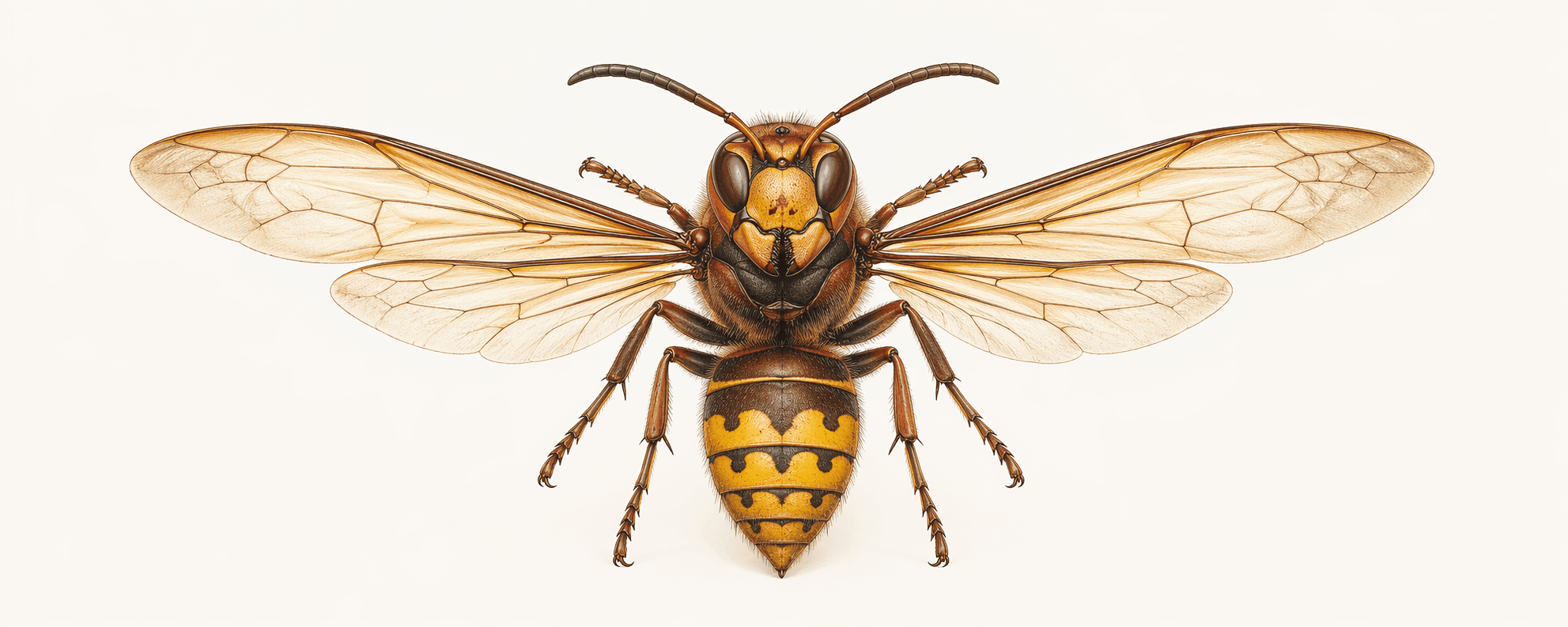
*The Asian hornet (Vespa velutina): - Smaller in size: workers 17 to 26 mm, queens up to 30 mm - Thorax entirely matt black - Dark abdomen with a single orange segment towards the tip - Two-tone legs: black at the base, yellow at the tips* (a highly reliable clue) - Head, viewed from the front: orange - Often seen hovering in front of beehives, ivy blossoms or bins
*The European hornet (Vespa crabro): - Clearly larger: workers up to 35 mm - Reddish-brown thorax - Abdomen predominantly yellow* striped with black, closely resembling a large wasp - Legs entirely reddish-brown - Also active at night (unlike the Asian hornet, which is strictly diurnal)
The European hornet is a locally protected species, useful to the balance of gardens. It should never be destroyed unless there is compelling necessity. The Asian hornet, on the other hand, is classified as an invasive alien species. A professional operator identifies the correct species before any treatment — a point on which MPS never compromises.
Primary nest, secondary nest: two faces of a single colony
The distinctive feature of the Vespa velutina life cycle is that, within a single year, the colony produces two successive nest types. Grasping this cycle radically changes intervention strategy.
The primary nest (April to June)
Founded by a fertilised queen emerging from hibernation, the primary nest is small (from the size of a tennis ball to an orange), spherical in shape and often orange-tinged thanks to fresh wood pulp. It is found at head height or lower: under an awning, in a garden shed, a service cabin, a meter cupboard, a wall cavity — sometimes even in a flowerpot abandoned on a terrace in La Condamine or Cap-d'Ail.
At this stage, the colony only numbers a few dozen individuals. Intervention is quick, clean and — most importantly — it prevents the formation of the secondary nest. This is the most valuable window for action.
The secondary nest (July to October–November)
Once a population threshold is crossed, the colony relocates and rebuilds a much larger nest higher up, shaped like an ovoid balloon that can exceed 80 cm in diameter. It is frequently installed at 6, 10, even 15 metres in a pine, a plane tree, a clipped hedge, or hooked onto the cornice of a building. In Monaco, they are regularly found in the tall pines of Roquebrune-Cap-Martin, the gardens of Beausoleil, or hidden in the dense foliage between Menton and Cap-Martin.
A secondary nest may house several thousand individuals by the end of the season. Destroying it demands specialised equipment.
Why you must act fast: the defensive risk
The Asian hornet is no more venomous than a European hornet — its sting is painful but rarely fatal to a non-allergic adult. The real danger lies in its collective defensive behaviour.
A nest disturbed by a gardener trimming a hedge, a child playing beneath a pine or a workman refurbishing a façade can trigger a mass attack. Workers pick up vibrations, breath and sweat — and attack in groups within a 5-metre radius around the nest. This aggression grows as the colony matures and peaks in September–October.
The most frequent scenarios in Monaco and along the coast: - Multiple stings while mowing or clearing ground - Children or pets stung on a balcony - Household staff caught unawares during terrace maintenance - Building workers on roofs or façades
People allergic to hymenoptera venom (wasps, bees) face a risk of anaphylactic shock. Angioedema (Quincke's oedema), a drop in blood pressure or breathing difficulties after a sting call for an immediate 112 call (the emergency number in the Principality as in the European Union).
Finally, an untreated nest produces founding females in autumn that will hibernate nearby and start just as many new nests the following spring. Every nest destroyed in time means several colonies avoided the year after.
What must never be done
One of the most consistent lessons from the field, in Monaco as elsewhere, is that DIY destruction attempts almost always make matters worse. Below are the most serious mistakes, to be avoided at all costs.
- Do not spray consumer insecticides. The anti-wasp aerosols sold in supermarkets have neither the range nor the active ingredient to reach the heart of an Asian hornet nest. The result: the workers pour out en masse, attack the improvised operator, and the queen survives inside.
- Do not blast it with a water jet. Water disrupts the nest but does not kill the colony. It simply leaves the insects soaked and furious.
- Do not seal the entrance to a wall cavity. The hornets will just bore new exits, sometimes into the interior of the dwelling.
- Do not burn the nest. Beyond the obvious fire risk on a roof or in a parched pine, the act sets off a defensive swarm.
- Do not approach within 10 metres without proper protective gear, even to take a photograph. A single quick movement is enough to trigger the attack.
- Do not climb a ladder to "get a closer look". The fall following a sting is the true danger.
The rule is simple: observe from a distance, put occupants under cover, then call a properly equipped Certibiocide-certified professional.
The three professional methods to destroy a nest
There is no universal method — only a technical choice dictated by the location of the nest, its height, its volume and its accessibility. MPS teams rely on three main approaches.
1. Telescopic pole up to 8–15 metres
This is the reference method for elevated secondary nests. An extendable fibreglass pole, fitted with an injection nozzle at its tip, allows an authorised biocide powder to be introduced directly into the nest opening. The powder settles on the workers, who carry it back into the heart of the colony, queen included. Full destruction is achieved within 24 to 72 hours. Used on pine-tree nests in Roquebrune-Cap-Martin, Beausoleil or on the high cornices of Monte-Carlo.
2. Rope-access or aerial-platform treatment (rare and tightly framed)
For nests unreachable with a pole — for example, hooked under a roof terrace or in the recess of a building — a rope-access or aerial-platform intervention can be arranged. This method remains marginal, reserved for cases where no other solution is feasible, and requires coordination with the managing agent or building manager.
3. Extraction from wall cavities
When the nest is lodged inside a hollow wall, a shutter box, a stump or a disused flue, mechanical extraction using a biocide-filtered vacuum makes it possible to physically remove the insects without demolition. Common in the older buildings of La Condamine or on the Rock.
In every case, MPS applies the principle of integrated pest management: minimum effective dose, targeted product, removal of nest remnants where possible to prevent recolonisation.
How an intervention unfolds in Monaco and the surrounding area
Speed is a core part of the service. Across the Principality and its neighbouring communes, a report made during working hours normally triggers an intervention on the same day or the following morning, depending on the queue and the perceived level of danger.
Step 1 — Call and triage. An MPS operator asks a few simple questions on the phone: precise location, estimated height, presence of children or animals, vehicle access. A framed verbal quotation is provided immediately.
Step 2 — Arrival on site. Typical response time of 2 to 6 hours during the day for central Monaco, Cap-d'Ail, Beausoleil and Roquebrune-Cap-Martin. As far as Menton, expect a comparable window on weekdays.
Step 3 — Safety perimeter. Cordoning off at 10 metres minimum, informing neighbours, moving occupants and animals away, closing windows facing the nest.
Step 4 — Treatment. The operator, in a full anti-sting suit, applies the chosen method. Actual duration: 15 to 45 minutes in the vast majority of cases.
Step 5 — Follow-up at D+7. Visual inspection of the nest, confirmation that no residual activity remains, mechanical removal of the nest when its position and accessibility allow. This follow-up is included in the service.
Every intervention gives rise to a written report detailing the molecule used, the dose, the GPS location of the nest and the preventive recommendations — a document useful to a managing agent, an insurer or a wealth manager.
Regulatory framework: what French law says, what Monaco does
The Asian hornet has been listed since the decree of 26 December 2012 among second-category health hazards in France, then classified as an invasive alien species of concern by European regulation. In practice, in France, destruction is not compulsory in the sense of a fine, but it is strongly encouraged by prefectures, town halls and beekeeping federations. Certain communes in the Alpes-Maritimes contribute financially to the destruction of nests on private land — Menton, Beausoleil or Roquebrune-Cap-Martin may, depending on the year, offer partial funding.
In the Principality, the framework is separate. Monaco applies its own regulations on biocidal products and invasive species. Any biocidal intervention on Monegasque territory must be carried out by an operator holding a recognised certification. MPS operates under Certibiocide N121134 and follows both the protocols applicable to the Principality and the French rules when intervening in Cap-d'Ail, Beausoleil, Roquebrune-Cap-Martin or Menton.
In a co-owned building, destroying a nest located on the common areas (façade, roof, shared garden) falls to the managing agent. On private areas (terrace, balcony, individual garden), it is the owner's or the tenant's responsibility depending on the lease. In case of doubt, the MPS team can supply a named quotation immediately usable by the manager.
Preventing recurrence: spring trapping and cavity maintenance
Destroying a nest treats the symptom. Avoiding the next one treats the cause. Two levers have proved their worth.
Selective trapping of founding queens, from March to May. Each secondary nest produces around a hundred future queens in the autumn that overwinter individually. In spring, these founders emerge hungry and hunt out sugary sources before building their primary nest. A properly baited trap (dark beer + syrup + white wine, in a cone with a selective exit for pollinators) placed at 1.5–2 m in height, on a terrace or in a garden, captures the founders before nesting begins. A well-placed trap potentially means one nest avoided. MPS installs and maintains seasonal traps for residences, hotels and villas throughout the Principality.
Maintenance of building cavities. Ill-fitting shutter boxes, loose roof tiles, disused chimney flues, poorly closed pool cabins, dry-stone walls: so many sites that a founding queen will scout in spring. An annual check in February–March allows entry points to be resealed and traces of former nests — which sometimes serve as olfactory landmarks — to be eliminated.
A preventive inspection built into an annual monitoring contract represents, for a building or a villa with grounds, a cost that bears no comparison with an emergency intervention on a mature nest.
Real-world case: a 40 cm nest in Roquebrune-Cap-Martin
At the end of last August, an alert reached MPS from a villa in Roquebrune-Cap-Martin, facing the sea. The caretaker had spotted intense activity around a large Aleppo pine at the edge of the grounds. Following a phone exchange, the operator visited the next morning.
On-site diagnosis. Secondary ovoid nest, roughly 40 cm in diameter, hooked to a side branch of the pine 6 metres above the ground, less than 4 metres from a terrace regularly used by the owners. Activity estimated at several hundred workers, entrance facing south-east. The pine was alive, the load-bearing branch sound.
Chosen method. 10-metre telescopic pole with an injection nozzle, authorised biocide powder at the minimum effective dose. 10-metre safety perimeter, immediate neighbours informed, villa windows closed. The intervention itself lasted 22 minutes, injection followed by staged withdrawal.
Outcome. Check at D+3: no further activity around the nest. Check at D+7: mechanical removal of the emptied nest using a long-reach pruning saw, sealed bag, disposal via the proper waste channel. The pine was inspected to confirm the absence of any new nest primordium — nothing to report. Spring trapping was proposed for the following season and taken up by the owner.
This type of case — secondary nest at intermediate height, close proximity to occupants, healthy tree — makes up a significant share of the summer interventions between Monaco and Menton.
How to reach us in an emergency
When faced with an active nest, two reflexes suffice: move occupants behind a closed door or window, then call a certified operator. Every hour of delay brings the next incident closer.
Monaco Pest Solutions, a Monegasque company registered with the Trade and Industry Register under number 26S10394, headquartered at 29 Bd Rainier III, 98000 Monaco, operates across the entire Principality and its immediate hinterland — Cap-d'Ail, Beausoleil, Roquebrune-Cap-Martin, Menton — under Certibiocide N121134 certification. Contractual discretion is systematic: NDA signed on request, unmarked vehicles, confidential intervention reports.
Any doubts? Our team responds in under 2 working hours. +377 37 70 70 02 — or **request a free quote**.
Frequently asked questions
How long does it take to destroy an Asian hornet nest in Monaco?
The intervention itself typically lasts between 15 and 45 minutes, safety perimeter included. The main variable is travel time: during working hours, an MPS team reaches central Monaco, Cap-d'Ail or Beausoleil within a 2 to 6-hour window after the call, sometimes less depending on the perceived severity. A follow-up is then scheduled at D+7 to confirm the full mortality of the colony and, if accessibility allows, remove the emptied nest. The complete protocol therefore spans a week, but the immediate risk is neutralised from the very first visit.
Can you destroy an Asian hornet nest yourself with a supermarket insecticide?
No, and for three reasons. First, consumer aerosols have neither the range nor the active ingredient to reach the core of a nest, especially a secondary one. Next, they set off a massive defensive response from the colony within a 5-metre radius, with a real risk of multiple stings. Finally, the queen almost always survives inside, and the colony re-forms within days. Destroying a Vespa velutina nest requires an authorised biocide powder, delivered by deep injection by a Certibiocide-certified operator in a full protective suit.
How can you quickly tell an Asian hornet from a European hornet?
Three criteria allow identification in seconds. The Asian hornet is smaller (under 30 mm), with an entirely matt-black thorax, a single orange segment on its dark abdomen, and black legs ending in bright yellow — the most reliable clue. The European hornet, which is protected and beneficial, is larger (up to 35 mm), with a reddish-brown thorax and a predominantly yellow abdomen striped with black, closely resembling a large wasp. If in doubt, a photo taken from a safe distance is enough for an MPS operator to decide before any pointless call-out.
Is destroying an Asian hornet nest compulsory in the Principality?
The Monegasque and French frameworks are distinct. In France, the decree of 26 December 2012 classes the Asian hornet as a second-category health hazard and European regulation designates it as an invasive alien species of concern; destruction is strongly encouraged but not penalised by a fine. In Monaco, biocide regulations require any intervention to be led by an operator holding a recognised certification. Without being strictly compulsory, destruction is strongly advised on public-health grounds, especially where children, allergic individuals or pets are present.
What should I do if the nest is on the common areas of a building in Monte-Carlo?
A nest sited on a façade, roof, shared garden or inner courtyard belongs to the common areas and therefore to the responsibility of the managing agent or building manager. In practice, any co-owner or tenant can flag the situation to the managing agent, who then commissions the intervention. MPS can issue a named quotation addressed directly to the manager, with invoicing accordingly, and coordinates with concierge or cleaning staff. On private areas (terrace, balcony, individual garden), the procedure falls to the owner or the tenant according to the lease terms.
Should Asian hornet traps be left out all year round?
No, permanent trapping is counter-productive: it captures useful pollinators in large numbers (bees, hoverflies, butterflies) without any real effect on the summer hornet population. The effective window is strictly spring, from March to May, when the founders emerge from hibernation and hunt for sugary sources before building their primary nest. A well-designed selective trap (cone with a graduated exit for small pollinators, bait based on dark beer, syrup and white wine) placed at 1.5–2 metres captures the future queens before nesting. A well-placed trap potentially means one nest avoided for the season.