
September 6, 2026 · 4-minute read
Asian hornet nests in Monaco: the October–November window
In autumn, future Asian hornet queens leave the nest. Destroying it before they go means fewer nests next spring in Monaco and on the Riviera.
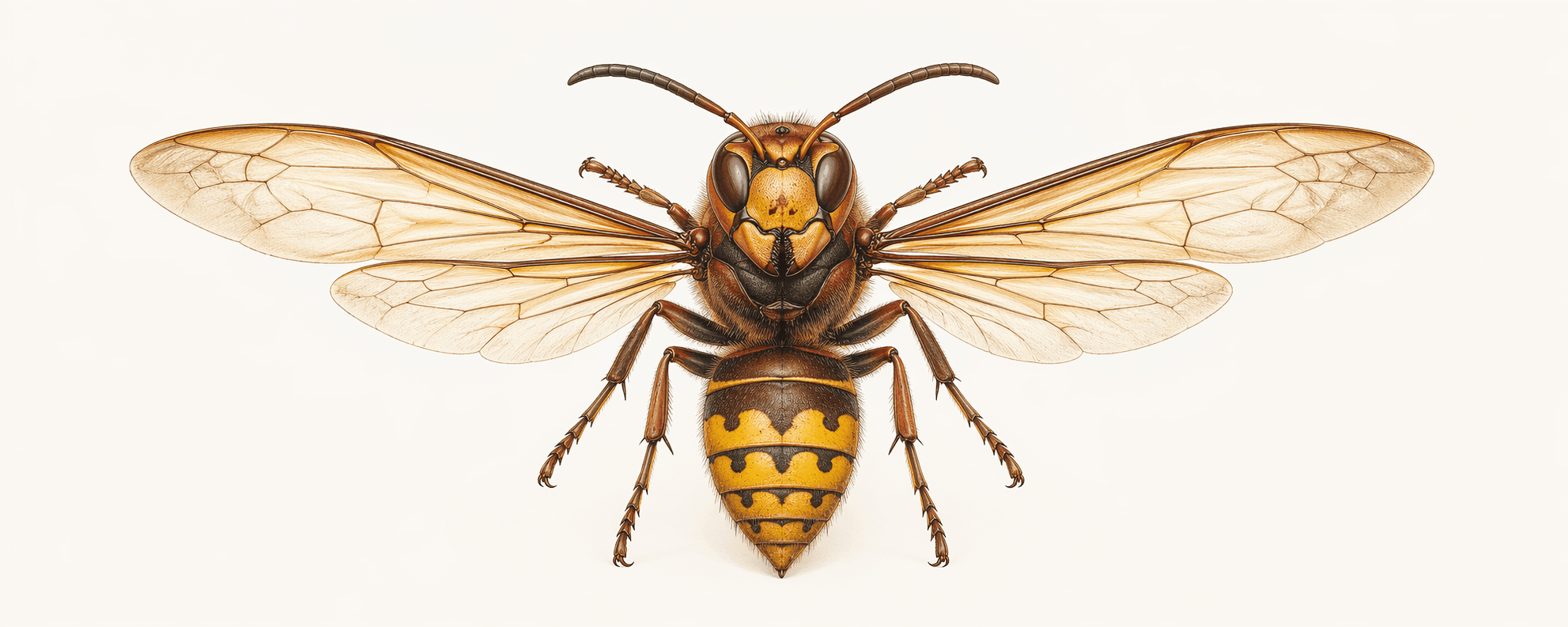
In late October, as Halloween approaches, the same scene plays out in gardens across Monaco and the Riviera: plane trees, fig trees and fruit trees shed their leaves, and a large ball of brownish-grey papier-mâché appears at the top of a tree, under a cornice or above a terrace. This secondary Asian hornet nest was there all summer, hidden by the foliage. Is it still worth dealing with now that the season is ending? Yes, as long as it is active, and as soon as possible: this is when the colony raises the future queens that will found next year's nests.
The Asian hornet cycle in four stages
Classified as an invasive alien species in France, the Asian hornet follows a well-known annual cycle (to recognise it, see our page on the Asian hornet):
- Spring: the foundress comes out of hibernation and builds a primary nest on her own, small and often low down: garden shed, awning, hedge, plant room.
- Early summer: the colony grows and often moves to a secondary nest, much larger, frequently high up in a tree, sometimes in a hedge or under a roof.
- Late summer and autumn: the population peaks, with up to several thousand individuals in a large nest, and the workers hunt bees and other insects. The colony then raises males and sexual females: the future queens.
- Late autumn and winter: after mating, the fertilised future queens leave the nest to overwinter alone, in shelter. The workers, the males and the old foundress die with the cold. The nest will never be reused.
Why October–November is a decisive window
A nest that is still active in autumn can hold hundreds of future queens that have not yet left. Destroying it before they go stops that many potential foundresses from getting through the winter. Not all of them would survive, but each one that does can start a new nest in spring, sometimes in your own garden.
On the Riviera, where autumn is mild, activity often continues late into the season: a nest discovered in November is not necessarily empty. Conversely, a nest that has truly been abandoned after the first cold spell no longer needs to be destroyed: it will not be reoccupied. To decide, watch the nest entrance from a safe distance on a mild, sunny day: regular comings and goings mean the colony is alive.
Nest spotted: the right reflexes
- Stay several metres away and avoid any vibration nearby: hedge trimming, mowing, ladders, ball games.
- Keep children and pets away, and alert neighbours, the caretaker or the managing agent if the nest overlooks a shared area.
- Photograph the nest using the zoom and note its height and access: tree, roof, façade.
- Check that it really is an Asian hornet: our guide to telling European and Asian hornets apart will help.
What you must never do: shoot at the nest, aim a water jet or stones at it, try to burn it, or climb a ladder with a shop-bought aerosol. A disturbed colony defends its nest en masse, and the risk of a fall then comes on top of the risk of multiple stings.
How a high nest is destroyed
The technician first confirms the species and whether the nest is active. Wearing protective clothing, they inject an approved insecticide straight into the heart of the nest, often using a telescopic pole, preferably when most of the workers are back inside. The treatment targets the colony alone: no spraying of the tree or the garden, out of respect for biodiversity. When access allows, the nest is then removed, so that birds do not eat treated larvae.
At MPS, an occupied nest counts as a situation with immediate risk: a first phone call triggers our 24/7 on-call service, and we call you back within 6 hours, 7 days a week. Our Certibiocide-certified technicians work throughout the Principality and the Riviera, from Cap-d'Ail to Menton via Beausoleil, Èze or Roquebrune-Cap-Martin, and the intervention report with photos then awaits you in your client area.
And next spring?
The future queens that escaped destruction will come out of hibernation at the end of winter. Then keep an eye on garden sheds, pool houses, awnings and the underside of roofs: a primary nest, still small and low, is far easier to deal with than a secondary nest at the top of a pine. Our article on how to find a primary nest in your garden shows you where to look. As for spring trapping, it remains debated: non-selective traps also catch many beneficial insects.
Nest in sight? Have it treated before the queens leave
In autumn, every week counts. To save time, you can send us a photo of the nest by WhatsApp on the same number, or call us directly.
Request your free quote or call +377 37 70 70 02: reply within 6 hours.
Frequently asked questions
- Should an Asian hornet nest still be destroyed in November?
- Yes, if it is still active: it may contain future queens that have not yet left. A nest that has truly been abandoned after the first cold spell, however, will not be reoccupied and no longer needs to be destroyed.
- Will the nest be reused next year?
- No. Asian hornets never reuse a nest: every spring, the queens that have overwintered build new ones. That is why it is better to treat the nest while it still holds the future queens.
- What should I do if the nest overlooks a terrace or a play area?
- Keep everyone away, do not attempt anything yourself and call +377 37 70 70 02: an occupied nest triggers our 24/7 on-call service, with a call back within 6 hours, 7 days a week.